Record high temps possible in Tahoe, Truckee


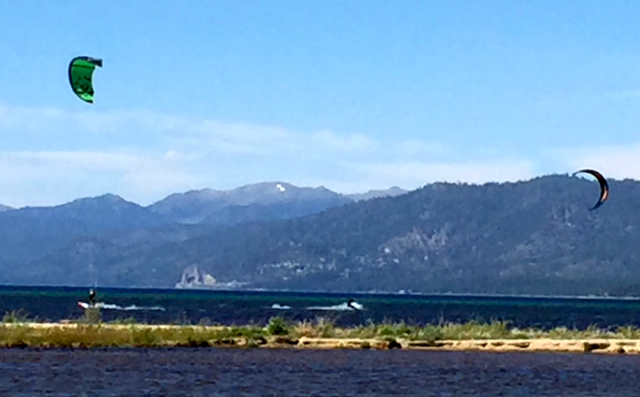
Afternoon winds on June 1 brought out kite surfers on the South Shore. Photo/LTN

Afternoon winds on June 1 brought out kite surfers on the South Shore. Photo/LTN

By Kathryn Reed

Keep the sunscreen handy, it’s just going to get hotter.

Temps in the Lake Tahoe Basin are expected to stay above normal through Saturday.

“We are not going to be this hot the rest of the summer. We had all those cold low pressures moving inland. This time it stayed off the coast so the high pressure could build and strengthen,” NWS meteorologist Mark Deutschendorf told Lake Tahoe News.

If record highs are going to be broken, it will mostly happen on Friday or Saturday, according to the National Weather Service in Reno.

Stats from the NWS:

·      June 3

·      South Lake Tahoe record high – 80, set in 1980

Forecast high – 81

·      Tahoe City record high – 83, set in 1924

Forecast high – 77

·      Truckee record high – 88, set in 1912

Forecast high – 86

·      June 4

·      South Lake Tahoe record high – 83, set in 2013

Forecast high – 81

·      Tahoe City record high – 83, set in 1992

Forecast high – 79

·      Truckee record high – 87, set in 2003

Forecast high – 89.

“There’s a little bit of a lake influence forecast for that side,” Deutschendorf said of the North Shore.

Temperatures will be trending lower starting Sunday, returning to normal for early June, which is right about 70 degrees for the basin.

There is a slight chance of late afternoon thunderstorms on Saturday and Sunday. The unstable conditions could last into Monday.


DA levels corruption charges against Stateline sewer district

By Evan Maxwell, Reno Gazette-Journal

Long-simmering political tension between Lake Tahoe casinos and the government of Douglas County broke out into open warfare last week.

In an extraordinary three-hour presentation before the Douglas County Board of County Commissioners last Monday, District Attorney Mark Jackson leveled charges of corruption, illegal collusion and political malfeasance against the leadership of a sewer district that treats millions of gallons of Stateline casino and resort sewage.

Severin Carlson, a Reno attorney who is representing board members and employees of Douglas County Sewer Improvement District 1, challenged Jackson’s right to offer his presentation to the board Monday, saying it amounted to “a public flogging” that was “not a valid use” of a public meeting.

The district attorney called for dissolution of the sewer district, a public agency that he said has not held elections in more than 30 years. He said the district’s board of directors has colluded in the last year to manipulate Douglas County politics in promotion of a plan to dump Lake Tahoe sewage in the Carson Valley.

Read the whole story


Feds make it easier for kids to get outdoors

By Katie Arnold, Outside

As a kid, Sally Jewell spent a lot of time outside. Her parents took her to her first national park when she was 4 years old, and by age 15, she’d scaled Mount St. Helen’s with a group of friends.

But the current Secretary of the Interior, now 60, isn’t as interested in recounting her childhood adventures as she is in trying to ensure that all American kids have the same opportunity to get outdoors that she had. Her latest initiative seeks to help young people from disadvantaged backgrounds experience the wilderness. Her new Secretarial Order aims to do just that, by making it easier, faster, and less costly for youth organizations to obtain permits to explore public wild lands on overnight or multi-day trips.

Jewell has issued similar orders, like one from 2014—the year after President Obama appointed her to the post—that sought to expand recreational, education, volunteer, and career opportunities for kids and veterans on public lands by encouraging the DOI to work with business and nonprofits. The new order goes a step further by targeting a very specific demographic. All participants must be under 26 years old, and 70 percent of the group must meet one or more of the following criteria: live in foster homes, have limited English proficiency, have run away from home or are homeless, live with disabilities, are at risk of dropping out, or are former juvenile delinquents or at risk of delinquency.

Read the whole story


Zero-turf yard beginning to bloom, look mature

By Kathryn Reed

Sweet woodruff is spreading, with tiny white flowers blooming. The yarrow is going nuts. The salvia is strong and the maple is happy.

Those are the sentiments of landscaper Brian Hirdman about the plants in my yard.

“This is what I aim for every year,” Hirdman said as he surveyed the work he did last year.

The growth since last August has been phenomenal. The mounds shrunk a little, which was to be expected. Nothing died, though a couple items that were transplanted look a little sketchy. Hirdman bent them – soft, not brittle, as well scratched a bit of the bark to reveal green – meaning it’s alive even though it doesn’t look like it.

I went through South Tahoe Public Utility District’s turf buyback program last summer. I took out all of the grass and then had Hirdman work his magic.

Brian Hirdman talks about what to plant to fill in the herb garden. Photo/Kathryn Reed

Brian Hirdman talks about what to plant to fill in the herb garden. Photo/Kathryn Reed

He was like a proud dad walking through the front yard last week. A smile never left his face. Looking at every plant, he marveled at the success.

“Your catmint exploded. You will have some beautiful purple flowers coming up soon,” Hirdman said.

The Shasta daises are taller than he would have expected this time of year.

As the snow was melting and things in the herb garden started to come to life, I would eat a little of the plant to determine if it stayed. There’s probably a more scientific method, but this worked.

I have a few holes to fill in because not everything is a perennial. Cilantro and basil for sure will be planted. Hirdman reminded me to plant those so they aren’t getting the intense sun.

The chives have already been prolific. The catnip has been a delight for my friends’ cats. The mint is doing well, I just haven’t done anything with it.

I’d like to think every year I’ll get morels in this spiral herb garden, but that is doubtful. I’m savoring the two I found in there.

Polemonium, the purple, and sweet woodruff, white, are already blooming. Photo/Kathryn Reed

Polemonium, the purple, and sweet woodruff, white, are already blooming. Photo/Kathryn Reed

While it’s still possible to get a late frost in Tahoe, any time after June 1 is usually OK to plant.

Something the herb garden didn’t have last year is salad greens, which Hirdman highly suggested. He even said tomatoes would do well in the hugel mound closest to the property line because of the amount of sun it gets.

“As for the irrigation, the way I tell if I need to turn it on is if I move the soil around, like dig an inch or 2 below the surface of your mounds. If it’s still wet, which it should be with the mulch that’s on the mounds, then I hold off turning on the irrigation,” Hirdman said. “If it’s looking dry, I turn it on. Also, the plants help me judge that too, cause I’ll pay attention to see if any of them begin to weep. If only a few weep, I’ll spot water until the majority of the garden needs water, then turn on all the irrigation.”

The whole point of the turf buyback is to use less water. Which I have. And I have a full rain barrel right now that will cover any spot watering I need before the sprinklers are turned on.


Down ticket primary races take shape in Nev.

By Megan Messerly, Las Vegas Sun

If the success of Donald Trump and Bernie Sanders is any indication, this could be the year of the outsider in American politics. But will the anti-establishment sentiment that has fueled their campaigns trickle down to statewide and local elections in Nevada?

That’s one of several key questions that will be answered in the run up to the June 14 primary election. Early voting kicked off Saturday, with a number of offices from school boards to Congress hanging in limbo.

The Nevada primary also is expected to be a reckoning over a $1.4 billion tax package passed by the 2015 Legislature, and some incumbent Republicans already have been fighting to justify their votes in favor. To top it off, the outcome likely will be decided by a fraction of Nevada’s electorate; historically poor turnout is expected, so a small number of votes could mean the difference between a candidate’s victory or loss.

Read the whole story


Distressed animals — to rescue or not?

By Todd Wilkinson, National Geographic

Maybe it’s a baby robin that falls out of a nest in the backyard, or perhaps twin deer fawns left orphaned after their mother gets struck by a car or eaten by wolves, or perchance a bald eagle, behaving strangely, staggering on the ground and unable to fly.

When wild animals appear to be in distress, should human beings intervene to rescue them or is it better to back off and let nature take its course?

This existential question is being debated again following a recent incident in Yellowstone National Park involving a bison that raised eyebrows and attracted international media attention.

Earlier in May, a Canadian tourist captured a wild bison calf with his bare hands and loaded it into his SUV. The man, Shamash Kassam, said he found the animal alone and shivering along the roadside in Yellowstone’s wildlife-rich Lamar Valley. Once he turned it over to rangers, park biologists made several attempts to reunite the youngster with its herd but when the calf was rejected, they euthanized it.

Read the whole story


EDC, residents at odds with West Slope tribe

The Shingle Springs Rancheria Band of Miwok Indians is not seen as a good neighbor by everyone. Photo/Provided

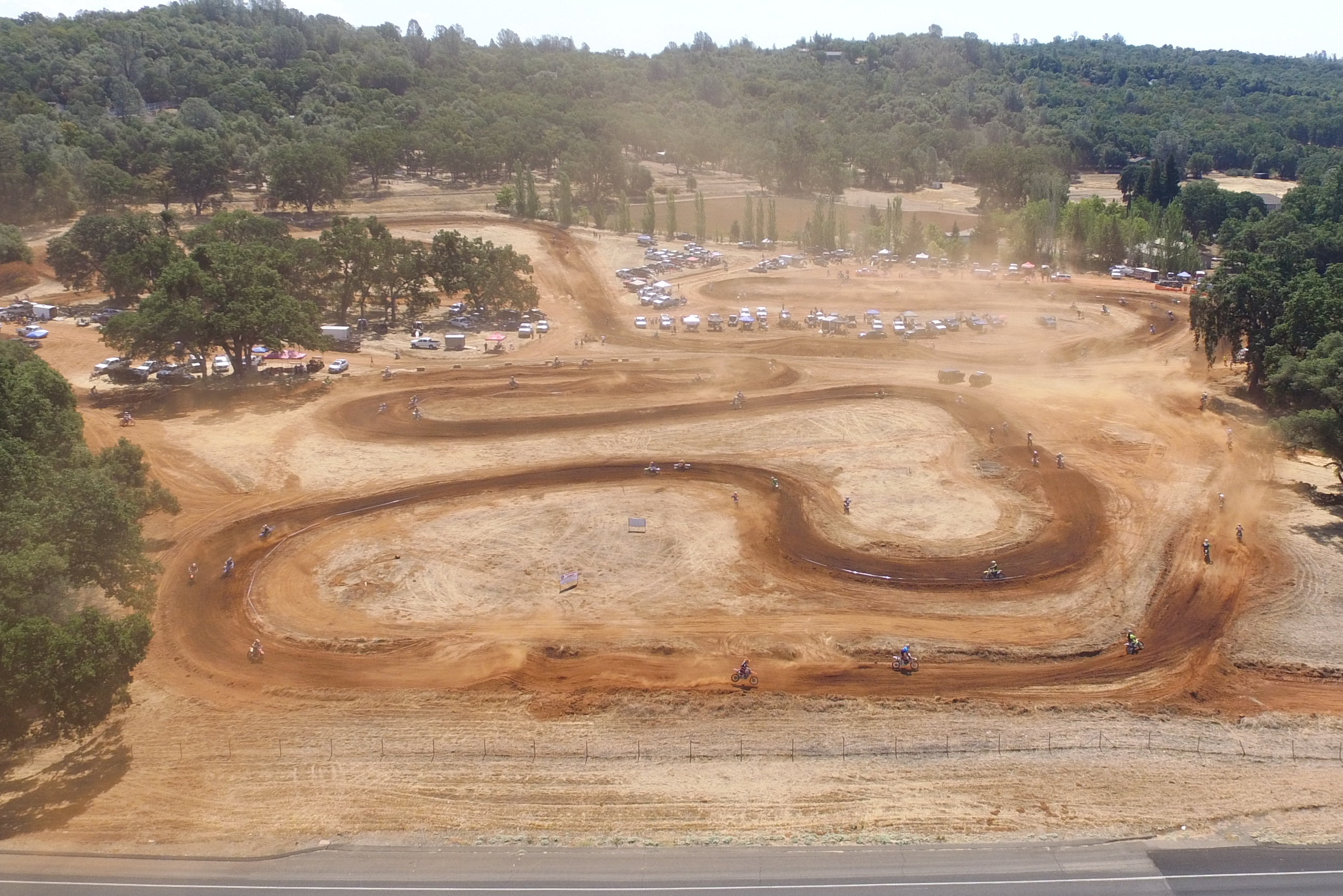
A motocross track went in on tribal land where housing was supposed to go. Photo/Provided

By Joann Eisenbrandt

PLACERVILLE – In early April, the Shingle Springs Rancheria Band of Miwok Indians presented two applications to the Bureau of Indian Affairs to have fee-simple lands that they had purchased put into trust with the federal government. Together, these parcels total just more than 35 acres and are adjacent to or in close proximity to the existing Shingle Springs Rancheria.

Once lands are put into trust, they fall under the tribe’s sovereign status. The federal government holds legal title to trust lands, but the tribe holds the right to occupy the land, called “beneficial ownership.” The land is under tribal jurisdiction and is exempt from state and local taxes and removed from state and local land use regulations. It is this lack of control that has county residents, especially those living in close proximity to the tribe’s trust lands, speaking out in protest.

“So what about the rights of non-Native Americans who have worked hard and saved for many years to buy land in this county … the tribe has stated on numerous occasions that they want to be good neighbors, but their actions prove otherwise. What this tribe has done (and plans to do in the future) with their fee-to-trust land severely devalues all neighboring property owner’s investments. The Shingle Springs Tribe has demonstrated that they are unwilling to be good neighbors and that they lack consideration for the health and welfare of the surrounding community.”

  – David, Thelma and Matthew White, Joan Fasnacht, Beverly Weston, and Mary West; written comments submitted for the May 24, 2016, El Dorado County Board of Supervisors meeting

The fee-to-trust process

The Indian Reorganization Act of 1934 gave the secretary of the Interior the discretion to acquire trust title to land on behalf of federally recognized Indian tribes. Factors considered in approving fee-to-trust requests include the tribe’s need for the land, the purpose for which it will be used, impacts on the state or county resulting from the removal of the land from the tax rolls, jurisdictional problems and potential conflicts of land use it may cause and its distance from the tribe’s reservation.

Depending on the type of land, its current and future uses, and whether or not federal funds will be used in its development, preparation of environmental documentation under the National Environmental Policy Act (NEPA) may be required. Public entities such as El Dorado County can comment on fee-to-trust requests and federal environmental documents, but they cannot approve or deny them. An administrative appeal may be made to the Bureau of Indian Affair’s decision to accept lands into trust and if denied, a judicial appeal can be made to the appropriate federal court.

Current and past concerns

At its May 24 meeting, the Board of Supervisors approved a letter to the Bureau of Indian Affairs (BIA) regarding the impacts the tribe’s two current fee-to-trust applications would have on the county and its residents. The board requested an extension of the 30-day comment period in April and was given until May 30 to respond.

The tribe’s applications say the lands will be used for tribal housing. The county is concerned that the planned density on one of the residential parcels will be higher than that of surrounding non-Indian parcels. It also worries about the loss of county revenue when all the parcels are removed from the tax rolls as well as loss of future traffic impact mitigation (TIM) fees when they are developed, and the increased service needs and impacts on county roads they will create.

This is not the first time the tribe has had “off-reservation” lands they purchased put into trust. In 2002, nine parcels totaling approximately 104 acres were requested to be put into trust. In that application, the tribe told the BIA that it “intends to use the new trust land for the construction of 1) a much-needed clinic facility for the Shingle Springs Tribal Health Program; and 2) single family tribal housing.”

This is not what happened.

The county pointed this out in its May 24 letter.

“Several years after the Department of the Interior accepted the parcels into trust,” it says, “the tribe proposed new and decidedly different uses for the parcels. Instead of a health clinic and tribal housing, the tribe proposed to use the parcels for a public shooting range consisting of 29 lanes and a gas station/convenience store.”

The shooting range was later downsized and limited to use by tribal members but the land originally targeted for the health clinic has been used for motocross events. Tribal housing was never built and the clinic was constructed on existing Rancheria land instead.

The area surrounding all of these parcels is a rural residential area, and residents have continued to express their concerns about the impacts on their way of life—impacts they cannot control.

In written comments for the May 24 board meeting, Ellen Van Dyke of Rural Communities United echoed the concerns of many area residents. “Being ‘sovereign’ should not mean one has the right to make neighbors fear for their safety, or destroy the quality of life of others. Yet this is exactly what has occurred utilizing bait-and-switch tactics, swapping anticipated beneficial land uses for severely incompatible ones on the existing trust land. Please do not reward bad behavior by approving this application to expand that sovereignty and its abuse.”

Speaking at that same meeting, Carol Louis of the El Dorado Council told the board, “We’ve investigated this tribe and their legitimacy. It has not been a good neighbor policy. They have done everything to undermine the community surrounding them and we expect them to continue that.” Louis asked the board to strengthen their letter to the BIA or even ask for denial of the tribe’s request.

As she later told Lake Tahoe News, “I’m concerned. The fee to trust process is broken. We have sent the BIA our response to the trust applications. We are also asking the secretary of the Interior to rescind the approval of the tribe’s earlier applications to put the land on the south side of Highway 50 along Shingle Springs Drive into trust.”

Formed in the early 1990s to inform residents about county issues, the EDC is focusing now on the Shingle Springs Rancheria. They believe that “off-reservation lands” should not be allowed to go into trust, but should be subject to the same rules and regulations as lands owned by non-Indians.

The board asked the BIA, “In order to avoid future impacts, the county requests that subject parcels be developed as proposed but not acquired to include in tribal trust. If the parcels are accepted into trust, such acceptance could be conditioned upon the parcels being used for residential purposes only as depicted in the environmental assessment for a period of at least 20 years and if the use is to be changed the tribe must comply with county land use regulations for the development of the parcels.

“An additional request of El Dorado County is to require the payment of any and all fees related to development of the subject parcels to help defray the revenues lost by the county through removal of the parcels from the county’s jurisdiction.”

The question of changing land uses

While the BIA considers a tribe’s need for land and the uses they propose for it, the process is not exhaustive nor the criteria very specific. The standards say the land must be necessary to facilitate tribal self-determination, economic development or Indian housing. Proposing a certain use in its application does not restrict a tribe from changing that use once land has been accepted into trust. As Chad Broussard, environmental protection specialist at the BIA’s Pacific Regional Office in Sacramento told Lake Tahoe News, “The fee-to-trust process is not a development project; it is the creation of ‘Indian lands,’ and its focus is jurisdictional.” If required, subsequent development of trust lands goes through the NEPA process.

Lori Parlin of the Shingle Springs Community Alliance, shared Louis’ concerns that the board’s letter did not “paint a clear enough picture for the BIA of what is happening on the ground … of how the tribe’s current trust parcels are impacting the neighborhood.” After discussion, District 1 Supervisor and Board Chairman Ron Mikulaco appointed an ad hoc committee consisting of Supervisors Michael Ranalli and Shiva Frentzen to review the county’s letter and make any needed changes. The revised letter sent to the BIA included a number of the suggested changes made by the public and the board.

According to Arvada Wolfin, BIA realty specialist in Sacramento, all comments submitted regarding the tribe’s applications would be reviewed. This can take from 30 to 60 days and then the BIA decides to go forward with the process, deny the applications or return them to the tribe for additional information or changes. A notice of decision is then published and a 30-day review period follows. It usually takes at least two years, sometimes longer, after approval for the lands to be finally received into trust.

The changing county and tribe relationship

The other issue in the mix is the county’s current memorandum of understanding with the tribe. At the end of the May 24 meeting, District 3 Supervisor Brian Veerkamp cautioned the board to be sure to “keep in mind the MOU we currently have with the tribe because that is legally-binding document. “

The MOU that Veerkamp alluded to only came at the end of a twisting road. In 1999, the tribe entered into a compact with California and received approval from the National Indian Gaming Commission to operate a gaming facility. Because the tribe’s Rancheria was landlocked, an overpass to Highway 50 had to be constructed before a casino could be built. In a 2003 position statement on the Shingle Springs casino, the county said it would “degrade the quality of life in El Dorado County in so many ways … this is a planning nightmare—no rational planner and no sensible public official would ever approve a commercial project of this magnitude in an area zoned for rural residences.”

The county filed a lawsuit challenging the state’s environmental analysis under CEQA (California Environmental Quality Act) of the impacts of the Highway 50 interchange on traffic. It also challenged the lawfulness of the recognition of the tribe by the BIA. “Under federal law, gaming is only permitted by a federally recognized ‘Indian tribe’ and only on ‘Indian lands,’ that is, land held in trust for an Indian tribe,” the board said in 2003. “Records from the Bureau of Indian Affairs disclose that the two unrelated groups of Indians from Sutter and Sacramento counties, jointly referred to at that time as the ‘Sacramento-Verona Band of Homeless Indians’ for administrative convenience, never functioned historically as a tribe, never had any historic relationship with El Dorado County, and were never formally or properly ‘recognized’ by the federal government as an ‘Indian tribe.’ “

Despite these comments, in September 2006, the county entered into an MOU with the Tribe to settle the litigation. In that MOU, the Tribe asserted their legitimacy and their right to the land they occupy. “Shingle Springs Band of Miwok Indians is a federally-recognized Indian tribe, which is the beneficiary of trust land that is owned by the United States, entitled Shingle Springs Rancheria and located within the geographical boundaries of the county of El Dorado.”

The county agreed to dismiss their federal recognition lawsuit and assist the tribe in winning the CEQA Highway 50 interchange lawsuit against the remaining private petitioner. In return, the tribe agreed to pay the county $5.2 million annually for 20 years to mitigate the anticipated impacts of the casino. The tribe further agreed to fund construction of a portion of a programmed HOV (high occupancy vehicle) project for Highway 50 from Bass Lake Road to South Shingle/Ponderosa Road. The interchange was subsequently constructed and Red Hawk Casino opened in December 2008.

In 2012, the MOU with the tribe was revised. Instead of using the tribe’s payments specifically for HOV lanes, the county would now be able to use the $5.2 million annual payment for “public improvements,” including road improvements and maintenance on a revised map covering a broader area from Cameron Park up to Placerville. The county also agreed to pay the tribe an annual payment of $2.6 million a year beginning in December 2017, to be applied to the health programs at the tribal health clinic since it serves tribal members and non-Indians.

Concerns have been expressed that the county is putting money ahead of the welfare of its residents. “It’s about the people, their quality of life and how they are being impacted,” Parlin told Lake Tahoe News. “The county tax dollars and MOU dollars should not be No. 1. It should be public safety and the quality of life.”

Status of the gas station complex

The final disposition of the tribe’s current fee-to-trust applications will take time. The gas station and commercial complex proposed for the southeast corner of Shingle Springs Drive and Highway 50 on land the tribe already holds in trust is currently moving through the environmental review process. The tribe prepared an environmental assessment under NEPA. The comment period for the EA closes June 8. After review of all comments, the BIA will either make a finding of no significant environmental impacts, or a finding that there are impacts that can’t be fully mitigated. In the second case, a more comprehensive environmental impact statement will be required.

Residents in the area of this project remain upset and frustrated. A September 2015 letter included in a packet of information the El Dorado Council sent to the BIA, local, state and federal agencies, says, “Our elected officials have a moral obligation to stand up and fight for what its community wants and needs. Our community does not need a commercial truck stop in a residential neighborhood, next to two elementary schools and a church. Our community doesn’t need a 29 lane gun range aimed at our back yards while school children are at recess. We expect and need our elected officials to state in a public forum that this is wrong. Some residents have expressed their view that the tribe is trying to pressure them into selling their land in what they term a tribal land grab.”

The county doesn’t have a say in the NEPA process but it can conduct a limited CEQA review of the proposed road encroachments needed for access from the gas station complex onto Shingle Springs Drive, and for water, sewer, utilities and storm drain improvements that are in the public right-of-way. It has prepared an initial study and just issued a mitigated negative declaration, saying in effect that any impacts found can be mitigated to less than significant. The 30-day comment period for this document began on May 28 and it will come before the Board of Supervisors on June 28.

The larger issue

The issue of federally recognized tribes putting lands into trust is not just an El Dorado County or California issue. It has raised concerns nationwide. Sen. John Barrasso of Wyoming, chairman of the Select Committee on Indian Affairs, introduced a bill to address what he sees as the ongoing problems with the Department of the Interior’s existing fee-to-trust land acquisition process.

Rural County Representatives of California (RCRC), an association of 34 rural California counties which work together on a variety of issues, including land use, has been involved in this issue. California has 100 federally-recognized Indian tribes, and many of them are located in RCRC representatives’ counties.  El Dorado County’s representative to RCRC is Supervisor Ranalli. The trust lands in question are in his district. Lake Tahoe News made repeated attempts to contact Ranalli on this issue, but he did not respond.

In an Aug. 27, 2015, letter to Barrasso, the RCRC said, “The existing fee-to-trust process is opaque, cumbersome, lengthy, and uncertain for all parties involved. More than one-quarter of the Tribes in California have applied for fee-to-trust lands within the past four years. These applications comprise 10,314 acres of land, approximately equal to the number of acres taken into trust in California in the previous 10 years. During that period, 100 percent of the fee-to-trust applications were approved by the Bureau of Indian Affairs. We recommend that land use be a required element of an application and that relevant mitigation be legally enforceable. Any change in land use, particularly in cases where there is no cooperative agreement, must be subject to review by the public and contiguous jurisdictions, otherwise, there is no accountability in the process at all.”



Park Service considers visitor caps

By Amy Beth Hanson, AP

As the National Park Service kicks off a centennial summer expected to draw record crowds, the agency is seriously considering caps on how many people pass through some of the country’s most iconic landscapes and historical sites each day.

Park managers have begun looking at whether, when and how best to manage the impact of more people on the parks, their features and the visitors’ experience.

“Fundamental to the mission of the National Park Service is preservation of natural and cultural resources, social and ecological values, for the enjoyment, education and inspiration of this generation and those to come,” said Rose Keller, social scientist at Denali National Park and Preserve in Alaska.

Denali and Yellowstone plan to survey visitors about their experiences this summer, hoping the responses will provide insight on what limitations visitors might accept.

Arches and Canyonlands national parks in Utah have been taking public comment on their plans for tighter rules about how many people can be in the park at the same time. Grand Teton National Park in Wyoming should announce by the end of the year how it intends to limit access to a popular roadway.

It’s not clear how individual parks would make up for any shortfall in revenue from letting in fewer paying customers. Some parks, including Mesa Verde National Park in southwestern Colorado, already employ congestion pricing, charging more per person and per vehicle during the peak season that begins this weekend.

Last summer at Grand Canyon National Park, park managers increased entrance fees and moved lines along by dedicating an entrance gate to people who already had an annual park pass. They also promoted the use of shuttles.

Nearly 4.1 million people visited Yellowstone National Park in 2015, a 17 percent increase in visitors over 2014 — or an additional 580,000 people. There weren’t enough bathrooms or parking spaces. Trash cans overflowed. Wildlife jams caused waits of up to two hours along park roadways. Staff and visitors reported pulses of crowding at popular spots, partially due to an increasing number of tour buses, Yellowstone social scientist Ryan Atwell said.

This season, the park hired extra workers and added bathrooms and trash cans in key locations. Yellowstone has seen a 60 percent increase in visitation in the first few weeks of the 2016 season, Park Superintendent Dan Wenk has said.

If the growth continues, Wenk told a gathering of business people last week, he could envision a peak-season limit on Yellowstone visitors, albeit not for at least a decade.

“We realize that currently we’re on an unsustainable course in terms of demands for visitation compared to the ability of the current park system to handle it,” Atwell said.

Last year’s record crowds pushed Yellowstone over some thresholds as far as employee and visitor safety and propriety, he said.

In 2015, interpretive rangers gave out 52,036 resource warnings for behaviors such as threatening thermal features, approaching wildlife too closely, hiking in restricted areas and “taking bathroom breaks outside of the restroom.” That number was a 19 percent increase over the 43,558 citations issued in 2014.

From 2014 to 2015, motor vehicle accidents with injuries were up 167 percent, emergency medical transports to facilities outside the park were up 37 percent and search and rescue operations were up 61 percent, Atwell said.

In anticipation of another record year, people who plan to check out Yellowstone’s grandeur are being asked to be patient and plan ahead, respect the park, consider entering the park before 9am or after 3pm to avoid larger crowds, drive responsibly and learn how to travel in bear country. Visitors are reminded to stay on the boardwalks, because hot springs have caused more injuries than wildlife. Park officials also urge visitors to “practice safe selfies” and not approach wildlife to take pictures.

Arches and Canyonlands national parks in Utah are looking at additional options to address increased visitor numbers, including a timed entry system, building more parking lots and other infrastructure, setting a daily cap on vehicle entrances and adding a private shuttle service.

Grand Teton expects a final decision by the end of the year on a proposal to limit visitor capacity on the 7.1-mile Moose-Wilson Corridor to 200 cars at a time, which would include implementing wait times during peak visitation days and times. Visitors to the Laurance S. Rockefeller Preserve in Grand Teton are limited by the 50 available parking spaces, park spokeswoman Denise Germann said.

“What we’re trying to create and manage is the experience that you come to the Moose-Wilson to enjoy, and protect the resources of that corridor,” Germann said.


Smartphones could fuel Internet gambling

By Wayne Parry, AP

Internet gambling has tremendous growth potential in the United States as ever-greater percentages of the public use smartphones, participants in a major gambling conference said Wednesday.

At the East Coast Gaming Congress and iGaming Institute in Atlantic City, casino and online gambling executives said the online gambling market has shown encouraging growth, but is still a fraction of what it could be.

They also said nearly three years of experience has shown that Internet gambling is not cannibalizing their existing brick-and-mortar casinos, but rather bringing in new customers, many of whom then visit the physical casinos as well.

“We’re seeing huge growth in mobile phone and tablet play,” said Luisa Woods, executive director of Internet marketing for Atlantic City’s Tropicana casino. “And we’re seeing huge cross-flows between players who visit the casino and then go home and continue to play online.”

Internet gambling brought in $160.7 million in 2015 in the three U.S. states that allow it. New Jersey is by far the largest market, at $148 million. Delaware brought in $1.8 million last year, and Nevada, which stopped reporting its Internet winnings publicly, is estimated at about $10 million in their poker-only market, said Eugene Johnson, senior vice president of Spectrum Gaming Group, an Atlantic City-area consulting firm.

The industry still needs to do a better job of marketing itself, many participants agreed. Itai Pazner, senior vice president of 888 Holdings, said when customs questioned him at Newark Liberty International Airport on his way to the conference, he told them he works for an Internet gambling company.

“Is that legal in New Jersey?” the agent asked Pazner.

“A lot of people are confused,” he told the conference at Harrah’s Waterfront Conference Center. “They don’t know if it’s legal, if it’s illegal, if it’s good, if it’s bad. We need to educate people.”

There was no mention at the conference of perhaps the greatest threat to the fledgling Internet gambling industry: the avowed opposition to it from casino billionaire Sheldon Adelson, who has promised to spend as much as it takes to enact a legislative ban on it in the United States.

Another major challenge is getting additional states to approve Internet gambling. Because only three states now offer it, the prize pools for online poker are small, and that is holding the industry back, participants agreed.

“Poker without enough liquidity isn’t viable,” Pazner said. “The markets are still relatively small. The U.S. needs more states (to legalize Internet gambling) and we need them urgently.”

He said Europe has more readily embraced Internet gambling, adding, “There is huge potential growth on both sides of the ocean.”

George Rover, deputy director of New Jersey’s Division of Gambling Enforcement, said unlicensed offshore sites still pose a major problem for legal Internet gambling sites by siphoning away customers and revenue to unregulated sites with no customer protections.

He said the state has been formulating plans to deal with such sites, promising a development on the issue soon.

Thomas Winter, vice president of Internet gambling for the Golden Nugget casino in Atlantic City, said his casino has seen good growth across its Internet platforms. But he said some customers still need to be assured of the integrity of Internet gambling.


Clear Creek: Varied landscape, fabulous views

Dropping in elevation means being able to see the mountains instead being immersed in them. Photo/Kathryn Reed

Dropping down in elevation means being able to see the mountains instead being immersed in them. Photo/Kathryn Reed

By Kathryn Reed

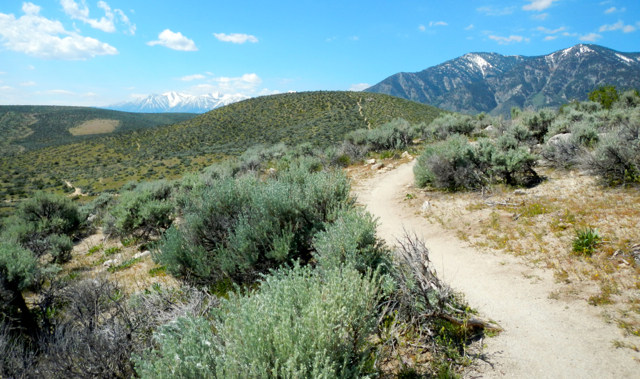
CARSON CITY – Rugged, desolate, colorful, stark, verdant, snow capped. Clear Creek Trail has it all.

Sagebrush is everywhere at the start, then it starts to peter out as the trail keeps going west into the mountains. The pines bring welcome shade. But they are never as thick and tall as hiking in the Tahoe basin.

A swath of mule’s ear blankets one section. But this is not a wildflower hike. A few snow plants are protruding and tiny wildflowers are out. This hike is about the views in the distance, not what’s immediately on the ground.

Butterflies are the most prominent fauna. Photo/Kathryn Reed

Butterflies are the most prominent fauna. Photo/Kathryn Reed

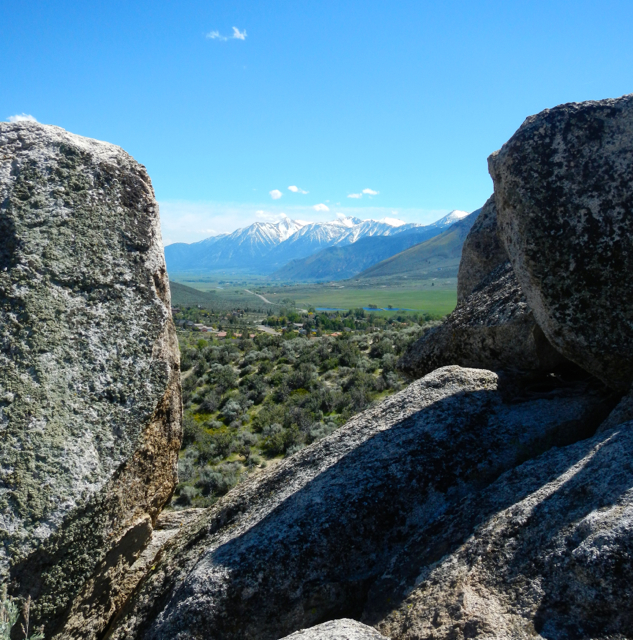
Still, the contrast in the landscape is welcome. As Sue put it, it was a nice change to be looking at the mountains instead of being in the mountains. The snow-capped peaks of the Carson Range were immediate, while the Pine Nuts were off in the distance.

The fertile Carson Valley seemed to never end. The lush green was clearly providing plenty of natural food for the cattle.

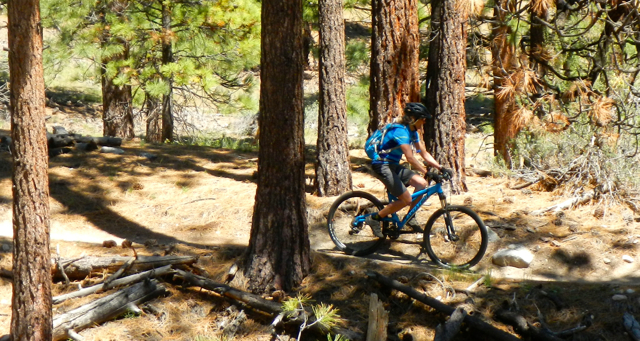
The trail is a mix of soft dirt and loose sand. It’s definitely single track. Most of the time there is enough room to comfortably get out of the way of mountain bikers. If sharing the trail is not your thing, this is not your hike. More mountain bikers were on this trail that is managed by the Carson Valley Trails Association than hikers.

Clear Creek is a popular mountain biking trail. Photo/Kathryn Reed

Clear Creek is a popular mountain biking trail. Photo/Kathryn Reed

At times the trail crosses private property. Signs say as much, and they ask people to stay on the trail. It proves public-private partnerships can work.

Our destination was The Knob. Having never been on the trail we didn’t know what outcropping we were headed to. I’m not sure it was ever distinct from the trail. It’s actually good there was a sign pointing us toward it.

From The Knob mostly the Carson Valley spills forth. Immediately to the left it’s possible to see vehicles coming down Spooner Summit, but it’s impossible to hear them. Greens belonging to the private Tahoe Golf Course seem within reach.

There is something to look at around every switchback. Photo/Kathryn Reed

There is something to look at around every switchback. Photo/Kathryn Reed

The 14-mile round trip hike in some ways feels less than that because the grade is gradual (5 percent or less most places) and the elevation gain (start 4,950 feet, highest is 6,200 feet) is not that much. Plus, the highest point is the same as Lake Tahoe’s elevation.

About 3,100 acres here are managed as winter deer range. After a fire in 1966, 700 acres were replanted for forage and ground cover. While this is mule deer country, we didn’t see any. In fact, other than hearing a few birds the fauna did not make themselves known.

Dogs are allowed off leash if they are under control. This is rattlesnake country, so that is something to consider. Clear Creek provides water, at least in May. This is one of those hikes, though, where I was glad I brought water for AJ. Even in May she needed more than just the stream crossing.

A gentle breeze cooled us off. This would definitely be a super hot trek in mid-summer.

Much of the trail is exposed. Photo/Kathryn Reed

Much of the trail is exposed. Photo/Kathryn Reed

—–

Getting there:

It will depend where you are coming from because the trail can be accessed from Kingsbury Grade or Spooner Summit.

The trail begins on the southwest side of Jacks Valley Elementary School.

Coming from Kingsbury Grade it is on the left side. It is well marked.