Calif. water crisis not on presidential candidates’ radar
By Carolyn Lochhead, San Francisco Chronicle
WASHINGTON – The 20th century dams and canals that gave birth to modern California – to San Francisco, to Los Angeles, to the San Joaquin Valley farms that feed the nation – are near the end of their engineered lives. The rivers and aquifers they tap are, simply, tapped out.
The state’s record drought, only dented by last winter’s rains, comes amid a 16-year dry spell in the Colorado River basin, which provides 16 percent of California’s water. The basin’s giant reservoirs are dwindling and may never fill again, even as the nation’s population continues to shift relentlessly into the arid West.
So far, the three people running for president have hardly noticed these problems as they barnstorm the state heading into the June 7 primary.
The Park Creek Waterfall near Jenkinson Lake is raging. Photo/Kathryn Reed
By Kathryn Reed
POLLOCK PINES – A gentle roar could be heard in the distance. There is no mistaking the sound of a waterfall.
With California finally having a relatively normal winter in terms of snow and rain, waterfalls everywhere are raging and will continue to as the white stuff melts.
Park Creek Waterfall brought out the masses last Sunday. Of course it was also a three-day weekend.
This 5.6-mile round trip hike isn’t for those who want seclusion and the silence of nature. It is for anyone who wants to be surrounded by people having fun, enjoying the outdoors. It’s bound to be a popular destination every summer weekend.
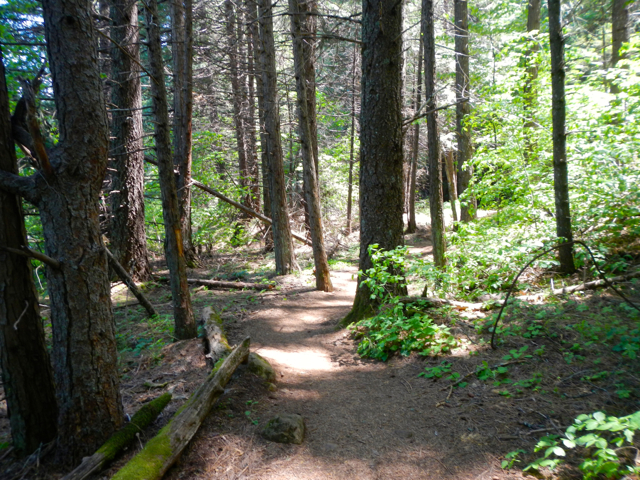
Most of the Bumpy Meadows trail is shaded. Photo/Kathryn Reed
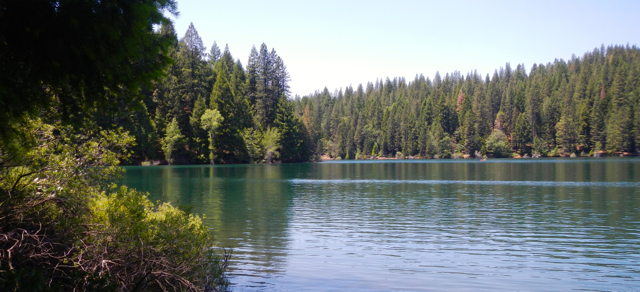
Most of the trail is alongside Jenkinson Lake in the Sly Park Recreation Area. The cackles of people being pulled on an inner tube drifted across the water. Fishermen were anchored, waiting patiently for a nibble from a trout.
On the other side of the 5 mph zone was where most of the kayakers were.
The dirt trail is covered in pine needles. Conifers and oak dominate the landscape, with the latter’s scent distinct at times. Shrubs are growing closer to the ground. A few ferns were spotted as well as some wildflowers.
On such a warm day it was a relief to have 95 percent of the trail shaded.
Being right next to the lake made it convenient for AJ to cool off whenever she wanted to. I was a bit jealous; at times wishing I had my swim suit along.
People are swimming in the pool of water at the bottom of the falls. Others are wading in the icy waters.
Jenkinson Lake provides the opportunity for various recreation activities. Photo/Kathryn Reed
Much of the trail is flat. The few uphill/downhill sections are steep, but short. Side trails in these areas allow for mountain bikers and equestrians to go around the hikers to avoid user conflicts.
Most people walked to the falls from the campground – a much shorter trek, albeit more crowded. A bridge built in 1994 links the two sides.
It’s possible to climb to the top of the falls. It’s a short, steep, slick scamper.
(The trail all the way around the lake is 8½ miles.)
In the mid-1950s, the U.S. Bureau of Reclamation built the dam that impounds Sly Park Creek, which is a tributary of the middle fork of the Cosumnes River. Today El Dorado Irrigation District operates the lake.
—–
Getting there:
From South Lake Tahoe take Highway 50 west. Take the Sly Park exit. Go left off the exit.
Go left on Mormon Emigrant Trail. Pass two dams. The trailhead (Bumpy Meadows) is on the left.
Parking is $5.
Easing drought boosts California hydropower
By Bobby Magill, Climate Central
The easing of California’s drought has boosted the state’s early spring hydropower generation to its highest level since 2011, helping it to recover from a 15-year low reached last year. But hydroelectricity production is not expected to improve much overall this year, according to the U.S. Energy Information Administration.
The West’s four-year drought desiccated many reservoirs in California, the nation’s fourth largest hydropower producer, reducing their ability to generate electricity and forcing the state to rely on other renewables and more fossil fuels for its power supply.
Prior to the drought, hydropower produced nearly 40 percent of the state’s electricity during wet years, with natural gas producing most of the rest. Today, about 11 percent of the state’s electricity comes from hydropower and 52 percent comes from natural gas, with wind, solar and nuclear producing much of the rest.
Across the political spectrum, Nevada voters generally support renewable energy, taxing mining companies, and the preservation of public lands, preferring a collaborative approach with the federal government on land issues, according to a poll released Wednesday.
The survey, prepared for the Center for Western Priorities, a nonpartisan conservation organization, asked 700 likely voters in the November election their opinions on an array of issues that affect land rights, the environment, energy policy and economic development.
These issues have been the subject of much attention in recent months, as federal authorities in February arrested Nevada rancher Cliven Bundy (who rose to national attention in 2014 for an armed standoff over grazing rights) and a regulatory decision in December prompted several solar companies to cease sales in the state. With the election looming, such actions have placed issues involving public land and renewables into the spotlight.
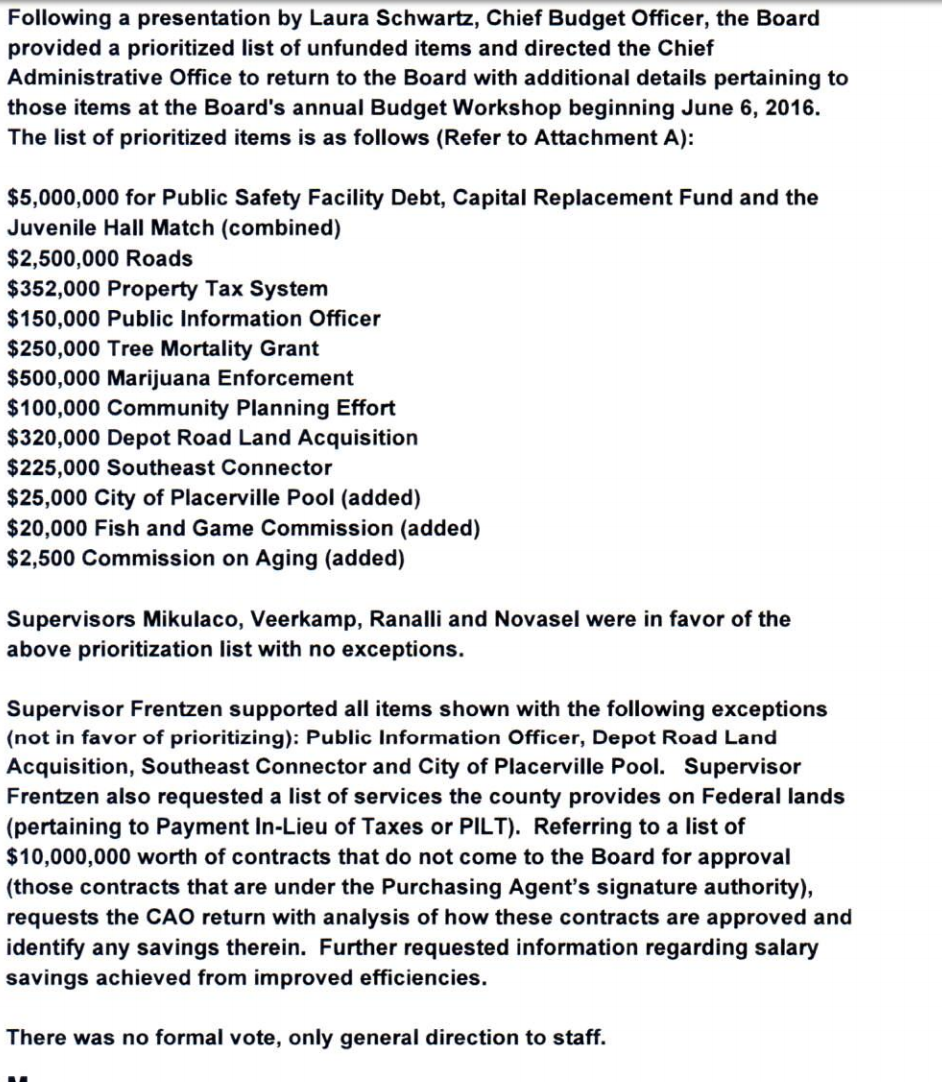
El Dorado County’s proposed budget that was released this week has zero dollars from the General Fund for roads and no money to build the public safety building for the sheriff’s department.
This, in essence, was Larry Combs’ parting gift to the county – a budget that does not reflect what the supervisors or department heads wanted. Combs was shown the door last week after nearly a year with the county. He worked part time while living in Auburn.
Now the five supervisors who supported Combs for much of his limited tenure are left to pick up the pieces. Helping them will be Don Ashton whom they hired last week to be the permanent chief administrative officer.
Source: April 26, 2016, EDC BOS minutes
“As you know, this is the first step in the annual budget process and between now and September the county will need to make some difficult decisions. During this period, the CAO’s office will be presenting the board with options and impacts relative to operating budgets and capital projects, including roads and the public safety facility,” Ashton told Lake Tahoe News.
What those recommendations will be Ashton did not share with LTN.
One of the bugaboos with the sheriff’s facility is that to qualify for the grant funding the county must show it has a balanced budget for the next five years. El Dorado County is forecasting a deficit in the coming years.
Neither Ashton nor Supervisor Sue Novasel could answer what this means for the public safety facility.
Technically the county is supposed to approve the budget this month before the start of the next fiscal year on July 1. Per standard operating procedure, adjustments are made through September. Normally planning for the next budget year then commences. That did not occur under Combs’ watch. That is part of the reason the county is scrambling to come up with a coherent budget for 2016-17.
It was Pamela Knorr, human resources director, who brought in her friend Combs to be interim CAO. She has been working remotely in Texas where her husband has a job. This is something Combs allowed, but is unusual for any department head, especially one dealing with all employees on a personal level. She recently put her house on the market, signaling she may have seen the writing on the wall now that she does not have a friend as her boss to protect her.
As for the budget, it could still look very different than this first iteration. This document that was released to the public on June 1 was sent to the printer the morning after Combs left the county.
“The proposed budget you are referring to is the CAO’s budget recommendations – and just that – recommendations,” Novasel told Lake Tahoe News. “The BOS has not reviewed nor had a chance to talk about the budget – the budget talks will begin on June 13. At that time, the board will begin a review of the recommendations and start to make changes, revisions, and additions that they feel are necessary. I am going to be asking that we look at adding a PIO position along with including additional funding from the General Fund for road maintenance.”
Asked what she would cut to fund the items she wants, Novasel said, “That is something that we will all be looking at – how much money does the county really have to pay for things that we, as a county, feel are most needed. We will be looking at our Strategic Plan as a basis for making those decisions. Of course, we don’t want to make cuts – but we also need to make sure that all programs and processes are in line with our Strategic Plan and the priorities contained within it.”
The budget hearing is June 13 in Placerville, a week later than previously planned – which was decided under the Combs’ regime, though the supervisors unanimously agreed to this on May 17.
This means the budget hearings are after the June 7 primary, when they were supposed to before the election.
Study: Trees, other foliage growing despite drought
By Matt Stevens, Los Angeles Times
Over the past year, scientists have studied California’s trees from the air, the ground and even using X-ray technology.
Each time, they have arrived at some version of a similar dreary conclusion: The state’s ongoing drought is wreaking havoc on forests, killing millions more trees at each check.
But a study published recently online in the Open Journal of Forestry offered a refreshing and counterintuitive piece of good news. A NASA research scientist found the drought did not stop trees, shrubs and other foliage from regenerating in areas ravaged by wildfires.
Casino tests program to prevent gambling addiction
By Phillip Marcelo, AP
BOSTON — Massachusetts is set to launch this week a first-in-the-nation system allowing slot players to limit their bets, following months of planning and some pushback from the gambling industry.
The goal is to prevent casual players from going down the destructive path of addiction, said Marlene Warner, executive director of the Massachusetts Council on Compulsive Gambling, which is helping administer the new feature along with the state Gaming Commission. It isn’t necessarily meant to address those with serious gambling problems, she said.
“It’s truly a prevention tool,” Warner said. “We want people to keep gambling in a way that’s healthy and safe for them, so that it doesn’t rise to that problematic level.”
The “Play My Way” system is being piloted at Plainridge Park, the slots parlor and harness racing track in Plainville and the only operating casino in Massachusetts so far.
If successful, the system may be imposed by the gambling commission at two other state-regulated casinos still in development: Wynn’s Boston-area resort and MGM’s Springfield one.
The federally recognized Mashpee Wampanoag tribe, which is building a resort casino on sovereign land in Taunton, says it’s also reviewing “Play My Way,” but declined to say last week whether it would commit to implementing anything similar when its First Light casino opens in part in 2017.
Massachusetts casino operators and the Washington-based American Gaming Association initially voiced reservations about the planned system, arguing such bet limiting or “play management” programs have not proven effective in Australia, Canada, Norway, Sweden and other countries where they’ve been tried.
But American Gaming Association spokesman Christopher Moyer said “productive conversations” with the state gambling commission has allayed most of the association’s concerns.
“Any responsible gaming tool should be targeted to assist the small minority of players that may confront irresponsible play without harming the entertainment experience for nearly all players who enjoy our entertainment experience responsibly,” he said. “We’re optimistic this tool will help to achieve this goal.”
Bet limiting systems are distinct from so-called “self-exclusion” policies in place at Plainridge Park and most U.S. casinos that bar enrolled gamblers from betting at casinos outright.
Warner said the Massachusetts system, which is similar to one also in development in the Canadian province of British Columbia, also is not as draconian as those imposed elsewhere.
“Play My Way” is voluntary and is only being offered initially to players signed up with the casino’s reward card program.
Gamblers would never be cut off from betting. By enrolling, they simply receive regular, onscreen notifications as they approach or reach their limit. They also can change their betting ceiling or unenroll at any time.
“It’s just a tool to make that person aware of what’s happening and the decisions they’re making.” Warner said.
Building a bridge over troublesome water
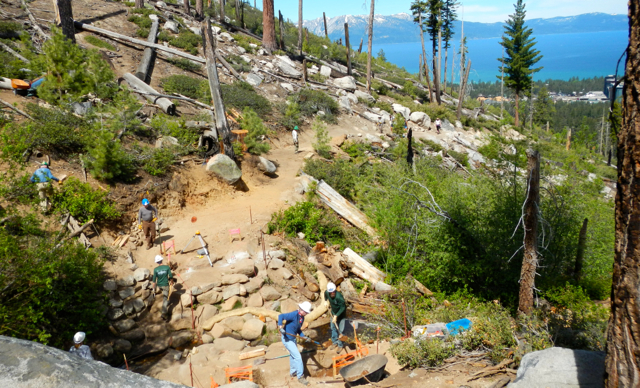
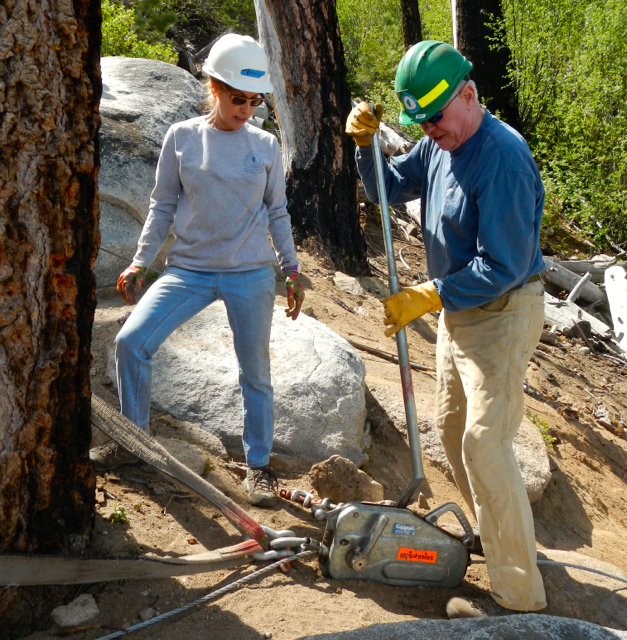
Tahoe Rim Trail volunteers prep the site for a bridge in Van Sickle Bi-State Park. Photo/Kathryn Reed
By Kathryn Reed
STATELINE – Five years after Van Sickle Bi-State Park opened, the main trail is getting a major upgrade.
A 26-foot long, 6-foot wide fiberglass composite bridge is being erected at the waterfall that is a little more than a mile up the trail from the parking lot.
The goal is provide access to more users of this 725-acre park – including equestrians, mountain bikers, small children, older people and those with some stability issues.
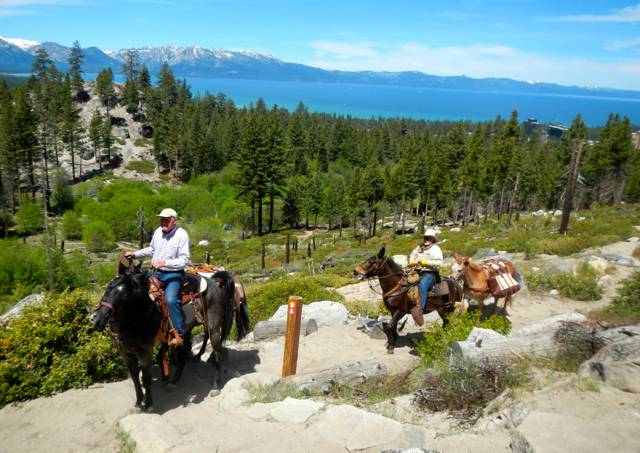
This is no easy undertaking. On Thursday about a dozen volunteers from the Tahoe Rim Trail Association were at the worksite. Horses were bringing in 80-pound sacks of cement. By the end of today more than 30 sacks will have been delivered.
Bonnie Fair and John McKenna work the hoist. Photo/Kathryn Reed
A grip hoist was rigged across the stream, with thick cables secured to trees. The cement bags were brought across the water this way – in the air – instead of carried by people. Mostly this had to do with ensuring it didn’t get dropped in the water. That would be an environmental nightmare.
Safety for the people doing the work and for the land is of utmost importance.
Clay Grubb and Chris Strohm are the project leaders. Both are veteran trail builders with long histories tied to the South Shore.
Horses bring the sacks of cement to the worksite. Photo/Kathryn Reed
In surveying the site on June 2, Strohm described the location as dealing with two imperfect surfaces in a tight spot.
The stream crossing comes at a bend in the trail. As with most mountainous areas, it’s not flat or even. And working around any body of water in the basin means needing to adhere to strict guidelines to ensure nothing gets downstream that could negatively impact Lake Tahoe.
Rock being used for the project comes from the side of the hill. By the time everything is done the landscape will look as though the workers were never there.
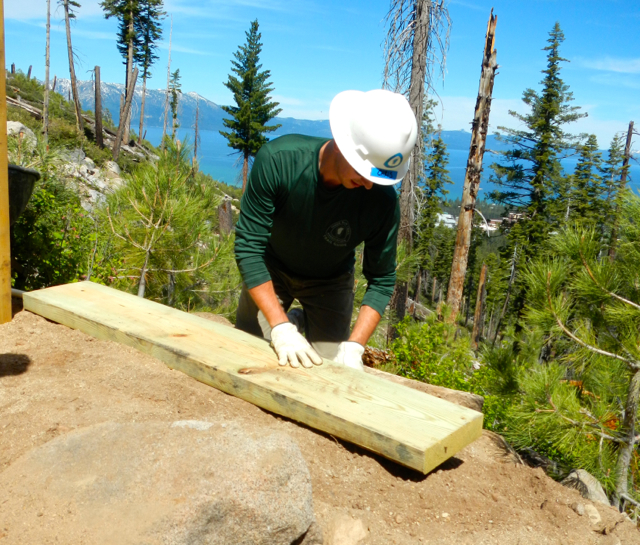
Chris Binder creates a landing area to store the cement. Photo/Kathryn Reed
“We’re building a structure that will last 100 years or longer,” John McKenna, who was working the hoist, told Lake Tahoe News.
While horses were used for the cement, the men and women hauled the rest of the tools, including the 50-pound generator, up to the waterfall. Wheelbarrows were pushed up the slope with tools.
McKenna, who is 70, brought up 75 pounds of gear his first trip on June 1, 50 pounds the second.
Many of the men and women are in their 60s and 70s.
The youngster of the group was Chris Binder. He was also the only actual employee of the TRTA. He started with the group about a month ago as the director of trail operations, having come from the Appalachian Trail Conservancy.
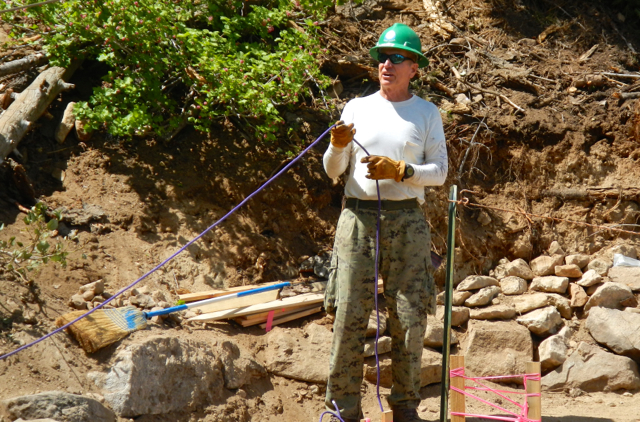
Clay Grubb, a former Marine officer, is a popular and well-regarded TRT leader. Photo/Kathryn Reed
“My involvement is fairly minimal,” Binder told Lake Tahoe News. This is because the logistics are done before the work begins. He praised the volunteers, realizing without them, this bridge and work on the 170-mile TRT wouldn’t get done.
The work actually started last fall with prepping the site, ordering the supplies and planning for the construction. Crews were back out in early May. The heavy lifting is this week. The bridge should be ready to be used in 10 days.
(The trail is still open while work is being done.)
Wagon Train veteran embraces history
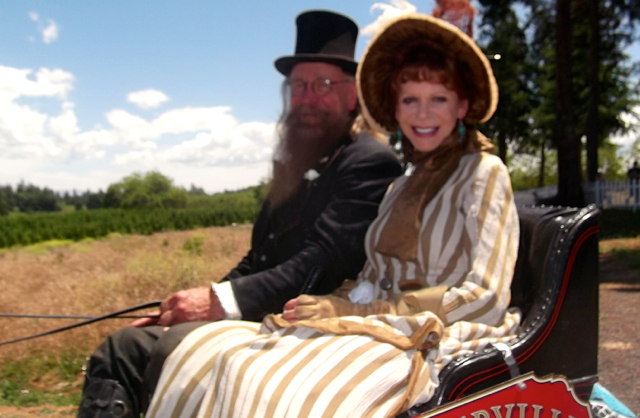
Davey “Doc” Wiser and Denise Sloan Smart are veterans on the annual Wagon Train. Photo/Projections Photography
By Denise Sloan Smart
Who inspires you to do crazy things? Such as riding on an annual wagon train for 30 years.
First would be my 4-H teacher who gave me a love of sewing at the age of 9, plus an incredible high school history teacher. Then my dad, who allowed me to drive alone 45 minutes each way every Saturday for a year into San Francisco at the age of 16 to a fashion design college. Years later, a crazy guy named Davey “Doc” Wiser mentored me on re-living American history in authentic attire to honor our California heritage.
At an early age, I began collecting and re-creating vintage clothing that ranges from the 1840s to the 1920s. Wearing any of the elaborate garments, you’ll find me volunteering at living history events and demonstrations from Great Gatsby to Gold Rush Days to Wagon Trains. I also demonstrate the delicate art of silk ribbon embroidery that was used as adornment on pillows, clothing and accessories of all manners, a craft that was immensely popular from the early 1800s to the late 1920s. I make all of my authentic 1800s garments.
It was the Highway 50 Wagon Train that gave me “gold fever” 30 years ago, when I was an editor at the Tahoe Daily Tribune.
I was on assignment to write about the 37th annual Highway 50 Wagon Train. I rode with Wiser and never stopped.
For the first couple of years it was a work assignment that usually stopped about the time the train rolled into Strawberry Lodge’s meadow for the halfway layover day, and I’d go back to work. By the third year I used my vacation days to ride the whole trip and the next thing I knew I volunteered to help the club with marketing and publicity.
I was honored as Highway 50 Wagon Train Queen in 1997.
A friend and former Highway 50 board member, Lynn Friesen, gave me an original 1850s dress that had some tiny stitching under the bustle. When I was in the process of constructing a pattern from the dress to make one for me, I did some searching and found there was a tiny pocket for a derringer hidden under the many layers of fabric. That was pretty exciting.
Getting involved in Highway 50 Wagon Train 30 years ago turned out to be a perfect combination of my love of history, historical clothing and sewing skills, and the desire to bring interesting, family friendly events to Lake Tahoe.
Those of us who possess a deep passion for Wagon Train keep this on the road for future generations so they will never lose our pioneer heritage.
Many of the Highway 50 pioneers and mountain men inspired me to keep coming back, but none more than Wiser. I’m so blessed to have been mentored and trained by him. He taught me that this “moving living history event” deserved total respect from start to finish. Once we leave home for Wagon Train, until the day it’s over we never change out of authentic attire, no matter what. You will never catch either of us in modern anything.
After riding together for so many decades, people ask, “Are Davey and Denise married?”
I always answer, “Of course, but not to each other.” However, we did create “The Firm of Smart & Wiser”.
Even though this is my 30th year on Highway 50 Wagon Train, it’s not old hat. Every year is just as exciting as the first. It’s not always pure fun, but it’s always an adventure.
Nevada prison guards will no longer use birdshot rounds and instead opt for less-lethal options when fights erupt, the agency said Tuesday.
The removal of all birdshot was ordered by new Department of Corrections Director James Dzurenda, with the full support of Gov. Brian Sandoval. It became effective Tuesday.
The agency has moved to implement less-lethal tools, such as rubber bullets, as well as update policies with new compliance measures and “more effective” defensive practices, the agency said in a news release.