Ballot puts medical, recreational pot users at odds

By Patrick Whittle, AP

A handful of recreational marijuana legalization drives has the medical pot industry bracing for something it never expected to deal with: competition.

Legalization is on the ballot in five states this November, and all five currently allow some form of medical marijuana already.

Growers, medical professionals and users of medical marijuana say they worry that people who want medical marijuana will buy it on the open market instead of going through the hassle of getting a doctor’s recommendation.

“This is being structured for big corporations to come in and in a very short period of time wipe out the caregivers,” said Lori Libbey, a board director of a Maine group campaigning against legalization and a nurse who administers cannabis. “I wonder who is going to be able to provide for pediatric patients.”

But in Maine and the other states considering legalization, others in the marijuana business are very much looking forward to the possibility of legalization. And some proponents believe medical marijuana professionals just don’t want to lose their monopoly.

Recreational legalization measures are also on ballots in Arizona, California, Massachusetts and Nevada. Concerns from medical marijuana professionals have also cropped up in those states, and they have echoed similar struggles in states that have already legalized recreational marijuana, such as Oregon and Colorado.

Competition in the marijuana market has become part of the landscape in Colorado, which saw nearly $1 billion in sales of medical and recreational marijuana last year. The state went legal in 2012.

Paul Armentano, spokesman for the leading marijuana legalization group NORML, said some medical users and advocacy groups worry about potential corporatization of marijuana as the market expands. Tension between medical and recreational marijuana supporters, he said, has already become an issue in California.

NORML is sensitive to the concerns of medical marijuana users, Armentano said, but also understands some of the consternation is about angst over free-market competition.

“There is a concern among individuals who largely have the marijuana market solely to themselves that the advent of broader legalization will introduce competition into the existing market and that competition will pose a threat to their existing business model,” he said.

Some advocates of medical marijuana feel state regulations are the key to making sure medical marijuana survives in the age of legal pot.

In Massachusetts, the language has alarmed some critics who fear passage of the ballot question could compromise or perhaps even overrun the state’s medical marijuana program, which has already been slowed by regulatory delays since Massachusetts voters authorized it in 2012.
Nichole Snow, executive director of the Massachusetts Patient Advocacy Alliance, said her group, which supports medical marijuana recipients, is neutral on the ballot question and uncertain of its potential impact.

“I hope there is still patient focus (if) this initiative passes,” Snow said.

Americans for Safe Access, an organization that advocates for legal access to medical cannabis, said recreational marijuana programs should be kept separate from medical marijuana.

The group sees potential “competing interests” between the two if they are comingled, said Beth Collins, a leader of the organization. The group also sees potential harm from the possibility corporatization of marijuana, Collins said.

“On the negative side, big business may try to impose regulations to keep other players out, which could lead to fewer products,” she said. “The best medical cannabis programs allow for both large and small businesses along with access via patient or caregiver cultivation.”

Some ardent proponents of medical marijuana are on board with broad legalization.

Carey Clark, a member of the board of directors for the American Cannabis Nurses Association, said recreational legalization will allow people who use marijuana as medicine to have easier access to it.

“When it’s legal we’re going to see an increase in quality and a decrease in cost, and that is really good for people who need access to this medicine,” Clark said. “Things will be labeled and they’ll know what they’re getting.”

Associated Press writer Bob Salsberg in Boston contributed to this report.



Silverado — sanctuary away from Napa’s chaos

By Kathryn Reed

NAPA – With 10 pools, two hot tubs, two PGA championship golf courses, 10 lighted tennis courts, three bocce ball courts, a spa, three restaurants, and a market why would anyone leave?

Wine would be the No. 1 reason.

The Silverado Resort is in the heart of Napa, just off the famous Silverado Trail. It’s a sanctuary nestled into what can be a chaotic world of tourists.

A toast to relaxation. Photo/Kathryn Reed

A toast to relaxation. Photo/Kathryn Reed

A calmness seems to permeate the grounds – even during a tennis lesson. Quinn, one of the tennis pros, keeps the clinic moving at a fun, adrenaline-pumping pace. He sprinkles in compliments with tips.

While Silverado is more known for its golf – especially with hosting the PGA Safeway Open earlier this month – tennis is also a big deal. Tennis Resorts Online regularly lists this as one of the top 50 tennis resorts in the world. Programs are offered daily – for guests and residents, as well as camps and tournaments throughout the year.

Driving in it’s almost like being transported to the South. The “big house” as I called it, looks like it belongs on a plantation. Construction of the mansion began in the 1870s by a Civil War general.

A variety of tennis programs are available at Silverado. Photo/Kathryn Reed

A variety of tennis programs are available at Silverado. Photo/Kathryn Reed

Today the Silverado is owned by hall of fame golfer and lead NBC analyst Johnny Miller and partners. He was instrumental in redesigning the North Course in 2014.

Being on a bottom floor unit was perfect because it meant walking right onto the golf course. There was no fence – so it was green lawn as far as the eye could see. I don’t really play golf, and didn’t intend to on this weekend visit. But there is something about walking the grounds with a glass of wine in hand that is so relaxing. Golf courses really are beautiful.

Scattered about are seven housing complexes making up the 1,200-acre Silverado community. Four of them are part of the condo rental program. Most of the 380 rooms were renovated two years ago.

While the area is sprawling, there is a free shuttle service via golf carts. It also didn’t take long to figure out how to walk to the various destinations.

The main building at Silverado was a private estate in the late 1800s. Photo/Kathryn Reed

The main building at Silverado was a private estate in the late 1800s. Photo/Kathryn Reed

A future destination will be the 30,000-square-foot events center that will include a 5,000-squre-foot pavilion, stage and small vineyard.

The only air of pretentiousness was at the spa. As a massage therapist I really don’t understand this uppity attitude that so many resort spas have. While the massage was adequate, what left a sour taste was the automatic 20 percent gratuity. This feels like stealing in a way. Pay the therapists more or raise the rates – just be honest with the price.

Being at the Silverado is relaxing in itself, especially with the numerous pools. The main one has food and cocktail service seasonally.

The market at the resort offers fresh baked goods and more substantive choices, along with a nice wine selection. Photo/Kathryn Reed

The market at the resort offers fresh baked goods and more substantive choices, along with a nice wine selection. Photo/Kathryn Reed

Tranquility was also found in the condo. The plush robe was perfect to lounge in while enjoying the comforts of what felt like home for a couple days. While there was a full size kitchen, not much cooking was taking place.

Being at the Silverado you are away from the hustle and bustle, and yet still close enough to partake in whatever might be going on off property. Uber is an excellent choice to get to downtown Napa where there is an abundance of restaurants and shops.

Wine tasting is walking distance, with William Hill Estate Winery on the same street. It, like so many wineries in the Napa Valley, requires reservations for tastings.

Tennis, wine and relaxation – not a bad birthday weekend.


Unions flex muscle in Nev.’s high-stakes Senate race

By Michelle Rindels, AP

A busload of casino housekeepers wearing pinstripe uniforms and Caesars Palace nametags waited at a warehouse early voting site just off the Las Vegas Strip, speaking in Spanish as they clutched pocket-sized brochures listing candidates endorsed by the powerful Culinary Union.

Asked who they chose in Nevada’s super-close Senate race, one worker simply said “the Democrat.” Another identified her choice as Democrat Catherine Cortez Masto, explaining with an argument progressive groups have relentlessly lobbed against Republican Rep. Joe Heck even after he revoked his endorsement of Donald Trump earlier this month.

“What I know about Joe Heck is he’s totally leaning toward Donald Trump,” Ana Aguirre, 40, said in Spanish, adding that she was particularly concerned that Heck is open to revisiting the idea of birthright citizenship.

And on Trump? “I’ve thought about the possibility that he’s president, and I feel terror,” she said.

Inflamed by Trump’s candidacy but with an eye on turning the whole ticket blue, organized labor groups including the heavily immigrant Culinary Union are in the thick of an aggressive get-out-the-vote campaign that’s contributing to Democrats’ early voting turnout lead in Nevada, and raising alarms for down-ticket Republicans. The union’s work so far this cycle included ensuring 34,000 of its members are registered to vote, reassigning 150 of its members to full-time political work and leading a ground operation that’s knocked on more than 200,000 doors.

Workers try to sway their co-workers in casino cafeterias and by phone, and they’re leaving no room for excuses in physically getting people to the polls. Chartered buses shuttle casino workers to an early voting site during their paid lunch break, and they’re handed a boxed lunch for the ride back.

The election comes just as the union engages in a labor dispute with management at Trump’s Las Vegas hotel, adding more ammunition to their campaign against him. A majority of workers voted for Culinary Union representation in December, but management has yet to come to the bargaining table to negotiate a contract.

As a result, union officials say, Trump workers make an average of $3 less an hour than their counterparts at hotels with union contracts.

“I think the workers at his hotel have a really strong message to bring the country and that is — what happens to them in Las Vegas could happen to America if he gets into the White House,” said Yvanna Cancela, the group’s political director.

Democrats have a 6 percentage point registration advantage in Nevada but have lived and died on motivating low-propensity voters in their base. Danny Thompson of the Nevada AFL-CIO often rallies his volunteers with reminders of the “red wave” in the 2014 midterm election, when lackluster Democratic turnout wiped out a bench of rising star Nevada Democrats and rendered the party largely defenseless against anti-union efforts in the Republican-dominated state Legislature.

“We lost everything,” he says. “We got a do-over.”

His group has coordinated waves of reinforcements from states like California with less-competitive elections. The LA County Federation of Labor, for example, has its members making phone calls into Nevada to talk about the Senate race and brings busloads of volunteers from Los Angeles for weekends of canvassing in Las Vegas.

“We see the work that’s happening here being critical to the national conversation, and we also have sisters and brothers in need here who are facing an uphill battle,” said Rusty Hicks, executive secretary treasurer of the union. “While we have our own work, we certainly feel a sense of responsibility to support those who need support.”

While they lack union muscle, Republicans point out that they’ve had boots on the ground far earlier than in years past, including 67 paid Republican National Committee staffers in Nevada as of late October. The organization has tried to mimic Democratic successes with a sophisticated data collection program modeled after President Barack Obama’s campaigns.

Republicans say that even though Democrats have an 8-point turnout lead in absentee ballots and the first six days of early voting, Democrats haven’t run away with the election.

“We always knew that we would go into early voting with a deficit. Republicans vote on Election Day. It’s their conservative mentality,” said Donald Trump’s Nevada State Campaign Director, Charles Munoz. “We feel extremely confident in what we’re seeing and trying out on the ground … I think we’re going to see that the Democrat lead for turnout taper off.”

But fears of a blue wave that could sink Heck are evident in outside TV spending. Groups linked to the billionaire Koch brothers that pulled off TV to focus on field work returned to the airwaves this week to boost Heck, while the Senate Leadership Fund, linked to Republican Senate Majority Leader Mitch McConnell, planned $7.5 million in last-minute ad spending in Nevada.

Labor isn’t taking its foot off the gas.

“There is still a difference between people power and money,” said Randi Weingarten, head of the American Federation of Teachers. “They don’t have people power so they try to fight by fear and not by hope. Catherine fights by hope, by opportunity. She exudes opportunity.”


SLT expected to host women’s Amgen bike race

The women cyclists are expected to start in South Lake Tahoe in 2017. Photo Copyright 2016 Carolyn E. Wright

The women cyclists are expected to start in South Lake Tahoe in 2017. Photo Copyright 2016 Carolyn E. Wright

By James Raia Sacramento Bee

The announcement likely will come early next week, but South Lake Tahoe officials expect to host the start of the 2017 women’s Amgen Tour of California. Sacramento is expected to be the start of the men’s race.

A four-day women’s stage race will be held May 11-14, likely from South Lake Tahoe to Sacramento. South Lake Tahoe was the start of women’s race this year and the finish for one of the men’s stages.

The men’s race will be one day shorter than in 2016, May 14-20. The men are returning to a north-south route, which will not include Lake Tahoe.

Neither the Anschutz Entertainment Group (AEG), which owns the event, nor the title sponsor would confirm the status of various cities.

But South Lake Tahoe and Sacramento officials confirmed they bid to host a stage.

Elk Grove, which has never been part of the event, has bid on a women’s stage.

Folsom, the site of the men’s individual time trial and women’s team time trial this year, did not bid for a stage in 2017.

Davis, which usually seeks a stage, won’t participate in 2017, focusing instead on the 100th anniversary of the city’s incorporation and other civic milestones.

Santa Rosa and Monterey, which hosted stages this year, won’t be involved in 2017, according to city spokespeople. Morro Bay, which hosted a stage start this year, and San Jose, which has been part of the event in nine editions, have bid for 2017.

Participating teams, key individual riders and route mileages usually are announced sporadically a few weeks before the event.

— Lake Tahoe News contributed to this report.


SLT children’s memorial creating unwanted grief

            “There is no footprint too small to leave an imprint on this world.” — Author unknown

By Kathryn Reed

For those who have a lost a child, that individual’s footprint has left an impression far deeper than most will ever know.

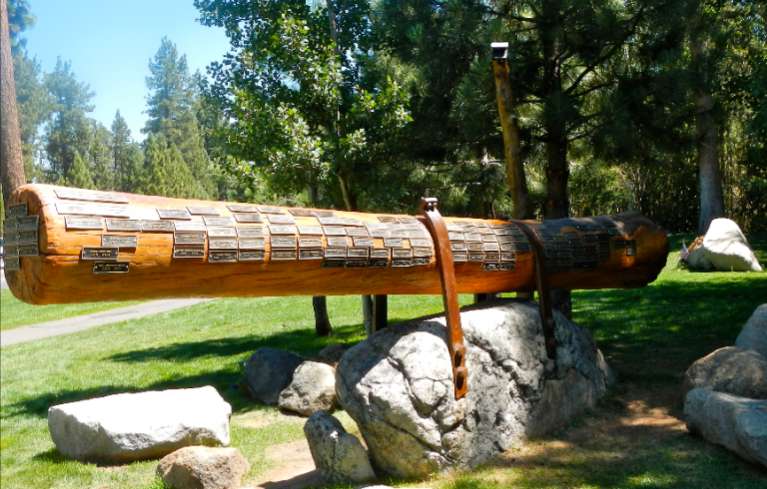
There are many ways to memorialize a loss. In South Lake Tahoe there is the Children’s Memorial at the corner of Highway 50 and Wildwood Avenue. More than 200 plaques have been placed on the tree since October 1994, when the tree was first dedicated.

Driven by the tragic death of her son, Rory, along with his two friends Sandy Haynes and Casey Wells in an automobile accident, Sue Hrbacek-Miller hoped to place, in a public location, the tree that the car struck on the night of Feb. 2, 1991.

Age and weather made the original tree no longer viable so a few years ago a “log” made out of a concrete-polymer material was installed with the idea it would be permanent.

The log has names of children from South Lake Tahoe who have died. Photo/LTN

The log has names of children from South Lake Tahoe who have died. Photo/LTN

The process to get a plaque on the tree has been simple and difficult at the same time.

This past summer Kenny Curtzwiler told the City Council he knows of 12 people who have run into issues at the city in regards to getting a name on the memorial. City Councilwoman JoAnn Conner has tried to get the topic on an agenda for months. It is supposed to be on the Nov. 15 agenda.

Lake Tahoe News reached out to Curtzwiler and Conner. Neither could provide Lake Tahoe News with names of anyone who supposedly is having an issue with the city.

“I will work on the list, but most of the people who contact me I just refer them over to Nancy [Kerry] by passing on her information and then lose the contacts,” Curtzwiler told Lake Tahoe News.

City Manager Nancy Kerry told Lake Tahoe News that Curtzwiler provided five names of people who had contacted him in 2013, 2014 or 2015. She said one was for a South Lake Tahoe child and that the mother told her she has yet to fill out the paperwork.

Conner did not speak to LTN until confronted at the last council meeting.

“They want to meet with a parent, to share their grief. They don’t want to be grilled,” Conner said. Many at the city are parents and some have even lost a child.

Conner had no names to provide to Lake Tahoe News.

When asked by the council and staff to provide names, she wouldn’t. Councilman Tom Davis asked her to provide names to him later so he could help. To this day she has not done so.

The city staff is in a quandary because it cannot help people without knowing who needs help.

Cindy Juarez spoke with Lake Tahoe News about her experience in getting her son’s name on the tree. Dave Suarez died seven years ago at the age of 42. He had worked in the produce department at Safeway for 15 years and had lived here for more than 20 years.

“With the passion my son had for Lake Tahoe I would really like for him to be a part of [the memorial tree]. At this point I’m not sure it will happen,” Juarez said from her home in the Bay Area. “Everyone has been very nice to me, but I felt I spent a week and got nowhere. It wasn’t that people didn’t seem as if they wanted to help me, but they didn’t have solutions.”

Lauren Thomaselli is in charge of the memorial tree for the city. She has people fill out a short form, directs them to a shop to get the plaque made and the city for free then installs the plaque.

In a memo to Kerry, Thomaselli wrote, “We have found that the new owner of Awards of Tahoe is not very easy to get a hold of and does not follow through in a timely manner – but this is more a problem for the family requesting the plaque.”

No one from Awards of Tahoe returned LTN’s call.

That is where the breakdown is for Juarez. While she was up here last week she couldn’t get the plaque made. The city doesn’t provide another alternative to the one they know is not working. All the plaques on the tree are the same size, same font, same point size, but what those are are not conveyed to people wanting a plaque.

Juarez said she was told to take a picture of one and get a plaque made in the Bay Area. She doesn’t have a smart phone to be able to so.

Just reaching the right person in the city was time consuming, she said. Nothing at the memorial site says who to call. For now, Juarez is at a loss as to how to proceed.


Calif. pension reforms haven’t reined in costs

By Judy Lin, Los Angeles Times

A year after his 2010 election, Gov. Jerry Brown made a rare appearance at a legislative committee hearing to confront lawmakers about the steep cost of public employee pensions — and to demand that they pass his 12-point pension overhaul.

Brown challenged fellow Democrats to drink political “castor oil” so public retirement costs would not overburden future generations.

State lawmakers eventually passed many of Brown’s proposals, including a higher retirement age for new employees. But they rejected those with the biggest dollar savings — notably his plan for a hybrid retirement system combining smaller pensions with 401k-style savings plans.

The state’s annual bill for retirement obligations is expected to reach $11 billion by the time Brown leaves office in January 2019 — nearly double what it was eight years earlier.

Read the whole story


The war against wildfire

By George Wuerthner, Earth Island Journal

Chad Hanson lopes over to a patch of young conifers and waves an arm at me. “Come over here, he says excitedly, pointing to dozens of 1- to 3-foot-tall saplings. “Look at pines and firs growing under these snags. See how healthy they are? And here, see these holes in the blackened bark? Those were made by black-backed woodpeckers. They are seeking the grubs of beetles that burrow into the dead trees after fires. Can you imagine how much energy it takes to drill these holes?” he says, his voice a mix of amazement and admiration.

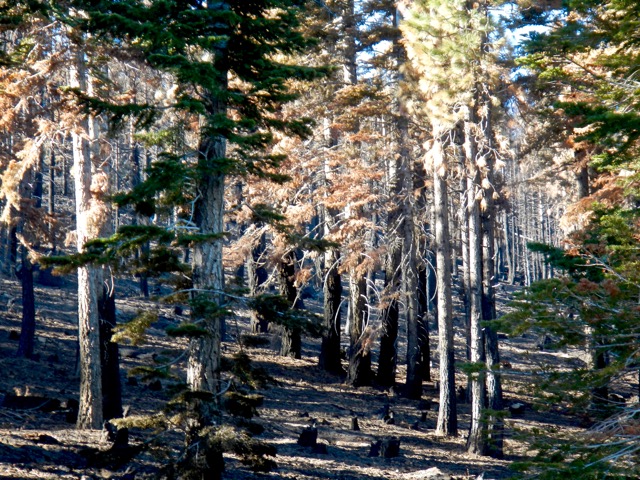
We are walking through Stanislaus National Forest, about a mile from the border of Yosemite National Park, in a patch of woodland that the Rim Fire swept through back in the summer and fall of 2013. It’s a pleasant summer afternoon. A faint breeze offsets the bright glare of the sun high overhead in the cloudless blue sky. The blackened trunks of the pines Hanson is standing amidst cast linear shadows on the ground. Patches of tender green shrubs and pine and fir seedlings cover the forest floor. Three years after the Rim Fire, this patch of forest is clearly regenerating itself.

Hanson, a tall, lanky figure dressed in khakis, is a forest ecologist who specializes in wildfires. He is also the director of the John Muir Project of the Earth Island Institute, a nonprofit that uses science and legal means to push for ecological management of forestlands, especially ones that have been severely degraded and damaged by decades of commercial logging and fire suppression measures. A California native, Hanson began studying the aftereffects of the Rim Fire – the third largest wildfire in California since the early twentieth century – almost as soon as the smoke cleared. As we walk through the charred trees, he can barely hide his enthusiasm, constantly pointing out signs of new life sprouting up amid the dead stands. “To me this habitat is fascinating. Every time I go out to a burn area I learn something new,” he says.

Read the whole story


Emerald Fire aftermath plagues area residents

Updated Oct. 28, 6:53pm: Power has been restored to Spring Creek. However, power will off Nov. 2 adn Nov. 3 from 8am-5pm to make final repairs. 

By Kathryn Reed

The 137 cabins in Spring Creek tract are still without power because of the Emerald Fire. Water is also an issue.

Liberty Utilities is hoping the lights will be back on by Nov. 4 at the latest. Multiple poles were reduced to ash when a fire swept through this area of the South Shore on Oct. 14. Replacement poles were flown in last Saturday.

“We are scheduled to pull wire in this week, but we are worried about the weather if the helicopter can fly,” Randy Kelly with Liberty told Lake Tahoe News.

While the cabins are on U.S. Forest Service land, the cabin owners are responsible for their own water.

Spring Creek Tract Association water manager Dave Braheny did not respond to an email inquiry from Lake Tahoe News.

The Emerald Fire singed nearly 200 acres on the South Shore. Photo/LTN

The Emerald Fire singed nearly 200 acres on the South Shore. Photo/LTN

A generator is being used to access the water from the old tank. This is causing some residents to have water pressure issues. (A few people use the cabins year-round, while most of the 176 cabins are used seasonally. Legally, the cabins cannot be a primary residence.)

“The water supply for the Emerald Fire came from the hydrant system at Spring Creek,” Lisa Herron with the Forest Service told Lake Tahoe News. “According to our fire managers, there were no issues with water flow during the Emerald Fire.” In some areas the fire burned on both sides of Highway 89.

Spring Creek has 12 fire hydrants and more than three miles of 8-inch diameter and smaller distribution pipe. There is also a new 80,000-gallon water tank, but that water cannot be used for human consumption.

Residents started the water tank replacement project in 2008, with it being erected in 2015.

“We had to add a few more braces, anchors to the tank because earthquake codes changed,” Jay Tripathi told Lake Tahoe News. He has a cabin there and used to be on the community’s board of directors. “The interior of the tank got compromised so we had to seal it up.”

This meant draining, cleaning, sealing and refilling.

When the fire hit, the housing tract was close to being at the end of the waiting period for the water in the new tank to have settled and for tests to be taken to determine if it is potable. That is why residents are relying on the old tank for drinking water.

Driving through the main area of the housing tract the fire is not evident – just a major thinning project.

“I think all the fire folks did a phenomenal job of keeping us in the loop. It was scary,” Tripathi said. “If it hadn’t rained, I think it would have gone through our tract.”

While CalFire has yet to release an official cause of the fire, evidence points to electrical wires during high winds sparking the wildland fire.


Research could help predict ‘flash droughts’

By Mallory Pickett, Forbes

Debasish PaiMazumder moved to Boulder, Colo., in the winter of 2012 to work as a climate scientist at the National Center for Atmospheric Research. PaiMazumder had spent the past three years in snowy Montreal, so he was pleasantly surprised to find winter in Boulder dry and warm. He was out hiking in shorts and a T-shirt in February, with no snow in sight.

But locals were quick to inform him that this was not a typical Boulder winter. Months later, this strange winter was followed by more exceptional weather: the “flash drought” of 2012-13 that started over the Rockies and went on to devastate agriculture in the Midwest, causing $30 billion in damage. It was one of the costliest natural disasters in recent history, and no one saw it coming.

The sudden onset and relatively short duration made the 2012-2013 dry spell a “flash drought.” Currently, scientists have no good way to predict these kinds of droughts, which can be devastating to farmers.

But in a paper published in Journal of Geophysical Research-Atmospheres this week, PaiMazumder reported a new method that could significantly increase forecasters ability to predict flash droughts. His idea was partly inspired by his warm, snow-free hikes in the winter of 2012.

Read the whole story


‘Mother of Nevada Wilderness’ Marge Sill dies

Marge Sill's conservation efforts took her to places all over Nevada. Photo/Friends of Nevada Wilderness

Marge Sill’s conservation efforts took her to places all over Nevada. Photo/Friends of Nevada Wilderness

By Henry Brean, Las Vegas Review-Journal

The wilds of Nevada have lost their matriarch.

Through more than five decades of conservation work, Marge Sill came to be known as the mother and, later, the grandmother of Nevada wilderness.

“It was a title she embraced fully and loved,” said Shaaron Netherton, executive director of the Friends of Nevada Wilderness, a nonprofit advocacy group that Sill helped found in 1984. “She’s just been a force in Nevada conservation for a long time.”

Sill died Sunday at her home in Reno at age 92.

Read the whole story