TRPA wins court challenge over Regional Plan

Updated Nov.2 3pm:

By Kathryn Reed

A court decision today upheld the validity of Tahoe Regional Planning Agency’s 2012 Regional Plan update.

The Sierra Club and Friends of the West Shore, represented by Earthjustice, filed a lawsuit saying the environmental impact statement for the RPU failed to analyze how the document will have negative impacts on soil conservation, water quality and air quality. Their contention is the plan promotes more growth, including in areas not already developed.

The environmental groups lost the initial case in April 2014 and then appealed the U.S. District Court’s ruling.

“We find it hard to believe, and extremely paradoxical, that problems caused by the overurbanization of Lake Tahoe can be solved with more urbanization,” Laurel Ames, conservation chair of the Tahoe Area Sierra Club, said in a statement. “The Regional Plan Update means more buildings, more asphalt, and more traffic – the very things that have caused Tahoe’s degradation. The public will have to be even more vigilant about conserving our beautiful natural areas. We are disappointed but we continue to believe that Tahoe can be protected.”

The Ninth Circuit Court of Appeals in San Francisco’s Nov. 2 ruling said, “The panel held that TRPA’s environmental impact statement and Regional Plan update adequately addressed the localized effects of the runoff created by the amount of development permitted under the update.”

The 29-page decision was unanimous.

“Today’s ruling by the Ninth Circuit Court of Appeals is yet another strong affirmation of the widely supported 2012 Regional Plan,” Joanne Marchetta, executive director of TRPA, said in a statement. “The plan is based on sound science, planning, and analysis and represents the best path forward for TRPA and its many partners to restore Lake Tahoe’s treasured environment and revitalize our communities.”

The Regional Plan had not been updated since 1997. There was much consternation to get the 2012 document passed, with threats from both states to pull out of the bi-state Compact. Ultimately consensus was found and the document was approved.

A change to the 2012 plan compared to the previous one is that there are constant updates – known as adaptive planning – so it reflects evolving times, new science and other issues.

Today’s decision further states, “The draft EIS drew criticisms that necessitated substantial revisions, but the final EIS for the RPU adequately addressed localized impacts on soil conservation and water quality. Notably, while California had strenuously objected to certain aspects of the draft EIS, particularly with respect to the localized impacts of runoff, both California and Nevada now urge approval of the plan, as evaluated in the final EIS. We also hold that TRPA reasonably concluded that, in light of anticipated improvements in BMP maintenance, the development permitted in the RPU would have less than a significant effect on water quality.”

SLT to host 2 legs of women’s Amgen bike race

By Kathryn Reed

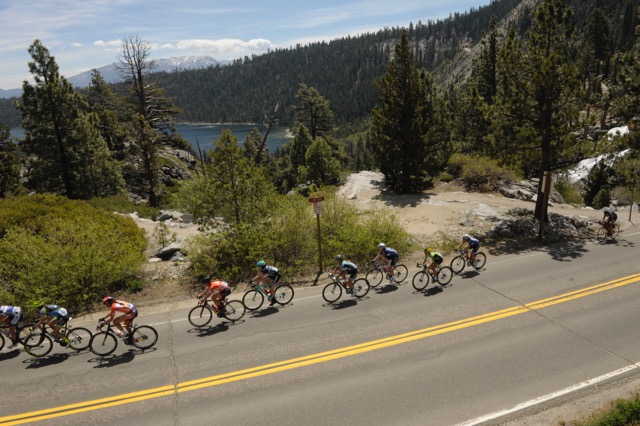
Half of the women’s 2017 Amgen bike race will be in South Lake Tahoe.

Officials announced today that the women will be returning to the area May 11-12.

Day 1 the cyclists will ride the 72 miles around the lake, finishing at Heavenly Mountain Resort. This will be the third year the women have ridden this route.

Officially called Amgen Breakaway from Heart Disease Women’s Race Empowered with SRAM, this race is one of the most prestigious in the United States.

““The Amgen Tour of California’s women’s race will return to Lake Tahoe for the third time in as many years and we like to think that these elite athletes have come to call this home. The women’s event is such a good fit for this destination and we enjoy being part of the effort to elevate the status of cycling here, particularly for the women, who are so engaged with the community,” Carol Chaplin, executive director of Lake Tahoe Visitors Authority, told Lake Tahoe News. 

Women cyclists will return to Lake Tahoe to in May 2017. Photo Copyright 2016 Lisa J. Tolda

Women cyclists will return to Lake Tahoe in May 2017. Photo Copyright 2016 Lisa J. Tolda

Day 2’s route won’t be disclosed until early next year. All officials will say is that “riders will face summits in excess of 7,300 feet.” That eliminates the 7,146-foot Spooner Summit. Plus, the women will have climbed it the day before.

Luther Pass is 7,740 feet. The men pedaled up it when they finished stage 5 this year. Kingsbury Grade, aka Daggett Summit, is 7,344 feet and Echo Summit is 7,382.

A common circuit for serious local roadies is to go up, over, and down Kingsbury and Luther passes. This would make for a challenging loop no matter which pass they would do first.

Lake Tahoe has always provided Tour of California riders with interesting weather. Even though it didn’t snow this year, high winds were a concern at the start of the women’s race.

While it’s too soon to know the exact teams and rosters, 2016 winner Megan Guarnier has committed to race here next year.

The women’s third stage will be in Elk Grove on May 13, with the final leg in Sacramento on May 14.

The men start their 600-mile race on May 14 in Sacramento, finishing May 20 in Pasadena. The 2017 race will mark the first year the men’s race has been elevated to Union Cycliste Internationale World Tour status, making it the only stage race in North America to receive this classification.


Keys pressing forward with weed removal

By Kathryn Reed

Twenty years ago it was recommended that herbicides be used in the Tahoe Keys to rid the canals of invasive weeds. That reality is inching closer, but is still two years off at the earliest.

No longer is it just Eurasian milfoil choking the waterways of this South Lake Tahoe neighborhood. Curlyleaf pondweed is becoming just as prolific. Both are spreading into Lake Tahoe.

It’s an environmental issue affecting the ecosystem, as well as a recreation-economic issue.

The Tahoe Keys Property Owners Association has been fighting the weeds for years, with a more concerted effort starting in 2011. Research and field tests have been taking place since then. In the 2017-19 time period non-herbicide demonstrations are scheduled, with the goal of herbicide demos in 2018-20.

In 2020, TKPOA would like to be embarking on a large scale, long-term implementation plan to bring the invasives under control.

“We want to take the level back to 1980 to have the weed mass be less than 10 percent,” John Larson, TKPOA board member, said. “We believe once we get to that point level, we can manage it without herbicides.”

Larson was speaking Nov. 1 at a meeting attended by about 40 people. They were there to get an update on the weed removal situation and learn what the plans are for the future.

In the 1960s the Tahoe Keys was built on the most sensitive marsh in the Tahoe basin. Photo/Kathryn Reed

In the 1960s the Tahoe Keys was built on the most sensitive marsh in the Tahoe basin. Photo/Kathryn Reed

Today, invasive weeds cover 90 percent of the canals.

To pay for future treatments the homeowners association is going to ask its members to impose a special assessment that could cost each of the 1,529 housing units $1,600.

Other property owners are also involved. The Tahoe Keys Beach and Harbor Association is on the same page as the TKPOA. The California Tahoe Conservancy is a partner, but has its own agenda with the Truckee Marsh restoration project. The problem entity is the Tahoe Keys Marina.

The marina had said it was going to use an ultra violet method to get the weeds out. While that has been talked about for the entire Keys, John J. Paoluccio, president of Inventive Resources Inc., wants to test his technique in a larger area than the Keys wants to use as a demo site.

Now the Keys marina says it is coming up with its own UV plan.

A 21-page 1991 agreement between the marina, Tahoe Keys Property Owners Association, and Tahoe Keys Beach and Harbor Association dictates how the three organizations work together, who pays what to whom and for what. However, disagreements, disputes and uncooperativeness have been the norm since the Krilichs took over the marina.

It’s possible the regional water board could put pressure on the marina to work on the weed problem.

TKPOA is going forward no matter what.

High powered equipment is going to augment the current harvester. This will help with milfoil removal so more of the fragments are pulled from the water.

Herbicide use would have to be OK’d by the Lahontan Regional Water Quality Control Board. While that state agency has approved the use in concept, each project has to be approved on an individual basis.

Several of the questions from the public on Tuesday night centered on the safety of using herbicides. Joel Trumbo with the state Fish and Wildlife Service said the herbicides target the intended plants, and don’t harm animals of any kind. Plus, the native plants also continue to live.

Rick Lind with Sierra Ecosystem Associates said diversion dams have been looked into, but would be “very costly and complex.” This is because the Keys was built on a marsh – meaning there is water everywhere. Underground water would fill the drained canal, thus requiring that water to be pumped. Even if there were the money to do so, where to put that water would be another regulatory issue.

Greg Hoover, the aquatic invasives supervisor for TKPOA, said once the problem is taken care of in the Keys, the entire lake will be fixed.


Study blames low 2015 snowpack on high temps

By Nicholas K. Geranios, AP

The Western United States set records for low winter snowpack levels in 2015, and a new report blames high temperatures rather than low precipitation levels.

Greenhouse gases appear to be a major contributor to the high temperatures, according to the study published Monday in the journal Geophysical Research Letters.

Scientists looked at snow-measurement sites in California, Oregon, Washington, western Nevada and western Idaho. They found that in 2015, more than 80 percent of those sites experienced record low snowpack levels as a result of much warmer-than-average temperatures.

Most of the previous records were set in 1977, a drought year, said Philip Mote, lead author of the study and director of the Oregon Climate Change Research Institute at Oregon State University.

“The 2015 snowpack season was an extreme year,” Mote said. “But because of the increasing influence of greenhouse gases, years like this may become commonplace over the next few decades.”

Winter snowpack in the mountains is important in the arid West because the melting snow provides precious water in dry months. The snow drought last winter led the governors of California, Oregon and Washington to order reductions in water use.

California has been in a drought since 2011. Oregon and Washington experienced much higher-than-average temperatures during the 2014-15 winter, but they were not as dry overall as California, the report said.

“The story of 2015 was really the exceptional warmth,” said Dennis Lettenmaier of UCLA, co-author of the study.

“Historically, droughts in the West have mostly been associated with dry winters, and only secondarily with warmth,” Lettenmaier said. But in 2015, “the primary driver of the record low snow packs was the warm winter.”

For 111 of the snow-measurement stations in the region, the April 1 reading was zero for the first time ever, essentially indicating that there was no snow left, the study found. The overall snowpack level on April 1 in California and Oregon was 90 percent below average, the report found.


More than 7 inches of rain soaks SLT in Oct.

Lake Tahoe experienced more rain than usual in October. Photo/Kathryn Reed

Lake Tahoe experienced more rain than usual in October. Photo/Kathryn Reed

By Kathryn Reed

South Lake Tahoe received 7.29 inches of rain in October. The average amount of precipitation for October is 1.8 inches at the airport.

The National Weather Service in Reno did not have monthly precip records for South Lake, but said this year is bound to be in the top three.

In Tahoe City, 6.96 inches was recorded last month. The October record of 8.34 inches was set in 1962.

Most of the moisture came in four days – Oct. 14-17.

“Three-quarters of the monthly total came in those four days. It was a combination of the atmospheric river and a strong jet stream across the Pacific that brought big surges of moisture,” Brian Brong, meteorologist with the National Weather Service, told Lake Tahoe News.

Scattered showers will linger today, with the next chance of moisture in the basin possible on Sunday. Snow levels will be above 7,000 feet.

Brong said it will be dry for the next few days in the basin. Truckee could experience some fog. Nighttime temps will be plummeting – low to mid-20s in the basin, in the teens in Truckee.


Concussion specialist warns of football’s hazards

By Linda Fine Conaboy

RENO – No child under the age of 18 should be allowed to play contact sports, forensic neuropathologist Bennet Omalu states in his clipped, fast-talking, often humorous manner.

Ranging from one side of the stage to the other, without notes, he continues talking to an audience of nearly 1,000 who have come to hear the doctor whose science is the subject of the recent movie, “Concussion”, starring Will Smith and Alec Baldwin. Last week Omalu was speaking at the UNR Medical School’s Healthy Nevada Speaker Series.

Bennet Omalu

Bennet Omalu

“Children are prohibited from smoking and drinking until they are 21, but not from contact sports,” he muses. “We have a duty to protect our children. When they play this game [football] they have a 100 percent chance of exposure to brain injury. We should not be afraid of the truth—it’s child abuse.”

Strong words, but this man has become a leading expert on traumatic brain injury, and through shear doggedness, has made his findings familiar to at least a good part of the population. Most football fans know of Omalu, the guy who autopsies the brains of football players and has found that there really is a reason for the sometimes erratic and unconventional behavior exhibited by some former gridiron jockeys.

Omalu autopsied Pittsburgh Steeler and Kansas City Chief center, “Iron” Mike Webster’s brain after his untimely death. Although he was disabled before his retirement from football, after retirement, it was obvious Webster suffered from amnesia, dementia, depression and acute bone and muscle pain. He lived out of his pickup, and in 2002, died of a heart attack.

“Concussion” graphically depicts Webster’s shattered life after football, his death and his relationship to Omalu, who examined his brain tissue and determined that amazingly, his brain was a fairly normal one, even though there is speculation that Webster exhibited the effects of someone who had been in 25,000 auto accidents over 25 years of playing football in high school, college and professionally.

But Omalu’s road to Webster and international fame as the person who finally discovered what was killing football players was a bumpy one.

Born in 1968, Omalu has six siblings and is a Nigerian-American physician, forensic pathologist and neuropathologist who was the first to discover and publish findings of chronic traumatic encephalopathy (CTE) in American football players while he worked at the coroner’s office in Pittsburgh.

He said as a child he discovered his imagination and also discovered the power of education. “If I’m educated,” he thought, “I have power over you. I studied hard and became a physician at 21. I was a simple man leading a simple life.”

But life at university wasn’t easy for him. “At med school I became extremely depressed and dropped out of school. Even though I was suffering, my parents punished me. To be myself, that’s all I wanted to be.”

He said he learned about the United States from the media; he arrived in Seattle in 1994 with $200, only to come face-to-face with racism, a subject previously foreign to him.

“I knew nothing about slavery, but then I discovered another Bennet and learned it’s OK to be him,” he said with a chuckle. “I must be true to myself. I’ve only got one life to live. No one could tell me what to do, it would be a denial of myself. If I was not true to myself, I would deny society of Bennet.” Again, that hearty chuckle.

It was in Pittsburgh that he learned about Webster and other football players who died mysteriously, many of them destitute, mentally ill and bankrupt, all with the common denominator being football. It was during this period that he asked himself, “Why do you need to wear a helmet to play a game?”

After their deaths, upon examination, the brains of these men all seemed fairly normal, leading Omalu to wonder why the erratic behavior? Although he didn’t know what he was looking for, he suspected football was the culprit.

When he lost his job, he found a way to take brains home with him, examining them on his kitchen and dining room tables, all the while struggling greatly with depression, a malady that began as a child as he watched the horror of war.

This is when he was finally able to make his CTE discovery. This is also when the National Football League denounced him. His fellow doctors called him a dangerous physician, saying he was disreputable.

“We Americans are infatuated with football,” he said. “We all look the other way; football cannot be harmful—the evidence was denied.

“I studied death and studied death,” he said. “I examined brains. There is a spirit that lives in everyone and is shared by everybody. We are members of one another. What I do, I do for all of us. When I look at myself, I see all of us. I want the NFL to do well, but the life of one player is worth more than the NFL.”

Before he officially ended his talk, Omalu mused, “What are we afraid of? Believe that faith causes the impossible to become possible. Always dream the impossible dream. Do the autopsy.”

Omalu later moved his family west, becoming chief medical examiner for San Joaquin County and professor at UC Davis’ Department of Medical Pathology and Laboratory Medicine.


Calif.’s $350 million social experiment over lawns

By Ellen Knickmeyer, AP

California water agencies that spent more than $350 million in the last two years of drought to pay property owners to rip out water-slurping lawns are now trying to answer whether the nation’s biggest lawn removal experiment was all worth the cost.

Around the state, water experts and water-district employees are employing satellite images, infrared aerial photos, neighborhood drive-bys and complex algorithms to gauge just how much grassy turf was removed. They also want to know whether the fortune in rebates helped turn California tastes lastingly away from emerald-green turf.

“How well did it work? That’s really key when we’re working on historic investments,” said Patrick Atwater, a project manager at the California Data Collaborative, a coalition of utilities and other water-related entities grappling with the question.

Removing lawns may sound like a small, wonky step, compared to building dams. But the green turf in American yards actually stands as a worthy target for water savings, a public enemy in the eyes of many during a drought such as California’s 5-year-old one.

The U.S. Environmental Protection Agency estimates one-third of all water used by American households goes to watering lawns and gardens. That’s 9 billion gallons of water each day — enough to supply drinking water daily for nine cities the size of New York.

In 2015, after a devastatingly dry winter, Gov. Jerry Brown ordered 25-percent water conservation by cities and towns. He mandated $25 million in state-government spending to help cover the costs of low-income California families in particular removing their grass, and putting less-thirsty, climate-suitable plants in their yards instead.

Brown set a goal of eliminating 50 million square feet of lawn. That breaks down to less than two square miles of greenery, out of what the Public Policy Institute of California think-tank has estimated at around 1,000 square miles of watered yards statewide.

But state spending proved a drop in the bucket compared to the money local water districts put into lawn rebates.

Metropolitan Water District of Southern California, a giant water wholesaler providing water to Los Angeles and more than two dozen other cities, counties and water districts, poured just over $300 million into lawn rebates from 2014 on, removing five square miles of lawn.

MWD doubled its rebate offer to $2 for each square feet of lawn removed, and the lawn rebates quickly became the district’s most popular program ever. Workers processed as much as $10 million in rebate applications a week at peak. In July 2015 alone, Southern Californians applied for rebates to remove the equivalent of 1,665 front lawns.

Santa Clara Valley Water District, serving Silicon Valley, provided more than $30 million in rebates. Dozens of other water districts put a few hundred thousand dollars to several million dollars into dead-lawn bounties. Rebates ranged from 50 cents a square foot of lawn to $4 and up.

Water districts revised rebate rules and amounts on the fly, after controversies erupted over golf courses and other properties that got millions of dollars each in rebates. Water boards imposed caps on rebates. Some districts dictated that homeowners put in California-suitable plants. Other water agencies faced criticism for allowing artificial turf, and swathes of gravel.

Now some water-district managers are nervous over political fallout if the benefits don’t measure up to the rebate costs, said Chelsea Minton of OmniEarth, a Virginia-based analytics firm that is using before-and-after satellite images to help tally the effectiveness of the lawn-removal program.

Privately, some worried water officials were “saying, ‘Let’s wait a year or two’” to study it, Minton said

Figuring out whether California’s experiment made sense economically is more involved than just totaling how much turf residents have ripped out.

Two key questions are whether households leave the lawns off for a generation or two, and whether each rebate helps turn Californian tastes away from lawns, independent of future rebates.

At Southern California’s Claremont Graduate University, Assistant Professor Andrew Marx is drawing on infrared imagery from airplanes, normally used by farmers, to help figure out whether the rebates are changing Californians’ tastes.

The state will go deeper still into the number-crunching, tallying not just water savings but spin-off savings. They range from lower energy costs for piping less water to households to reduced climate-changing pollution from lawn mowers, said Ken Frame, a project manager at California’s Department of Water Resources.

In Southern California’s Irvine Ranch Water District, which spent $638,403 on lawn rebates since 2014, workers sent surveys and drove block to block to nail down just how many homeowners joined the lawn-less trend.

Irvine’s pilot study found that for every three homeowners who took the rebate, at least four others converted their lawns to less water-hungry plants. Water experts say other factors besides the rebates played a part, including news reports about turf removal programs and the governor’s drought-messaging.

Rebates aren’t about trying “to buy up all the turf in California — that wouldn’t be cost-effective,” said Ellen Hanak, director of the water-policy center at the Public Policy Institute of California.

Instead, the rebates have built awareness that water-thrifty landscapes also look good, Hanak said.

In Santa Rosa, homeowner Trudi Schindler took the rebate to replace deep-green grass with flagstone pavers and a silvery-green groundcover with yellow flowers. Schindler wouldn’t go back to grass.

“It looks beautiful and sophisticated. And just more lovely than a lawn,” she said.


A new approach to navigating the PCT

By Caroline Benner, High Country News

At exactly 583.28 miles north of the U.S.-Mexico border, along the Pacific Crest Trail, you will come upon Golden Oak Spring. Just shy of a mile later, the trail crosses a power line near a wind farm. A half-mile farther, a man named Lon Cooper, a retired information-technology professional with an enormous amount of energy, stood thinking that the spot would make a nice place to camp.

He turned the data he’d collected into a GPS application for navigating the trail, and offered it as a free download for a smartphone. Hikers who use the so-called Halfmile app can now know exactly where they are on the Pacific Crest Trail, or how far away from the trail they are if they have wandered off it.

This sort of hyper-detailed, micro-documenting of the trails of the West — the Arizona Trail and the Colorado Trail have similar apps, for example — is a new trend in backcountry exploration. But before downloading these guides, consider whether you really want or need to know all the precise details that these wilderness apps offer.

Read the whole story


South Shore cycling advocates seek upgrades

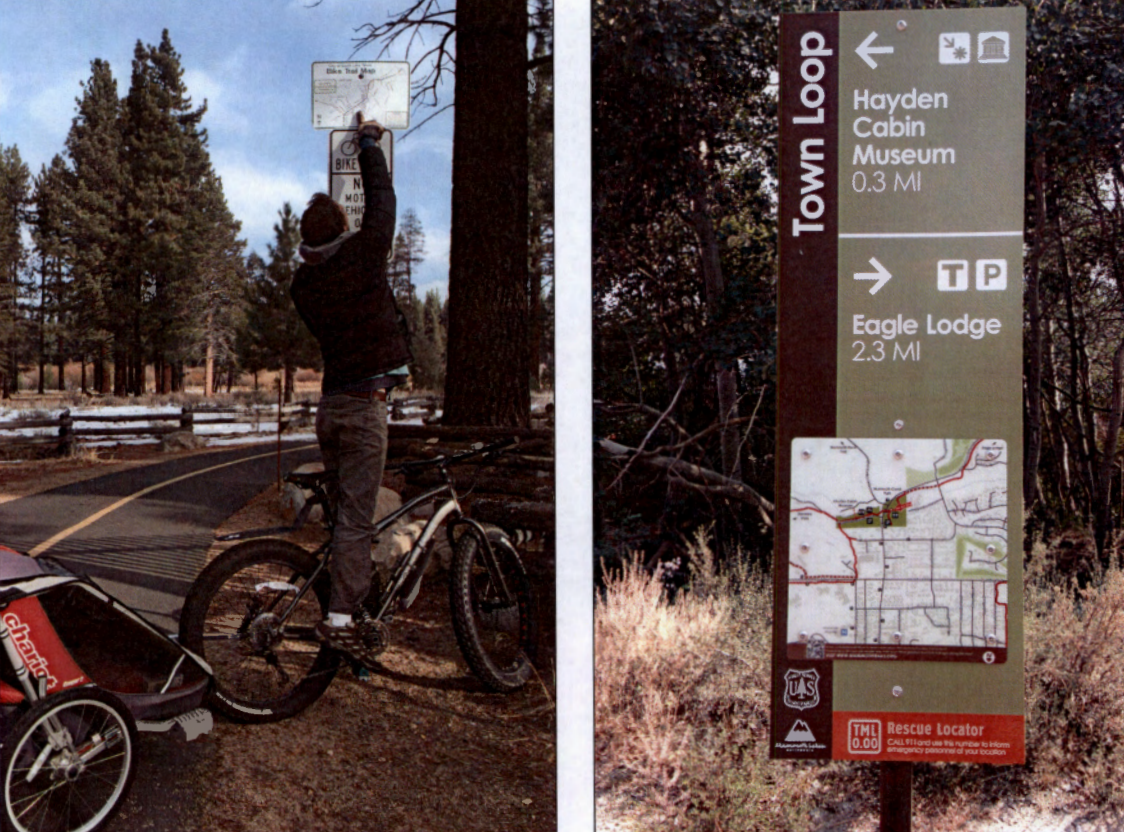
Scott Valentine, left, tries to read a bike route sign in South Lake Tahoe. At right is signage in Mammoth. Photos/Provided

Scott Valentine, left, tries to read a bike route sign in South Lake Tahoe. At right is signage in Mammoth. Photos/Provided

By Kathryn Reed

Signs don’t do much good if no one can read them, and recreation amenities don’t do much good without staff to manage and maintain them. Those were two of the overriding messages delivered this month by the South Lake Tahoe Parks and Recreation Commission to the City Council.

Commissioner Scott Valentine, who is about 6-feet-tall, showed a picture of himself standing on his bike pedals, arm outstretched trying to read the tiny print on a mounted trail sign in the city.

“It’s 8-point font on an 8 x 10-inch tin,” he told the council. “I’m not sure how many people can read a sign that is 10 feet off the ground.”

The commission acts as an advisory body to council about all things recreation. Signage, connectivity and staffing were the three points stressed during this annual report.

“Clear and consistent signage will improve visitor enjoyment and enhance traffic flow and resolve safety issues,” the report states.

Valentine, who is chairman of the commission, suggested adding QR codes to signs so people with smart phones could get an automatic link to information.

The commission recommended better signage at:

·      Tahoe Keys Boulevard-Eloise Avenue

·      Springwood trailhead

·      Viking Road trailhead

·      Al Tahoe Boulevard-Pioneer Trail

·      Tahoe Keys Boulevard-Venice Drive.

In terms of trails that will help get people around the area better, Valentine said the most important one is the Greenway. While ultimately it will go from Meyers to Stateline, it is being built incrementally from the center outward. The California Tahoe Conservancy is the lead on this project.

In 2015, 0.42 miles of the Greenway was built between Herbert Avenue and Glenwood Way. Future sections include going from Herbert to Ski Run Boulevard, and then from Ski Run to Van Sickle. When those are completed the trail will be 3.86 miles long.

A few of the improvements the commission would like in the near future include:

·       Connecting the old Alta Mira building to Ski Run Boulevard;

·       Continuing the trail at Viking Way-Lake Tahoe Boulevard to the Y;

·       Creating a spur from the trail behind Fitness Evolution-Scusa to Sierra Boulevard.

“We can’t recommend any of these additional projects without first addressing our staffing needs,” Valentine said.

He said the ongoing maintenance is an issue. People are needed to maintain these trails.

The council did not discuss anything that Valentine presented that day.


Call center industry flourishing in Nevada

By Nicole Raz, Las Vegas Review-Journal

Amid Nevada’s economic slowdown between 2008 and 2013, the call center industry settled in the state.

What it found was a gold mine of talented, unemployed labor.

Most industry settlers came in the form of high-end call centers that require specialized training, boosting today’s average call center hourly wage to $14.86 statewide.

“The (contact center) companies who we talk to now, we’ll tell them if you are not paying $15 an hour, good luck finding a workforce (in Northern Nevada),” said Mike Kazemierski, CEO of the Economic Development Authority of Western Nevada.

Read the whole story