Angora Fire anniversary — a time of reflection

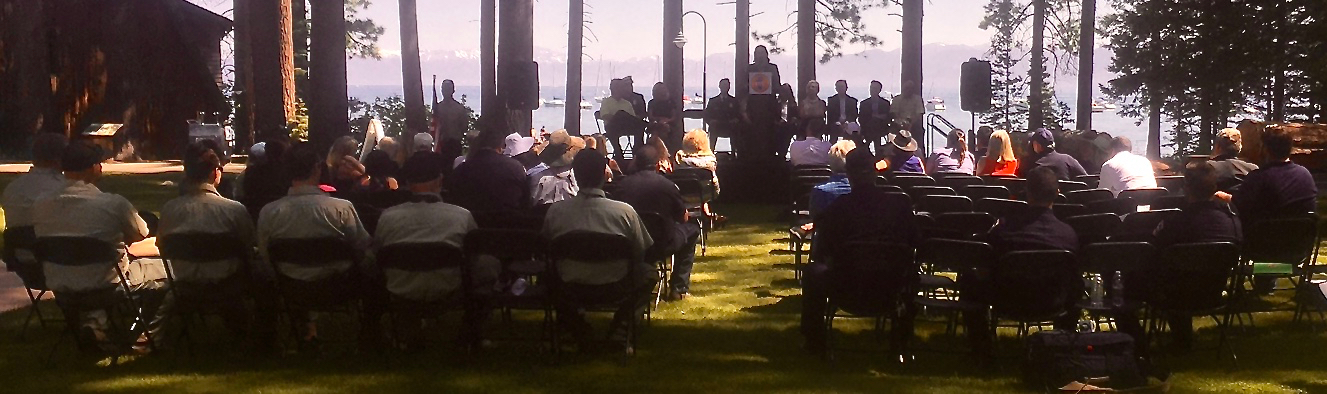
Speakers at the June 24 10-year Angora Fire anniversary reflect on the changes since 2007. Photo/Susan Wood

By Susan Wood

CAMP RICHARDSON – In what could have been the safest place to be in the event of a wildland blaze, about 30 Lake Tahoe fire and forest management dignitaries and community stakeholders came out to commemorate the 10-year anniversary of the Angora Fire outside the Valhalla Grand Hall on Saturday.

It was a picture perfect, serene setting to reflect back on the devastating fire that consumed 254 homes and 3,100 acres in the Upper Truckee and Tahoe Mountain neighborhoods.

For some in attendance, it was an emotional time – a time to heal and note the tremendous progress the Tahoe Fire & Fuels Team has made over the last decade.

The slogan of the day could have been “stronger together” as speaker after speaker on the panel pointed out the collective collaboration Lake Tahoe agencies made for the common good of the community.

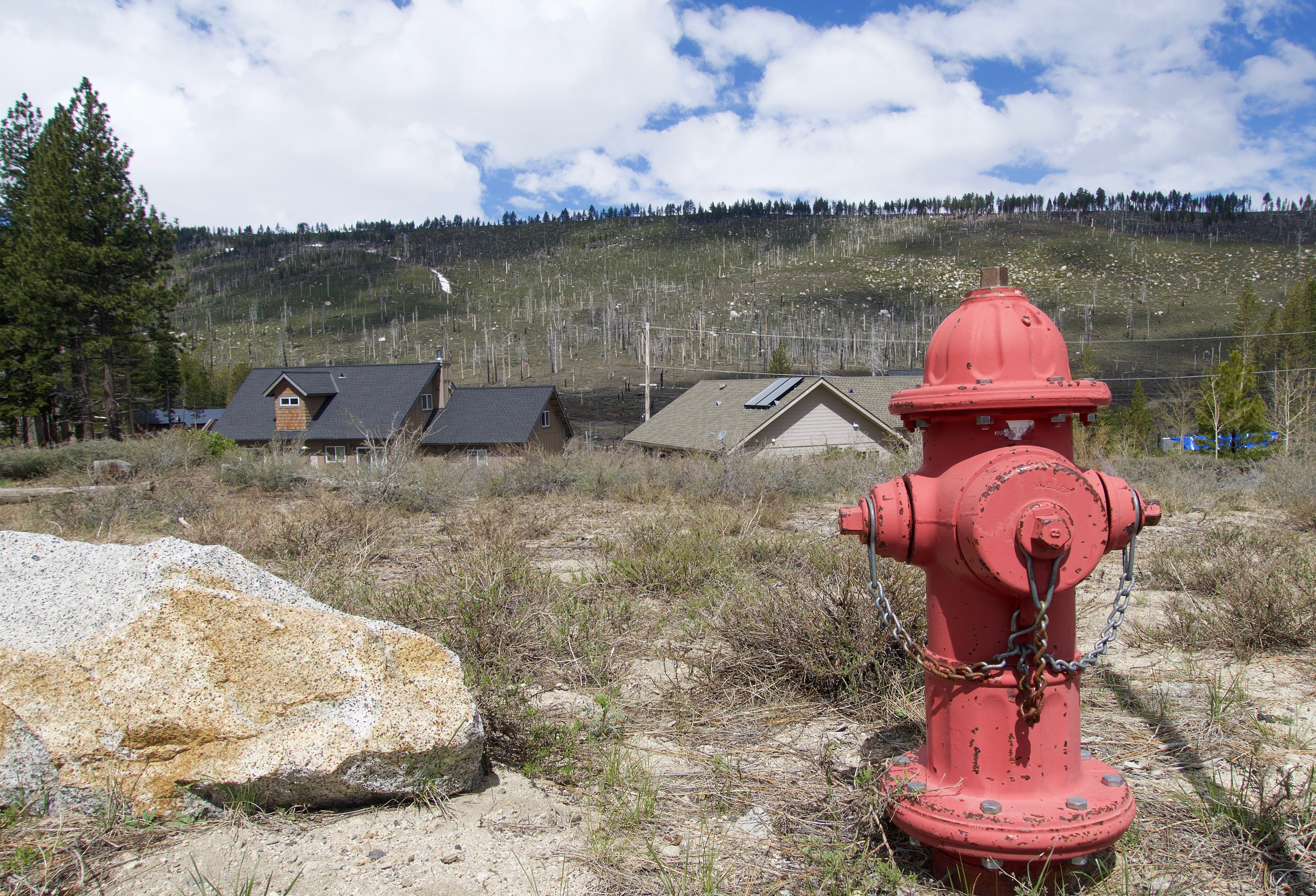
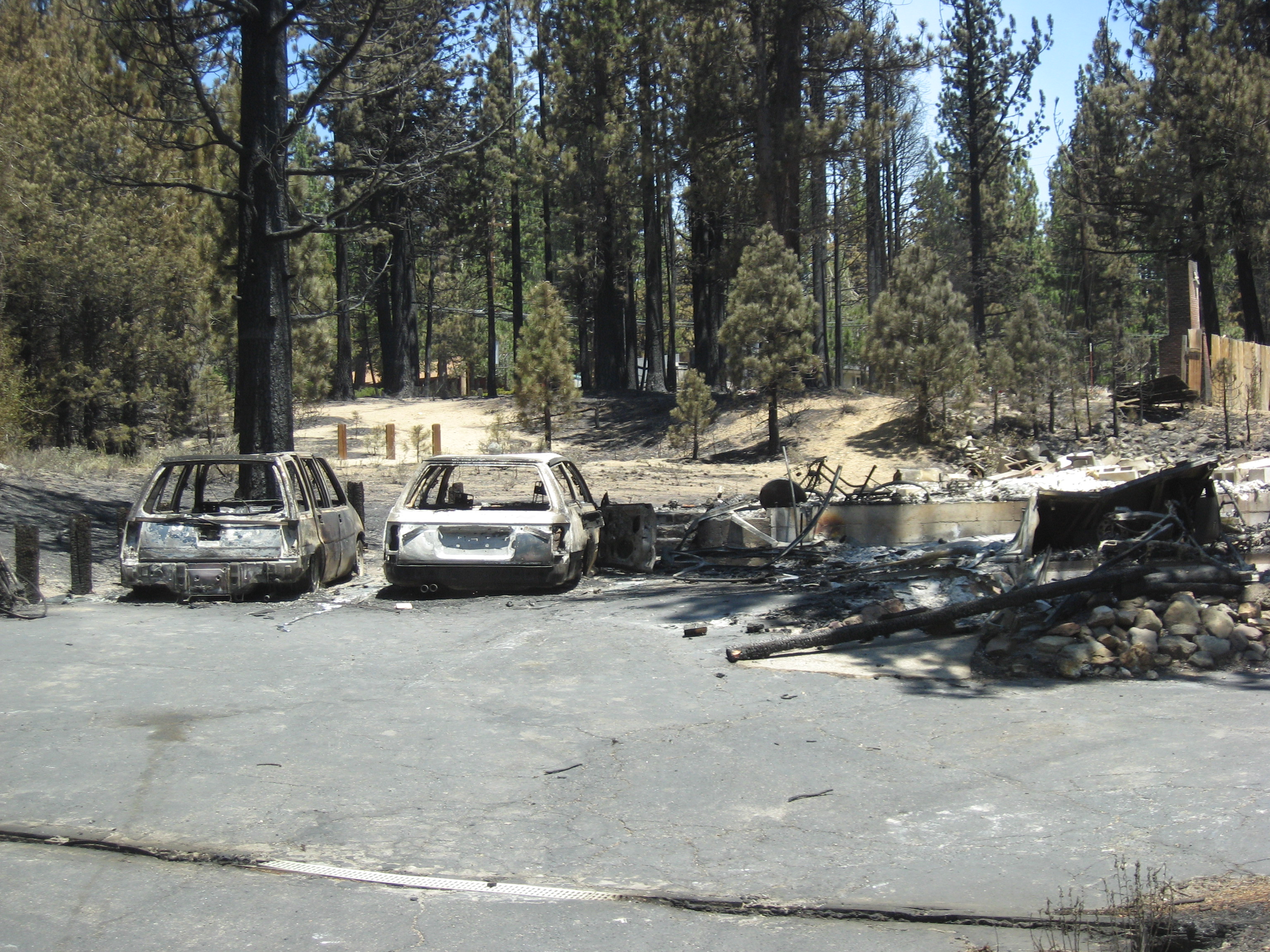
The scar of the Angora Fire will be a reminder for decades of that 2007 tragedy. Photo/Kathryn Reed

Elwood Miller, the Nevada Network of Fire Adapted Communities Coordinator, became poetic when describing ripe fire conditions.

“And into the fire-prone (conditions) comes people,” he said, in explaining how homes built in the forest are fuel for fire.

Despite tons of equipment, super aircraft and thousands of firefighters, major fires are costing more than $1 billion to fight.

The era of the mega fire overwhelms fire resources, echoed Miller. He received an encased hatchet in honor of his retirement next week after years of service as the “consummate woodsman,” according to Tahoe Fire and Fuel Team Chairman Forest Schafer.

Leona Allen pays respects to her father at the 10-year Angora commemoration by wearing his belt. Photo/Susan Wood

Schafer, former Lake Valley Fire Chief Brian Schafer’s son, explained the fire ax is a traditional retirement gift. The hatchet serves as a sign of prevention – a method of firefighting forest management agencies focus on.

Partnerships, partnerships, partnerships represent the underlying goal, Schafer emphasized.

And with the successful ones come goals met, as noted by Kate Dargan, who as California fire marshal at the time served on the Bi-State Fire Commission that spawned the Angora Protocol of forest management practices going forward. The commission was formed shortly after the fire by then California Gov. Arnold Schwarzenegger and former Nevada Gov. Jim Gibbons in response to the need for an action plan to quell future Angoras.

Dargan commended the fire agencies and political organizations in succeeding to meet 90 percent of the 90 recommendations made by the commission. The efforts required 19 public hearings over a seven-month period.

“This needs to be shouted around the world,” she said, calling the efforts “solutions that make a difference in your community.”

After all, community – which is people centric – places people first and politics last to effect lasting, civically-minded change. 

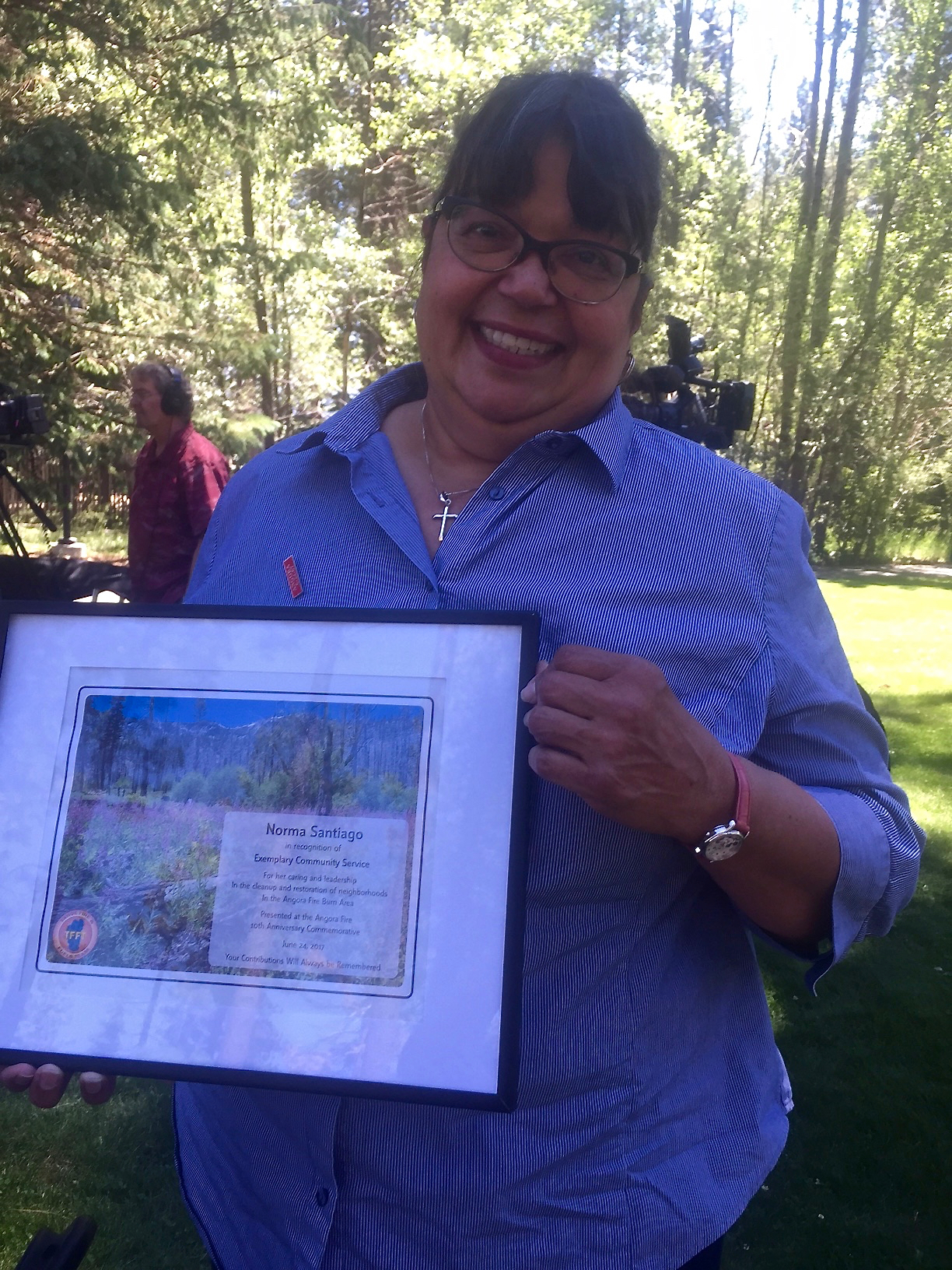
Norma Santiago as El Dorado County supervisor during the Angora Fire was instrumental in helping people recover. Photo/Susan Wood

“It’s our resilience as a community that moves us forward,” a teary former El Dorado County Supervisor Norma Santiago told the attentive crowd. Santiago, who was a newly elected supervisor at the time, was thrown into a fire of competing goals and an angry mob of citizens in wanting change for protecting property.

“We live in divisive times,” she said, while commending county staff and agency personnel for “making sure everyone was OK.”

A visibly moved Santiago received a plaque of recognition for her efforts.

She was not alone in feeling the commemoration represented a poignant time.

Leona Allen, a former police dispatch supervisor who runs the Lake Tahoe Fire Academy and serves on the Lake Valley Fire Protection District board of directors, lost her home and her parents’ home. The lifelong Tahoe resident made June 24 about her father who at 90 years old lost everything, but healed by creating a community garden on his lot.

She told the attendees her father pledged: “We got our community after that day,” in a show of unity that became a synergistic force for change and care.

“I’m wearing his belt today,” Allen said in a touching tribute to her late father, Owen Evans.

“What did we learn?” she asked.

Allen cited evacuation preparedness as huge, along with how implementing defensible space works and that resiliency makes for a community of survivors.

And survival was the order of the day and the time.

Remarkably, no one was killed or critically injured June 24, 2007, but the fire’s impact was lasting.

Nevada Department of Conservation and Natural Resources Deputy Director Jim Lawrence recalled the day like it was yesterday.

“I remember where I was,” the Tahoe Regional Planning Agency board chairman said like it was the day President John F. Kennedy was shot and killed.

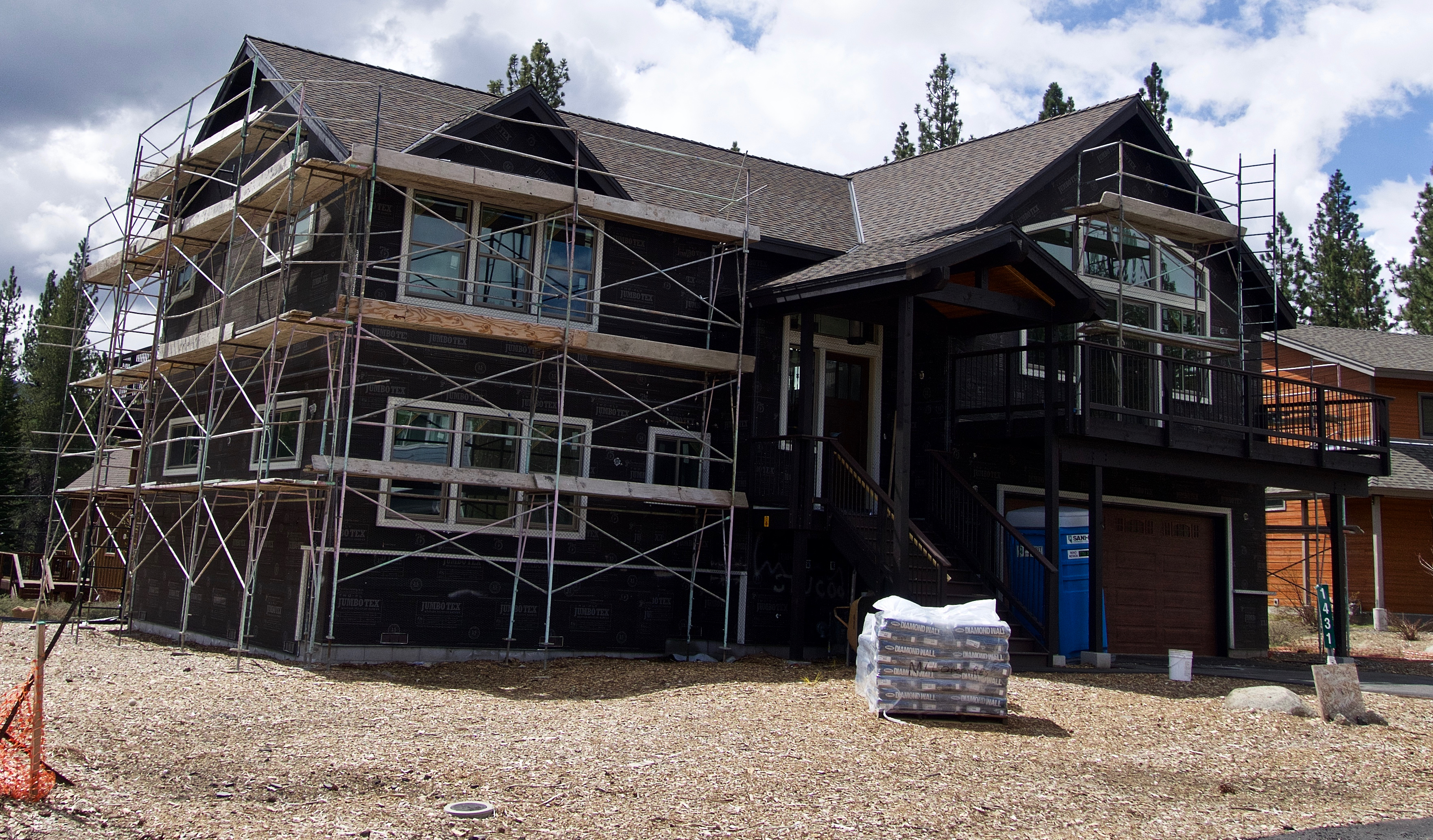
Homes to this day continue to be built on the 254 lots where a house burned to the ground. Photo/Kathryn Reed

Lawrence came up from Carson City for a hike up to Snow Valley Peak. At the top, he saw a wisp of smoke that soon got immensely large by the time he got back to his vehicle at Spooner Summit. A bad feeling set in the pit of his stomach.

Lawrence’s sinking feeling turned into a grave reality for Eli Ilano, who recounted the fire’s aftermath as “a scene from Armageddon.” He was the deputy forest supervisor for the Lake Tahoe Basin Management Unit at the time and is currently forest supervisor for the Tahoe National Forest.

“It was a scary sight – like nothing I’ve ever seen before,” Ilano said of the tour he took to witness the landscape.

Still, the community rose like a Phoenix from the ashes, Ilano pointed out. The crossroads of a divided, angry community was clear.

“Are we going to stop blaming each other and start to come together?” was the question the community needed to answer.

Yes, was the response.

The collective of agencies developed an action plan that has ultimately led to more than 16,000 acres of land treated for fuel reduction on both sides of the state line. Abandoned slash piles due for burning made the Angora Fire particularly hot as it roared through the county.

Within the fire area, 1,100 acres have been reforested  and about 2,000 feet of stream channel restored.

The Fire & Fuels Team, consisting of 20 agencies, has done as much to work with the public as it has to create a healthy forest. Consequently, the community has learned how to adapt to the risk of wildland blazes; because there will be other fires.

And no longer will a report with so much at stake be considered a document to collect dust on the shelf. To that, TRPA government affairs staffer Julie Regan nodded.

We’re not perfect, but we’ve come a long way, many reiterated.


What you need to know before buying that vacation home

By Jeff Brown, MarketWatch
 
It’s that time of year, when legions of vacationers decide they want to take the plunge and buy a second home. And this year, perhaps, it may be especially true: The economy is firming up, interest rates are still relatively low and investment accounts are brimming.

So consider this a reality check. Whether people are looking for a spot to enjoy themselves, rent to others or resell for a big profit, there are many mistakes that could bring them big headaches or cost them a lot of money.

Experts and homeowners warn newbies, for instance, that they may end up putting in a lot more work than they expect—and taking on a lot of frustration—to keep renters happy. They can easily run afoul of rules laid down by local governments or homeowners’ association, or find themselves facing unexpected costs. And there’s no guarantee the rental or resale market will stay strong enough to justify the expense.

Read the whole story


Lake Valley: Angora Fire — a helpless feeling

Publisher’s note: Lake Tahoe News this month has been running several stories leading up to today’s 10th anniversary of the June 24, 2007, Angora Fire.

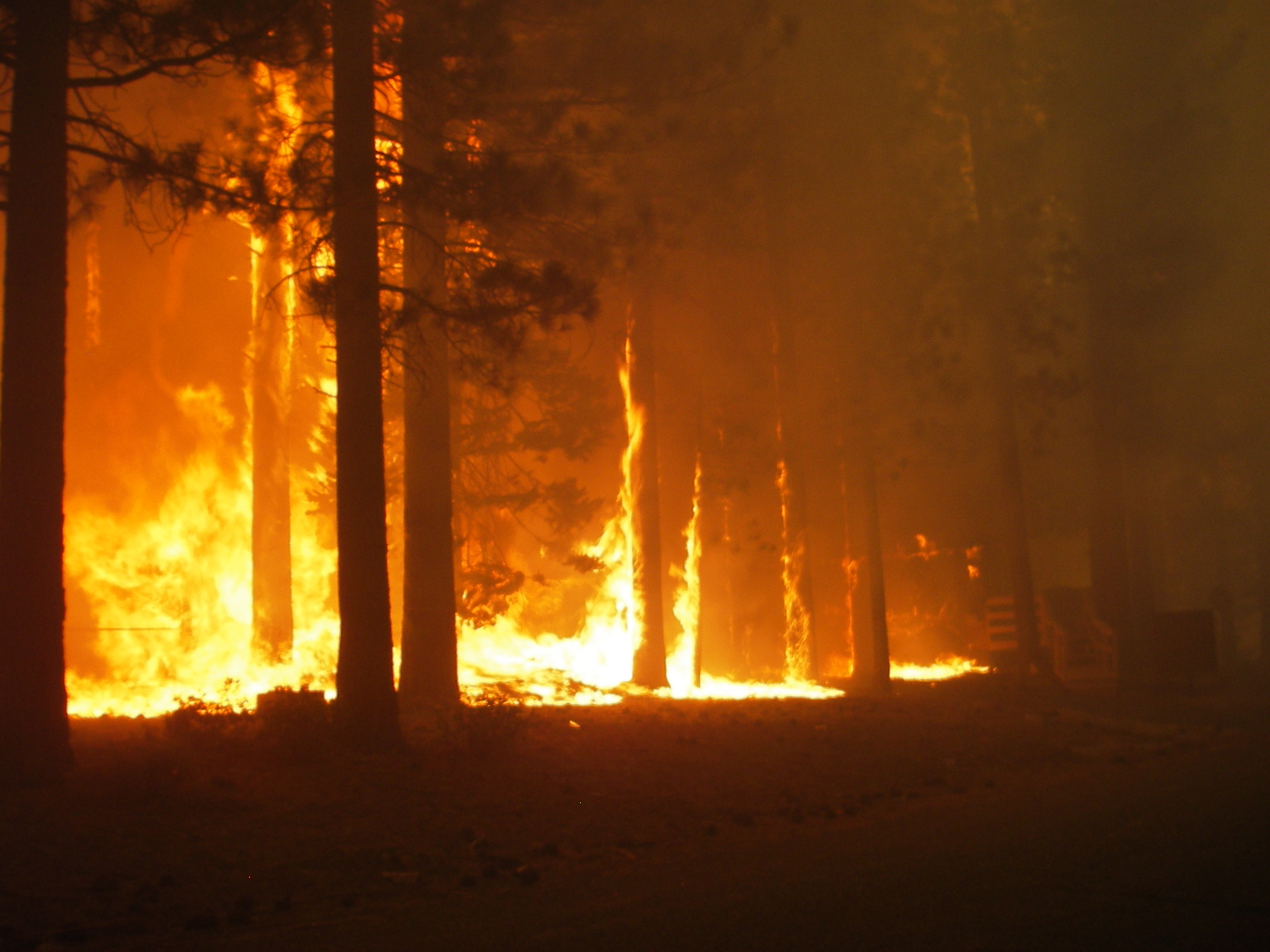
The Angora Fire spreads rapidly through the forest. Photo/LVFPD

By Kathryn Reed

“In the firehouse it was a quiet, somber mood. Everyone was really tired and we were all really sad. It was our local fire district. We were wishing we could have done more, but knew it was totally out of our control. It was a helpless feeling.”Capt. Mike Mosca, Lake Valley Fire Protection District

Mosca wasn’t supposed to work on June 24, 2007. He was camping with his family at Fallen Leaf Lake.

He and then Battalion Chief Joe MacAvoy had been mountain biking at Scott’s Lake that morning. Siren, after siren wailed in the not so far distance. Coming down the trail into Meyers they saw the plume of smoke. It was black. Structures were on fire. The two had never pedaled as fast as they did that Sunday afternoon.

Mosca was dropped off at the station, while MacAvoy secured Mosca’s family.

But there was no time for MacAvoy to save his own house from the destructive Angora Fire.

“The first two engines in Angora got to a vantage point to see the fire. They called the battalion chief to evacuate this neighborhood,” Mosca said.

Mosca had only been a captain for a few months at that point. That day he was an engineer – meaning he was driving the fire truck. Making the sharp left on Lake Tahoe Boulevard at Angora Creek it was impossible to see anything.

The sky was orange for days and nights as the Angora Fire raged. Photo/LVFPD

“Trees were torching up like Christmas trees. You could hardly see the road,” Mosca told Lake Tahoe News. “By Coyote Lane and Eagle Ridge you could hear the fire. It was like a freight train. Already houses were on fire. Spot fires thrown by the houses on fire exceeded our span of control. There was nothing we really could do.

“We got the engine out of those streets and pulled back to station 5 near Boulder Mountain to see what the fire was doing. When we saw it making a run through the neighborhood above Lake Tahoe Boulevard we went in to see what houses we could save.”

Most of the 254 houses that burned that day did so in the first eight hours.

Air suppression that first afternoon wasn’t possible because the winds were so high.

“When it’s that hot and intense and crowning the radiant heat is so intense you can’t get within several hundred feet of the fire front because it will just burn you up,” Mosca said.

Those who fought the fire that day were wondering how many people died, and how many they might know. After all, this was a locals’ neighborhood, with most houses occupied by full-time residents.

The remains after the flames moved on from the neighborhood. Photo/LVFPD

Miraculously no people died, though some animals perished. In fact, there were only minor injuries to firefighters. People for the most part obeyed orders from law enforcement to evacuate. Friends called friends. It was a community looking out for one another.

“It was amazing what law enforcement did. They knew where the disabled and elderly in the community were and they got them out,” Mosca recalled. “And they didn’t have safety gear. They were in summer street clothes.”

The fire was out in less than a week, having consumed about 3,100 acres – mostly U.S. Forest Service land. For the local firefighters after the first day they were no longer in control. On a fire of this size and nature the state and feds take over. The local guys are told to resume their regular duties.

“It’s hard when they come in and say ‘we have it from here and go back to your station’. But there is also the understanding they have an unlimited amount of resources and the command structure to run a giant scale event,” Mosca said.

Lake Valley firefighters on the Angora Fire in 2007. Photo/LVFPD

That didn’t mean Lake Valley, or even surrounding departments, stayed in their stations as the fire kept burning. They were in the neighborhood, especially the Lake Valley firefighters. They sifted through rubble, they listened to those who lost everything, and to those who wondered how and why their house survived.

They, too, though, were devastated.

Ten years later, about half of Lake Valley’s employees are veterans of the Angora Fire. It’s a physical and emotional memory with many lessons that are passed on.

Not long after the fire a counselor came in to do a critical incident stress debriefing. Attending was optional.

“We sat in a circle, talked about things, what we saw, what we did, what we felt,” Mosca said. “Guys cried, some were quiet.

“One of the things the counselor said when we were in the group is one of the biggest problems is with our job we go in and we fix things. People call us because they are having a really bad day and we fix it.  When we get a call and there is nothing we can do it is hard to deal with.”

About half of the two dozen Lake Valley employees live in Meyers or South Lake Tahoe. They hear the tone and they go to work. They did it that Sunday and they keep doing it, never knowing if it will be the next Angora.


Money, leadership stall Kahle Drive’s future

By Kathryn Reed

STATELINE – Kahle Drive is an auto repair shop’s dream. It’s that bad.

Douglas County owns this Stateline road, but it’s Oliver Park General Improvement District that is responsible for maintaining it and the other neighborhood streets.

The five-member board that operates the GID plans to fix the potholes, but the problem is the entire road needs to be overhauled. Like so many streets that were created in the basin decades ago, they were never designed to a high caliber or intended to be used year-round with the level of today’s traffic.

About a dozen residents attended an OPGID board meeting June 21 to voice their frustration. Some believe all the trucks going down the road to build the lakefront Tahoe Beach Club, the multi-million-dollar luxury housing development, have contributed to the road degradation because they drive through the potholes, which makes them larger.

Tom Castaneda and Bob Mecay bought the 19-acre parcel in 2002 for about $12.6 million. At that time 155 mobile homes occupied most of the land that sits between Rabe Meadow and the University of Nevada 4-H Camp.

They have a vested interest in wanting the road to be nice; it would help sales. After all, the goal is for people to move into the first 46 units in about a year.

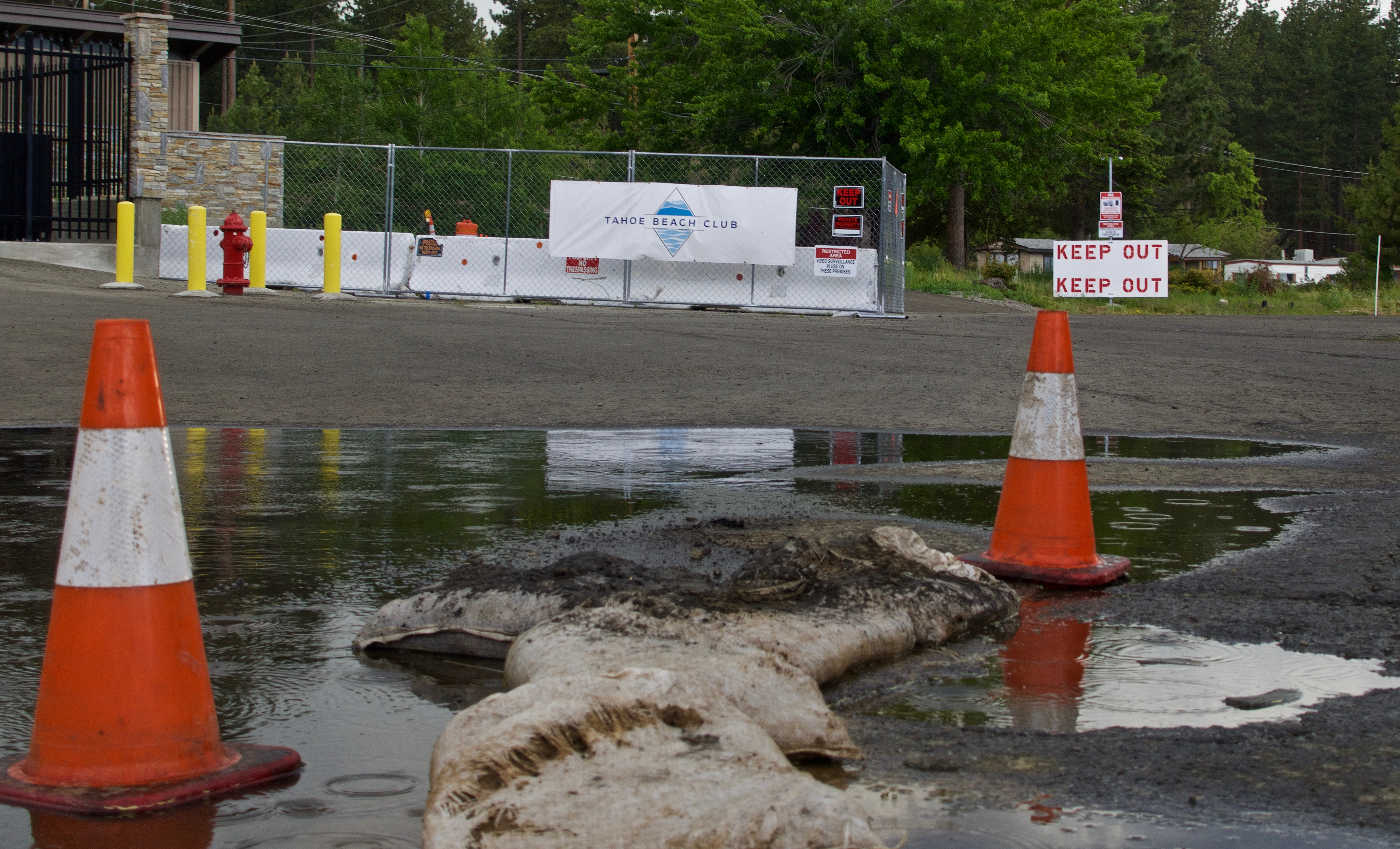
Potholes mar the entrance to the Tahoe Beach Club construction site on Kahle Drive. Photo/Kathryn Reed

Tahoe Beach Club was part of a group in 2014 that had Design Workshop come up with preliminary plans to make Kahle Drive a complete street. This would include sidewalks, curbs, gutters, undergrounding the utilities (electric, cable, telephone), lighting and bike lanes.

Tahoe Beach Club is not a member of the OPGID, however, the owners help pay for the maintenance of Kahle Drive. Along with Lakeside Inn, they are the largest contributors. Mecay and Castenada own a 39-unit apartment complex in the area that is part of OPGID.

Leadership and money are missing from the equation in order to move the complete street idea forward. While Oliver Park was part of the discussions about redesigning the entire street, the board members are all new since then and don’t have any institutional knowledge.

Mecay and Castenada brought consultant Steve Teshara to the meeting to talk about the complete street proposal. He repeatedly urged the OPGID board to have a bigger community meeting to get other players involved to move the project forward, and added that the district needs to decide if it wants to be the lead agency on this.

Most residents at the meeting just wanted the potholes fixed. The board at its July meeting is expected to have an agenda item regarding a future meeting to discuss the bigger road project.

The only enthusiasm for the larger project was from Teshara, Mecay and Castenada. It’s obvious why Mecay and Castenda want a beautiful gateway to their lakefront development.

For Lakeside Inn, the plan is to redevelop the corner of Highway 50 and Kahle Drive. (The current building is the sales office for Tahoe Beach Club.) The hotel-casino wants that intersection to be a gateway to Stateline with expansion of their holdings going there.

For the residents, they may get squeezed into paying for a nice road that benefits two commercial entities. Though, they would have a nice road to drive on.

Oliver Park GID’s responsibility is just roads; maintenance includes snow removal. Other than Kahle Drive, no one at Wednesday’s meeting had any complaints about the streets. And if the road becomes more than it is today, all that improved infrastructure would be OPGID’s responsibility — at least as things stand now. It is assessments to property owners that pay for the road maintenance.

Kahle Drive shows up in the five-year transportation plan for Douglas County that was approved by the commissioners in March. It’s under the Rehabilitation and Reconstruction Program. The estimated cost to turn it into a complete street is $2.283 million. No time line was given and the county’s share was listed as “undetermined.”

Under comments in the document, it says, “Reconstruct road with cost sharing from the Beach Club project. Redevelopement (sic) District area may be a source of funding. Chairperson [Nancy] McDermid to write a letter to assistant DA Zach Wadle about desolving (sic) Oliver Park GID.”

Dissolution was not discussed this week.

“This is not our road to maintain. Oliver Park GID is responsible but to our knowledge they have not been able to come up with a funding source. The county has met with the Beach Club and Oliver Park to discuss options last year, but that is about as far as it has gotten at this time,” Melissa Blosser, spokeswoman for Douglas County, told Lake Tahoe News.

No one from the county was at the meeting.

In January 2016, the county created a redevelopment area that includes Kahle. The hope is that some of the money collected through tax increment could be used to fund the Kahle Drive project. However, that cash will take years to accumulate and right now the powers that be want to spend it on the Stateline entertainment venue. Estimates are the redevelopment agency through the tax increment would collect $47.2 million in 30 years.

With how things move in the basin, this complete street could be a decade away at best.


SNC faculty may not have a job this fall

By Carole Jablon-Bernardi

INCLINE VILLAGE – When a college is competing to maintain enrollment, even grow it, and is faced with rising tuition costs to offset expenses, faculty can become the target.

Such is the case at Sierra Nevada College.

The administration of the four-year liberal arts institution in Incline Village announced to faculty members that no contracts would be renewed for the 2017-18 school year. SNC intends to award faculty agreements by August, but urged instructors that “no reliance should be made on this time line nor should the statement of the intended dates create an expectation or guarantee of future employment with SNC.”

For several years there has been a downward enrollment pressure on small, private liberal arts-oriented colleges that survive on small endowments. While SNC has experienced steady, modest enrollment growth over the last several years (primarily due to its graduate programs in teacher education which are primarily delivered in Reno, Henderson and online) the main SNC Tahoe campus and its undergraduate programs have been subject to this pattern being felt by many colleges across the country.

Changing demographics and less general demand for traditional liberal arts programs around the country, as well as competition for students, has intensified. SNC Tahoe competes with many better resourced liberal arts colleges for what has been identified as a “shrinking pool of students.”

“These are challenging times,” Atam Lalchandani, chair of the SNC board of trustees, told Lake Tahoe News. “Higher education in our country is undergoing a seismic shift. Many institutions like SNC Tahoe are finding ways to reduce the cost of higher education and improve accessibility.”

The college is aligning its annual contracting procedure to time better with its enrollment calendar. Historically, the college has become contractually obligated to a major expense before having good visibility of its revenues for the coming year. The change for 2017 is intended to be more fiscally responsible because it allows the college to budget, and spend, in line with enrollment.

A significant portion of the entering class at SNC Tahoe comes in later than other institutions (beyond the traditional May-early June period). This year, registrations are coming in at a slower rate than usual. SNC Tahoe is still in the process of gauging the most likely level of enrollment that can be expected for the 2017-18 academic year. The fall semester starts Aug. 21

SNC Tahoe anticipates growth in its enrollments at its Lake Tahoe Community College location, which was launched last fall. It’s even expanding offerings.

As of June 9, the board of regents for the Nevada State System of Higher Education approved a partnership between SNC Tahoe and Truckee Meadows Community College for this coming fall, similar to the SNC center in South Lake Tahoe.

These expansions help the long-term sustainability of the college by optimizing enrollment with options.

The shift in contract renewal timing does not suspend faculty pay or benefits. Faculty will continue to be paid during the summer. Many of the faculty work in summer and the college is proceeding business as usual as it relates to summer. No rehiring, or interviewing process applies to this shift and there are no unions involved. The college is shifting faculty contract renewals (some faculty are on 12-month contracts and others nine-month) from May to August.

When Rick Parsons, associate professor of art at SNC received his letter from President Alan Walker on May 24, he read the words “to provide written notice of non-renewal per Section 11 of the Handbook,” and admits it caused concern. Although the announcement also included a statement from Walker saying, “SNC is taking this action in order to have more time to better gauge the level of enrollment that can be expected for the 2017-18 academic year and the impact on the college’s ability to develop a balanced budget based on this decision, and other budget factors,” Parsons says it makes sense, but does little to alleviate the anxiety.

“SNC is a tuition driven Institution. The faculty understands this, but it’s not easy being put in this situation. As a faculty member, I believe admissions and recruitment should be the No. 1 priority for SNC,” Parsons told Lake Tahoe News. “Students are the heartbeat of this institution and they are the critical component that makes the college run on many levels. The highly qualified dedicated faculty and an active engaging curriculum, coupled with the location of the institution, is what attracts students. I think all members of SNC’s faculty, staff and administration should focus on enrollment to help stabilize the institution.”

Contract non-renewal comes on the heels of more than $2.1 million in budget cuts at SNC Tahoe since August 2015. That doesn’t stall the vision of Walker.

“A prosperous future awaits SNC Tahoe and to realize the promise of such a future it will need to be re-imagined, and reinvented, as a comprehensive university that is skilled at embedding the fundamental skills and knowledge areas at the heart of the liberal arts programs. We are well on the way to that vision,” Walker told Lake Tahoe News.

Some would argue that taking free or inexpensive courses online offers the same value. But others would argue being in a room with a teacher, and students is a much richer experience.


Opinion: Lahontan expedites projects post-Angora

Publisher’s note: Lake Tahoe News this month will be running several stories leading up to the 10th anniversary of the Angora Fire on June 24, 2007.
Patty Kouyoumdjian and the Lahontan staff work to make forest health a priority. Photo/Provided

By Patty Kouyoumdjian

As the 10-year anniversary of the Angora Fire approaches, many of us in the government agencies charged with environmental protection are reflecting on the lessons learned from that natural disaster and what we’ve done since then to ensure we don’t see a repeat of the tragic destruction that ravaged our community.

The devastating results of the Angora Fire touched many lives as hundreds of residences were destroyed and families found themselves evacuated from their homes as others unfortunately lost everything and became homeless — including members of our staff. With these thoughts still with us, the Lahontan Regional Water Quality Board has taken actions to help facilitate forest health, create defensible space and protect water quality.

Prior to the Angora Fire, the Lahontan Water Board’s members directed staff to speed up the necessary permitting process to thin our forests, as forest health and defensible space are necessary to protect the public. This action was significant since the Lahontan Water Board’s rules adopted in 1980 to protect Lake Tahoe’s exceptional water clarity prohibited land disturbance in sensitive stream zones unless the Lahontan Water Board granted exemptions. Projects that related to public health and safety, or environmental protection, fall under these exemptions.  

Following the Angora Fire, the Lahontan Water Board took additional steps to further simplify and expedite the permitting process for forest thinning and defensible space projects. The Water Board’s regulatory tool to complete these projects is the Timber Waiver – a permit with performance expectations that ensures water quality protection while allowing tree removal and vegetation management to occur. The Timber Waiver was updated in 2009 and 2014, and with each change the Lahontan Water Board increased flexibility in the permit to expedite projects.

The Timber Waiver describes several tiers based on the threat to water quality. Vegetation clearing on private lots for construction or to create defensible space, and hand crew operations on any size project do not require notification to the Water Board. Larger projects using existing roads and meeting some conditions require the project’s managers to submit applications to the Water Board, but they can begin work without immediate Water Board response.

Only projects with a high risk to water quality, such as new road construction, require the Lahontan Water Board to review a permit application before work can begin. During the last update of the Timber Waiver in 2014, the U.S. Forest Service sent its appreciation and support to the Lahontan Water Board for the changes made to simplify and expedite permitting. Since these changes in 2014, Water Board staff has seen increased levels of compliance and water quality protection from the U.S. Forest Service.

The Lahontan Water Board participates in the multi-agency Tahoe Fire and Fuels Team meetings where priorities are set, lessons learned are shared, and successes are tracked. Because of our increased level of participation and cooperation with fire districts and the U.S. Forest Service, the Water Board incorporated the results of demonstration projects and research into the Timber Waiver. The waiver allows for some earth-moving equipment in sensitive stream environment zones, and it allows pile burning in stream zones. We have made improvements while ensuring water quality is not harmed, and now more projects are being completed to reduce the risk of severe wildfire in our communities and watersheds.

Water quality impacts and the destruction of vital watershed functions from severe wildfires continue to pose a significant threat in the Lake Tahoe Basin. Fortunately, following the Angora Fire, multiple agencies, including the Lahontan Water Board staff, quickly mobilized and cooperated to ensure erosion control measures were installed. The Water Board also secured funds to support post-fire water quality monitoring and continues to support watershed restoration efforts. 

Because of these quick actions water quality impacts to Lake Tahoe were considered minor. Watershed recovery and restoration is evident — streams and meadows are doing the work of enhancing water quality. The greatest impacts to Lake Tahoe came — and continue to come — from our man-made environment. We can continue to improve our water quality and safety by maintaining defensible spaces, protecting soils from erosion and infiltrating runoff.

Patty Kouyoumdjian is executive officer of Lahontan Regional Water Quality Control Board.


South Lake Tahoe breaking temperature records

By Kathryn Reed

It might be time to buy sunscreen in bulk.

South Lake Tahoe has set three records this week. On June 19 it was 90 degrees, breaking the record set in 1988 of 85 degrees; on June 20 it was 90, the old record set in 1981 was 85; and on June 21 it was 87 degrees, the old record was 85 set in 1988. On June 17 the city tied the 1985 record of 85 degrees.

During this time Tahoe City has not broken any records.

A warm air mass and high pressure is causing what the National Weather Service in Reno calls a “typical summer heat wave.”

It should cool down a bit on Friday, but still be above normal. Normal would be temps in the upper 70s in the Lake Tahoe Basin.

The weekend, though, is expected to back in the mid- to upper 80s at the lake, with a cool down starting on Tuesday.

“We have a system moving in; the winds will pick up and the clouds,” meteorologist Brian O’Hara told Lake Tahoe News.

The heat wave in Tahoe is breaking 30-year-old records. Photo/Kathryn Reed

The mercury will be in the upper 70s next week.

Some parts of the lake saw rain in the early evening of June 21 to start summer. There is a slight chance of moisture on Sunday night.

With this unseasonably hot weather, people are reminded not to leave pets or children in vehicles, to drink plenty of water and try to do physical activity in the morning. At the same time, remember the lake and tributaries are super cold. Just jumping in could be a bad idea because the surface temp and about 8 inches below are drastically different; that sudden cold can be debilitating.


Project analyzing if meadows reduce carbon dioxide

By Jane Braxton, Scientific American

The record piles of snow across California’s Sierra Nevada are melting away, exposing once again its breathtaking alpine meadows. As temperatures warm the moist soil, the meadows quicken, cycling carbon from the ground into the atmosphere and back again in a pattern essential to the planet’s health. Scientists and land managers are heading into the mountains to measure the greenhouse gas activity at 16 hand-picked meadows—some recently restored, others degraded from a century of grazing and logging.

The four-year study is part of California’s pioneering effort to reduce carbon emissions. The project is designed to determine whether restored meadows hold more carbon than those that have been degraded. The outcome could prove pivotal for California and the planet. Worldwide, soils store three times more carbon than vegetation and the atmosphere combined. If the research shows restored meadows improve carbon storage, it could stimulate meadow restoration around the world.

The $4.8-million project has an unusual twist, too. It is funded by the California Air Resources Board, which wants to know if restored meadows can hold enough tonnage of carbon dioxide equivalents, per acre per year, to qualify as carbon credits in California’s cap-and-trade market. “It’s kind of geeky but we’re poised to do something that’s never been done with alpine meadows,” says Mark Drew, Sierra Headwaters director at California Trout, who is coordinating the work.

Read the whole story


TAUs secured for Tahoe City Lodge

By Kathryn Reed

KINGS BEACH – Despite an ongoing lawsuit that could upend the Tahoe City Lodge project, more pieces of the development were secured last week at the California Tahoe Conservancy meeting.

The state board on June 15 agreed to sell 16 residential and tourist accommodation units that would equate to 61 usable units based on a bonus formula. The TRPA still needs to certify the transaction.

The Tahoe Regional Planning Agency has created commodities out of these units as well as commercial floor area, so know they have a monetary value. The initial goal was to limit development. The policy now restricts redevelopment and adds significantly to the cost of a project. It puts a cog in the wheel of the free market.

The bi-state regulatory agency subsequently came up with “bonus units” if the commodities came from a stream environmental zone. So, the overall amount of potential development is somewhat arbitrary.

Placer County was the one doing the purchasing at the CTC meeting.

The hotel is 118 units. It will be 78 condos and 40 traditional hotel rooms. The four-story structure will front Highway 28 and replace a dilapidated structure. The condos can be put into the rental pool as hotel rooms.

Some, though, questions how tourist accommodation units are being used for the condos.

Ann Nichols with the North Tahoe Preservation Alliance is worried the CTC is becoming a development agency and told the board as much. (Board member Larry Sevison was absent.)

The mission of the CTC “is to lead California’s efforts to restore and enhance the extraordinary natural and recreational resources of the Lake Tahoe Basin.”

Having the bank of commodities helps ensure the CTC’s solvency, especially as state bond money dwindles.

CTC and Placer had been negotiating a price of $12,000 per unit. When the state got wind the city of South Lake Tahoe was selling TAUs to Placer at $12,500, they inflated their price last month. That 64-unit transaction, though, with the city and Placer is not complete and is not expected to be until the Knights Inn in the city is demolished this summer. The $12,500 figure was agreed to about three years ago.

Jennifer Merchant, deputy CEO for Placer, told the board that changing the price at the last minute was not fair. Ultimately the board agreed to a per unit price of $12,250, for a total of $747,250.


Angora Fire: Life altering tragedy

Publisher’s note: Lake Tahoe News this month will be running several stories leading up to the 10th anniversary of the Angora Fire on June 24, 2007.

Ken Herrmann’s lot after the Angora Fire leveled his house in 2007. Photos/Ken Herrmann

By Ken Herrmann

First Wednesday

It had been a tough day. Actually, the last few days had been stressful and I had not been sleeping well. I am thinking again that it might be time to change my 25-year career to something new. But this evening I just want to go home and read a book, put on some CDs, turn on the idiot box, or do something else to relax.

I drive up the main drag and turn onto my street. A neighbors’ dog, a big Saint Bernard, is out on the front lawn, as usual, looking very contented with its place in the sun.

I pull into the driveway and step out of my truck. As my feet touch the ground the layer of pine pollen on the driveway puffs up around them. The pollen had been falling for about a week and gives a slightly yellow tinge to everything.

I set my lunch box on the front steps and open the side door to the garage.

One of my kayaks is just inside the door. Maybe this next Sunday I would get out on the lake for a while. I might even meet someone to paddle with in the future, and if she’s cute and single, all the better.

A stack of boxes against the back wall holds a collection of “The World’s Best Reading” from the magazine company. With the built-in shelves in this house, I can unbox them and start reading again. Other boxes hold remaining texts, work from college (both degrees) and general references that I have picked up through the years.

Also boxed are thousands of photographs documenting people, places, events, vacations and photo-logs including the bridge at Cal Poly and other work projects I’m proud of. I also have mementoes of driving athlete buses for the ’84 Olympics, raising a guide dog, clogging in parades and being a parent in two years of the “Nutcracker” for Central Coast Dance.

Two two-drawer file cabinets hold documents and personal history papers including the “as your kid grows” binder of school papers, pictures, accomplishments and growth measurements that mom passed to me a few years ago. Now if I ever want to know who my third-grade teacher was, what my interests were, or how tall I was, I can look it up. But some of that stuff must be made up. Haven’t I always been able to see the top of the refrigerator?
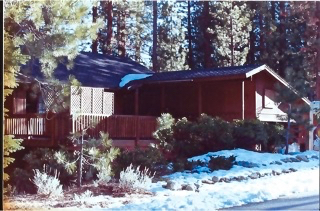
Not all the boxes were unpacked before Ken Herrmann’s house burned to the ground.

A few other cabinets and corners of the garage hold tools or various parts of assorted things that I want to try to turn into something else. Parts to make unique fountains, or lamps, or a combination of the two. There is also the stack of irreplaceable old-growth heart redwood siding recovered from an early1960s vintage sauna that I dismantled a few years back. Beautiful wood grain patterns ready to be turned into … something.

On the workbench is the magazine with plans for deck chairs. As with making additions for my existing furniture to make it all taller, I would alter these plans to make taller furniture from scratch. I have gotten tired of “fitting” into “normal” sized (short) furniture. From now on, find it or make it. It would also be nice to have furniture on the front and back decks for the summer.

The plan, now that my year of ceramics classes at the college is over, is to spend the equivalent time per week, (probably end up being much more) in the garage. My tools, which have been in storage for three years, finally have their proper places. The last thing to finish is that the new, still boxed, Delta drill press gets a rolling platform and its own corner.

With combination chop saw, table saw, drill press and the multitude of other tools now arranged on steel shelves and in drawers I can get back to my fountain designing, make furniture that fits, and what else? It’s time to play!

Hand testing my off-road bike tires, I find that the rear tire is low again from a persistent slow leak. I’ll have to remember to fix that before I get the desire to go riding the trails up the hill toward the ridge.

I pull out my plumbing toolbox to take into the house. There is a leak in one of the bathroom sinks that needs attention and this box has any tool I need to repair just about any plumbing fixture I might come across. It even has some standard replacement parts.

Going in the house I set my toolbox in the hall, and lunch box and mail on the counter.

The dishwasher is partly open to remind me to empty it. What luxury! This is the largest most comfortable kitchen I have ever had. Four months ago when I moved in I wasn’t sure what to do with the space. But it has worked out and although the cabinets are not full by any means, I find that not being limited to four feet of counter space is wonderful. The dining counter is also a very comfortable place to work or eat a meal.
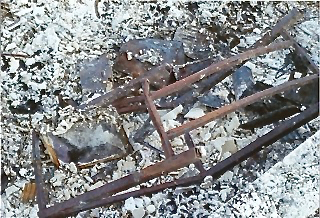
The upside down drafting table with G5 monitor, inside to the left.

Thirsty for some good old H2O, I take down the mug sister gave me about 20 years ago, it’s shaped like part of a saggy pair of jeans with my name written on a pant pocket. Always cute. Not her, the mug. Well, … her sometimes too.

Boots off, I sit down to watch the last 20 minutes of a sci-fi show on the box. With no cable service and questionable satellite capability (trees) for the last three years, the swimmer TV (resurrected from a pool, by buddy Andy, 10 years ago) is finally getting to re-exercise its multiple channels capability, instead of the 2½ off the local airwaves.

Four months living here and my DVDs and CDs are still mostly boxed.

I’ve been enjoying the tree-based entertainment across the back deck or the many TV channels.

But the home-made “entertainment center” given to me by a friend on the coast some 12 years ago also might look better with DVDs and CDs in it rather than in boxes on it. Have to work on that as I might as well look as if I live here rather than just squatting.

Show over, I change into running shoes, shorts and T-shirt. The shirt is one of a collection of race shirts and fleece vests acquired from over 20 years of running benefit races, mostly 10Ks down in San Luis Obispo County.

On the way to the back deck for a pre-run stretch I notice that my Djembe, sitting on the fireplace hearth, and the tube-type amp and five-CD changer, just inside the door, are dusty. But also noticing that the window nearby is partially open I suspect that most of the “dust” is pine pollen. The stuff is everywhere.

Facing southeast the deck is mostly shaded this time of day. The garage is street level, the main house floor partly above that, with the lot sloping down to the back that puts me about mid-tree height. Even my downstairs neighbors deck is 10 feet above the ground. My deck is a very nice place to hang out (deck chairs please!).

A chickadee is running up a tree beside the house. He stops on a branch to look at me (maybe he’s just resting from the climb) then flicks his tail and continues up into the branches. The local Steller’s jay has landed down the deck rail and is yelling at me for intruding on “his” deck, I’m stretched and not willing to argue, so out the front deck doors, down to the walk and off running I go.

Turning left down the street away from town I reconnect with the main drag and turn right toward the stub street of the Creek Road to connect with a single-track forest trail.

While the forest is green with grasses and new shoots on the fir trees, it is drying fast. The 28 percent, or there about, snowload this last winter was not good. Last year at this time the basin mountains had snow on them. Today, in mid-June, there is less snow in the highest protected areas than there was in late August of last year. Not good.

After a time of crossing gullies, a small stream and following old logging roads, I arrive at the pond and take a break to stretch. Mr. and Mrs. Mallard, unconcerned with my presence, are having a spirited discussion about something while cruising in the direction of the small island. The tree caressing mountain breeze in a clear blue sky is very refreshing.

Running again, I retrace my steps down the trail and turn left at the fork to take a longer route home, uphill from the neighborhood. This area still has its slash piles from the thinning operation of some seasons back. Judging by the condition of these piles, they are overdue for burning. The acres of piles burned around my previous solitary residence this last fall were evidence that these will also go to smoke hot and fast.

I see the water tank. If not looking, distracted by nature, it’s easy to miss it. From the street below it is practically invisible, hidden by the trees of the forest. The many hard switchbacks going up the hill turn easier as the trail eases downhill. I cut down across the easy switchbacks and join a side trail down to my road, turning right up toward the house.

The white Shepard-cross-whatever-he-is from across the street comes to say hello and walk with me as I cool down. This dog really has it made. He surveys his realm from an elevated driveway, gets attention nearly whenever he wants it, and though he could have a lot to say, he just smiles, wags his tail and wanders around. After I’ve cooled, he really wants to come in the house, but I give him another good scratch and rub, tell him to go home, and go inside.
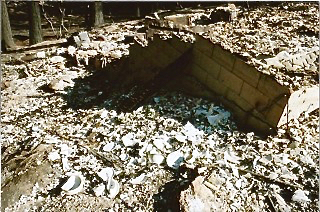
What had been boxed family China became rubble.

More H2O from the mug and I grab my toolbox to fix the leak. I find that the seal retaining screw is loose, but the seal is also worn so it is best to replace it. It turns out that I have a seal that fits, so in less than 10 minutes and no more leak. Magic!

Toolbox back to the front hall, I go to my office to check email. This “office” contains my 20-year-old queen-size futon couch (3-year-old mattress), and the seven-wood slope-top desk that was someone’s woodshop senior project. The desk is on blocks because it is of course, too short, but also so I can use one of the bar stools, (that I assembled and finished years back) for it and the drafting table (in flat position) that my G5 sits on.

The room also contains the solid red oak two-drawer/two shelf nightstand that I made for a lady but never had a chance to deliver (funny how people move on.). My ’95 PowerMac is also here. Still as useful as the day it came off the line; its only failing is that it couldn’t keep up with Internet speeds and software. If technology were only less shortsighted and money hungry, we could save a lot of energy and landfill space.

Against the wall, still not hung, is the tall bulletin board containing; lapel pins from events that I helped organize or attended (La Fiesta, Poly Royal, a parade or three), pinned birth announcements of nieces and nephews (six now) plus wedding invites and memorial notices (Uncle Bob, Mother Wood). Also pinned are pictures of me with a large boa constrictor around my neck and one of a nasal polyp. (Uh huh, next!)
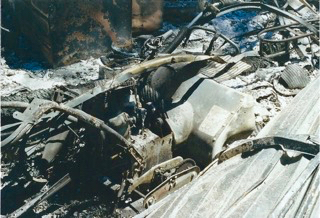
Remnants of the snowblower and other items in the garage.

The less than 3-year-old G5 pulls a few notes and jokes written by friends from my ISP.

“Did you hear the one about the guy from Biloxi that found his hollering cat in the toilet with the top down? No? Me neither.”

Here’s another candidate for the Darwin Awards, seems he couldn’t wait for his ship to make landfall.

“Waaas uuuup?”

Going online there are no interesting/available jobs with the parks, or any of the normal “Favorites list” places to check for options. How to find another place to take care of…?

The camp was perfect. Flexible schedule, a certain autonomy, but also long hours and a fair amount of responsibility. If the owners had not failed to support it or the staff, camp might have been a long time gig for me.

Well, I was on my own way out (in disgust) long before the Forest Service threw their wrench in the works and ended the job. It still bugs me though. (Phhhptttz and sputter). Maybe I really should consider a total career change, just as long as it’s a creative trade.

Cooled from the run beyond the point of comfortable, I sign off and take a quick hot shower. I think the large, thick, colorful beach towel idea for bath mat/bathroom rug looks good. The four I have, in rotation, will keep the room lively and bright throughout the year.

Food! I whip up a cubed steak with my spices, a large salad with avocado and tomato, toast some thick raisin bread with butter, add a large milk and sit to eat. I decide to watch the TV news while eating so I pull out the “history” tray to balance the meal on.

Some 20 years previous I had worked at a student-housing complex in San Luis. The complex closed to become senior housing a year or so after I was there. About 14 years later at a new job for the county schools I found, behind a refrigerator, a near mint-condition serving tray from the complex. Others that I know from that time were tickled to hear I had found the tray. It is a good reminder of college years to sit down with a Tropicana Village tray for a meal.

And as history goes, I still need to repack family China and crystal ware that are in boxes against the wall in the dinning room. That’s eight boxes of cool old stuff. The crystal glasses are items I have enjoyed the look of as long as I can remember. It’s also fun, when using the leaded crystal, to make them “sing” with a wet finger on the edge.

Dinner over and cleaned up (I’m tired of doing everything myself but the plants will not raise a leaf to help) I decide to take an evening walk.

Turning right out of the driveway I’ll walk a route down to cross the boulevard, go through the meadow neighborhood reconnecting with the boulevard again a mile or so away for the loop back to the other end of my street. Nice houses in that area, and great views of the mountains and the wooded ridge above where I ran earlier.

As I leave the house I notice the white Shepard-cross-whatever-he-is on his driveway across the street. I call to him but, as is his want, he chooses not to respond and just sits and watches with a grin as I walk away.

As the sun lowers toward the mountains a few people are out enjoying the evening in yards or on the streets, some are still tending a barbecued meal. The cooler air encountered when the road crosses a draw leading down from the ridge and mountains is one reason this area of the basin is so pleasant.

Just before turning up my street, I notice the new house on the boulevard is progressing with floor joists going in and stacks of lumber on the driveway. A petrified deer stands not far away in a front yard. It’s actually fake, but it always catches the eye. Hunter instinct I guess.

The white Shepard-whatever-he-is finds me two lots from home. He trots up with a smile for a good rub and scratch before taking off again to rejoin his boys that are playing on the street.

Back inside I go through the mail and then TV channel surf to finally settle on a crime show for a while.

Show over and nearly time to hit the hay. I move out to the back deck for a breath of cool night air. This pollen is really covering everything.

This is a great house. It’s winter warm and in a quiet, wooded residential area. Looking through the trees there are good views of Twin Peaks east, the mountains to the south, and the summit and highway pass southwest. I have all my stuff with me, and room to play as a counteractive activity to the job and the type of work I’ve burned out on over the last years.

I think I can do this for a while … though the 28-year-old GMC truck may not last to the winter.

Well, …just another beautiful day in the mountains.

Tomorrow would be another day.

A few ceramics were able to be salvaged from the burn pile.

Next Wednesday

It had been a tough day. Actually the last days had been stressful and I had not been sleeping well. Too much to think about (or try not to think about) and do, and not enough daylight/ business hours to do it all. And then there is still (maybe more now) this job thing that I keep doing. It floats my boat but fails to put any wind in my sails. But this evening I just want to go home and read a book, put on some CDs, turn on the idiot box, or do something else to relax.

The checkpoint officer, finished with my ID, hands it back issuing a further safety warning (like I need one!) and lets me go.

I drive up the main drag and turn onto my street. The neighbors have an American flag flying. Just another thing, of many lately, that tugs at my heartstrings.

I pull into the driveway and step out of my truck. As my feet touch the ground the layer of ash on the driveway puffs up around them. It covers most everything within sight, making the neighborhood either black or gray.

I figure I would spend an hour or two here, then go find another hotel for the next few days. Maybe by that time I will have found a new place to hang my hat (the 16-year-old hat that I no longer have). Oh, and I need to eat dinner somewhere too.

I open the back of the truck that now holds everything I own, it barely fills half the bed, (including the Schwinn Frontier with low tire pressure) and pull out the rake I recently got from dad and my folding military shovel, one of the very few tools I have left.

Today, maybe some of my ceramics from the hallway and my collection of belt buckles.

I walk past the garage with its collapsed/deformed metal door that is draped over the exploded snow blower and what remains of my 36-year-old Schwinn Varsity. The twisted skeletons of tool shelves and cabinets are witness to the heat of that fateful Sunday afternoon.

I’m putting off spending time in the garage, I’m trying to work up the courage.

Down the hill, below the garage, I enter the house through my housemate’s front door. Well, at least where it would have been. I step into the foot of ash and rubble with its protruding charred appliances that is all that remains of an over two-story house that contained evidence of my near 47 years, and what was once my best home, to start looking.

The neighborhood of destroyed homes, charred trees and lack of wildlife stands quietly around me.

The quiet is occasionally lessened by a passing car with the people inside, usually behind raised windows to keep out the smell, wearing shocked or disbelieving looks on their faces.

Life is different now. I really don’t know what to do next. My side of the fence is bare ground and ash. Is there green grass on the other side?

Tomorrow would be another day.  Maybe … a better one.
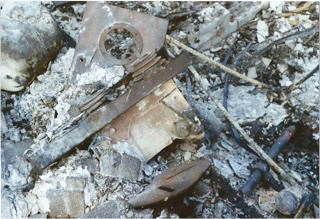
The brand new drill press that never got out of the box.

Epilogue…

I was one of the victim/survivors of the Angora Fire that occurred on a very windy Sunday afternoon, June 24, 2007.

The wildfire, started by an illegal campfire, swept through 3,100 acres of forested land, destroying 254 human and thousands of wildlife homes, and killed or injured (some to die, or be euthanized later) hundreds, possibly thousands, of animals.

The fire left a portion of the Lake Tahoe Basin and its inhabitants with a scar to be seen, and felt, for years to come.

In January 2008, I moved out of the Lake Tahoe Basin to continue my recovery, trying to rediscover, and rebuild a life, in the warmer climate of San Luis Obispo. I was mostly using my heels and toes natural affinity for each other … to keep moving. I miss Tahoe, and still visit every year to run the Kokanee 10K through the forest where I lived for three years.

Today, 10 years on, I am looking for a move and new opportunity to creatively enjoy life. I’m kind of burned out again, (figuratively) with what I’m doing.