Studies: Cafeteria better than brown bag lunch

By Jane E. Brody, New York Times

Many parents undoubtedly think they are doing the best for their children by having them bring lunch from home instead of eating the lunches served in school. But recent studies clearly prove them wrong.

Home-packed lunches, the research showed, are likely to be considerably less nourishing than the meals offered in schools that abide by current nutrition guidelines for the National School Lunch Program.

That program is, distressingly, increasingly under attack. The requirements for less salt and only whole grains were already reversed in the final federal spending bill approved by the Senate on Dec. 13.

But the program must not continue to be undermined, and more schools should be encouraged to participate. Nearly 32 million of the more than 50 million children in public elementary and secondary schools currently eat school lunches, most of them provided through the program. For about 60 percent of those children, half or more of their daily calories are consumed at lunch.
Read the whole story


Chard is the new glamour crop

By Barbara Damrosch, Washington Post

Kale might be called the new spinach, but behind the current crispy-kale-chip fetish I can see a competitor sneaking up. I’ll bet chard will be the new kale.

You might know it as Swiss chard, but the Swiss have little to do with this ancient Mediterranean plant. Botanically, it’s a beet, but one bred for lush leaves and stems instead of big, sweet, bulbous roots. Sometimes, the leafy type is called silverbeet, on account of its broad, silvery-white stem and ribs.

Barbara Damrosch is a freelance writer and the author of “The Garden Primer.” View Archive
Chard became a glamorous crop when varieties with brightly colored stems began turning up in gardens, not just bright red ones such as Ruby or Rhubarb but also the multicolored mixes such as Bright Lights, Rainbow and Five Color Silverbeet. But gardeners soon discovered how easy chard is to grow. Even in cool climates it can survive the winter with no protection. Leaf production might slow down or stop, but the roots are often still there in spring, only to sprout again for a quick flush of greenery before going to seed. If protected by a cold frame or unheated greenhouse, its tasty greens are even more abundant in wintertime. In our garden trials, we’ve found the variety Argentata to be the most cold-hardy.

Read the whole story


Neighbors not happy with Placer wineries

By Richard Chang, Sacramento Bee

Placer County officials are looking to clamp down on its burgeoning wine industry following complaints by residents over noise and traffic.

In the last decade, several wineries have opened, with vintners spending millions of dollars on tasting rooms that have become regional attractions. But the newfound popularity and growth has come at the expense of neighbors, who often put up with rowdy parties, loud wedding music and large tour buses.

The Placer County Planning Commission is considering limits on any for-profit event with more than 20 people, wine tastings exempted. The restriction would allow wineries to have only six such events per year.

Winery owners are pushing the county to move in the opposite direction, noting that private events – weddings, fundraisers, parties, dinners – are essential to their bottom line. The wine industry brings tourism and tax dollars to the county, the owners argue.

Read the whole story


Gift and party wine ideas

By Mike Dunne, Sacramento Bee

Along with strands of colorful lights and sets of Nativity figures, sales of wine peak during the year-end holidays. But you may be asking what to buy, whether as a centerpiece for a Yuletide soiree or as a gift for your favorite wine geek.

When the holiday open house is relaxed and casual

If you pour solid, interesting and modestly priced representatives of the three most popular varietals, you aren’t likely to disappoint your neighbors. Plus, throw in one outrider sure to surprise the resident wine authority in the gathering.

Read the whole story


The save-the-world diet for athletes

By Ben Radding, Outside

The Mediterranean diet burst into American consciousness in the mid 1970s when renowned physiologist Ancel Keys began championing it as a heart-healthy way to eat. Since then, the primarily plant-based program has oscillated in popularity.

Now, researchers are bringing it back because they believe it could play a key role in curbing global warming — and keep you fit, with some important caveats.

“We analyzed how diets are changing in 100 countries around the world, the impacts of different food types on greenhouse gas emissions and land use, and the health impacts of different diets,” says physician David Tilman, author of a study of the Mediterranean and similar pescatarian and vegetarian diets published in the journal Nature. “What we found is that alternative diets that have less empty calories and less meat are much healthier for you and have significant environmental advantages.”

Between 1961 and 2009, people began consuming more meat and empty calories —  calories from solid fats and added sugars, Tilman and his colleagues found. The researchers speculated that diets in 2050 would contain fewer servings of fruits and vegetables but 60 percent more empty calories and 25 to 50 percent more animal protein than the current American diet.

Read the whole story


Questioning the idea of good, bad carbs

By Anahad O’Connor, New York Times

The idea that all carbohydrates are not created equal has become the foundation of many popular diets. Some argue that foods like white bread and potatoes, which have a high so-called glycemic index because they spike blood sugar and insulin, should be avoided in favor of more healthful carbs like whole grains and non-starchy vegetables.

But rigorous new research from the National Institutes of Health suggests that for people who already follow a healthful diet, the glycemic index may not be very important.

The study, published in JAMA, found that diets containing low glycemic foods did not lower cholesterol and other heart disease risk factors compared to diets containing mostly high glycemic foods. Nutrition experts argue that low glycemic diets improve blood sugar levels and insulin sensitivity. But the new study found that low glycemic diets actually made insulin sensitivity worse.

Read the whole story


Congress to nutritionists: Don’t talk about environment

By Dan Charles, NPR

A government-appointed group of top nutrition experts, assigned to lay the scientific groundwork for a new version of the nation’s dietary guidelines, decided earlier this year to collect data on the environmental implication of different food choices.

Congress now has slapped them down.

Lawmakers attached a list of “congressional directives” to a massive spending bill that passed both the House and the Senate in recent days. One of those directives expresses “concern” that the Dietary Guidelines Advisory Committee “is showing an interest in incorporating agriculture production practices and environmental factors” into their recommendations, and directs the Obama administration to ignore such factors in the next revision of the guidelines, which is due out next year.

The directive is not legally binding, but ignoring it would provoke yet another political battle between the Obama administration and Congress.

The federal dietary guidelines have never explicitly considered the effects of food choices on the environment, but the idea of doing so is not new.

Read the whole story


K’s Kitchen: A dish worthy of a fine wine

By Kathryn Reed

Usually I fix something to eat and then decide what wine to have with it. But earlier this month I took the reverse approach.

A friend gave me a bottle of Silver Oak Cabernet to celebrate Lake Tahoe News turning 5 in September. I knew I needed the perfect entrée to complement this wine.

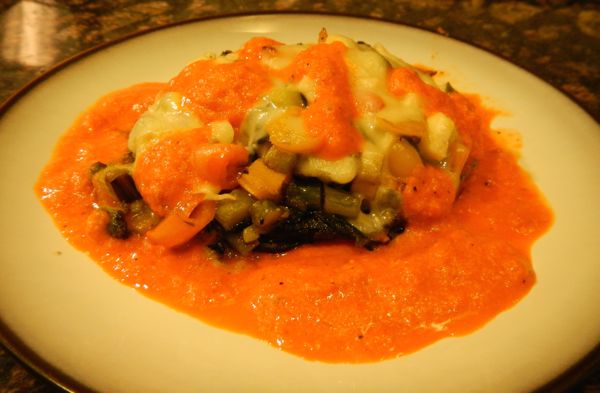
On a solo sojourn to Scottsdale I created a stuffed portabella mushroom dish that paired exquisitely with the wine. I realized I was taking a chance by not using a recipe, and instead coming up with the concoction as I shopped. Fortunately, it worked out.

Portabella mushrooms are one of the most hearty vegetarian options to complement a robust red wine. In the vegetable world, it’s our steak.


stuffed mushroomStuffed Portabella Mushroom

2-3 portabella mushrooms

1 bunch green onions, minced

½ bunch asparagus, finely chopped

9 mini bell peppers, finely chopped

2 T butter

Fontina cheese, shredded

Vegetable oil

Black pepper

½ jar roasted red peppers

½ small jar marinated artichoke hearts

Cut off stems of mushrooms, mince to add to veggie mixture.

Over medium-high heat sauté onion, asparagus and peppers in melted butter. Add pepper to taste. Add chopped mushroom stems. Cook until soft.

Place mushrooms on pan with edges. Brush mushroom with oil. Heat mushrooms for 10 minutes at 350 degrees.

Remove mushrooms from oven.

Divide vegetable mixture evenly into mushroom caps.

Cover veggie mixture with shredded cheese.

Bake at 350 degrees until cheese is melted.

In blender mix roasted red peppers and artichoke hearts.

Put mushrooms on individual plates to serve. Pour pepper-artichoke mixture on mushroom. Serve.

(The leftover pepper-artichoke mixture is superb on scrambled eggs.)


Ex-Mirabelle chef to reopen restaurant

By Kathryn Reed

A former cook at Mirabelle restaurant in Stateline is now the owner.

The eatery had closed in September after owner-chef Camille Schwartz retired. It is reopening Dec. 19.

Kenn Druely, who moved to Lake Tahoe two years ago with the intention of buying the French restaurant, wasn’t able to because of financing. This time it all worked out. The deal went through the week of Thanksgiving.

Druely was a sous chef at Mirabelle for the first year he was here. The last year he has been at Lake Tahoe Vacation Resort as the food and beverage manager. His training was at the Culinary Institute of America at Hyde Park in New York. Druely has spent the past 20 years working at a variety of restaurants in the Napa Valley, including Terra, French Laundry, Tra Vigne, Carneros Inn and Cook.

“We’ll be opening with a menu that is basically one of Camille’s old menus. Some of the dishes are tweaked a little bit,” Druely told Lake Tahoe News.

Other than a cook the rest of the staff is new.

Down the road Druely expects to put his own twists on entrees. He also expects to have more options for vegetarians and to pay more attention to what is in season, using those ingredients.

Other than painting the dining room, the décor is the same. That could change in the spring.

Mirabelle will be open Tuesday-Sunday starting at 5:30pm.


Meat prices keep going up

By Bruce Kennedy, MoneyWatch

While consumers gear up for all the end-of-year celebrations, they are also shelling out more for that holiday ham, roast or turkey.

Meat prices across the board have moved higher in 2014, led by record highs in U.S. beef prices. Cattlefax, an information and analysis service, notes the USDA’s retail beef price rose to a record high of $5.96 a pound in October.

Steve Meyer, livestock market analyst and president of Paragon Economics, says that through October of this year retail prices on all fresh meats were up around 12.4 percent, compared to the same time period a year ago.

A number of factors are behind the jump, but the main issues appear to be weather, disease and demand.

Read the whole story