Publisher’s note: This is one in a series of stories about Park City, Utah.
By Kathryn Reed
PARK CITY – With a ski-in distillery, food as satisfying as high-end big city restaurants, along with casual hangouts, it would be hard to be hungry or thirsty in Park City. It’s also easy to leave with a larger waistline and much thinner wallet.
The Farm at the Canyons Village is all about locally sourced food (within 200 miles) that has been raised sustainably and is prepared from scratch.
The open kitchen allows diners to see the organized chaos in motion – with sous chefs keeping an eye on multiple pans, taking pinches of herbs to season the dishes and churning out savory meals to eager diners. Manual Rozehmal took over executive chef duties last fall.
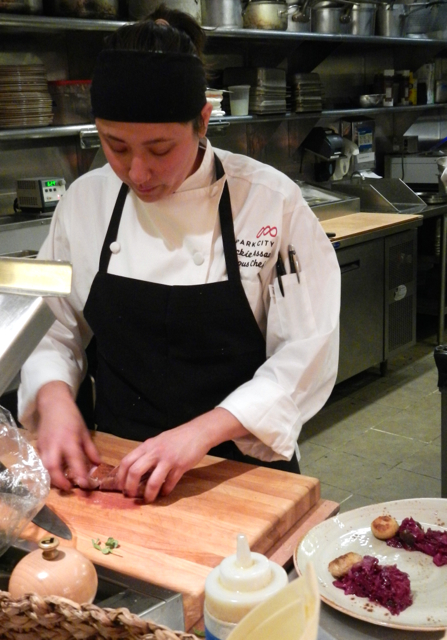
Sous chef Jackie Assaad at The Farm plates an entree. Photo/Kathryn Reed
The menu is divided into small and large plates, with two of the large plates being vegetarian.
Sharing a variety of small plates did not leave enough room to finish the entrees.
The cheese is made in house with cows milk and the honey is local. It’s so soft and light it almost seems whipped. The apple and Brussels sprouts come with toasted pine nuts, Gold Creek Parmesan, kale and a lemon mustard dressing. Fortunately the dressing was not overbearing, but instead added a delectable tanginess. The roasted beets and honey is refreshing. It includes whipped honey ricotta, toasted walnuts, frisée, and pickled mustard seeds. The ricotta is spread on the bottom, is light and not overpowering.
JT, the waiter, is delightful and patient with answering questions about the menu and the area – as well as keeping the wine glasses full.
The herbed Spätzle pays homage to the chef’s German roots. In many ways it is like a fancy mac and cheese. This ensemble had Emmenthaler, truffle, caramelized onions, crispy shallots and black chanterelles. It was so incredibly rich and satisfying; fabulous comfort food on a winter night.
The Sugar House herb brined tomahawk pork chop comes from a farm outside of Salt Lake City. It is served with savoy cabbage, cannellini beans, tomato concasse and basil. Seasoned perfectly, pieces sliced easily off the bone.
Choices for wine are plentiful, with selections from throughout the world. The Honig Cabernet was a nice pairing with all the food on the table.

Part of The Farm restaurant is in an umbrella bar. Photo/Kathryn Reed
While eating in the umbrella section is unique and it allows diners to see the snowcats on the hill after dark, it is chilly, at least sitting right next to the window. Being uncomfortable with cold toes throughout a meal should be reserved for true outdoor dining.
Vail Resorts operates this eatery, so those who’ve skied where there are umbrella bars will understand what this was like. There is interior seating, which walking through had an ideal temperature.
Finding the Farm was also a bit difficult even for the Uber driver. No signs point to it in the dark. It’s behind the Grand Summit in Canyons Village, less than a 15-minute drive from the heart of Park City. When skiing this side of Park City it’s easy to find it as it sits almost directly across from the Red Pine Gondola.

Doughnuts for dessert at Troll Hallen at Stein Eriksen Lodge are delightful. Photo/Kathryn Reed
Stein Eriksen Lodge has two choices for dining – Glitretind is more high-end and described as being like a three-hour experience, whereas Troll Hallen is more casual, with what the establishment calls lighter choices. Troll Hallen’s “lighter choice” for a vegetarian was mac and cheese. Fortunately it was possible to order the mushroom risotto (also not light) off the Glitretind menu. It was rich and cooked exquisitely, but a salad or soup should have been ordered first because it wasn’t enough to be an entrée.
The scallops, perfectly tender in the middle, were some of the best ever, according to an aficionado of this shellfish delicacy.
The extensive wine list on the one hand is a connoisseur’s dream; on the other hand it’s a bit overwhelming. And it’s pricey – with a half bottle of Cab running about $100.
Dessert was a delightful twist on breakfast – doughnuts. Only these are Korean sweet potato doughnuts with sesame chocolate sauce, pickled Asian pear, and miso-shiso ice cream. They are worth saving room for.
Breakfast at Stein comes in two forms. For those staying the night, the buffet is included. It is much more robust than most “free” breakfasts, as well as a higher quality – like the maple encrusted bacon. It’s also possible to order off the menu.
Sitting at a window looking out onto the slopes of Deer Valley one doesn’t want to linger too long because the corduroy is getting skied off.

Ryan Burnham, chef at Goldener Hirsch, has no trouble catering to diner’s food preferences. Photo/Kathryn Reed
The mountains call to Ryan Burnham, chef at Goldener Hirsch. He worked at Sunnyside in Tahoe City from 1999-2000, left for the flatlands, and is now in his fourth winter at this restaurant in Park City.
“You have to cook in the vein of the restaurant and listen to the clientele. The owners here are awesome. It’s a beautiful location, family run, and I have a ton of leeway,” Burnham told Lake Tahoe News.
While the restaurant has overtones of its Austrian roots, Burnham has flexibility with some of the dishes, while the classics like wiener schnitzel are not to be altered. Even though offerings for a vegetarian are limited, Burnham welcomes the challenge to please diners with different diets. He didn’t disappoint. He assembled a plate full of the accompaniments for the meat-fish entrees that became an entrée for a vegetarian.

The mushroom salad is the perfect start to dinner at Goldener Hirsch. Photo/Kathryn Reed
Starting the dinner was incredible – warm mushroom salad with Humboldt fog chevre, hazelnuts and Solara sherry. It was out of this world. The pungent cheese, sliced nearly paper thin and placed at the bottom blended well with the wild mushrooms and frisée greens. It was hard to share it. This with a soup would be an ideal meal for those not wanting meat.
The steelhead trout with potato-leek rosti, Swiss chard and preserved tomato nage was perfectly stacked so a bit of the fish and potato could be put on the fork together. While the trout isn’t local, it was fresh.
The Prisoner’s red blend was a fantastic complement to all the dishes, but the $160 for the bottle is about four times what it retails for.
Sticking with tradition, apple strudel is available. It’s not too sweet, which was great. But even better was the chef’s recommendation of the sticky toffee pudding. Don’t leave without having it.

A soft pretzel with mustard is a satisfying after ski snack. Photo/Kathryn Reed
Goldener offers an après ski menu – ranging from a Bavarian soft pretzel (yummy) to cheese fondue. Several European beers are available on tap and in bottles.
Breakfast is complementary for guests. An array of cold items – homemade pastries and fruit are on the bar. Hot items are made to order, including eggs, pancakes and oatmeal.
Most of the hotels in Park City have a restaurant associated with it, which makes it nice so travelers don’t have to leave. But they are also destinations for others. At the Goldener Hirsch, with only 20 rooms, the restaurant survives because of people dining there who are not guests.
Even the Park City Marriott has a restaurant and bar. What was nice about coming back to the hotel after a day on the slopes, though, were the hot cocoa and fresh baked cookies available on the first floor by the cushy couches and fireplace. The day started with breakfast upstairs – the choice of hot (eggs and meat) or cold (cereal, fruit, yogurt).

Miners Camp is Park City ski resort’s newest dining option. Photo/Kathryn Reed
Skiers are presented with several food options at Park City and Deer Valley. Miner’s Camp is Park City’s newest edition. A vegetarian even has choices from the soups to grilled skewers to pizzas. Utah lamb Miner’s pie, part of the Mediterranean station, isn’t something any California resort is going to offer. The three cheese Miner’s potatoes are worth the threat of clogged arteries. The vegetable Moroccan stew is seasoned so well it’s hard to believe this is ski resort food.
Park City (including the former Canyons resort) has eateries scattered about the mountain.

Empire Canyon Lodge offers upscale dining choices. Photo/Kathryn Reed
Deer Valley’s choices are at several base lodges. The prices are comparable to the Vail Resorts’ owned Park City or slightly less. A main difference is the lodges all seem like a lodge and not a fancy cafeteria. Wood is everywhere. It feels authentic.
The smell of a wood fire fills the Empire Canyon Lodge at Deer Valley. A pint of beer is only $6.50, and most on tap are from the Wasatch mountains. From the specialty grill people may order items like grilled venison, catfish tacos, and fresh made fettuccine. Burgers and fries are at the traditional grill.

Chips, salsa and margarita are the perfect apres ski mix at Baja Cantina. Photo/Kathryn Reed
A 42-year local recommended Baja Cantina for margaritas after the ski day. Situated at the base of Park City ski resort, it was a good choice. The restaurant has been around for 31 years. The margaritas – especially with Grand Marnier – are tasty, and the perfect libation with a basket of chips and salsa.

Lights beckon people to Main Street Pizza and Noodle. Photo/Kathryn Reed
A plethora of dining choices are available along Main Street in Park City. Music spills forth from some, others offer windows for passersby to get a peak inside, and most have menus out front. Casual and simple were on order this particular night. Main Street Pizza and Noodle fit that description.
It has a super casual ambiance – with diners placing their orders at a counter and then having servers bring it to the table. The openness allows for conversations to carry and loudness to create a bit of a party atmosphere.
Being able to get half orders of pasta – all of those dishes sounded wonderful – and various size pizzas make sharing easy. “Noodle” in the name of the restaurant is a bit of a misnomer if one is thinking an Asian influence.
What left a sour taste was the automatic 12 percent tip, especially for two people, in an era when restaurants are starting to do away with tipping and the fact a server didn’t even take our order. The food was good, but the price was a little more than casual dining.
Another night of low key dining was take-out from Park City Chinese and Thai. Fortunately Dave, the concierge from Goldener Hirsch Inn, did the driving so it was more like delivery.
Menu offerings were pretty standard fare – but the flavor and spiciness – especially on the kung pao tofu – was fabulous. It was great to have leftovers – especially when the vegetable entrees are only $10.
The Salt Lake City 2002 Olympics, Park City officials told Lake Tahoe News, might have been the only time in Utah’s history that state officials didn’t enforce the state’s liquor laws. The need for a membership or to pay a cover charge to get an alcoholic drink in Utah disappeared in 2009.
However, some quirky regulations still exist. Bars-restaurants cannot have a happy hour price for drinks. All prices must be the same throughout the day and be posted.

Royal Street Cafe won awards for these drinks. Photo/Kathryn Reed
At the Royal Street Café adjacent to the Silver Lake Lodge at Deer Valley the waiter warns that a second round of drinks will require ordering food – even if it’s the cheapest thing on the menu. He smiled as he said this was the state law, acknowledging it was a bit quirky in 2016.
And while the RSC St. Germain Cocktail – winner of the 2009 Park City Cocktail Contest, and RSC Blueberry Mojito – winner in 2007, were both delightful concoctions, one was plenty to wind down with after a day of skiing. They were equally as pretty as they were delicious.
This eating while drinking law might also have had something to do with the St. Regis serving rosemary oil infused popcorn and a crunchy trail mix like bowl of goodies along with cocktails. It meant a second round could be ordered without the need to look at the food menu.

The 7452 Bloody Mary at St. Regis is worth the ride to the top. Photo/Kathryn Reed
The St. Regis in New York is the birthplace of the bloody Mary, so it was essential to have one overlooking the slopes of Deer Valley. The 7452 Mary (named for the elevation) is only available at Deer Valley, whereas the others are available at every St. Regis. The base for the bloodies is the same throughout the world. This one is topped off with a wasabi and celery espuma, cayenne pepper and black lava salt. It also comes with a stick filled with Worcestershire sauce and Tabasco for the imbiber to regulate the heat. The vodka comes from the High West Distillery in town.
It is definitely the way to start the ski day or a good reason to take a break. Sitting in a chair with a modern gas fireplace directly behind and the slopes of Deer Valley in the front, it was hard not to be relaxed. Outdoor seating is available, but flurries and 20-degree temps didn’t make that appealing.
A funicular whisks people to the on-mountain hotel. Skiers and riders can have staff at the bottom take their equipment to the top, which is then waiting outside ready for them to hit the slopes which are just steps from the restaurant.
While staying at the high-priced resorts might be out of reach for many people, their bars and restaurants are open to those who are sleeping elsewhere. And the eateries don’t all come with prices that correspond to what a room night costs.

Marshmallows for s’mores at the Montage come in an assortment of flavors. Photo/Kathryn Reed
The Montage is like a classic mountain lodge, the interior grandeur reminiscent of the Ahwahnee at Yosemite. Comfy seating surrounds a fireplace. Farther down is a bar, but the best views of the mountains are reserved for those in the dining room or sitting outside.
Those outside are bundled up, surrounding the fire pit as they roast marshmallows for s’mores. No signs said this was for guests only. The flavored marshmallows – in particular the peppermint – are quite tasty.
Down the hall is the much more casual Burgers and Bourbon restaurant. A wall of windows at least 12-feet high look out on the area near the base of the Empire lift at Deer Valley. A structure left over from when this was a bustling mining town in the 1800s sits on its side, not far up the slope. It toppled over in spring 2015 and officials have yet to be able to do anything with it.
As with most places, plenty of outside seating is available. But when the wind chill makes it feel like single digits, the inside warmth is the logical choice.
It would be surprising if a bourbon-Scotch-whiskey drinker couldn’t be satisfied here. Several varietals of whiskey from the local distillery are available.
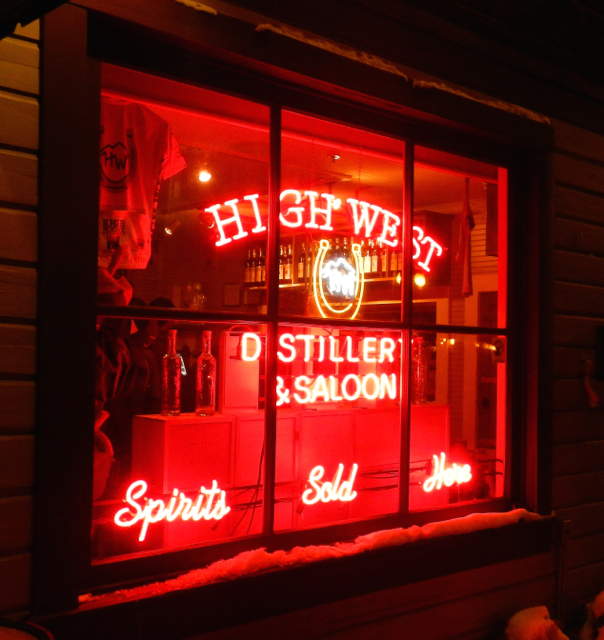
High West Distillery makes a variety of whiskeys and vodkas. Photo/Kathryn Reed
High West Distillery is on Park Avenue in the heart of Park City. At the end of the day it’s possible to come down Park City’s Quittin Time run and be right at the watering hole.
Opened in 2007, is has garnered quite a following based on the lines – one for the bar, the other for the restaurant. Built in 1914, the building is listed on the National Historic Register. Upstairs is the bar and off to the side is the aptly named parlor, ideal for sampling a flight of the high-octane liquid.
The quick-talking Chris Dorsey explains how bourbon has nothing to do with Kentucky, a bit of history, the aging process and other subtleties.
The flight consists of American Prairie, Double Rye, Rendezvous Rye and Campfire. A sip of water is recommended in between the alcohol. It’s an experience to enjoy even if this isn’t your usual drink of choice. And it’s a wonderful way to warm the insides before wandering off to further explore Park City.
 Veggie Enchiladas