Ski report: Powder, powder, powder
 Grab the fat boards — powder is everywhere.
Remember to ski with a buddy, especially going off-piste.
Here is the Dec. 23 ski report.
— Curtis Fong
Grab the fat boards — powder is everywhere.
Remember to ski with a buddy, especially going off-piste.
Here is the Dec. 23 ski report.
— Curtis Fong
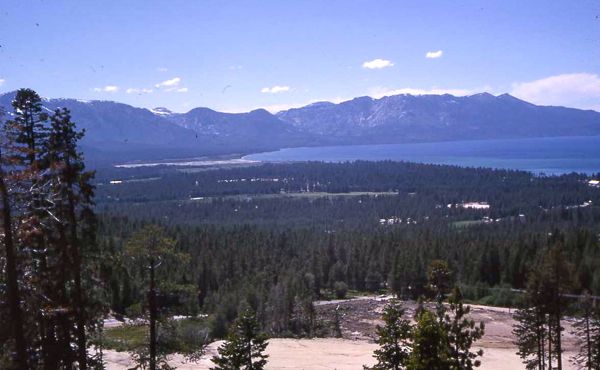 Here’s one extra 1963 photo showing a naked Tahoe Keys and naked Heavenly parking lot.
I’m working on getting permission to use other oldies. Until then, Dec. 30 will the last Then and Now.
— Bill Kingman
By Kathryn Reed
TRUCKEE – “Everything in the middle of nowhere.” That was Northstar’s motto in 1972 when the first lift started turning.
A lot has changed since Dec. 22, 1972 – owners, lifts, amenities, and definitely the fact that the Truckee resort can no longer be considered being in the middle of nowhere.
Its evolution into being a fixture in the greater Lake Tahoe area and a destination resort for those beyond the drive up market of the Bay Area and Central Valley was heralded on its 40th anniversary.
In blizzard conditions year 41 started with snowboard legend Shaun White joining a group of riders for first tracks. While he is normally in the resort’s halfpipe (when it’s built), on this Saturday he was letting loose in the fresh powder – and not always on the trails.
The day before, White, who is now sporting a much shorter haircut after last week cutting off his locks for charity, did another charitable act. He made a Make a Wish come true by giving a young boy a snowboarding lesson.
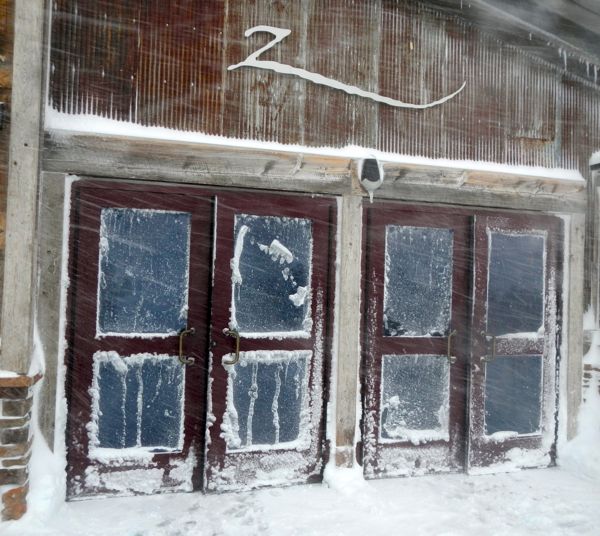
Northstar’s Zephyr Lodge is one indication of Vail’s commitment to upgrade the resort. Photos/Kathryn Reed
On Dec. 22, White dropped in on the kids at the Burton Snowboard Academy to offer some advice.
Still under snowy skies, at 4pm it was time for White and Northstar COO Bill Rock to offer a toast.
Earlier in the day Rock had been at a celebration that was part reminiscing about the past and part looking forward to the next 40 years.
A bit of history
In 1949 a tree farm was started where Northstar is located. The land when Georgia Pacific owned it was called the Timber Farm.
It was the Fibreboard Corporation that opened Northstar-at-Tahoe in 1972.
The first snowboarders were allowed in the 1988-89 season. In the video that was shown at the celebration on Saturday the binding settings on the boards were much different than they are today.
Trimont took over operations of the resort in summer 1994. Two years later, Booth Creek Ski Holdings acquired Trimont/Northstar.
In 1999, Booth Creek and East West Partners agreed to a real estate agreement that led to the development of the village and various lodging properties. The first phase of the village opened in 2005-06. The village kept expanding, culminating with a third phase.
The Ritz-Carton, Lake Tahoe opened three years ago at mid-mountain – though it has separate owners.
(The Highlands Gondola that goes from the Village at Northstar to the Ritz-Carlton was in jeopardy of not operating this season. The funding partners for the eight-passenger gondola that opened in 2009 were having trouble finding resolution. A deal was reached Dec. 21. However, that same day a tree fell on the cable. It should be fixed by the end of the year.)
In 2010, Colorado-based Vail Resorts bought Northstar. In its first year more than $30 million in on-mountain improvements were made.
The past and future
Hank Schwarz, Zeke Straw and Paul Daily were highlighted in the video shown to a select group at Schaffer’s Camp on Saturday. The trio talked about the early days, the dozens of romances developed in ski school and the fun that was had on the slopes.
Blaise Carrig, president of mountain operations for Vail Resorts, recalled how his first experience at Northstar was in 1982. He was impressed with the ambiance, sense of feeling from the people, but completely understood why it had the moniker “flat star”.
In 2002, after Vail Resorts bought Heavenly Mountain Resort on the South Shore, Carrig made it a point to return to Northstar. The transformation was remarkable. More of the mountain was open – which included steeper terrain.
As the top executive at Heavenly, he would bring his management team to Northstar each year to see what the resort was doing.
“We saw Northstar as an able competitor,” Carrig said.
But he also knew about the 40-minute lines on busy weekends and people having to eat on the floor of the mid-mountain lodge.
In 2010, Vail Resorts bought Northstar.
“We wanted to come in and capitalize on their success,” Carrig said. That meant an infusion of cash to disperse people around the mountain via a lift that opened last December, new runs, and a lodge at the top of Zephyr chairlift to provide more dining choices – and chairs.
And Vail is not done. The master plan is in the works.
As Carrig said, Beaver Creek is the template for what Northstar will become.
Beyond the infrastructure improvements, Carrig said it’s the people who come to the mountain that matter most.
“It’s not about customers, it’s about maintaining relationships,” Carrig said.
Taking on a trait from its Colorado properties, guests at Zephyr Lodge are now offered a tissue when they walk in – and more than one when dripping wet coming in from a blizzard.
In the end, it’s all about the experience people talk about long after they’ve left the mountain.
ngg_shortcode_0_placeholder (Click on photos to enlarge.)
By Bill Keller, New York Times
In a smart, disheartening piece in the New York Times magazine last month, Robert Worth surveyed the frustration of American diplomats who signed up to engage the world — even dreamed of changing it — and now find themselves encumbered by the safeguards and protocols of a risk-averse Washington. It is hard to change the world when you live in a fortress and travel in an armored motorcade.
The article was prompted, of course, by the death of J. Christopher Stevens, the ambassador killed in a Sept. 11 jihadi attack on the American mission in Benghazi, Libya. His death, Worth wrote, “set off a political storm that seems likely to tie the hands of American diplomats around the world for some time to come. Congressmen and Washington pundits accused the administration of concealing the dangers Americans face abroad and of failing Stevens by providing inadequate security. Threats had been ignored, the critics said, seemingly unaware that a background noise of threats is constant at embassies across the greater Middle East.
“The death of an ambassador would not be seen as the occasional price of a noble but risky profession; someone had to be blamed.”
That phrase — “the occasional price of a noble but risky profession” — struck rather close to home. It is a calculus familiar to the tribe of foreign correspondents who work, as Bobby Worth often does, in places that can blow up in your face. If diplomats are withdrawing behind blast walls and armed escorts, and if that is costing us some useful understanding of the world, is the same thing happening to those who cover the news, and with what consequences?
Like the truly committed diplomat, the truly committed foreign correspondent is something of an endangered species. News organizations began their retreat from the world long ago, driven by economics and a wrongheaded belief that Americans don’t care that much about foreign news. The American Journalism Review, which began charting the decline of foreign reporting in 1998 (that first article was entitled “Goodbye, World”), reported two years ago that 18 American newspapers and two entire newspaper chains had closed every one of their overseas bureaus. Other news outlets, including most TV networks, have downsized or abandoned full-time bureaus in favor of reporters or anchors who parachute in when there’s a crisis. They give us spurts of coverage when an Arab Spring breaks out or Hamas fires rockets into Israel, but much less of the ongoing attention that would equip us to see crises coming and understand them when they erupt.
The New York Times and a few other news organizations — NPR, the BBC, Wall Street Journal, CNN — have bucked the trend. This is not so much out of altruistic spirit as an awareness that our identity (our brand, to use the obnoxious term of art) promises the world. And, not incidentally, our fastest-growing audience is the world.
But the Times is not immune to the dangers that have caused so many diplomats to play safe. My most haunting memories of the eight years I spent as executive editor are phone calls to parents and spouses to say a correspondent had fallen into the hands of bad people, and reckoning with the evacuation of a photographer maimed in the field, and sitting vigil with the families of Times employees killed in Kabul and Baghdad. On the 15th floor of the New York Times Building, the meeting rooms are named for Times journalists who died pursuing news. We are running out of rooms. The “occasional price of a noble but risky profession” is only a little consolation.
Anthony Shadid was our Chris Stevens: a passionate correspondent, fluent in the language, culture and history, a voracious listener, a beautiful writer. Careful, but impatient to see for himself. Anthony’s death earlier this year — after a severe asthma attack while on a surreptitious reporting trip in Syria — was a freakish horror. But following on the kidnapping of four Times journalists in Libya and David Rohde’s seven-month ordeal in Taliban captivity and other incidents, it prompted the paper to ratchet up already rigorous security, causing some correspondents to worry that an added layer of precaution would mean a little more distance from the truth. That does not seem to have happened yet to any significant degree, as readers can see from recent coverage of places like Gaza and Congo, but correspondents — I checked with half a dozen — are watchful.
“Everything is the balancing act,” Alissa Rubin, who travels widely in her coverage of Afghanistan, told me in an e-mail. “I know the paper has gotten a lot more careful and it’s a good thing — but only if it doesn’t go too far.” In Kabul, she said, there are major news organizations that simply do not let reporters venture outside the capital and others that take “stupid crazy risks.” The Times has long employed security experts in dangerous places, whose mandate is to find the balance between getting the story and getting home safe. To travel with Alissa into the war-wracked countryside is to fully appreciate the meaning of the word “meticulous.” Reporting ventures are planned, mapped and timed in exquisite detail, and everyone is alert to signs of potential danger.
In the end, you have to trust trained, experienced correspondents to judge how much risk is too much. And that brings me to the main point. To my mind, the bigger question for our business is not whether we sometimes err on the side of caution, but whether we are hiring, developing and deploying the next generation of trained, experienced correspondents to make those calls. That also happens to be the best possible investment in security.
Diplomats and journalists serve different masters but both need proximity. Yes, “citizen journalism” has been an asset. YouTube videos from Iran’s 2009 uprising kept the story alive after foreign reporters were expelled, and tweets from Tahrir Square provided real-time guidance to the Arab Spring. But tweets are no substitute for being there.
That’s why Anthony went into Syria, and why some of my colleagues worry that in our response to the very real and increasingly unpredictable perils of that place we could lose a dimension in our reporting. We have local stringers on the ground, and correspondents like C. J. Chivers have produced illuminating stories based on well-planned forays into Syria. But British, European and Arab news outlets are there full time — perhaps foolishly, but it’s possible we miss a layer of an immensely complicated story when we are not.
The price we pay for not being where news happens can be reckoned not only in less good journalism, but in less good policy. Because, make no mistake, some portion of the information governments call “intelligence” is nothing more than an attentive reading of the news.
It is ostensibly a scandal that the Obama administration initially described the attack that killed Chris Stevens not as a terrorist plot but as a protest gone bad. How could the “intelligence community” have gotten it so wrong? How could United Nations Ambassador Susan Rice have gotten it so wrong? Well, go back and read the first online reports after the Benghazi attack.
The Wall Street Journal: Stevens was killed “amid angry protests over a film by a U.S. producer that mocks and insults the Prophet Muhammad.”
The Associated Press: “… protesters in Libya burned down the U.S. consulate in the Libyan city of Benghazi, killing the U.S. ambassador. …”
The Washington Post: “In both Cairo and Benghazi, protesters said they were demonstrating against a U.S.-released film. …”
CNN: “The Benghazi consulate was one of several American diplomatic missions that faced protests. …”
The Los Angeles Times: “Angry crowds attacked U.S. diplomatic posts in Egypt and Libya … after a video appeared on the Internet. …”
The New York Times: “Protesters angry over an amateurish American-made video denouncing Islam attacked. …”
It is not irrelevant that every one of the online reports I just cited had a dateline somewhere other than Benghazi — Cairo, Washington, New York. In the ensuing news cycles some excellent reporting by journalists on the scene set the record straight: there were no protesters in the street, but the perpetrators of the attack were, by their own account, infuriated into violence by reports of the offensive video. By then it was too late. The story had been hijacked for partisan spin and counterspin. But I strongly suspect that one reason Susan Rice got it wrong at the outset is that most of us in the press weren’t there.
To the community,
It gives me great pleasure and pride to tell readers about the positive changes we made to the Pollock Pines Library this year.
Our Pollock Pines Friends chapter has been busy putting donations to work. Our objectives for 2012 were to improve the facility (making the lovely little library as appealing and functional as we could), improve programming, and materials selection, and to increase the
effectiveness of library staff. This year, we upgraded some of the interior furnishings, purchased a laptop for staff use, improved the landscaping, replaced the carpeting (which was nearly 30 years old and getting threadbare), and expanded the kids’ area. We also purchased a storage shed for use in storing future book sale books.
The Friends hosted the ever-popular Wild Things Animal Program, which was enthusiastically attended by dozens of children and adults. The Friends also sponsored the Back to School Party with school supplies, ice cream, and cake. In addition, we hosted the Democracy Program with speakers on the Holocaust and Japanese internment, which packed the house.
All of these programs and improvements have been made possible by donations from Friends of the Library and other residents, grants from the Dogwood Garden Club and the Pollock Pines-Camino Rotary, and many enthusiastic hours of volunteer effort. We could not have done this without the support of the community.
In 2013, we plan to make additional minor facility improvements, fund new reading material purchases, and sponsor several children’s programs.
We have a cozy and wonderful library in Pollock Pines, with access to the county’s collection of over 400,000 books, magazines, videos and audiobooks. Our library has computers for Internet access, WiFi, and a very helpful staff. Through funding from First 5, the Pollock Pines
Library has become a leader in early literacy programs for young children. We’re duly proud of and grateful for our library and its staff of two dedicated librarians.
Much thanks to our Pollock Pines community for its support of the Pollock Pines Library.
Becky McIntyre, Pollock Pines
By Phillip Reese, Sacramento Bee
A 71-year-old man died Friday after skiing into a tree at Squaw Valley, according to a statement released by resort officials.
The man, whose name has not been released, was skiing on the west face of KT-22 about 11am when he hit the tree. He was wearing a helmet.
To help eliminate alcohol related collisions involving minors, combat underage alcohol abuse and help ensure the overall safety of the community, the Washoe County Sheriff’s Office is collaborating with regional law enforcement agencies regarding juvenile parties and other incidents in which alcohol and/or illicit drugs are contributing factors.
The sheriff’s office is partnering with the Nevada Highway Patrol, Reno Police Department, Sparks Police Department, Washoe County School District Police Department and the University of Nevada Police Department.
These partnering agencies all share the same message; alcohol-related collisions, crimes, incidents, emergencies and tragedies are absolutely preventable and it is never a responsible decision to drive impaired.
Local law enforcement agencies are taking a proactive approach in helping to ensure each person enjoys the holiday season. Their objectives are to prevent tragic incidents that are a direct result from underage alcohol consumption and/or illicit drug use.
Law enforcement officials will also be visiting numerous businesses and establishments that sell alcohol to check for up-to-date alcohol awareness training cards.
The environmental nonprofit Tahoe Fund has launched the Lake Tahoe License Plate Plate Spotte’ program to reward owners of Lake Tahoe license plates with free lift tickets during the 2013 ski season.
Tahoe plates spotted by official “spotters” and the general public will be entered to win free lift tickets every week until March 20. The program is designed to raise awareness of Lake Tahoe license plates, and to reward and encourage renewals and new Tahoe license plate purchases.
More than 96 percent of the funds raised through the Lake Tahoe license plate sales go directly to the California Tahoe Conservancy and Nevada Division of State Lands to fund hiking and biking trails and watershed restoration projects.
Tahoe plates “spotted” by the Plate Spotting Team will be photographed and eligible for the weekly drawing of two lift tickets at a participating Lake Tahoe area resort.
The public is invited to spot plates and upload their own photos to the Tahoe Fund Facebook page as well.
The Lake Tahoe Federal Advisory Committee is scheduled to meet from 9am-noon Jan. 10 at the Lake Tahoe Basin Management Unit, 35 College Drive, South Lake Tahoe.
LTFAC will address issues related to federal activities at Lake Tahoe.
Items on the agenda include updates on Tahoe Interagency Executive Steering Committee activities, the Tahoe Regional Planning Agency Regional Plan update, Forest Plan Revision status, and public comment.
LTFAC consists of 20 members representing a broad array of constituencies.
For more information on the Lake Tahoe Federal Advisory Committee, go online.
By Debbie Arrington, Sacramento Bee
In its claim to farm-to-fork fame, Sacramento has another distinction to add to its credit: caviar capital of America.
Locals may not know that the Sacramento Valley has become home to the nation’s surging caviar industry, as California fish farmers capitalize on a shortage of wild caviar.
This holiday season, Sterling Caviar hopes its home base will discover its gourmet product, coveted by chefs and enjoyed by diners nationwide. It’s rolled out new labeling, a new website and a higher profile as another sustainable crop that’s Sacramento grown.
“San Francisco, New York, Miami, that’s where we sell a lot of caviar,” said Enrique Castano, Sterling’s managing director. “Sacramento? Not so much. But we hope to change that.”
At its Elverta fish farm and processing center, Sterling recently hosted 16 Northern California chefs so they could learn firsthand about the pluses of local, sustainable caviar. In addition, Sterling produces an abundance of caviar’s byproduct: farmed sturgeon.
“Think global, act local,” said farm manager Peter Struffenegger. “We’re the leading U.S. producer of caviar. Internationally, we’re known as one of the best alternatives (to wild caviar). This is our identification, yet to most of Sacramento, we’re still a best-kept secret.”
Sterling caviar already is on the menu as an appetizer or an ingredient at Mulvaney’s B&L, Ella Dining Room and the Hyatt Regency in Sacramento. Thomas Keller’s famed restaurants – Bouchon Bistro and French Laundry in the Napa Valley and Per Se in New York – serve Sterling.
“Most people don’t even know where caviar comes from,” Castano said. “They say they tried it and it was too salty, fishy, yucky – but that wasn’t good caviar. We’re educating chefs and the public.”
High-quality caviar is not fishy or overtly salty. Instead, it has a buttery, almost nutty flavor that develops through aging.
Supplier to caviar giant Petrossian, Sterling now accounts for about 80 percent of the domestic caviar market. Its demand has skyrocketed following restrictions on imported wild caviar.
Those bans are intended to protect the dwindling wild sturgeon population. The best caviar comes from sturgeon, an ancient fish that – like salmon – spawns in fresh water, and then travels out to sea.
Overfishing in the Caspian Sea pushed several species of sturgeon – including those that produce Russia’s prized beluga caviar – to the brink of extinction. Since 2005, the U.S. has banned imports of wild beluga caviar.
California’s own green sturgeon is endangered (and an illegal catch). Sport fishing of wild white sturgeon is allowed, but commercial fishing is prohibited.
Native to the Sacramento River, California white surgeon can be farmed successfully in fresh water and actually thrives in controlled conditions.
Farmed caviar has made the delicacy more available and sustainable, a plus for consumers and restaurateurs. Chefs traditionally love caviar. Its complex taste and texture add an exquisite note to haute cuisine. Alone as an appetizer, it symbolizes the ultimate luxury food.
“Caviar plays an extremely important role in my cuisine,” Timothy Hollingsworth, who is wrapping up his stint as chef de cuisine at the French Laundry, told the Wall Street Journal. “Russian caviar is, unfortunately, pretty much obsolete. So having an alternative that is local, and sustainable, is simply – great.”
The switch to domestic caviar has another upside. Besides a growing local supply, prices are lower.
Sterling’s caviar is priced at $62 to $88 for 30 grams (about 1 ounce), depending on grade. An ounce of imported Russian Osetra caviar can cost $300 and up.
San Francisco-based Tsar Nicoulai Caviar also farms its product in the Sacramento Valley. An ounce of its California Estate caviar – from Wilton-raised sturgeon – costs $70.
How did Sacramento become the caviar capital? Location and luck.
Struffenegger points to UC Davis. Serge Doroshov, an animal science professor, brought Russian insight to California aquaculture. Doroshov’s research and studies on sturgeon helped local farmers get a huge head start on caviar production as an alternative to wild catches.
America’s largest freshwater fish, white sturgeon predate humans in the Central Valley. Roaming at sea from the Aleutian Islands to Monterey, they can live for decades and reach mammoth proportions – up to 20 feet long and more than 1,000 pounds. They return to the river to spawn.
Covered with bony armor, sturgeon have a serpentlike appearance that make them the “monsters” of the Delta. They’ve changed little in 175 million years.
“We really don’t know how long they can live,” Struffenegger said. “We know they can live to be 70 or 80 years old, but in the depth of the river, it could be 400 years. They have no natural aging process.”
Sterling got its original breeding stock – just a few fish – from the Sacramento River with permission from the state’s Department of Fish and Wildlife.
“It’s technology at work,” said Fish and Wildlife’s Randy Lovell. “These farms take pressure off the wild catch. When you consider how long it takes these fish to reproduce, they’re very vulnerable.”
Sturgeon thrive in warm groundwater, which at Sterling’s hatchery stays at 65 to 75 degrees.
“It’s an eternal summer for these fish,” Struffenegger said. “People ask, what’s our secret? Our fish have a much easier life.”
With an excellent diet and human help, the huge fish reach maturity in half the time.
“In the wild, they’re bottom feeders – they’ll eat anything,” Struffenegger explained. “They have tough winters when they struggle for food and don’t grow. Here, it’s like they have two summers in every year. They’re always growing.”
The proof swims in large above-ground tanks, sheltered in warehouses 15 miles north of downtown Sacramento. Leaping and splashing, thousands of sturgeon swim circles around 40-foot tanks, 9 feet deep. They’re separated by age, size and eventually sex.
“They have a hierarchy,” Struffenegger said. “The biggest ones lurk down at the bottom.”
No matter their swim speed, these fish are slow food. It takes three years to determine which fish are male or female. Caviar is harvested from fully mature females, usually at age 10.
Only the biggest and best females will become caviar mamas. (The others: smoked sturgeon.)
Harvested in spring, the eggs typically make up 20 to 25 percent of a fish’s weight. A 100-pounder can yield 20 or more pounds of caviar. Like dark pearls of tapioca, the eggs can range in color from olive green to obsidian black. Salt is added as a preservative.
Lucy Bowman, Sterling’s quality control expert, tastes caviar from every fish harvested. That was about 3,000 spoonfuls this year.
“At 40 calories a tablespoon, it adds up,” joked the 27-year-old Louisiana native. “That’s why I work out a lot.
“Not many people have this job,” she added. “Even my mama can’t believe it.”
Every fish at Sterling is numbered and tracked; so is its Sacramento-grown caviar. “We know everything about that fish,” Castano said. “We bred it, we raised it, we harvested it. We know that it’s sustainable. You can’t say that about wild caviar.”