Snippets about Lake Tahoe

• Tahoe Douglas Fire Protection District has hired Sylvia Lee as a fire inspector. She was most recently with the Clark County Fire District.

• South Lake Tahoe native and 2005 South Tahoe High grad Nicole Pierini received the Dean’s Fellowship Award from Arizona State University’s school of engineering. It is only offered to top graduate student recruits.

• This is the Caltrans roadwork schedule for the week for El Dorado-Tahoe.

• The Kings Beach Commercial Core Improvement Project is expected to break ground this summer. There will be an open house Feb. 19 from 5:30-8pm at North Tahoe Event Center, 8313 North Lake Blvd., Kings Beach.

• This video is from the celebration of Barton Memorial Hospital marking its 50th year:


Outdoors writer to speak in Incline

Author Tracy Ross will be part of Sierra Nevada College’s ongoing Writers in the Woods series on Feb. 8.

Ross is an award-winning journalist and contributing editor at Backpacker magazine. She recently published a memoir “The Source of All Things”, which was chosen for inclusion in Best American Sports Writing and Best American Magazine Writing.

The 7-9pm reading is free. It will be at Sierra Nevada College’s Tahoe Center for Environmental Sciences, room 139-141.

Ross will also conduct a writing workshop (free to SNC students; $50 for community members) from 2-5pm that same day. Register online for the workshop.


Copper thieves hit Camp Concord, 2 Tahoe parks

By Kathryn Reed

Copper thieves stole an estimated $50,000 worth of pipes from Camp Concord.

The January crime is similar to the thefts that occurred last fall at Emerald Bay and D.L. Bliss state parks.

The suspects, who remain at large, broke into the restrooms at the South and West shore facilities and took out the copper piping to presumably sell as scrap metal.

Copper theft is big business.

“Copper is becoming more valuable, and it is difficult to trace and identify. Most of the copper plumbing doesn’t have identifying marks, so it’s difficult to trace it,” El Dorado County sheriff’s Lt. Pete Van Arnum told Lake Tahoe News.

The price for scrap copper can change on a daily basis. In California it can go for more than $3 a pound. (South Tahoe Refuse does not buy scrap copper.)

The value increased about 50 percent from 2006 to 2011.

According to the U.S. Department of Energy, copper thievery is about a $1 billion a year business.

A law that took effect Jan. 1, 2012, in California makes stealing copper with a value of more than $950 grand theft. A felony conviction can come with a three-year prison sentence and $10,000 fine.

Van Arnum believes the same person or people could be responsible for the thefts in El Dorado County.

“The method of operation was pretty much the same,” he said.

The lieutenant said no other jurisdictions in the Lake Tahoe Basin have reported similar thefts.

His department is responsible for the Camp Concord investigation off Emerald Bay Road. State Parks has its own law enforcement team. However, the two do share information and work together when appropriate. The sheriff’s office also works with the state copper task force.

“We know in the materials alone it will be about $15,000 to replace what was taken. Because we have our own maintenance staff, the labor we did not cost into that. If we contracted out, it would be higher,” Brian Barton, chief ranger for the Tahoe area said.

But the restrooms at the two parks have not been fixed because there isn’t the money to do the work. Barton is hoping by the time the parks reopen at Memorial Day that the restrooms will be serviceable.

Barton said a material other than copper is being considered for the replacement pipes.

All of the locations that were hit aren’t used in the winter, so the exact dates the thefts occurred is unknown.

“We don’t know how they got in. We feel someone had a key to our gates because the gates were not damaged,” Barton said. He said a current employee is not believed to be involved.

Anyone with information on any of these copper thefts is asked to call the sheriff’s office at (530) 573.3000 or Secret Witness at (530) 541.6800.


NV Energy wants to charge analog customers extra fee

By Cy Ryan, Las Vegas Sun

CARSON CITY — NV Energy has filed with state regulators its proposed added rates for thousands of customers who want to retain their analog meters instead of switching to so-called smart meters.

The company is asking the state Public Utility Commission for permission to charge an initial one-time fee of $52.86 for an analog meter and a monthly fee to cover the cost of employees to read the meters.

The monthly fee would be $8.82 in Southern Nevada and $8.72 in Northern Nevada. The number of analog meters would be restricted to 12,000 in Southern Nevada and 4,500 in Northern Nevada.

NV Energy has installed smart meters statewide. The meters can be read remotely from a central location.

But some customers have complained that they do not want the new meters, citing, among other things, health concerns.

The rates must be approved by the PUC.


Gamblers wage record $98.9 million on Super Bowl

By Case Keefer, Las Vegas Sun

The crowds that turned out to bet on the Super Bowl yesterday in Las Vegas awed legendary oddsmaker Jimmy Vaccaro.

Vaccaro, who’s spent nearly 40 years in the betting industry and is a spokesman for William Hill sports books, had never seen a turnout quite like Sunday’s.

“It was a sight to behold,” Vaccaro said after the game. “I’d expect the state is probably going to set a record.”

Vaccaro’s prediction was proven true less than 24 hours after the Baltimore Ravens goal line stand propelled them to a 34-31 victory over the San Francisco 49ers in Super Bowl 47.

The Nevada Gaming Control Board announced bettors wagered $98,936,798 on the 2013 Super Bowl, the most in the history of the state. This year’s game easily surpassed the $93,067,358 bet on the 2006 Super Bowl when the Pittsburgh Steelers beat the Seattle Seahawks 21-10.

Sports books held 7.3 percent of the total handle, calculating to a win of $7,206,460. That’s the most since the 2007 Super Bowl, when Nevada made $12,930,175 on the Indianapolis Colts 29-17 victory against the Chicago Bears.

As previously reported, it marked the 20th time in the last 22 years — and sixth year in a row — that casinos won on money on the Super Bowl.


Prison for SLT man who drew gun; Mo’s beating case lingers

South Lake Tahoe resident Scott Enerson is expected to spend seven years in prison after pulling a gun on a fellow patron at Whiskey Dick’s bar.

Enerson has pleaded guilty to assault with a firearm in the June 2012 incident. The enhancement to the felony charge is what is sending him to state prison.

Formal sentencing is scheduled for Feb. 21 in El Dorado County Superior Court.

The Whiskey Dick’s incident came two weeks after the beating of Derek “Zippy” Penaranda at Mo’s Place. Penaranda died in October from his injuries. No charges have ever been filed in the case.

“The investigation and review of the matter at Mo’s Place is continuing, but I am not at liberty to make any further comment about that situation at this time,” El Dorado County Assistant District Attorney Hans Uthe told Lake Tahoe News.

— Lake Tahoe News staff report


Internet allows Nevadans to follow Legislature

By Ed Vogel, Las Vegas Review Journal

CARSON CITY – Just because you live in Las Vegas, Caliente or even Jarbidge doesn’t mean you can’t keep in touch with nearly everything that happens at the 2013 Legislature.

In fact, if you become adroit in handling all the features of the legislative website – leg.state.nv.us – you will get a better view than those hanging around the Legislative Building – without the hassle of crowded committee hearings and the occasional blizzard that can make capital city travel impossible.

With high-speed Internet access, you could follow the Legislature from the comfort of your bed. Of course, you won’t find out about the behind-the-scenes deals that are part of every session.

“It’s what the public expects,” said Legislative Counsel Bureau Director Rick Combs about the availability of all possible legislative information. “It is what the legislators expect. They want their constituents to have the ability to follow what is going on.”

Combs noted that when he joined the legislative staff in 1994 it was the dawn of the Internet age. Now that technology has advanced, he said most states have taken the same steps as Nevada to allow their citizens to follow their respective legislatures, in part, “because we can.”

On the website, click on “committee/view” and you can watch or listen to hearings on your computer. Every committee hearing and state Senate and Assembly floor voting session is broadcast over the Internet.

Click “Nelis,” for Nevada Electronic Legislative Information System, and you can follow along by reading every report and handout given to legislators.

Click “legislator information,” and you will find the office and home telephone numbers of all legislators, their email addresses and names of their secretaries. You also can type in your home address and find the name of your state senator and Assembly member in case you are not sure who represents you.

Click “personalized bill tracking” and sign up to be notified about what happens with the bills and budgets that interest you. There is no charge to track five or less bills, a $50 charge to follow 25 or fewer bills and $600 if you want to track every bill. Call (775) 684.6835 for more information.

Click on “session inform” on the left side of the main legislative page and then on “bill information.” You can read the contents of any bill, what happens to it in committee, in floor sessions and whether it fails or is signed into law. On “session inform” you even can find the names of lobbyists, the numbers and the companies they represent.

For history buffs, you even can find information on the website on all bills going back to the 1985 session.

You also can find on the website a video of Gov. Brian Sandoval’s State of the State address and his entire 3,440-page budget, along with the response to his speech by state Senate Majority Leader Mo Denis, D-Las Vegas.

While the technology today is light-years better than 1994, Combs isn’t advising people to stay away from Carson City, its restaurants and the nearby ski slopes around Lake Tahoe.

“I still think it is better being here,” he said.


Stolen petroglyphs from Eastern Sierra recovered

By Dan Whitcomb, Reuters

Four ancient petroglyphs that were stolen from a historic site in Northern California last year have been recovered, but no suspects have been identified in the brazen theft, federal authorities said on Thursday.

The petroglyphs, which were carved into volcanic rock more than 3,500 years ago, were discovered missing in October from the site in the Volcanic Tablelands, east of Yosemite, near California’s border with Nevada.

They are said to represent a pristine example of Great Basin rock art that portrayed the daily hunter-gatherer activities that took place in the area at the time.

“Recovery of the petroglyphs was a priority from day one. I am pleased that they were returned,” Bernadette Lovato, manager for the bureau’s field office in Bishop, said in a statement.

“Now we need the public’s help to identify the vandals responsible for damaging the site,” Lovato said.

A Bureau of Land Management spokesman declined to release further details about the recovery of the petroglyphs, citing an ongoing investigation. The bureau said the suspects may have experience with masonry cutting and access to such tools.

The Volcanic Tablelands are described by the Bureau of Land Management as a vast volcanic landscape formed more than 700,000 years ago by materials spewing from the Long Valley caldera.

The high-desert site and its volcanic rock outcroppings are listed in the National Register of Historic Places, protected under the Archaeological Resources Protection Act and used by local Paiute Indians for ceremonies.

The Bureau of Land Management has offered a reward for information leading to the arrest and conviction of the people responsible for the theft. First-time violators of the Archaeological Resources Protection Act can be imprisoned up to one year and fined $20,000, according to the bureau.


Number of snowboarders on the slopes declining

By Christopher Solomon, New York Times

Late last summer when Shaun White, the two-time Olympic gold medal snowboarder and X-Games superstar, was charged with public intoxication and vandalism, he became at age 26 an accidental metaphor for his sport: a young phenom all grown up and in a spot of trouble.

After exploding onto the scene about two decades ago, snowboarding is now sputtering in the United States, according to a recent study by RRC Associates, which tracks trends that affect the winter-resort industry.

“Today, there is every indication that the growth in snowboarding we took for granted has stalled, and visitation from snowboarding is headed toward a path of substantial decline,” Nate Fristoe, RRC Associates’ director of operations, wrote in the National Ski Areas Association Journal.
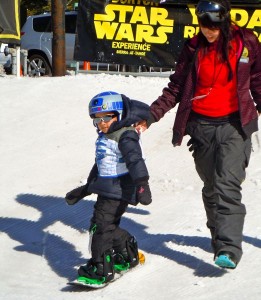
Sierra opened a Burton Riglet snowboard learning area to lure younger riders. Photo/LTN file

For several months now, Fristoe’s report has been the buzz of the industry. For some it’s also become a rallying cry to revive this sport, which, with its bad-boy image, was widely credited with saving a dull and moribund ski industry in the early 1990s.

From just 7.7 percent of all visits to U.S. ski slopes two decades ago, snowboarders accounted for nearly one-third of visitors two years ago. Now that surge has fizzled. The percentage of visits to resorts by snowboarders even declined slightly each of the past two seasons, to 30.2 percent last winter, according to a survey by the National Ski Areas Association. The average number of days that snowboarders — usually a more hard-core bunch than skiers — hit the slopes also has seen a “sharp drop” from 7.6 days a year at its height 15 years ago, to 6.1 today, Fristoe wrote. Meanwhile the average number of days that skiers went to the mountains has remained consistent at about 5.5 days for several years.

“Snowboarding lost some of its mojo around 2005, 2006, and we’ve been running on fumes since then,” Fristoe said. “It’s like any kind of trend: It’s full of all sorts of energy … until it isn’t.”

The causes of the slowdown are many, Fristoe said. Chief among them is age: The young “grommets” who fueled the sport’s explosion have matured. A 15-year-old who started snowboarding in the 1996-97 season is now 30. Nearly 38 percent of snowboarders are either part of a couple or have children, up from 23 percent a decade before, the report said.

“They’re getting older, they’re forming families, they’re in their career-building phase,” he said.

Translation: less free time to shred, and less money to burn.

Yet other forces are at work, too, including the fact that fewer young people seem to be taking up snowboarding. In the 2003-04 season more than 42 percent of all beginners on the slopes ages 14 and younger started out on a snowboard. The percentage has steadily fallen since then, last season dropping to about 34 percent, according to the ski areas association.

One reason may be that snowboarding simply doesn’t have the rebel cachet that it once did. Skiing has appropriated everything from snowboarding’s swagger to its trendy clothing to technology like fat skis. Simply put, it’s cool to be on two planks again.

Then there’s the gender gap. Although male and female boarders start the sport in equal proportion, many more women are dropping out as proficiency grows.

“We’re not retaining our female participants like we should,” Fristoe said.

Furthermore, he said, those female boarders don’t switch to skiing and are “lost” to the resorts.

“Combine all those factors, and that’s what makes us fearful of a lack of rebound of snowboarding.”

If nothing is done to reverse the slip, visits by snowboarders to resorts could plunge by one-third from its high by the winter of 2021-22, Fristoe predicts.

Although some industry leaders say Fristoe’s projections are too dire, others are listening.

“We need skiing and snowboarding to grow in lock step” for the continued growth and health of the industry, said Michael Berry, president of the National Ski Areas Association.

To that end, efforts have been made to attract new snowboarders by making the entry into the sport easier, especially for young children.

Jeff Boliba, vice president of global resorts for Vermont-based Burton, the world’s largest snowboard maker, has been at work on that challenge for years. He dreamed up the Riglet Reel — a retractable cord that can be attached to some Burton boards so parents can tow children around on carpets or on snow, to help give them the feel of sliding. (It’s available at some snowboard shops and at Burton.com for $29.95.)

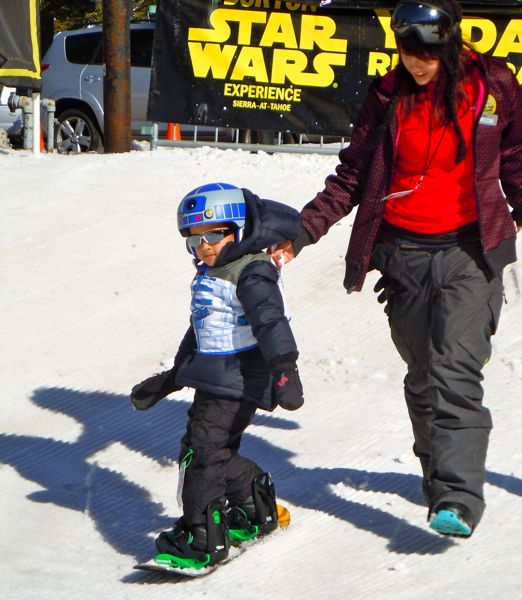
Burton has also established 20 Riglet Parks at resorts nationwide, where children as young as 3 can start learning how to snowboard. These include a Star Wars-themed park at Sierra-at-Tahoe, and another that features a “treehouse” at Smuggler’s Notch in Vermont. The company has also developed children’s snowboards — including its Chicklet and Chopper boards, which have convex bases that make the boards easier to turn.

The recent statistics, Boliba said, “don’t take into effect kids 7 and under, and from my business, that’s where we see great growth around the globe,” he said.

For snowboarders — no matter what their age — who might not want to enter an intimidating half-pipe, Burton has also established Stash Parks, or terrain parks that use more natural features (branchlike rails to slide, stumps to hop), at Jackson Hole Mountain Resort in Wyoming, Killington in Vermont, and Northstar at Lake Tahoe.

Meanwhile, Squaw Valley and its sister resort Alpine Meadows, have opened Start Parks: special beginner areas with mini-terrain features, gentle transitions, soft pitches and signs describing how to navigate them, all built in a way so that there’s no cross-traffic to fear.

“What we’re trying to do is connect new skiers and riders to sensations they will get on the mountain” but in “a very controlled setting” where “there’s less to take in,” said Josh Thompson-Bourrie, Squaw’s snowboard supervisor.

This winter both resorts are again offering a specially priced “progression package”: three days of lift tickets, snowboard rentals and full-day group lessons, for $299 with advance purchase.

Other resorts are trying other things, including eliminating what Karl Kapuscinski, president and chief executive of Stevens Pass Mountain Resort near Seattle and Mountain High Resort outside Los Angeles, calls “the hassle factor.” For instance, both areas now have benches at the top of chairlifts so riders can buckle in without wallowing in the snow. Snowboard boots that dispense with annoying shoelaces are available for rent, and there are newer, easier terrain parks at both resorts for less daring snowboarders.

Kapuscinski said the dwindling number of snowboarding visitors makes such changes necessary. Last November, he said, “literally mimicked” a November 10 years ago — the same snow conditions, the same number of runs open. That year his resort saw nearly 80,000 visits, an overwhelming proportion of them snowboarders.

“This last year we did almost 42,000 visits — so, basically half,” he said, even though his resort today offers much better terrain parks and half-pipes for snowboarding. “That fanaticism,” he said, “has disappeared.”



Love isn’t priceless

By Tiffany Hsu, Los Angeles Times

If there was any doubt that Valentine’s Day is as much about consumption as it is about amour, consider this: Americans will shell out $20.8 billion on Feb. 14 this year.

That’s 3.2 percent more than in 2012, or $134.08 a person, according to a report from research group IBISWorld.

Much of that spending will come on conventional gifts such as candy and flowers as they weather the higher payroll taxes originating from the government’s fiscal cliff negotiations, according to IBISWorld.

“Although overall spending will increase slightly, consumers are still watching their wallets, and spending on expensive items will suffer as a consequence,” said IBISWorld analyst Lauren Setar in a statement.

Lovers will drop the most money on meals out, collectively paying out $9.9 billion – a 2.9 percent increase.

Sweets will be the next major purchase, swelling 4.3 percent to $2.9 billion in sales. Flowers will get a 5.7 percent bump.

Both categories will get a boost from Valentine’s Day falling on a weekday. More blooms will be delivered to paramours in the workplace, while students will buy candy to give to schoolmates and teachers.

Consumers will also increase spending overall on romantic getaways, lingerie, and jewelry.