Shot dog accumulating big vet bill

Tonka is racking up vet bills after being shot by a narcotics officer in South Lake Tahoe. Photo/Provided

Tonka is racking up vet bills after being shot by a narcotics officer in South Lake Tahoe. Photo/Provided

Tonka, the dog that was shot last month during a drug raid, had surgery this week to remove the bullet.

Three more teeth had to be removed because they were shattered from the bullet entering below his left eye, traveling through his mouth, through his tongue and into his neck.

The two drainage tubes in his neck should be removed in a week.

So far, Tonka has racked up more $3,000 in medical expenses.

A day of grooming will be provided by Best in Show Groomers in Stateline on March 16 form 9am-5pm. All of the money raised will go to help Tonka. Call for an appointment — 775.901.2671.


Avi dogs — the difference between life and death

By Susan Wood

Ski trail maintenance worker Jeff Eckland can thank his lucky stars he had man’s best friend looking for him when he broke his back tumbling in a massive avalanche at Kirkwood Mountain Resort a decade ago.

Although the highly trained canine leaped across the rainbow bridge 14 years ago, the golden retriever named Doc will live on in the heart of Eckland. The Kirkwood staffer is only one of three people in 159-chronicled avalanches who was rescued alive by a dog in the United States since records were kept by the National Search and Rescue organization in 1969.

“It was 11:30,” Eckland recalled as if it were yesterday. “It had been snowing for days.”

The snow stopped, and the Kirkwood snow safety crew had already blasted the night before. But the wind loaded the slope above Button Bowl.

The three off-duty employees made a short hike up. Eckland took off first on his skis in front of his colleagues on snowboards when a soft slab avalanche wider than the length of a football field gained on him. Trees that appeared 300 yards away were suddenly in his face and scooped him up like a ragdoll.

“I went 80 mph in the blink of an eye,” he told Lake Tahoe News.

He was held against the tree debris for 20 seconds, then buried under 4 to 5 feet of snow just above the lifts along Buckboard flats.

“I thought ‘I’m going to die here’,” Eckland recalled.
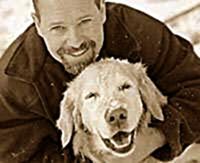
Jeff Eckland and Doc Photo/Provided

Jeff Eckland and Doc Photo/Provided

One friend rode down to Chair 3 to call in the destructive slide. The other went to the ski patrol station at Chair 2, where longtime ski patroller and Doc’s handler Dave Paradysz was digging a pit. He quickly took Doc on the snowmobile as far as he could go along the slide path while another dog looked at the end of the slide. Doc immediately headed for the trees debris.

Eckland was motionless and hypothermic, folded upside down in half with his ski boots next to his head. A piercing pain came from his back, prompting him to think a tree impaled him.

“I didn’t know which way was up. I was losing air and going black, when a paw broke the snow. I knew what it was, then all the oxygen rushed in,” he said, adding how his body corrected like a spring when the very excited dog dug him out.

Eckland estimated he was buried for about 15 minutes, the golden quarter hour for avalanche victims to survive.

It took three months of mainly rest for Eckland to recover from a broken back.

It broke his heart when Doc died in 2000. He immortalized the dog with a tattoo on his chest.

Eckland certainly is a believer in the avalanche dog program and tells his story whenever he can.

“If not for the dog, I’d be dead. This was the only tool we had that would’ve found me,” he said. “Their sense of smell is so incredible.”

In the land where skiers and riders may boast some of the deepest snow – at times on the planet, snow safety is serious business. Kirkwood maintains a program with seven dogs: Logan, 8; Stella, 8; Boji, 6; Pearl, 3; Huckleberry, 3, MoMo, 10 months; and Chewy, 7.

Fred Newberry, a Kirkwood ski patroller since 1999, handles Chewy, a golden retriever. He admits snow safety work can be unpredictable and “not an exact science.”

What he does count on is the dedication, training and drive of his dog, who primarily works inside the ski resort boundaries, but ventures out to assist Alpine and Amador counties in this rugged Sierra Nevada mountain country. The dogs are there to protect in-bounds skiers and boarders, along with the patrollers.

“The dog saved his life,” Newberry said of Eckland. “It’s why we not only have the dog program, but we support it.”

Many of the Lake Tahoe area ski resorts have dog avalanche rescue programs. Golden retrievers like Doc and Chewy are commonplace.

“They’re very obedient, trainable and have a good fetch drive,” Newberry said.

A godsend to Heavenly

With seven dogs of its own, sister ski area Heavenly Mountain Resort would add “good victim loyalty,” “high energy” and “good physical condition” as characteristics that make for an ideal avalanche rescue dog. Some of the dogs are related to others at fellow ski resorts.
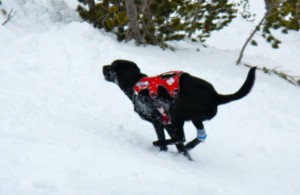
Truckee bounds up the slope at Heavenly. Photo/Kathryn Reed

Truckee bounds up the slope at Heavenly Mountain Resort. Photo/Kathryn Reed

Heavenly patrollers got to prove the traits firsthand on a recent demonstration drill with 3-year-old black Lab Truckee. According to his playing card that Heavenly hands out, Truckee is Heavenly’s first Lab on its rescue dog team.

Truckee came down Milky Way Bowl on handler Chris Child’s shoulders, ready and eager to work. Some ski resorts have leaned toward delivering smaller dogs that way.

Child met up with fellow handler Colton Terry, who acted as a witness to the mock scene. The two discussed clues, then the collar came off and that was Truckee’s clue to go to work searching for a buried Heavenly employee.

“The idea is to get him downwind (to pick up the scent),” Terry said.

With a few quick, shallow digs at the snow, Child kept Truckee focused. His nose covered what appeared to be a mock slide path in a grid pattern. In a matter of a few minutes, the canine started digging feverishly where the staffer was buried more than 3 feet.

Truckee slid on his belly down the hill afterward to celebrate his find.

“The dogs always find their person,” Terry said.

The patrollers bring in a few tricks of the trade to try such as using squares of wool against a sweaty body to simulate the human smell.

Terry has assisted Douglas County sheriff’s deputies with his golden, Summit, who’s in his ninth season.

Apparently, Summit’s work ethic is even better than Terry’s. The patroller admits when he wants to relax on his day off, Summit acts like he’s ready to work every day. And this could mean appearances at schools and events and serving as ambassadors of the resort. Guests can’t help but surround the canines and pet them like one recent day at the top of the Sky Express chairlift when a few people had their pictures taken with Summit and Madeline, another golden retriever.

But one thing is clear. These dogs are working machines, and they must go through a rigid certification program to do what they do. Terry mentioned the dogs having to locate two people in 15 minutes in a 200-foot square area.

Sierra’s new pup to follow in proven path

“Search,” the stern call came from Sierra-at-Tahoe ski patroller Tim Owen to his 2-year-old golden retriever, Kopa, in the trees alongside Castle where a resort employee was buried on another recent drill.
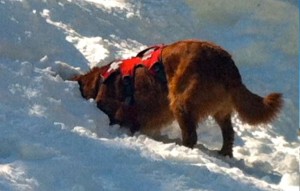
Kopa furiously digs for the buried person at Sierra in a training exercise. Photo/Susan Wood

Kopa furiously digs for the buried person at Sierra in a training exercise. Photo/Susan Wood

In his second season at Sierra, Kopa comes from a long line of patrol dogs. Boomer Murphy from Squaw Valley is his father. Kopa, who has been in training since he was 6 months old, is thought to be “extremely playful, but disciplined.”

After a few minutes passing and a few nudges from Owen “to go to work,” Kopa went right to the hole. Sierra patrollers have a few holes they dig on Castle, but move them often to test the dogs.

Kopa has not been on a mission yet, but “we do train for the worst and hope for the best,” Owen explained. The dogs use the Swiss standards for avalanche dog rescue training, which involve phases of progress.

Kopa and 5-year-old Khuno, the senior dog in the group, assist in backing up the patrollers, especially when they sweep Huckleberry Canyon. The gates leading to the El Dorado County backcountry are increasingly enticing for riders seeking powder.

With more skiers and boarders each year going into the backcountry to make fresh tracks, the dogs become more of an asset. Varying layers of snow from soft to hard contribute to the chance of more avalanches.

“I think the combination of more backcountry users in general and having weather patterns we’re not used to out here make it more of a factor. People in the backcountry take it for granted that the conditions could be the same (all the time),” fellow Sierra ski patroller Shannon Maguire, who handles the newest addition to the resort’s pack of dogs, told Lake Tahoe News.

Nine-month-old Hunter, another golden, has been “killing it” in his training Owen praised, as Hunter and Kopa played outside the Grandview Lodge.

Maguire said it’s been a learning experience for both handler and dog. Each handler of the 22 patrollers at Sierra becomes an alternate handler before making the grade. Each dog goes to school for up to two years.

“It’s definitely a learning curve. He’s a puppy. It’s a lot of work because he’s surrounded by people and smells. It can be a challenge,” she said, smiling.

Maguire played hide-and-seek last summer to get Hunter in the mode of finding people.

Then after training switches to snow, the idea is to have the dogs ready in two seasons.

The avalanche rescue dog program was initiated in the 1997-98 ski season with patroller Bob Schults and his dog Sirius, who was tragically killed when he was struck by a vehicle on Highway 50 about a decade ago. The program was diligently maintained through the efforts of Keebah, Rush-To and later Cruiser in 2005.

“They’re a valuable asset when you consider most people in the ski area aren’t wearing beacons,” said Sierra Avalanche Center forecaster Brandon Schwartz, who works for the U.S. Forest Service in Truckee.

Avalanche conditions have been all over the map this season with varying layers of snow when it does appear.

A small avalanche recently occurred in Eagle Bowl at Kirkwood and someone had to be dug out.

Devastating avalanches have happened this year in the West from Colorado to Oregon, with some resulting in fatalities and living up to its name “the white death.” A book under that name highlights the large avalanche at Alpine Meadows north of Lake Tahoe in 1982.


Opinion: South Shore Olympians add to area’s history

By Garry Bowen

As we near our celebration of our local Olympic triumph in honor of the glorious efforts of our three Olympians, I thought it might merit a look at Lake Tahoe’s ski legacy over the decades, as its significance is now enhanced, to say the least.

Back in the mid-1950s, with the announcement of the Olympics coming to Squaw Valley, the country said, “Where is that?” It’s by Lake Tahoe. “OK, where’s that?” That’s by Reno. “ Oh, you mean the divorce capital of the U.S.?”

In short, the 1960 Olympics really did a lot to put this area on the map, particularly since the Squaw Olympics was the first to be televised around the world, though not in living color.

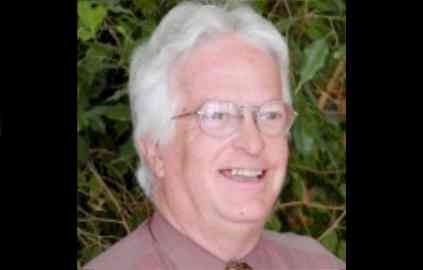
Garry Bowen

Garry Bowen

After those Olympics, Lake Tahoe had a relatively strong international ski presence, with many notables hanging out here for various events. And we have had our share of local notables, recognition on the international stage of the FIS (Federale Internationale du Ski), and even our own Heaven(ly) ski joke.

Those were the days of Squaw’s Tamara McKinney and Jimmy Heuga, Billy Kidd, Bill Marolt, Bob Beattie; all from elsewhere but who hung out here. A number of those went on to keep their presence in the ski world (Bill Marolt, for example, is part of the U.S. Olympic Committee and president of the U.S. Ski & Snowboard Association; Bob Beattie became the voice of skiing for ABC’s “Wide World of Sports”). But some were not so fortunate: Jimmy Heuga, who along with Steamboat Springs Billy Kidd, won the Olympic bronze to Kidd’s Olympic silver in the 1964 Olympics in Innsbruck, Austria, suffered the cruel indignity of multiple sclerosis.

As a true Olympic champion Heuga dignified his condition with his long-fought advocacy for the benefit of all MS patients.

Our own closer-to-home celebrity from that era, Vladimir “Spider” Sabich (his dad was the CHP lieutenant at Kyburz) was the victim of a fatal celebrity shooting in 1976 a number of years after winning the World Cup in 1968 here. The traumatic loss of Sabich was especially heart-breaking for me, as I used to ride the school bus everyday to Placerville (El Dorado High) with he and his older sister, Mary (his younger brother, Pinky, was much younger) – an hour and a half round trip journey with a good friend. And the end of many, many escapades on the slopes, at parties, here and in Aspen Highlands.

The World Cup that Sabich won was right here at Heavenly – and was the source of national TV exposure through Beattie and the “Wide World of Sports” – that, plus the FIS event ceremony dinner at Harrah’s South Shore Room, where we were treated to our own Heaven(ly) joke at the expense of a skiing legend.

Told at the World Cup dinner ceremonies at the conclusion of the World Cup: “It seems a long-term, fanatic skier died and ended up at the pearly gates: upon arrival, he’s greeted by St. Joseph, who welcomes him by suggesting a tour of the facilities. He’s promptly shown the brand new sparkling 40-lane bowling alley (open-all-the-time!), then shown the spectacular 27-hole golf course (with no sand traps). Then, as they start off for yet another place, the newcomer stops him, and asks, ‘Hey, what about me? You know I’ve been a life-long skier, don’t you have something here for me?’ At which point St. Joseph takes him a distance where he tells him of ‘the thousands of feet of vertical drop, the several ridges and cornices where he can leap 60-80-100 feet through the air to his heart’s content, the lifts that can take he and five others in speedy fashion up the slopes for an unbelievable number of runs, etc., etc.’ – when suddenly they are both interrupted by this sleek figure in perfect form, zooming by exceptionally fast, incredibly dressed. And the newcomer turns and says, ‘Wow! That guy was great, that must have been Stein Erickson!’ To which St. Joseph responds, ‘No, that was God! But he thinks he’s Stein Erickson.’”

The Lake Tahoe region has a long and strong history in the ski world, and I’ll add yet another local dimension. We also had, for instance, Greg Dorland as the U.S. National Junior Ski champion, Wally Rothgeb Jr. on the U.S. Ski Team (his mom and dad ran Heavenly Valley in the 1960s), and even Julia’s dad, Ciro Mancuso, as part of the South Shore contingent.

After this quick review of those before them, Lake Tahoe’s long-time ski connections are now greatly enhanced by the three young ladies that will be honored this week: Jamie Anderson, Maddie Bowman and Hannah Teter.

Having surpassed all of whatever any expectations there might have been and have outdone and added to all previous accomplishments and skills of those who came before, which, knowing most of them as I do, would most probably be a thrill to them all, it is a great honor to add all of them to Tahoe’s history.

Thanks for all your dedicated work and for bringing this prestige and recognition back home. Welcome!

You’ve outdone them all.

Garry Bowen has a 50-year connection to the South Shore, with an immediate past devoted to global sustainability, on most of its current fronts: green building, energy and water efficiencies, and public health. He may be reached at tahoefuture@gmail.com or (775) 690.6900.


Tahoe brings down Vail Resorts’ earnings projections

By Jason Blevins, Denver Post

Snowy Colorado buoyed Vail Resorts in first three months of the 2013-14 ski season as the historic drought in California shriveled visitation and revenue at the company’s three Lake Tahoe-area resorts.

Skier visits at Vail Resorts’ Colorado ski areas — Vail, Beaver Creek, Breckenridge and Keystone — climbed 11.9 percent in the three months ending Jan. 31, compared with the same period last season. But a 73 percent decline in snowfall around Lake Tahoe triggered a 27.7 percent decline in visitation at the company’s California resorts — Heavenly, Northstar and Kirkwood.

The rough winter in California forced the company to decrease its projected earnings for fiscal 2014 by about 10 percent.

Read the whole story


Snippets about Lake Tahoe

meyers• The next Meyers Area Plan workshop is March 19 from 6-8pm at the CCC building. A summary of comments is on county’s website.

• Matthew Brown has been hired as communications program manager for Reno after being managing editor of Nevada magazine for the last seven years.

• The grand opening for the Aspens housing project in South Lake Tahoe is March 27 at 3pm.

National Geographic has named Reno one of the top 10 emerging ski towns. This is the second year in a row Reno has earned this designation.

• ValuePenguin.com analyzed annual premiums for a basic liability policy to give drivers an idea of car insurance costs in the Golden State. Markleeville came in at 28, South Lake Tahoe 46 and Placerville 52.


House to debate USFS, ski resort water rights

By Jason Blevins, Denver Post

The Water Rights Protection Act — which would prohibit the federal government from seizing privately-acquired water rights used on federal lands — arrives for debate on the House floor Thursday.

HR3189 — sponsored by Rep. Scott Tipton, R-Colo., and co-sponsored by 15 Western members of Congress — stems from the ski industry’s now 3-year-old fight with the agency, which sought in 2011 to revise permit regulations to require ski areas to transfer water rights used on public lands over to the Forest Service.

The ski industry — which sued to stop implementation of the new water-rights clause — argues the permit change amounts to illegal takings of private property. The Forest Service says the water regulation is a return to original policy outlined by the 1986 National Forest Service Ski Area Permit Act and keeps water resources connected to public land.

A U.S. District Court judge in December 2012 overturned the water clause and required the Forest Service to gather public input on the change to federal permitting.

Read the whole story


Prescribed fires planned for Tunnel Creek

The Nevada Division of Forestry will be conducting prescribed burns at Tunnel Creek in the Lake Tahoe Nevada State Park backcountry in March, April and May, weather permitting.

The Tunnel Creek road from Highway 28 to Tunnel Creek Station may be closed in order to conduct the burns. Signs will be posted throughout the area when burns are being conducted.

Fifty acres will be burned in eight treatment units.

The burns are part of ongoing fuels treatment and forest restoration efforts being conducted by the Nevada Tahoe Resource Team in the Lake Tahoe area. The goal of the project is to create a healthier forest and to make the area more resistant to catastrophic wildfire.

For more information, contact the Nevada Division of Forestry at 775.684.2500.


UC Davis establishes center to study coffee

By Edward Ortiz, Sacramento Bee

UC Davis has made a name for itself researching beverages people use to relax – like wine and beer. Now it’s turning its attention to one Americans use to get wired: coffee.

On March 11, a roster of eight UC Davis scientists will come together for a research conference run by the school’s recently founded Coffee Center. At the conference, the scientists and coffee industry stakeholders will gather to plumb such diverse topics as the genetics of coffee and the sensory perception of coffee drinkers.

It’s the first step in an effort that some on campus see as leading to a dedicated coffee research study center akin to the Robert Mondavi Institute for Wine and Food Science, said J. Bruce German, director of the Foods for Health Institute at UC Davis. He also suggested the school could eventually offer a major in coffee science.

Coffee is certainly a powerhouse commodity. It is the largest food import in the U.S., and the world’s most widely traded tropical agricultural commodity, according to the International Coffee Association. Worldwide coffee production is growing along with coffee consumption. In 2012-13, production is expected to hit a record 148 million bags.

Read the whole story


Drought driving up food prices

By Dana Hull, San Jose Mercury News

With 2013 the driest year on record and 2014 possibly worse, the devastation of California’s drought is trickling down to crops, fields, farmers markets, grocery stores — and the kitchen table.

While it’s too early to tell precisely how much the drought will push up household grocery bills, economists say consumers can expect to pay more for food later this year because fewer acres of land are being planted and crop yields are shrinking.

Large grocery chains have distribution networks and can import produce from around the world to keep customers in everything from cantaloupe to cauliflower, but experts say California’s smaller yields will inevitably lead to higher consumer prices here and elsewhere. Some consumers already are plotting ways to keep their food budgets under control if there is a big spike in prices.

Read the whole story


Caesars losses continue to grow

By MarketWatch

Caesars Entertainment Corp.’s fourth-quarter loss widened sharply as the casino operator recorded $1.96 billion of asset impairment charges, though revenue improved.

The asset-impairment charges stemmed from deteriorating market conditions in Atlantic City and potential changes in the expected useful life of certain property assets, the company said.

Operationally, revenue fell for the company’s casino segment on increased regional competition and continued softness in the domestic gaming market in some U.S. markets outside of Nevada, along with the reduction of revenue from the partial sale of the company’s Conrad Punta del Este casino in Uruguay in the second quarter of 2013. This revenue decline was offset by growth for the company’s food and beverage, and rooms segments, as well as management fees.

Caesars is the parent company of Harrah’s Lake Tahoe and Harveys.

Read the whole story