Snowshoe Thompson event at Squaw

The Village at Squaw Valley and Sons of Norway, Snowshoe Thompson Lodge 6-078, are hosting a dedication celebration honoring the Sierra legend Snowshoe Thompson at Squaw Valley at 1pm June 25 in the Events Plaza of The Village at Squaw Valley.

The dedication is for the 13-foot copper sculpture of Snowshoe Thompson created by artist Richard Gill of Nevada City. The sculpture depicts the legendary character who carried the mail through Sierra snows, from Placerville to Genoa for more than 20 winters.

The event will include a brief history of Snowshoe Thompson and a reading of Gills’ poem, Norwegian dancing and instruction provided by the Kropps, Norwegian singing by Phil Walker and a special performance by Snowshoe Thompson impersonator, Steve Hale.

For further information, call (530) 584.6266.


Elementary students get lesson in dental care

During the 2010-11 school year, students at Bijou Community School, Lake Tahoe Environmental Science Magnet, Sierra House, Tahoe Valley and Zephyr Cove Elementary schools were provided a special dental kit and given a lesson on the importance of good dental hygiene and dental care.

This was the result of a partnership between Lake Tahoe Unified School District, Tahoe Magic, First Five and a grant from Barton Health’s Community Advisory Committee. The grant also provided eight dental story books to each school library.

South Tahoe High School students put together 2,000 dental bags filled with a toothbrush, floss, flossers, a dental book and a bracelet that reminded youngsters to “Brush, Floss and Smile.”

Education was provided on how many teeth they have, how to correctly brush and floss with a special emphasis on what plaque is and the long term health problems it can cause.

Also included in the bags was a letter to the student’s parents about the importance of dental care and a list of dentists.


Nev. bill to alter TRPA being massaged, vote likely Monday

By Anne Knowles

CARSON CITY – The bill to pull Nevada out of the Tahoe Regional Planning Agency unless the body implements certain reforms passed out of the Assembly’s Government Affairs committee Saturday evening.

The bill passed with a vote of 10-1, with the lone no vote cast by Assemblywoman Teresa Benitez-Thompson, D-Reno, who had expressed opposition to the bill during two days of hearings last week.

“Withdrawal could cheat Nevadans of having a say on what happens on more than half the lake,” Benitez-Thompson said during the Friday hearing.

Politics cloud the futre of Lake Tahoe.

Politics cloud the future of Lake Tahoe.

Assemblyman Ed Goedhart, R-Amargosa Valley, and Assemblywoman Peggy Pierce, D-Las Vegas, were both absent. Pierce, who was reportedly sick with food poisoning, was expected to vote no on the bill.

The latest version of the bill includes an amendment introduced by Secretary of State Ross Miller, who sits on the TRPA board, that changes the agency’s voting structure so approval of projects at Lake Tahoe would require a total of nine votes from the board with at least four of those votes made by members from the state where the project is located. Current requirements now call for a total of eight board votes with at least five coming from members of the project’s state.

The bill also included additional language clarifying the role of an oversight committee that will produce a report on the TRPA and Nevada’s role in it before legislators and the governor decide whether to withdraw.

Senate Bill 271 is expected to be voted on by the Assembly Monday, the last day of the 2011 legislative session. If it passes, it goes to Gov. Brian Sandoval, who has already expressed support for the bill, for his signature.


Stand up paddle board festival in Lake Tahoe

The Lake Tahoe Paddle Festival is a solstice celebration of human powered watercraft featuring “Ancient Art to State of the Art” boats, boards and paddles.

The focus is the preservation of indigenous watercraft art and culture.

The paddle race through Emerald Bay starts in Meeks Bay on June 18 at 8am.

Interpretive exhibits will highlight sustainable recreation, healthy foods, yoga, healing arts and environmental awareness.

It is a weekend of workshops, clinics, fun, food and family entertainment. Try out the world’s fastest growing sport — standup paddling — on a demo, or paddle your canoe or kayak over to learn more about protecting Lake Tahoe’s clarity and efforts to prevent the proliferation of invasive species.

Go online for more information.


30 years later and still learning about AIDS

By Lawrence K. Altman, New York Times

At first it seemed an oddity: a scattering of reports in the spring and early summer of 1981 that young gay men in New York and California were ill with forms of pneumonia and cancer usually seen only in people with severely weakened immune systems.

aidsIn hindsight, of course, these announcements were the first official harbingers of AIDS — the catastrophic pandemic that would infect more than 60 million people (and counting) worldwide, killing at least half that number.

But at the time, we had little idea what we were dealing with — didn’t know that AIDS was a distinct disease, what caused it, how it could be contracted, or even what to call it.

As AIDS has become entrenched in the United States and elsewhere, a new generation has grown up with little if any knowledge of those dark early days. But they are worth recalling, as a cautionary tale about the effects of the bafflement and fear that can surround an unknown disease and as a reminder of the sweeping changes in medical practice that the epidemic has brought about.

Reports of the initial cases were confusing. The first federal announcement, 30 years ago this week, concerned “five young men, all active homosexuals,” with pneumocystis carinii pneumonia, or P.C.P., a disease “almost exclusively limited to severely immunosuppressed patients.” Initial suspicion fell on a known infectious agent, cytomegalovirus.

A month later, on July 3, 1981, I wrote The New York Times’s first article about AIDS, this one headlined “Rare Cancer Seen in 41 Homosexuals.” (“Gay” had yet to be accepted by The Times’s style manual.) The cancer was Kaposi’s sarcoma, and until then it had seldom been seen in otherwise healthy young men.

Read the whole story


Snippets about Lake Tahoe

douglas• When the Douglas County commissioners approved the 2011-12 budget in May it meant laying off 12 employees and not filling six positions.

• Gordon Boettger of Minden set a Northern Hemisphere record in May when he flew 1,401 miles by himself in a sailplane. The previous record was 1,367 miles.

• Because of the outbreak of the equine herpes virus EHV-1 the National Pony Express Association is postponing its annual reenactment of the famous ride from St. Joseph, Mo., to Sacramento from June to August. It still plans to come through the South Shore.

• Nevada County in May became the ninth California county affected by the European grapevine moth quarantine. Most of the affected area in the state is in Napa County.

• The 62nd anniversary run of the Highway 50 Wagon Train started June 4. It runs through June 12. Go online for more information.

• Here is Caltrans’ Sierra roadwork schedule for the coming week.

• Here is Caltrans’ Lake Tahoe roadwork schedule for the coming week.


Vintage Tahoe streetcar gets new life in San Diego

By Robert J. Hawkins, San Diego Union-Tribune

SAN DIEGO — As early as mid-July, downtown San Diegans should begin spotting a ghost from a past most never knew.

A painstakingly restored electric streetcar, the likes of which last ran here in 1949, will begin operating on a downtown loop on weekends and holidays.

When state regulatory approval is given, the streetcar will run on what will be called The Silver Line, a clockwise loop starting at the 12th & Imperial Transit Station to America Plaza, east on C Street to City College before returning to 12th & Imperial.

The Silver Line streetcar will run on existing track in between Blue and Orange line trolleys. A special stop at the 12th & Imperial station will have a canopy that echoes the coloring and design of the streetcar era.

The stylishly art-deco streetcar, which once plied the streets of San Francisco, was among three purchased in 2005 and 2006 from a South Lake Tahoe entrepreneur whose vision of a lakeside trolley system never materialized.

Read the whole story


Opinion: Sometimes the public doesn’t need to know

Publisher’s note: This editorial is from the June 4, 2011, Sacramento Bee.

As a general proposition, we’re all for transparency and making information available to the public.

But some things we just don’t need to know.

El Dorado Superior Court Judge Douglas Phimister was absolutely right to keep under wraps the unspeakable details of Jaycee Lee Dugard’s 18 years of captivity.

On Thursday, he released much of the transcript of the grand jury testimony Dugard gave last September. But the judge appropriately sealed parts that were, in his words, “absolutely disgusting” and “just plain pornographic.”

There’s no compelling reason that such information should be part of the public domain – certainly not enough to outweigh Dugard’s right to privacy.

It’s enough to know that her ordeal, which began when she was snatched off the street at age 11, was truly horrific – and that the life sentences given Thursday to Phillip and Nancy Garrido for kidnapping, raping and holding her hostage are the least punishment they deserve.

Wanting to know all the sordid details would be only prurient curiosity. And, unfortunately, our culture already satisfies that appetite well enough.

The Bee and other media organizations properly went to court seeking the transcript, which is typically unsealed after a case is over.

Read the whole story


Trail building day ensures July opening for Van Sickle Park

By Kathryn Reed

STATELINE – I will never look at a trail the same.

Tahoe Rim Trail Association officials warned us this could happen. They even said next time we hike on this section of trail we’ll smile, point out to our buddies what areas we are responsible for. I already feel that sense of ownership.

Saturday was my first experience with any type of trail building. I’m hooked. Besides spending time in the outdoors and feeling good about putting in a few hours of volunteer service – what made this different was the sense of accomplishment and camaraderie. More than 100 people signed up (a few probably didn’t show up because of the lousy weather) to work on the trail at Van Sickle Bi-state Park.

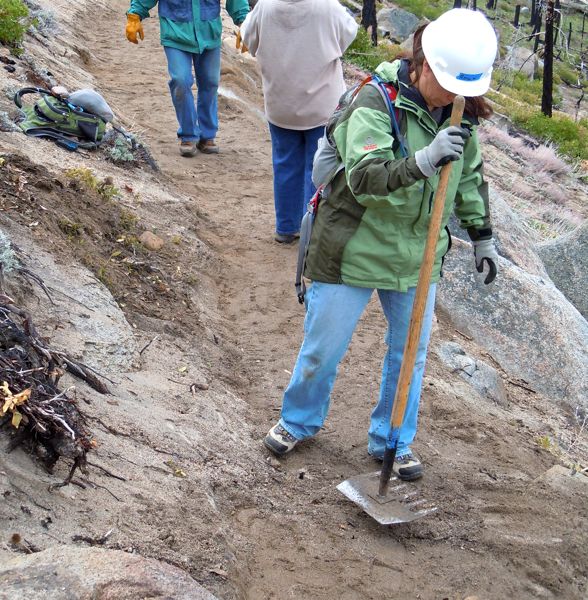
Anna Watkins of Carson City works to improve the trail June 4 at Van Sickle Bi-state Park. Photos/Kathryn Reed

Anna Watkins of Carson City works to improve the trail June 4 at Van Sickle Bi-state Park. Photos/Kathryn Reed

We walked through sections saying, “good job” “this looks great” “keep it up.”

We weren’t the only ones playing in the dirt. June 4 was National Trails Day, an event that has been going on for decades. The American Hiking Society always schedules it the first day of June. (It will be June 2 next year, so mark your calendar.)

“You will never look at a trail again when you are out hiking without realizing what it takes to build a trail,” Mary Bennington, TRTA executive director, told the volunteers before they headed out in the drizzle from Harrah’s Lake Tahoe parking lot.

That is one of the great things about the country’s only bi-state park – it’s accessible by foot from the South Shore’s main bed base at the state line.

Van Sickle Bi-state Park is scheduled to open in July.

The final work being done by professionals is construction of the California day use area under the oversight of the California Tahoe Conservancy. That work started June 1.

The 725-acre park is mostly in Nevada, but the entrance is in California near the intersection of Montreal Avenue and Heavenly Village Way.

The park will be open from sunrise to sunset all seasons except winter.

Steve Weaver, whose goal was to stay employed with Nevada State Parks until the park opened, just retired. But he plans to be at the official ribbon cutting during the environmental summit in August.

Weaver told Lake Tahoe News he is optimistic about the park opening because of a TRT grant. The Tahoe Rim Trail Association secured a $16,000 grant from the Van Sickle Foundation for fire suppression.

Bennington told the volunteers Saturday the TRTA has a five-year contract to pay the water and sewer bills. This commitment is what is allowing the park to open at a time when both states are in a precarious financial situation when it comes to putting money toward state parks.

What the volunteers were working on Saturday was the Daggett Summit system. Most of the work was maintenance. Widening the trail a bit so hikers won’t feel like they are teetering off the edge, trimming back manzanita, removing pine needles and other debris that has been deposited over the winter.

This is a connector trail from Van Sickle to the TRT. The project, which has a couple years before it is complete, includes eliminating three miles of paved trail and putting them in the forest. The whole project adds 13 miles of trail. Included is a short, scenic loop around the Upper Kingsbury neighborhood and out to Castle Rock.

Equestrians will be able to use this trail network. To test what has been built, Petra Keller took Tiara Nevada and Paula Walkins had Jake on the trail. The horses did not like the narrow, rocky stream crossing at the waterfall. This means more technical work by the experts is needed to make it horse friendly.

Rosemary Manning of South Lake Tahoe said women are probably part of the crew because of the detail they put into their work – like getting the pine needles off the trail and making it just so.

A foursome of friends from Carson City came up to work on this trail system in their back yard. They met a couple years ago through Muscle Powered Carson City.

“We love to hike and we want to give back,” Anna Watkins said.

For Watkins, Gina DaSilva and Gisele Geary this was their first experience at trail building. Jenny Haas was the veteran of the group – this being her second time.

“It’s a passive way to get exercise,” Haas said.

Although the TRT says trail building is for all abilities, I have to disagree. A certain amount of physical shape is necessary. You have to hike to the work area – and part of the way includes carrying tools. And then it’s manual labor.

John McCall, who has been building TRT trails since 1985, had his crew of 11 (myself included) make sure some of the spots on the sandy trail we were working on were widened so horses wouldn’t have a problem.

McCall’s basic advice was, “Two things make a successful trail – it keeps water off and it keeps people on.”

We used tools I wasn’t familiar with – like a pickmatic and McLeod. And some tool I didn’t get the name of that a U.S. Forest Service employee created.

Then there was the loper – which I always thought was just called a trimmer.

I learned it is best not to use a shovel for prying things out of the ground. McCall said this is because it’s likely the tool will soon be in two pieces.

It was hard not to put the tools down for a minute to take in the views – even under the always cloudy and intermittent rainy conditions. The views of Lake Tahoe from this trail are stunning. A few offshoots (which have to be enjoyed on a non-work day) look like they will provide even more incredible unobstructed views of the South Shore.

The TRTA needs volunteers on the Daggett Summit portion Tuesdays and Saturdays. Go online for more information.

ngg_shortcode_0_placeholder (Click on photos to enlarge.)


Dizzying news cycle challenges media organizations

By Howard Kurtz, Newsweek

ABC’s Martha Raddatz was minutes from taking off for Afghanistan when her BlackBerry buzzed with a colleague’s message that Osama bin Laden might be dead. She dragged her luggage off the plane, sat down on the floor of Dulles airport, and started making calls.

It was 9:45pm on May 1 as the veteran correspondent, a phone in each hand, learned details—they had bin Laden’s body!—that she provided on the air from Terminal C. She drove to the office at 3am and kept on working.

The network had run more than a dozen drills for precisely this moment. “News is the ultimate defibrillator for an organization,” says ABC News president Ben Sherwood. “We get shocked to life and go right into action.” The problem: after the Tucson shootings, the Egypt and Libya uprisings, the Japanese nuclear catastrophe, and now the death of the mastermind of 9/11, ABC has blown through most of its multimillion-dollar emergency fund set aside for unexpected events. That is rare and could force the network to ask the Disney bosses for more, though an executive says there is “no blank check.”

Big media organizations pull out the stops for game-changing stories, but they may be bleeding themselves to death in the process. The lumbering old news dinosaurs have slashed their staffs and watched online rivals eat their lunch as ratings and circulation inexorably slide downward. There are fewer ambitious projects, reduced scrutiny of government, more journalistic recycling.

Brian Williams is proudly old-fashioned. Having landed in London for the royal wedding, he immediately flew home to chase the killer tornadoes in Alabama. The NBC anchor was in his Connecticut kitchen that Sunday night when White House spokesman Jay Carney called to say he should get to the chair: “Close hold: we got bin Laden. Tell no one.”

Read the whole story