Snippets about Lake Tahoe

cricket• The good thing about a wet spring: the Nevada Department of Agriculture forecasts just an average year for the number of Mormon crickets.

• At a future South Lake Tahoe City Council meeting the five are going to discuss the merits of changing to a government structure where the mayor is in charge and not the city manager.

• The Lake Mary Cabin Dinner Series benefiting North Shore nonprofits will be Fridays and Saturdays from July 29-Sept. 24 at Sugar Bowl. For more info, call (530) 426.9000 or go online.

• Tahoe City Dog Park opened June 16 off Highway 28 on Grove Street (behind Fat Cat and below Conners Field). The dog park will be open Thursday-Tuesday dawn to dusk, and Wednesday noon to dusk. For more information, call (530) 583.3440, ext. 10.


Snowshoe Thompson sculpture to be dedicated at Squaw

The Village at Squaw Valley and Sons of Norway, Snowshoe Thompson Lodge 6-078, are hosting a dedication celebration honoring the Sierra legend Snowshoe Thompson at Squaw Valley at 1pm June 25 in the Events Plaza of The Village at Squaw Valley.

The dedication is for the 13-foot copper sculpture of Snowshoe Thompson created by artist Richard Gill of Nevada City. The sculpture depicts the legendary character who carried the mail through Sierra snows, from Placerville to Genoa for more than 20 winters.

The event will include a brief history of Snowshoe Thompson and a reading of Gills’ poem, Norwegian dancing and instruction provided by the Kropps, Norwegian singing by Phil Walker and a special performance by Snowshoe Thompson impersonator, Steve Hale.

For further information, call (530) 584.6266.


Opinion: California’s budget probably not the last

By Dan Walters, Sacramento Bee

So did Democratic legislators accomplish anything on the state budget crisis Wednesday other than protect their paychecks?

Probably not.

Instead, by whipping a gimmick- and debt-based budget through both legislative houses lickety-split, Democrats appear to be petty and self-serving, thus adding to their already poor public standing. And they may have weakened Democratic Gov. Jerry Brown’s hand and bolstered Republicans in the budget game.

The precise consequences are unclear because this is uncharted political territory. It’s the first time in decades that the budget could be passed by a simple-majority vote, thanks to voters’ passage of Proposition 25 last year, rather than the long-standing two-thirds margin.

Read the whole story


Appraisals for KMS next step for closed school

With three public sessions to get feedback from about what to do with the shuttered Kingsbury Middle School site completed earlier this month, the next step is to get appraisals on the Zephyr Cove site.

Douglas County School District Superintendent Lisa Noonan updated the board Tuesday afternoon about what the public had to say and what happens next.

Getting appraisals, which could take months, will put a value on the land and structures. The board would ultimately make the decision about who would be hired to do the appraisal.

It’s still possible the site could be used by the district, or another Douglas County agency. However, it is in the board approved facilities master plan to sell the property.

The school closed three years ago this month because enrollment at the three lake schools was on a steady decline. Now the K-12 students are in two schools in Stateline.

— Kathryn Reed


Recreation advocates take sides on ballot measure

By Kathryn Reed

If an umpire had been in the room, several “players” would have been ejected.

And it was a good thing no children were there Thursday night, even though the subject matter was recreation. These grown men don’t all play nice together.

What brought them to the South Lake Tahoe Recreation Complex was to discuss Measure S and the possibility of changing it into Measure R. What got them riled up was if voters should be asked to change how the dollars are divvied up and how the dollars should be allocated.
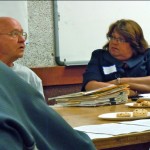
John Upton and Norma Santiago get an earful at the June 16 meeting about rewriting Measure S into Measure R. Photo/Kathryn Reed

John Upton and Norma Santiago get an earful at the June 16 meeting about rewriting Measure S. Photo/Kathryn Reed

South Shore voters on the California side approved Measure S in 2000 to provide money to maintain future bike trails, create ball fields, and build an ice rink – in that order. Instead, the order was reversed. The ice rink is done, one ball field is in, and little of the bike trail funds are spent because no asphalt is being laid.

The ball field proponents, led by John Cefalu and Measure S’s lone paid staff member John Upton, tried in 2009 to get more money out of the measure for their preference and failed with Measure B. This time they brought the bike community to the table in hopes altering the measure’s language to allow for old trails to be renovated would sweeten the pot.

“Little League is trying to get more money. I will very much be opposed. I think the funds should go to what was originally voted for,” Jerome Evans, a former city recreation commissioner, said. (The only current rec commissioner at the June 16 meeting was Jonathan Moore.)

Evans and Cefalu traded verbal jabs. Evans was confrontational as he spoke. Cefalu and Upton were not always gentlemen-like, either. Cefalu eventually left the meeting when it came time for Evans to speak again.

Before he departed, Cefalu said based on the opinions of the dozen people in the room, he didn’t see Measure R having the two-thirds votes needed to pass.

He suggested the bike people get their own measure on the ballot to raise funds for their cause.

The reality is what’s left to be collected through 2030 from property owners at a rate of $18/year for single family residences and what’s in the bank from Measure S is not enough to take care of what voters thought they were paying for. Cyclists and baseball advocates agree on that much.

However, one person described it as everyone wanting a piece of the pie, with Measure R creating a smaller piece for bike trails. And it ultimately would no matter how people sugar coat it.

Upton and Cefalu lobbied hard that doing nothing is sticking with the status quo. For them, and the ball field gang, it means not being able to make the improvements they want.

The status quo for cyclists means the only bike trails that would be improved are new ones when they need it.

It’s the pot of money being set aside for those improvements that ball field advocates want to get their hands on.

Cyclists contend while the money for new trails is stagnant, one day the fiscal situation will change and those dollars voters approved for their maintenance will be needed.

The next step is the recreation joint powers authority will meet June 30. Because the meeting as been noticed to be at Lake Tahoe Airport at 9am, it will start there, and then be moved to the library on Rufus Allen Boulevard because of a conflict in scheduling. So attendees just need to be at the library about 9:15am.

The three members of the JPA (El Dorado County Supervisor Norma Santiago, South Lake Tahoe City Councilman Hal Cole and Tahoe Paradise Park board member Deborah Henderson) will be asked to vote on a resolution to create Measure R and the November ballot language.

When asked Thursday by more than one attendee if any of this could be changed, Upton said an emphatic no. Santiago said the politically and legally correct answer of yes. A “no” would imply a decision had been made – which at a minimum violates the Brown Act. And it would be political suicide to admit to making a decision before a public hearing is conducted.

Santiago told Lake Tahoe News for the JPA board to consider amending the language of Measure R the verbiage would need to be presented in the necessary legalese at the June 30 meeting.

But the truth is the ballot language does not need to be finalized until July 29, so the JPA could schedule a special meeting to create some other iteration of Measure S if they so desired.

Santiago took issue with the allegation rewriting Measure S has not been transparent, citing the May 5 meeting that resulted in Measure R being tweaked.

But the truth is Kathay Lovell, as South Tahoe mayor last summer, approached the Bicycle Coalition, saying a compromise to amending Measure S needed to be found.

Talks between the Coalition’s Ty Polastri, Upton and Cefalu started earlier this year. The first time the idea of altering S was brought to the public’s awareness was at an April South Lake Tahoe City Council meeting.

By that time, the language for R was written. No public meetings were conducted before then to get input from anyone. It was all behind the scenes finagling by youth baseball leaders to get it to that point.

On a side note, the Cefalu family is involved in this in another way. Even though no money from Measure S goes to the ice rink operation, it was South Shore property owners who built it via the tax assessment. The city sought bids from people and entities wanting to run the rink, with Chris Cefalu – son of John Cefalu – being the frontrunner to get that bid in July when it comes to the City Council. The proposal was submitted by Tahoe Sports and Entertainment, owned by Van Oleson and Cefalu.

The is proposed Resolution and this is the proposed ballot measure.



Trout Creek extends well beyond its banks

Trout Creek in South Lake Tahoe is expected to rise Friday morning to 8.5 feet, near the channel’s capacity.

The National Weather Service in Reno said it was at 8.3 feet at 1pm Thursday. Lake Tahoe News saw the marker in the creek at Martin Avenue at 7:50pm June 16 at 8.1 feet.

Trout Creek in South Lake Tahoe on June 16 is extending well past its bank. Photos/Kathryn Reed

Trout Creek in South Lake Tahoe on June 16 is near flood stage. Photos/Kathryn Reed

Even though the weather service is not expecting any flooding by their definition, water is in the back yards in this area. The trail to the creek on O’Malley Drive at Bertha Avenue is flooded. The creek has busted its bank all along its route – including on Black Bart Avenue headed to Meadow Crest Drive. It’s also visible on Highway 50 where it goes under the road. Looking south at that bridge it’s all water.

It’s possible the freezing overnight temps Thursday slowed the  snowmelt a bit.

A low pressure system moved through the Lake Tahoe Basin Thursday afternoon and into the evening, bringing a few showers and cold temperatures. Warm weather is in the forecast going forward, with no more threat to outdoor plants.

— Kathryn Reed

ngg_shortcode_0_placeholder (Click on photos to enlarge.)


Harveys hit with $3.5 mil. judgment in tainted water case

Within seconds of taking a sip of what she thought was water, Julia Ellis doubled over at the bar at Harveys Lake Tahoe.

The casino’s mistake of serving her a highly toxic cleaning solution instead of bottled water resulted in a jury this week rendering a verdict that Ellis be paid $3.25 million in damages for past and future medical bills, as well as for pain and suffering.

“Food safety is a national priority. This is a tragedy that never should have happened and that could have been avoided,” Christopher Dolan, Ellis’ attorney, said in a statement.

The case was tried in San Francisco Superior Court. Dolan said the company has accepted responsibility. What the jury decided Monday was what damages should be.

On Dec. 2, 2007, Ellis asked a Harveys bartender for water. He thought that’s what he brought her. In reality a Harveys employee had poured a highly caustic, highly toxic, concentrated cleaning solution with a PH of nearly 13.5 out of 14 into an unmarked Harrah’s water bottle and left it in the kitchen, where it was soon served to Ellis.

Ellis, who lives in Mill Valley, suffered severe chemical burns to her esophagus and stomach.

— Lake Tahoe News staff report


California drought drove up energy costs

By Bettina Boxall, Los Angeles Times

Drought One of the biggest costs of California’s recent drought went largely unnoticed, according to a report that estimates state ratepayers paid $1.7 billion to replace lost hydropower with natural gas generation that also pumped millions of tons of pollutants into the atmosphere.

“Some of the drought’s most direct and costly impacts were to air quality and California electricity ratepayers,” concludes an analysis of the drought’s impacts by the Pacific Institute, a Northern California think tank that focuses on water issues.

In an average year, about 15 percent of the electricity produced in-state comes from hydropower. Citing data from the California Energy Commission, the authors found that figure dropped to 8 percent to 10 percent with falling runoff levels during the 2007-09 drought. Utilities made up for the loss by burning more natural gas and buying more power from out of state, driving up production costs as well as greenhouse gas emissions. The authors calculated that the switch to other power sources resulted in an additional 13 million tons of carbon dioxide emissions.

Read the whole story


Sacramento turmoil keeps budgets downstream in flux

By Kathryn Reed

Now there’s a state budget, now there’s not. This fiscal gamesmanship California lawmakers are playing may ensure they keep getting a salary, but it is creating an eraser hole in ledgers up and down the state.

Lake Tahoe Unified and Lake Tahoe Community College boards of education on June 14 discussed their respective budgets. Both plan to adopt so-called final budgets June 28. But in reality they are placeholder budgets until the state approves a budget.

budgetJune 15 was the legal deadline for lawmakers to approve a state budget. It was done so on controversial party lines. The following day Gov. Jerry Brown vetoed the Democrats’ plan – even though he is one of them.

Brown said what landed on his desk contained “legally questionable maneuvers, costly borrowing and unrealistic savings.”

State Sen. Ted Gaines, R-Roseville, and Assemblywoman Beth Gaines, R-Roseville, who represent Tahoe in the Legislature, voted no on the budget.

LTUSD and LTCC had found ways to work within the confines of what Brown proposed in his May revise.

But what the Dems put forth Wednesday would have thrown at least K-12 CFOs scrambling to find money.

“It is unfortunate that the state has chosen to shift the burden to fund state education obligations – forcing districts to use precious limited dollars to borrow money — to meet unavoidable expenses for salaries and operations,” LTUSD CFO Deb Yates told Lake Tahoe News before the governor’s veto.

According to the California Department of Education, the following K-12 districts are on fiscal early warning:                                               El Dorado County: • Black Oak Mine Unified • Gold Oak Union Elementary  • Rescue Union Elementary Placer County: • Auburn Union Elementary     • Placer Hills Union Elementary

While it’s a wait-and-see mode right now, it’s like a fiscal (and bit of an emotional) yo-yo that educators, cities and counties are subjected to.

The budget lawmakers came up with would have eliminated redevelopment agencies. Placer County adopted a five-year redevelopment plan in May, while South Lake Tahoe transferred most of its Redevelopment Agency holdings to the city.

Marc Sabella, director of fiscal services at LTCC, presented options to the board Tuesday night for being able to keep from bouncing checks. At the May 24 meeting the board was briefed on possibly needing a TRAN (Tax and Revenue Anticipation Note) to keep the cash flow going.

The board decided this week to hold off on that idea and instead consider borrowing from reserves or a local bank or possibly some other scenario. This is because a TRAN could cost $65,000 and other options would be nil or significantly less.

The money is needed because the state stops paying its bills if a budget is not in place. The fiscal year for the state, LTUSD and LTCC starts July 1.

On Thursday, Sabella told Lake Tahoe News June 16 just before Brown vetoed the budget, “Only when all parties agree to the state budget, does it effect the college. We will have to wait for a completed state budget before there are any changes here.”

When that day will come remains a mystery.


Politicians question spending money on wants vs. needs

By Ed Fletcher, Sacramento Bee

With local governments facing historically tight times, some are asking whether elected officials should forgo district discretionary funds.

In Placer County, two supervisors are asking that their $20,000 in unrestricted funds be tossed back into the general fund.

Sacramento County and the cities of Sacramento and Roseville are among the other local municipalities that have programs that give elected officials wide latitude in spending a small pot of money.

The Placer County program, called revenue sharing, earmarks $20,000 annually for each supervisor to dole out to local nonprofits, special causes and community events – usually in small amounts ranging from $200 to $1,000.

Supervisors Jack Duran and Jennifer Montgomery say that while the causes are worthy, core county functions should take precedence.

Montgomery has already turned her allocation back to the county to support health and human services programs in the Tahoe area.

Read the whole story