Ignite! Museums as Catalysts for Sustainability

What are the top environmental challenges for our region? Who is working to address these challenges? How can museums be involved? These are some of the questions to be posed on Oct. 14 by the UC Davis Tahoe Environmental Research Center to discuss how museums can inform their communities about environmental challenges and inspire action.

The 9:30-10:30am event is free and can also be viewed via webcast.

The UC Davis Tahoe Environmental Research Center and six other cultural organizations, all representing distinct bioregions across California, will engage museum, environmental, and community leaders in roundtable discussions as part of a statewide initiative, titled Ignite! Museums as Catalysts for Sustainability.

The goals are to explore the fundamental ecological issues facing each region and to seek ways in which museums can be partners in finding solutions to these challenges. The seven concurrent discussions will be connected virtually and environmentalist, entrepreneur, and author Paul Hawken will give the keynote address.

Ignite! Museums as Catalysts for Sustainability is spearheaded by the Green Museums Initiative, a program supported by the California Association of Museums. The regional roundtables will take place concurrently at seven host institutions: the Annenberg Center at Sunnylands in Rancho Mirage; San Diego Zoo; Aquarium of the Pacific in Long Beach; UC Merced Library; California Academy of Sciences in San Francisco; UC Davis Tahoe Environmental Research Center; and Gateway Science Museum in Chico. Each site is convening museum leaders, scientists, environmentalists, community stakeholders, and artists to discuss how to preserve ecosystems and promote healthy communities in their region. Artists participating in the regional roundtable discussions will create artworks for a statewide traveling exhibition by Exhibit Envoy.


USPS looking for ideas for who should be on stamps

Beginning next year, Americans will see acclaimed musicians, sports stars, writers, artists and other nationally-known figures on U.S. postage stamps — while they are still alive. The Postal Service is inviting the public to use social media to submit their ideas for individuals to honor.

The Postal Service is dropping a rule that currently requires an individual to have been deceased at least five years before being honored on a stamp. Under the new guidelines, living or recently deceased individuals will be eligible for commemoration on postage stamps.

customers may submit five living individuals they would like to see on stamps through Facebook and Twitter or mail suggestions to the Citizens’ Stamp Advisory Committee, c/o Stamp Development, Room 3300, 475 L’Enfant Plaza SW, Washington, DC 20260-3501.


Deaths climb in California national forests

By Matt Weiser, Sacramento Bee

Yosemite National Park has gotten all the attention for a spike in visitor deaths this year. But fatalities also are up on national forest lands throughout California, such as an expert kayaker who drowned in a remote creek near Sonora.

Data provided by the U.S. Forest Service show there have been 27 deaths in 18 national forests in the state through Aug. 15, the most recent data available.

That is about equal to the total number of deaths in each of the last three full calendar years, said Stanton Floria, a spokesman for the Forest Service’s Pacific Southwest Region, which is based in Vallejo and oversees all the California forests.

“We have been noticing a trend toward more injuries and fatalities,” Floria said. “We’re already at the point where we’ve been in past years, and we haven’t concluded the year yet, so that’s fairly telling.”

The Bee reported in August about a similar deadly trend at Yosemite, after prominent incidents at Half Dome and Vernal Fall. Since then, six more people have died at Yosemite, bringing the park’s total for the year to 20 fatalities.

As at Yosemite, many of the deaths on forest lands are water-related, including instances in which people were swept into creeks and drowned.

“This might be a result of a link to the heavy snow year, with heavier and longer runoffs,” John Chang, chairman of the California Mountain Rescue Association, said via email. The addition of a mild summer may have “led to more people being caught off guard.”

Some of the deaths are connected to extreme sports.

Read the whole story


Fire near Bridgeport expected to be contained Thursday

By KOLO-TV

The Buckeye Fire burning near Bridgeport in Mono County is 50 percent contained, with full containment expected Thursday.

Smoke from that fire can be seen in the Truckee Meadows.

Click here to find out more!

Tuesday, fire crews are focusing on improving and holding containment lines, and they are starting to mop up all hot spots 100 feet in. Firefighters have been faced with steep, rocky terrain, making it a difficult fire to contain.

Read the whole story


Cell phone use growing among ages 12-17

By Claudia Buck, Sacramento Bee

Brandon Gonzales has been carrying his black Pantech cell phone with the slide-out keyboard for two years. Brandon is 12.

And he’s certainly not unusual. Over the last decade, the age of kids packing their first cell phone has been dialing back younger and younger.

This month, as millions of students swarm back to school, it’s estimated that more than 75 percent of all U.S. teens have a cell phone.

And so-called “tweens” – kids ages 9 to 12 – may be the fastest-growing cell phone market out there.

“The age a child gets a first cellphone is getting progressively younger. Parents want to be in touch with their kids,” said John Breyault, who authored a new guide on tweens and cellphones for the National Consumers League (NCL) in Washington, D.C.

For Brandon, a skateboarding tween, having a cell phone is no big deal. Even though he almost doesn’t “know anyone who doesn’t have one,” Brandon said he’s not much of a serial texter and only makes occasional calls.

Picking up Brandon outside Sutter Middle School last week, his mom, Elizabeth Gonzales, said he got his first phone at 10 “for safety reasons.” Even when he’s outside with friends in their midtown Sacramento neighborhood, she likes knowing Brandon can call home in any emergency. “It gives me peace of mind,” Gonzales said.

There’s plenty of debate over what age kids should get their first cell phone.

Read the whole story


Calstar in the air at a moment’s notice to help those in need

By Carlos Alcalá, Sacramento Bee

After dark, on a moonless Wednesday last week, the El Dorado County Sheriff’s Office received three 911 hang-up calls from within Desolation Wilderness, near Eagle Lake.

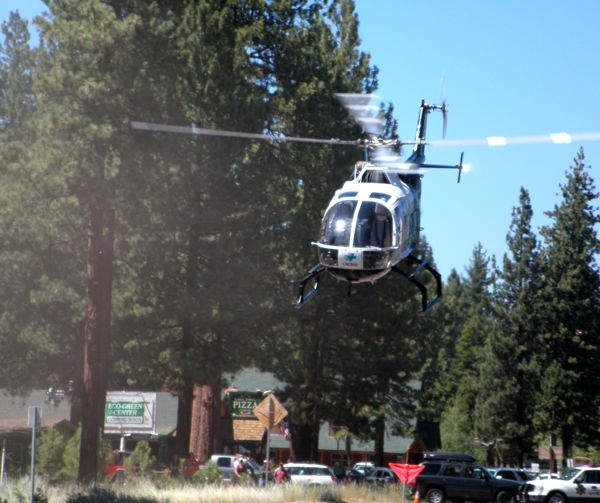
Uncertain of exactly where the caller was, the Sheriff’s Office did what it has done many times before: It radioed Calstar 6 – the non-profit rescue and air transport helicopter service in South Lake Tahoe.

Calstar has a base at Lake Tahoe Airport. Photo/LTN file

Calstar has a base at Lake Tahoe Airport. Photo/LTN file

“We are the only emergency aircraft located in the Tahoe basin … available 24 hours a day, seven days a week,” said Tom Pandola, Sierra Nevada regional director for Calstar.

Calstar’s Messerschmitt Bo 105 was already up in the air, and pilot Luca Dell’Anese turned it around to look for the possible caller.

Anyone whose commercial flight has come into Sacramento over the Sierra knows how featureless the backcountry can appear in the dark.

However, Dell’Anese and flight nurse Stephen Poehls were both equipped with night-vision goggles – a $15,000 piece of gear that allows them to spot a cellphone screen at night from 1,000 feet above.

Read the whole story


Outsourcing doesn’t affect Nevada as much as other states

By Karoun Demirjian, Las Vegas Sun

For months, Senate Majority Leader Harry Reid has blocked consideration of any free trade agreement until Congress first approves a federal program to help retrain U.S. workers whose jobs are outsourced.

“I’ve told Sen. McConnell, I’ve told the president, I’ve told anyone who will listen. I told Speaker Boehner. There will be no trade agreements unless trade adjustment assistance passes,” Reid said, referring to the program last week.

Reid’s distrust of free trade agreements runs deep: He’s said often that he doesn’t think they’re fair, and that in pressing for Congress to take up treaties to remove trade barriers without offering displaced workers some compensation, Republicans “are more concerned about what jobs are being created in Colombia or Panama or Korea than what are being created here in America.”

Trade-related outsourcing is a real concern for many states, but the impact in Nevada is small.

Trade adjustment assistance, or TAA, is offered to workers who have been hurt by competition from imports, or by companies moving their U.S. operations to a foreign country with which the U.S. has a free-trade agreement.

Last fiscal year, almost 16,000 displaced workers in Pennsylvania were certified to receive the benefits.

In Nevada, there were 63.

In fiscal 2009, when the recession hit and companies all over the country started to shed jobs, the Labor Department certified employees of 199 Michigan-based workplaces as eligible for TAA assistance.

In the same fiscal year in Nevada, the Labor Department certified five companies. The year before, it certified one; six employees received benefits.

In fact, through the past decade Nevada has ranked among the bottom handful of states for workers seeking such assistance.

“There’s not much going on there for Nevada’s economy,” said Elliott Parker, chairman of the UNR economics department and a professor of international trade. “When Sen. Reid makes that argument, he’s thinking about it on a national scale and not a state scale … The truth is, Nevada does not have much of a history of a manufacturing base, and that is the area that has been harder hit by free-trade agreements.”

In other words, Nevada’s 13.4 percent unemployment may be the worst the nation, but it isn’t because foreigners have been picking off our jobs.

Read the whole story


Squaw-Alpine join forces to become one ski company

By Kathryn Reed

The owners of Squaw Valley and Alpine Meadows are forming a company that will own and operate the two legendary North Shore resorts.

KSL Capital Partners bought the 1960 Olympic venue in November 2010, while JMA Ventures took over the neighboring resort in 2007.

With the Tahoe-Reno area going after the 2022 Winter Olympics, this combined force could add to the region’s solid foundation to prove it is worthy of hosting the Games again.

Looking toward Squaw Valley from Alpine Meadows. Photo/LTN file

Looking toward Squaw Valley from Alpine Meadows. Photo/LTN file

Rumors have circulated for years that Squaw and Alpine would become one resort in some fashion, with the latest chatter about it coming in June. It was officially announced today Squaw Valley Ski Holdings Inc. is operating both resorts.

Officials say the resorts will retain their unique brand and that the terrain will remain separate. But with one owner, those who have skied both resorts and kept an eye on all of the changes in the industry know that linking the resorts with something like the Peak-2-Peak Gondola that combines Whistler and Blackcomb mountains would be ideal in the Sierra.

Combined, Squaw and Alpine have 6,000 skiable acres, with more than 3,600 of them at Squaw. That terrain encompasses eight peaks.

KSL of Colorado will be the majority owner of the combined company, though it was not disclosed what the actual split is of the resorts that are just a 10-minute drive from one another. Nor has is been disclosed how the operations will be structured other than Andy Wirth, who was brought in as CEO of Squaw after CNL bought the resort, will be CEO and president of the new company.

The U.S. Forest Service and California Tahoe Conservancy must approve the transaction because both government entities own the land where the resorts operate.

Homewood Mountain Resort on the West Shore of Tahoe will remain solely owned and operated by JMA. The San Francisco-based company is in the process of trying to turn that small resort into a destination with hotel, condos, on-mountain upgrades and a new base lodge.

KSL already pledged $50 million in improvements to Squaw. The first $15 million will still be spent on upgrades for this season that is just two months away.

Wirth sent a letter this morning to Squaw guests that says, “Like many of you, I have stood at the top of KT-22 and looked at Alpine Meadows thinking how incredible it would be if the two resorts were combined. The idea of combining Squaw Valley and Alpine Meadows is a long time coming, but the actual transaction originated, very fittingly, on a chairlift.

“It was on a spectacular California bluebird day when I happened to be riding a chairlift with Todd Chapman, President and CEO of JMA (the owners of Alpine Meadows). We were talking about what an amazing winter we were all enjoying and lamenting that we didn’t have more time to get out and enjoy the snow.

“As the chairlift ride came to an end the talk turned to the obvious concerning our two mountain resorts. In the end, this was an effort forged in a passion for the mountains, snow, skiing, and riding.”

The first noticeable change for skiers is a joint pass for the two resorts called the Tahoe Super Pass.

With this merger, it ups the stakes a bit in the Lake Tahoe Basin to be the talk of the industry. After all, it was just a year ago Vail Resorts acquired Northstar-at-Tahoe. With Heavenly Mountain Resort being in its stable of resorts since 2002, it gives the Colorado company a presence on the North and South shore.

How the Alpine-Squaw merger will change the skiing community in Tahoe remains to be seen.


K’s Kitchen: Peach pie extends the flavors of summer

By Kathryn Reed

One advantage to a late harvest is being able to buy peaches in September. Normally those sweet nectars of summer are long gone from farmers’ markets by this time of year.

k's kitchenFortunately, I was able to buy about a dozen from the Perez Red Shack table at last week’s Tuesday market in South Lake Tahoe. (The market will be at the American Legion parking lot through Oct. 11 from 8am-1pm.) However, I was told it’s iffy if they’ll have more today.

Just like the harvest, I continue to be slow in making my usual summer foods. Thursday was the first peach pie of the season. Shame on me. I’ll be regretting that decision until next summer.

I invited friends over so Sue and I wouldn’t eat the whole thing – that, and it’s always nice to spend time with friends.

Kim did the research to know what the best beverage would be. Prosecco was what she wanted to buy, but Raley’s didn’t cooperate, so ended up with another sparkling wine. We all agreed bubbly is a good choice for peach pie.

The peach pie recipe is one my sister, Pam, shared with me years ago. It is originally from Bon Appetite magazine. Although it calls for a crust from scratch, I’m sure store bought would suffice – I would just be disowned by family if I ever bought a crust.

And for whatever, this crust never works well for me. I’m guessing whatever crust you normally use for pie would work fine.

Open-Face Peach Pie

1¾ C all purpose flour

2 tsp sugar

½ tsp salt

½ C (1 stick) chilled unsalted butter, cut into small pieces (salted works fine)

2-3 T ice water (Tahoe tap is cold enough)

3 pounds unpeeled peaches, pitted and sliced

¾ C sugar

½ C all purpose flour

2 T butter, cut into small pieces

1 tsp fresh lemon juice

Combine flour, sugar and salt in processor. (The food processor is not necessary. I use a pastry blender — one of those wire things with a handle.) Cut in butter until mixture resembles coarse meal. With machine running (or arm whirling), add enough water through feed tube drop by drop until dough just holds together; do not form ball. Turn dough out onto plastic wrap. Press into disc. Wrap and chill at least 1 hour. (Can be prepared three days ahead.)

Coat 10-inch (I always use a 9-inch) pie pan generously with nonstick vegetable oil spray, or butter pan. Roll dough out on lightly floured surface to 1/8 inch thickness. Fit dough into pan. Trim, leaving 1-inch overhang. Fold overhang back into pie pan. Press edges with fork. Refrigerate shell 1 hour.

Preheat oven to 425 degrees. Line shell with foil or parchment; fill with pie weights or dried beans. Bake 10 minutes. Remove foil and weights. Bake until golden brown, about 5 minutes. Reduce oven temp to 400 degrees.

Arrange peaches in crust. Mix sugar and flour. Sprinkle over peaches. Dot with butter. Drizzle with lemon juice. Bake until peaches are tender, about 45 minutes. Serve with vanilla ice cream.

Should make 6-8 servings unless you cut a pie like I do, in which case there are fewer servings.


History: Looking back at time on Tahoe’s beaches

Publisher’s note: This is reprinted with permission from the August 1976 Lake Tahoe Historical Society newsletter.

Several months ago, our newsletter carried a report of Linda Mendizabal’s interview with Mrs. Meliba Vallet Meier, whose father was chef at Tallac House some 65 years ago and whose playmate at the time was Gladys Comstock. Since that time we have had correspondence from Velma C. Eden further commenting on the time of which Mrs. Meier spoke. From her letters, we quote:

history logoFebruary 25, 1976

You asked about the ‘fabled beach tents’. My personal knowledge of Tallac is from the period September 27, 1900 to late fall 1913, the last year my family lived at Tallac. To my knowledge, there never were any tents on any of the Tallac beaches. However, much as I seem to be a slayer of myths, I hesitate to do so in this case, since there was a lot of going on in the 80’s and 90’s of which I had no knowledge. I have taken the time to reread some of my father’s memories painstakingly written down by my stepmother when he was a very old man. In speaking of the year 1885, he recalls “There was a fine sandy beach at Tallac and below the hotel, but not in sight of it, was creek named Taylor Creek.”

This would have been west of the old (original) Tallac House. In Scott’s Saga of Lake Tahoe, No. 1 Pg. 154, he mentions a quote, “Tallac is rustic and comfortable as well as commodious with a while sand beach one-half mile west.”

However, on pg. 156 of this same book, Scott mentions that the bathing activities were moved to a beach in front of the Tallac Hotel, a little to the east. This would have been after the Hotel Tallac was built in 1898. This is the beach I remember and not a very good or sunny beach. There was a slightly rickety wooden bathhouse at this beach, and very little used. Why, do you ask, was this beach used instead of the very fine one which I think now is called Baldwin Beach? Alas, the swampy area at the mouth of Taylor Creek was used as the Tallac sewage dump, and this would have influenced the removal of the swimming activities. We should not be too fast to criticize these early arrangements, as the early timers were face with many problems and had to face them any way they could.

It is entirely possible that there may have been some tents at the early beach to the west, but I do not know of them at first hand. Strange to relate, neither my sister nor I learned to swim while we were at Tallac. Our lives seemed to have been full of horseback riding and hiking and shooting. When very little I can remember playing in the sand at the beach. No one taught us to swim. When we moved to Brockway in 1915 we both learned to swim there and my sister, in her Senior year at U of California made first place in diving. I learned to swim well enough to feel very much at home in the water and still swim anytime I get the chance …”