Slew of water quality projects to improve Hwy. 50 in S. Tahoe

By Kathryn Reed

Expect traffic delays through much of the South Shore for the next several summers. This is because Caltrans has significant projects on the books.

Michael Cook with Caltrans was at the Feb. 21 South Lake Tahoe City Council meeting to give an update on what his agency is doing. The Trout Creek to Ski Run Boulevard project that started last summer is expected to wrap up in October.

While Southwest Gas is not expected to add to the congestion this summer like it did in 2011 with work on Pioneer Trail, significant delays will be unavoidable before July 4 and after Labor Day.

Nancy Kerry, who was acting city manager while Tony O’Rourke was out Tuesday, suggested Caltrans reach out to the chambers of commerce much like the transportation department did before Echo Summit was closed last year. This would be so businesses would know what to expect in terms of work in front of their business, limitations to driveways and other impacts.

Last summer many businesses on Harrison Avenue experienced a significant drop in business because people could not conveniently get to their location.

Caltrans also has a 72-hour obligation to let businesses know of road closures affecting their business.

Councilman Tom Davis asked what happens to parking near Tep’s restaurant and the neighboring businesses.

Cook said what is there will go away to accommodate the curb, gutters and sidewalk.

“There’s not room for both,” Cook said in reference to parking and improvements.

In 2013, Caltrans will widen Highway 50 in the area of Lake Tahoe Airport.

In 2014, Caltrans expects to begin work on the water quality project from the Y to Cascade Road on Highway 89. Also starting that summer are upgrades from Trout Creek to the Y. That is likely to be a three-year project.

All of these are considered water quality projects, with the emphasis of reducing sediment from reaching Lake Tahoe. At the same time some bike paths, sidewalks and lighting will be added.

What doesn’t have a timetable is the adaptive traffic signal project. Funding is the problem – there isn’t any.

Councilwoman Angela Swanson brought up the possibility of getting local transportation dollars to help with it – specifically Congestion Mitigation and Air Quality funds.

Some of the technology will be put in while Caltrans is working on the highway. The idea is one day traffic lights on the South Shore will be synchronized.


‘Tenth Inning’ is perfect prelude to baseball season

By Kathryn Reed

Ah, it’s baseball season. Pitchers and catchers for the San Francisco Giants reported to spring training in Scottsdale on Saturday. Position players report Thursday. The first full workout is Friday.

Each winter it’s a ritual in our house to watch baseball movies to fill the void between the last out of the World Series and first crack of the bat for the new season.

Instead of our normal line up, we rented something new. “Baseball: The Tenth Inning” is a film by Ken Burns and Lynn Novick. It will get you ready for the 2012 season – all four-plus hours. The documentary is so long it comes on two discs. I would have been fine with it being longer.

This movie is essentially a follow-up to Burns’ 1994 movie “Baseball”. It picks up in the 1990s and goes until just before the film came out in 2010.

From the film’s website, “In an age of globalization, deregulation and speculation, the film demonstrates that baseball has continued to be a mirror of the country – at its best and at its worst. The film also movingly shows that when America felt most threatened, following the terrorist attacks of Sept. 11, 2001, baseball offered common ground, providing Americans with solace, distraction, and the hope that things could one day return to normal.”

The film doesn’t gloss over the steroid infused players, the strike, and the Boston-New York rivalry. With there being so many facets to the world of baseball, many segments could have been four-hour documentaries on their own – like the use of performance-enhancing drugs.

The whole issue of Bill James transforming baseball through nontraditional stats was barely touched on. One has to read “Moneyball” to get that full story.

Still, “Baseball: The Tenth Inning” is a must-see for anyone who calls themselves a fan of baseball.


Snippets about Lake Tahoe

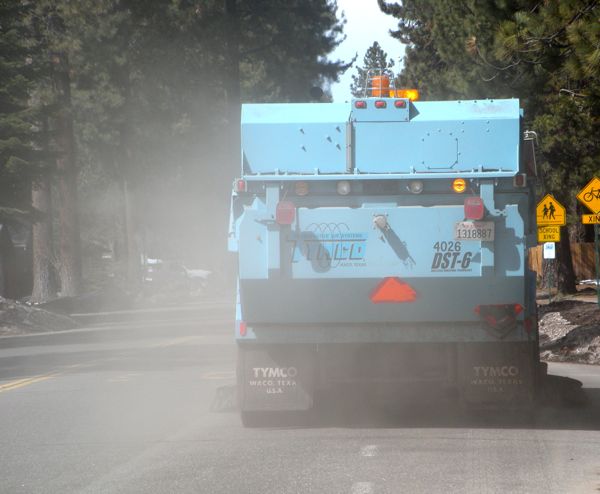
• Does sweeping the roads of Lake Tahoe hurt or help lake clarity? Here’s what the Tahoe Pipe Club has to say.

• State Sen. Ted Gaines, R-Rocklin, has been appointed to serve as a member of the Budget and Fiscal Review, and Legislative Ethics committees for the remainder of the 2011-12 legislative session.

• Leave No Trace Center for Outdoor Ethics honored Dave Polivy, owner of Tahoe Mountain Sports in Kings Beach, as one of its extraordinary member-activists of 2011.

• Read about Random Acts of Kindness beyond the Lake Tahoe Basin.

• Results of the annual South Lake Tahoe citizens’ survey, which is randomly sent to residents and businesses, are on the city’s website.


Barton doc in Russia scouting out site of next Winter Games

By Rebecca Wass

Sochi, Russia, is next on the list for orthopedic surgeon Terry Orr’s medical volunteerism. As a physician with Tahoe Orthopedic & Sports Medicine, he will be previewing the site of the 2014 Winter Olympic Games as part of his role as head team physician for the U.S. Men’s Alpine Ski Team — a position he has had since 1999.

Orr has dedicated much of his orthopedic career to treating the world’s top winter athletes, including Olympians. With his experience in the Olympics, he was chosen to serve as chief medical officer at the first Winter Youth Olympics in Innsbruck, Austria, in January. There, he oversaw medical care for the U.S. team.

Terry Orr

The youth event included athletes from more than 60 nations competing in skiing, snowboarding, bobsleigh, biathlon, cross country skiing, figure skating, freestyle skiing, luge, ice hockey, speed skating, Nordic combined, ski jumping, skeleton and short track speed skating events.

When it comes to the winter games, Orr is a seasoned veteran of Olympic athlete medical care.

Lake Tahoe News caught up with Orr before the 2010 Vancouver Games.

Orr is currently spending a few weeks in Russia providing medical coverage for the U.S. team at the first Alpine World Cup races in Sochi. Traveling to Sochi will give Orr an opportunity to assess the event venue and help develop an emergency action plan in case of any emergency incidents at the site of the 2014 Winter Olympic Games.

“As the host nation for the Olympics, Russia will set up a mini-medical-center and provide the necessary equipment and facilities to care for all athletes,” Orr said. “Such a center typically features exam rooms, X-ray, laboratory, pharmacy, MRI, along with a mobile operating room and includes all of the basic necessities of a hospital. In addition to injuries, we also treat illnesses that come along with just being on the road.”

Orr has volunteered much of his time on the medical team for the U.S. Ski Team. This has included covering training camps, World Cup races, World Cup finals and World Championships throughout the world. He says he will be on the side of the race course in Sochi whenever the U.S. team is training or competing. If someone is injured, he travels down with the athlete to evaluate, treat and/or assist in treatment.

“We build great relationships with the athletes while they are competing to qualify for the Olympics,” Orr said. “When the physicians that have been there by the athlete’s side during their competitions are able to follow them through to the Olympics, it gives the athlete a sense of ease, because we know them, their medical background, as well as the sport.”

In the 2002, 2006 and 2010 Winter Olympic Games, Orr served as a physician on the medical staff for Team U.S.A., with a primary focus on the Men’s Alpine Ski Team.

“When he [Dr. Orr] talks, you listen,” said Daron Rahlves, men’s downhill and alpine champion and U.S. skicross Olympian. “He has seen me throughout my career about 10 times; he’s also taken care of my family and friends. I have 4-year-old twins now. If they were ski racing, I would definitely want Terry there.”

In 2010, Rahlves suffered a dislocated hip during a competition and Orr took care of him with platelet rich plasma injections — a procedure based on a once seemingly revolutionary idea: inject people with their own blood, concentrated so it is mostly platelets, the tiny colorless bodies that release substances that help repair tissues.

“He’s really cutting-edge and I was back on my skis in two weeks and competing in three,” Rahlves said. “He really reduced my recovery time. When you travel someplace new, it’s not only imperative to have someone experienced who really knows the team, but someone you trust and has been around for a while.”

Selections for the 2014 Winter Olympic Games medical team for United States’ athletes will take place in 2013.

“The Olympics has always been my favorite sporting event, and it has been great to be able to be a part of it,” Orr stated.

Rebecca Wass works for Barton Health.


What actor or film is Oscar-worthy?


El Dorado County Grand Jury funding issue remains unresolved

A February court date to determine whether the El Dorado County Grand Jury will be funded at the level it wants or if the Board of Supervisors can enforce the budget it approved last year has been pushed back to mid-March.

The Board of Supervisors on Jan. 24 augmented the grand jury budget by $12,000.

It’s possible the topic will be on the Board of Supervisors’ agenda Feb. 28, as well.

Lake Tahoe News first reported on this Feb. 1.

— Lake Tahoe News staff report


Opinion: A lesson in civility

By Cal Thomas

When one writes about moral convictions, it’s probably a good idea to consistently live up to them. That way people can still disagree with your convictions, but they have a difficult time accusing you of hypocrisy.

Earlier this month at the Conservative Political Action Conference (CPAC) in Washington, I failed to live up to one of my highest principles. Here’s the background. The story about the Obama administration’s attempt to force Catholic and other faith-based institutions to offer employees free contraception in their health care coverage was still fresh. I was asked to be on a panel before what looked like a crowd of about 1,000 conservatives, hungry for “red meat.”

Cal Thomas

A clip was played from Rachel Maddow’s MSNBC program. It featured her commenting on the subject. I stupidly said before thinking, “I think she’s the best argument in favor of her parents using contraception.” I then added, “and all the rest of the crowd at MSNBC, too, for that matter.”

It didn’t matter that far worse things have been said in print and on TV about me. I am not supposed to behave like that. I co-wrote a book with my liberal Democratic friend, Bob Beckel, called “Common Ground: How to Stop the Partisan War That is Destroying America.” We also write a column together for USA Today. One of the principles in which I believe is not to engage in name-calling; which, to my shame, I did.

The next morning I felt bad about it, so I called Ms. Maddow to apologize. It wasn’t one of those meaningless “if I’ve offended anyone…” apologies; it was heartfelt. I had embarrassed myself and was a bad example to those who read my column and expect better from me.

Maddow could not have been more gracious. She immediately accepted my apology. On her show she said publicly, “I completely believe his apology. I completely accept his apology.” To be forgiven by one you have wronged is a blessing, it’s even cleansing.

Politics has always been a contact sport. Thomas Jefferson and John Adams went at each other like the worst of enemies, using some of the most outrageous and slanderous language. I don’t have bona fides equal to their founding of America, so there is nothing of similar magnitude on which I can fall back.

Maddow also accepted my invitation to lunch and we will soon meet in New York. I am looking forward to it. Since the incident, which, of course, garnered a mini-tornado of media and blogosphere coverage, I have watched a couple of her shows. Without engaging in any qualifiers, she is a strong and competent advocate for her position. Why do so many of us only watch programs that reinforce what we already believe? Where is the growth in that? Whatever else she may or may not be, she is my fellow American.

I have many liberal friends acquired over the years. They are impossible to avoid in the media, but I don’t wish to avoid them. They became my friends because I stopped seeing them as labels and began seeing them as persons with innate worth. That is what I failed to do in my first response to Rachel Maddow. One might expect a pro-lifer like me to support the birth of fellow human beings and not suggest they should never have been born.

I expect to like Rachel Maddow because my instinct is to separate the value of a person from his or her political position. For some strange reason (demon possession, perhaps) I failed to do that at CPAC.

So, apology delivered and accepted and lunch will soon be served. I’m trying to decide whose career might be hurt more should someone take a picture of us enjoying a meal and –it is to be hoped, at least by me — each other.

Cal Thomas is co-author with Bob Beckel of “Common Ground: How to Stop the Partisan War That is Destroying America”.


KidZone Museum fundraiser

Everyone is invited to Big Night Out – Disco on April 28 at Dragonfly restaurant in Truckee from 5:30-11pm to raise money for KidZone Museum.

Tickets cost $40 per person in advance and $45 at the door. They include three complimentary drinks (beer and wine), dinner, dance music by disc jockey Brian Hess, a silent and live auction and raffle.

Go online for tickets.

KidZone Museum is a nationally recognized children’s museum that is striving to see some big dreams come true in 2012. One vision is to broaden the museum’s reach and extend its programs to more children and their families in the Truckee-Lake Tahoe region.


Meet the League’s new ED

League to Save Lake Tahoe Executive Director Darcie Goodman-Collins is having a meet and greet reception on March 6 from 6-8pm at the League’s offices in South Lake Tahoe.

The office is at 2608 Lake Tahoe Blvd.

RSVP (530) 541/5388 or events@keeptahoeblue.org.


Hwy. 50 speed limit changes anger South Shore residents

By Kathryn Reed

“Fifty on 50” has long been the joke about the speed locals drive on the main thoroughfare through the South Shore. Only it’s not a joke anymore. And the actual speed limit from Meyers to Stateline is 55 mph where it’s one lane in each direction and 65 mph where it’s two lanes in each direction.

This is because Caltrans conducted traffic and engineering studies that found people are already safely driving faster than the posted limit. Until the new limit signs are in place, the current speed limit signs are not enforceable per state law. Instead, the law becomes what is normal for state highways based on the number of lanes – thus the 55 and 65 mile per hour limits.

When the signs go in – which is expected within two months – the speed limit on this nearly 10-mile stretch of highway will be 5 mph higher than what it is now posted. So, it will be 45 mph in Meyers, 55 from Country Club Drive to just past Lake Tahoe Airport where it will switch to 45 at Kyburz Road, then a quarter mile farther east it will switch to 40 mph and will remain that limit through South Lake Tahoe.
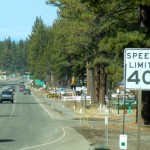
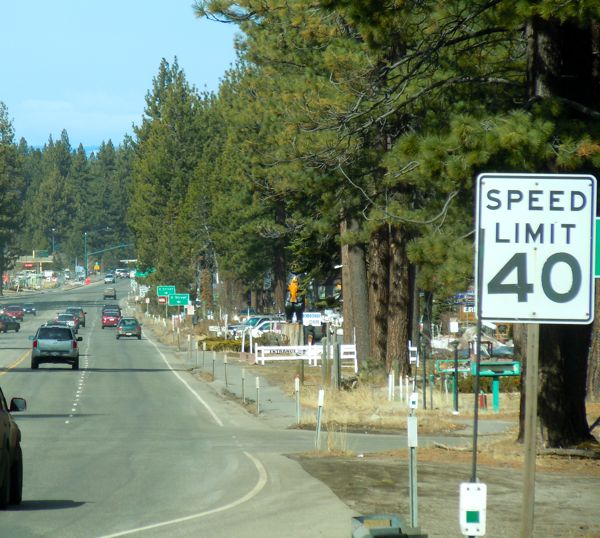
Speed limit signs don't mean a thing right now on the California side of the South Shore. Photo/LTN

Anyone who has gotten a ticket since December for speeding should be able to successfully win in court.

CHP officers have not been enforcing the posted limit signs since December when they were notified by Caltrans officials of the survey results.

“We haven’t noticed any changes yet,” California Highway Patrol Officer Jeff Gartner told Lake Tahoe News in regard to drivers altering their speed through the South Shore. This means they are going the posted limit.

State transportation officials were in town Feb. 21 for two meetings to discuss the issue with officials and residents. The first session was before the South Lake Tahoe City Council; the evening session was at Lake Valley fire station in Meyers.

Pat Kelley, an engineer with Caltrans, told those at both meetings, “There must be a legal reason not to raise the speed limit.”

But she could never cite a legal reason despite being asked to do so at both meetings. People at both meetings were clearly frustrated in wondering what the point of the gatherings were when Caltrans was going to raise the speed limit despite all of the objections from those in attendance.

People in Meyers questioned whether the Tahoe Regional Planning Agency could launch a legal fight by saying the increase in speed increases emissions and increases sediment reaching the lake.

Later in the meeting, TRPA spokeswoman Kristi Boosman said, “The major focus of the Regional Plan update is livable, walkable town centers. This flies in the face of that.”

She also mentioned air quality concerns.

Of the seven people who spoke at the council meeting, all were against raising the speed limit. Of the more than 50 people at the Meyers meeting, no one spoke in favor of upping the limit.

When El Dorado County Supervisor Norma Santiago said she thought the speed through Meyers should be reduced to 35 mph, it was met with applause.

What the council wants to do is change the state Vehicle Code that uses a one-size-fits-all approach to setting speed limits on California highways. Mayor Claire Fortier will write a letter to Caltrans as well as to state lawmakers to work on changing the law.

State law was changed in 2009 to parallel federal law that in the end stripped Caltrans of its ability to lower speed limits based on criteria that would consider specific needs of a community.

Today the law does not take into consideration that the state highway goes through a town, the number of stoplights, the number of driveways, that people are walking in the highway (especially in winter) because this area is so deficient on sidewalks, or the fluctuations in traffic based on Tahoe being a tourist community.

Santiago at the night meeting also expressed how the law doesn’t consider the character of a community, the fact that schoolchildren are crossing a state highway with no marked crosswalk, and that cyclists share the road in so many areas where no path is available – just the lane of traffic.

For locals, Highway 50 is more like a city street and not a state highway. After all, much of it is called Lake Tahoe Boulevard or Emerald Bay Road. But for Caltrans, it only sees the highway designation.

Kelley said the surveys were taken in dry conditions, in the middle of the week, and during the off-season (for the city).

The council wants Caltrans to count cars and their speed midweek during peak summer season.

As Councilman Hal Cole put it, he believes the statistics are skewed in favor of raising the speed limit, and that a compromise of the varying conditions needs to be considered.

Pete Fink, an avid cyclist, said, “We are trying to increase the recreation aspect of this town. Increasing the speed limit is diametrically opposite of that.”

Many said how the South Shore is trying to be more pedestrian and bicycle friendly, and that making it a more scary endeavor to walk or bike through town because of vehicles racing by even faster will thwart any progress that has been achieved and unhinge future improvements.

In the end, Kelley said she would take the council’s concerns back to her legal department to see if the current limits could remain. She also said Caltrans could conduct another survey one day this summer.

The Meyers area also wants another survey because people don’t believe the three April 2009 dates and July 2 that year reflect a true representation of traffic. They want more locals and fewer tourists to be counted. Caltrans did not agree to do this.

What Caltrans studies are prevailing speeds, accident data and conditions not readily apparent to a driver. The minimum number of vehicles counted is 100 at each location. These studies are supposed to be done every seven years. But it’s been 10 years since the South Shore was last studied. Why the delay? Kelley deferred the question to a spokeswoman for the agency who could not answer the question.

In South Tahoe, 13.3 million vehicles traveled through town in a three-year period. Four collisions involving eight vehicles occurred in that time, according to Caltrans.

In Meyers, 8.3 million vehicles went through the area in three years, with 37 accidents involving 74 vehicles. Twenty-seven of those accidents occurred between Friday and Sunday, according to Caltrans.

Highway officials say the accident rate on the South Shore is extremely low for the number of vehicles using the state highway.

Stats, according to Caltrans, show the accident rate does not rise as the speed limit increases.

Another trigger for Caltrans to reconsider speed limits is if changes have been made to the area that would affect how people drive. For South Lake Tahoe, the curb-gutter-sidewalk project that should be completed this summer should necessitate another traffic study in spring 2013.

For Meyers, nothing is on the books today that would necessitate another study.

While some time was spent on how best to cross the highway in Meyers, residents scoffed when told a striped crosswalk is more dangerous than not having one. Caltrans said it gives people a false sense of security. Residents are looking for security and believe no designated area to cross is more dangerous.

A roundabout was talked about, but the discussion was lost among the speed limit dialog.

For today, the speed limits from Meyers to Stateline on Highway 50 are either 55 or 65 mph.

Because of that, South Lake Tahoe Police Chief Brian Uhler wants the new limit signs – even though they increase the current posted limits – put up ASAP so the speed laws are more reasonable. He said those signs could always revert back to the lower speeds if Caltrans can be convinced raising the speed limit is not logical.