Coffee linked to lower risk of death

By Amina Khan, Los Angeles Times

Researchers have some reassuring news for the legions of coffee drinkers who can’t get through the day without a latte, cappuccino, iced mocha, double-shot of espresso or a plain old cuppa joe: That coffee habit may help you live longer.

A new study that tracked the health and coffee consumption of more than 400,000 older adults for nearly 14 years found that java drinkers were less likely to die during the study than their counterparts who eschewed the brew. In fact, men and women who averaged four or five cups of coffee per day had the lowest risk of death, according to a report in Thursday’s edition of the New England Journal of Medicine.

The research doesn’t prove that coffee deserves the credit for helping people live longer. But it is the largest analysis to date to suggest that the beverage’s reputation for being a liquid vice may be undeserved.

“There’s been concerns for a long time that coffee might be a risky behavior,” said study leader Neal Freedman, an epidemiologist with the National Cancer Institute who drinks coffee “here and there.” “The results offer some reassurance that it’s not a risk factor for future disease.”

Coffee originated in Ethiopia more than 500 years ago. As it spread through the Middle East, Europe and the Americas, its popularity was tempered by concerns about its supposed ill effects. A 1674 petition by aggrieved women in London complained that coffee left men impotent, “with nothing moist but their snotty noses, nothing stiff but their joints, nor standing but their ears,” according to the book “Uncommon Grounds: The History of Coffee and How It Transformed Our World.”

Read the whole story


A night to learn about birds; a field trip to find them

Two birding events are coming to the North Shore in June.

The first is June 14 at 5:30pm where people can learn about Tahoe’s avian summer visitors. This will be at the Tahoe Center for Environmental Sciences (291 Country Club Drive, Incline Village).

Kirk Hardie, co-executive director of the Tahoe Institute for Natural Science, will be conducting both events.

The second is a bird watching walk on June 16 starting at the UC Davis Tahoe City Field Station. This is from 8-10am.

A $5 donation is suggested.

For additional information, contact (775) 881.7566, tercinfo@ucdavis.edu.


Melinda Gates using her money and influence to help women

By Michelle Goldberg, Newsweek

In the 12 years since Melinda Gates and her husband, Bill, created the Gates Foundation, the world’s largest philanthropic organization, she has done a lot of traveling. A reserved woman who has long been wary of the public glare attached to the Gates name, she comes alive, her associates say, when she’s visiting the foundation’s projects in remote corners of the world. “You get her out in the field with a group of women, sitting on a mat or under a tree or in a hut, she is totally in her element, totally comfortable,” says Gary Darmstadt, director of family health at the foundation’s global health program.

Visiting vaccine programs in sub-Saharan Africa, Gates would often ask women at remote clinics what else they needed. Very often, she says, they would speak urgently about birth control. “Women sitting on a bench, 20 of them, immediately they’ll start speaking out and saying, ‘I wish I had that injection I used to get,’” says Gates. “‘I came to this clinic three months ago, and I got my injection. I came last week, and I couldn’t get it, and I’m here again.’”

They were talking about Depo-Provera, which is popular in many poor countries because women need to take it only four times a year, and because they can hide it, if necessary, from unsupportive husbands. As Gates discovered, injectable contraceptives, like many other forms of birth control, are frequently out of stock in clinics in the developing world, a result of both funding shortages and supply-chain problems.

Women would tell her that they’d left their farms and walked for hours, sometimes with children in tow, often without the knowledge of their husbands, in their fruitless search for the shot. “I was just stunned by how vociferous women were about what they wanted,” she says.

Because of those women, Gates made a decision that’s likely to change lives all over the world. As she revealed in an exclusive interview with Newsweek, she has decided to make family planning her signature issue and primary public health a priority. “My goal is to get this back on the global agenda,” she says. She is sitting in an office in the Gates Foundation’s 900,000-square-foot headquarters in downtown Seattle, a pair of airy boomerang-shaped buildings flooded with natural light. It was here at headquarters late last year that she announced her new emphasis on contraception at an all-staff meeting, to thrilled applause.

Now the foundation, which is worth almost $34 billion, is putting her agenda into practice. In July it’s teaming up with the British government to cosponsor a summit of world leaders in London, to start raising the $4 billion the foundation says it will cost to get 120 million more women access to contraceptives by 2020. And in a move that could be hugely significant for American women, it is pouring money into the long-neglected field of contraceptive research, seeking entirely new methods of birth control. Ultimately Gates hopes to galvanize a global movement. “When I started to realize that that needed to get done in family planning, I finally said, OK, I’m the person that’s going to do that,” she says.

Despite Gates’s passion, stepping forward wasn’t an easy decision. For one thing, the former Microsoft manager has always shunned the spotlight. The first time she agreed to a magazine profile was in 2008, 14 years after her marriage, when she spoke to Fortune about the foundation’s work. “I was reluctant to speak out on behalf of any foundation issues early on, because I had little kids, and I wanted some privacy in my family life,” she says.

Read the whole story


Truckee area boat inspections about to begin

Tahoe Resource Conservation District will again manage the Truckee Area Watercraft Inspection Program for 2012. Entering its third season, Truckee area inspections and boater education on aquatic invasive species will take place at Donner Lake and Boca, Prosser, and Stampede reservoirs from late May through September.

Current funding for Truckee Area watercraft inspections and outreach has been provided by the Truckee River Fund.

Boat inspections are the front line to prevent the introduction of AIS, as boats and other motorized watercraft are the largest vectors for spreading AIS into new water bodies.

Free decontaminations will be available for high risk vessels wishing to launch at Truckee area water bodies. These will occur at Alpine Meadows Transportation Station parking lot, off Highway 89 and Northstar’s Castle Peak parking lot off Highway 267.


LTCC student art to be on display

Lake Tahoe Community College’s annual student art exhibit opens Sunday. There will be a reception from 2-5pm in the commons area.

More than 500 pieces will be on display starting May 20.

The free exhibit will be on display through June 16.


Security an issue as Nevada delves into online gaming

By Richard N. Velotta, Las Vegas Sun

With the state about a month away from granting its first online gambling license, two experts told members of the Gaming Policy Committee on Monday that regulators needed to stay vigilant in their efforts to keep the online gaming environment secure.

One of them hopes to take the security of Nevada’s potential Internet gambling industry to a new level by using grant money to develop a system that not only would protect gamblers’ online transactions but detect and prevent underage players and cheaters from playing.

Online security strategist James Elste, principal for INOV8V CyberCQRT, told the advisory committee that his company was one of 27 finalists out of 186 applicants for a federal grant through the National Institute of Standards and Technology. Up to eight grants are expected to be awarded in several aspects of cybersecurity.

Elste’s company is working on behalf of the state to get $2 million a year for two years to develop the gold standard for Internet gambling security.

Committee member Mark Lipparelli, chairman of the state Gaming Control Board, said the state would demand the highest levels of security when regulators begin issuing licenses. Under regulations approved by the Nevada Gaming Commission, there’s no specific security standard in place since companies are using differing strategies to detect illegal play and participation.

However, applicants will have to prove to regulators that their systems will be able to identify players and prevent underage gamblers from playing and detect whether players are within the state’s borders.

Read the whole story


LTN tidbit 19: Business, service information in the Directory

May is 31 tidbits about Lake Tahoe News month.

LTN tidbit No. 19:

Need to find a business or resource in the Lake Tahoe Basin? Then consider taking a look at the Directory that is accessed at the top of Lake Tahoe News’ home page.

Advertisers who have at least a six-month contract are in the Directory – one of the perks of advertising. Service clubs that have contacted Lake Tahoe News are in it for free. Key recreation resources that readers would want are listed.

If you, your business or the entity you represent are not in the Directory, consider doing so for $100 a year. If you think you should be in there without paying the annual fee, let us know. Shoot us an email at info@LakeTahoeNews.net to find out more about the Directory.

Here is information about becoming a paid subscriber.


Free Bird awarded Lakeview Commons concessionaire, Regan Beach up in the air

By Kathryn Reed

One South Lake Tahoe beach concessionaire is locked in – Free Bird will be at Lakeview Commons.

These are the crepe people.

Lake Taco has been offered a deal to continue operating at Regan Beach, but owner Danny Chavez has told city officials he isn’t so sure he wants it because access to the beach will be encumbered this summer.

The day after the City Council tabled making a decision on who will be selling food, staff decided to reject all bids. This also eliminated the need for the May 18 special meeting that had been scheduled.

City Attorney Patrick Enright and Assistant City Manager Nancy Kerry met with Lake Tahoe News on May 18 to talk about what is likely to happen.

Because there were two ranking systems used by the three city staff members who evaluated the potential concessionaires, there were irregularities. That is why the top candidate from each set of criteria was chosen.

Staff, because no money is being expended and it’s a short-term contract, can make these decisions without council approval. The contracts are for this season only.

The plan is to send out a request for proposal in the fall to have a business or businesses on board for the following five summers.

Enright said Chavez has not signed the one-summer contract because new playground equipment will be installed at Regan Beach this summer and the parking lot will be used as a staging area for construction work in the Al Tahoe neighborhood after Labor Day.

Chavez is afraid it will not be a profitable endeavor, Enright said.


Snippets about Lake Tahoe

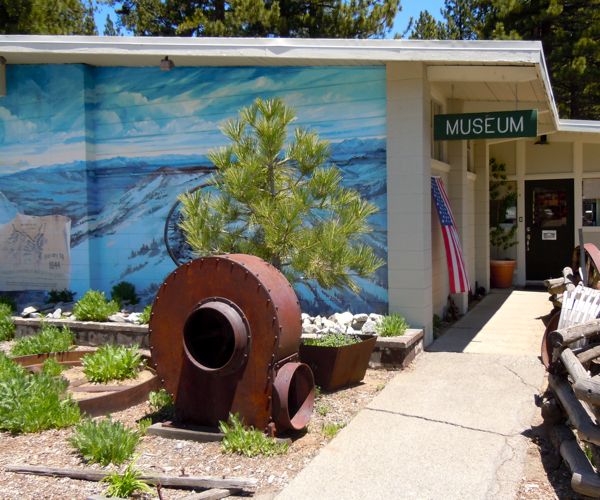
• Lake Tahoe Museum’s season begins May 26. The South Lake Tahoe museum will be closed Mondays and Tuesdays unless an appointment is made.

• Placer County is selling surplus equipment via online auction companies. This is a link to the first site, and to the second site.

• Gregory Eyre, general surgeon, recently joined Lake Tahoe Surgery Center.

• On May 24 from 7-9pm will be an Incline Village General Improvement District candidate forum at the Tahoe Environmental Science at Sierra Nevada College.

• Porters Sports has closed its Tahoe City store, but the Truckee outlet is still open.


Taking care of injured, unwanted wildlife should be immediate

By Cheryl Millham

I am so sad because a baby Steller’s Jay was never brought in for care. I have had to learn just to let things go, but it still hurts.

As the story goes, I got a call last Saturday from a young lady at Lake Tahoe Community College saying some Jays built a nest on a piece of equipment and one egg hatched on Friday. Since she called me on Saturday, I told her to let the baby Jay stay as long as it could with its mom. I explained it only takes 23 days before the baby will fledge and leave the nest and would they be able to wait.

She told me the piece of equipment had to be used this week. I told her to bring in the nest – with the baby to the wildlife center – just before they would use the equipment.

We would then complete the “raising” of the baby. Well, here it is, a week later, and no baby. I do not know if they just threw out the nest with the baby (yes, it has been done before), or if someone took it home to raise, which is illegal in most states (including California).

Let me tell you why this is a bad idea.

It takes 14 days for an egg to hatch and 23 to 25 days for the baby bird to leave the nest. This is called fledging. The young bird goes to the ground to hop around and learn to fly. The parents feed it and encourage it to fly. Some kids are quick learners and some take a few days.

If the baby bird does not get the proper diet – due to the fact they develop so fast in 23–25 days – they cannot develop strong bones and feathers. Baby birds get fed every 15 minutes for 14 hours, plus have to be kept warm.

If you know you are going to do work on your house or paint it and can’t leave a nest alone for one month, please do not let the birds build a nest at your house.

Brewers Blackbirds might seem cute, building their nest and sitting on eggs, but once the eggs hatch and they are caring for their babies, they become very protective and will dive bomb anyone who gets close to the nest. Sometimes, even hitting people on the head.

One of our senior volunteers called this week and said her dog alerted her that something was in the chimney. So, she opened the flu and saw an adult raccoon looking down at her. So, she called LTWC for some direction.

She thought the raccoon was stuck. I assured her that raccoons climb up and down inside chimneys just like they do trees. They have their babies inside a chimney because to them it is a safe place.

Warning — do not start a fire. Doing this can kill her and if she has already had her babies, they will suffocate as well.

One way to get the raccoons to leave is to use regular scented Pine Sol. Soak the Pine Sol on some rags and stuff them up in the chimney (using a stick, pole, branch, etc.) close to where the raccoon is trying to nest. The fumes will definitely cause her to re-think where she should make her nest. Only use “regular” Pine Sol.

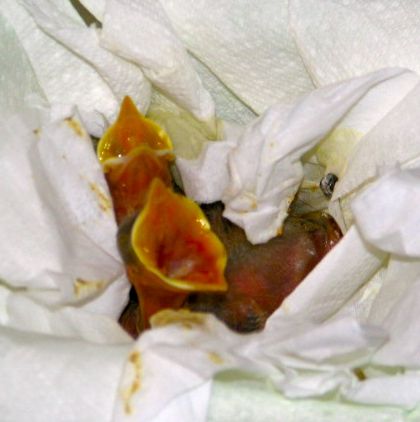
These newly hatched birds are called nestlings. They have just hatched and have no feathers. They rely on mom entirely for warmth, food and safety. Photo/LTWC

I got a call back about 30 minutes later by our volunteer, saying that within 5 minutes the mom raccoon made a bee line out of the chimney. She went to get her camera to take a picture of mom coming out of the chimney, but she had already left.

Please feel free to call Lake Tahoe Wildlife Care (530.577.2273) to receive some directions if you have wildlife trying to move in with you and your family. We have lots of suggestions.

Cheryl Millham is executive director of Lake Tahoe Wildlife Care on the outskirts of South Lake Tahoe.