S. Tahoe skydiver dies landing in Lake Tahoe, 2 survive

Updated: May 22, 2012, 3:25pm

By Kathryn Reed

CAMP RICHARDSON — One skydiver is dead and two others survived their jump near Camp Richardson on Tuesday morning.

Robert Ranieri, 29, of South Lake Tahoe was found in 12 to 15 feet of water by El Dorado County sheriff’s divers.

Lt. Pete Van Arnum said Ranieri used to be a search and rescue volunteer for his department.

The coroner is likely to perform an autopsy Wednesday. The FAA will be part of the investigation.

The plan was for the three to jump from the helicopter that had taken off from Lake Tahoe Airport and land on Pope Beach like they had done last week. Instead, two of the jumpers landed in the icy waters of Lake Tahoe, while the third landed on the sand.
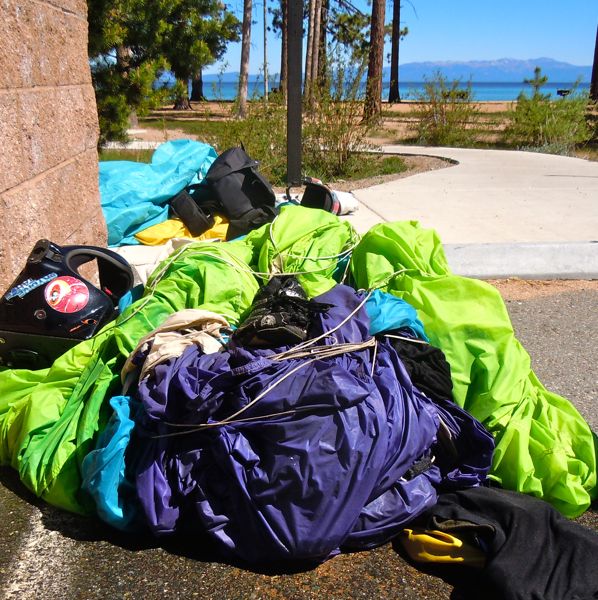
Helmets, parachutes and other gear from the skydivers. Photos/Kathryn Reed

According to the National Weather Service in Reno, the wind speed at the airport at 8:53am was 17 mph, with gusts of 24 mph. The accident occurred moments earlier.

Van Arnum said sky diving is rare in the Lake Tahoe Basin.

“There are not that many good landing areas in the basin because you don’t want to land in the water or in the trees,” Van Arnum told Lake Tahoe News. “These guys chartered a helicopter ride from airport. Supposedly they were experienced.”

Chris McKean, who owns a barge that is docked at Camp Rich, said he and some of his crew at about 8:45am raced to the jumpers who were in the water. He said the man they pulled to safety was about 250 yards from shore and about three-quarters of a mile down Pope Beach.

McKean said the person was treading water without a life jacket and yelling for help.

“He was shivering and cold and worried,” McKean said.

Hypothermia can set in quickly and people cannot survive for long in Lake Tahoe because of the temperature. The water temperature last week at Camp Rich tested at a depth of 10 feet was 48 degrees, while the surface temp at Timber Cove was 52 degrees.

“We went for the other guy. We found his chute and helmet floating, but not him,” McKean told Lake Tahoe News.

At 10:42am a yell from one of the searchers on one of the nearly dozen vessels helping with locating the missing parachutist could be heard on Pope Beach. The victim’s body had been found several hundred yards off shore.

Law enforcement and private boaters had been using a grid system to locate the victim. A CalStar helicopter had helped early on, with a CHP and Coast Guard chopper called off once the body was located.

The surviving skydivers and their friends waited out the search at Pope Beach, but declined to speak with Lake Tahoe News. Gear from two of the parachutists was in a heap at the edge of the beach parking lot.

“I don’t mean to be rude, but I have no comments at this time,” Claudio Belloto, who runs the helicopter tour operation out of Lake Tahoe Airport wrote in an email to Lake Tahoe News.

About 12 boats, some private, help locate the skydiving victim on May 22.

 

It was a long wait for friends at Pope Beach.


Creative writing workshop in Truckee

The Craft Cafe Creative Writing Workshop Series is May 24-June 24 in Truckee.

Craft, technique, and prompts for fiction, nonfiction, and poetry will be the focus of the four-week session.

This is an opportunity to connect with a writing community and improve your writing practice.

The class is from 6-8pm on Thursdays nights. Cost is $80. Drop-in friendly with reservation.

For more info, email tangledrootswriting@gmail.com or call (530) 386.3901.


Fundraiser benefits trail system in Carson Valley

The Carson Valley Trails Association fundraiser for the Carson Valley Discovery Trail is June 19 from 5-8pm at the C.V.I.C. Hall in Minden.

The event will feature live and silent auctions, games, live music performed by Foothill Road, complimentary refreshments and no-host bar.

Tickets are $10 and may be purchased by calling (775) 265.3736.

This event will kick off CVTA’s fundraising effort for the 100-mile Carson Valley Discovery Trail, a 100-mile loop trail system envisioned to eventually encircle the Carson Valley. This trail system, which is part of the CVTA’s Strategic Plan, generally follows the Douglas County Trails Master Plan, and is on the way to becoming a “destination trail”, with recognition as a National Recreation Trail.


Truckee photographer commissioned to do work at Donner Museum

Local award-winning Truckee photographer Elizabeth Carmel has been selected to produce images for the Donner Memorial State Park Museum.

She will photograph a series of panoramic murals to convey the beauty and power of the Sierra Mountain Range, which will serve as backdrops for exhibits about the people and events that have taken place near the site. Carmel will employ aerial photography with the use of a helicopter to acquire optimum views of the mountain peaks and landscapes during sunrise and early morning time frames to capitalize on the best available light for the museum project.

Included in the new museum will be displays and information about one of the earliest pioneer wagon trains, the Donner Party. Also to be featured will be native American history of the region, natural resource history through time, the history of the railroad development through the Donner Pass, and the construction of Interstate 80 and how transportation played a role in the development of California.

Funding for the new visitor center at Donner Memorial State Park is separate from the current State budget crisis in California and cannot be used for things other than the kind of project proposed for the new museum. Funding is provided by the federal Highway Administration. Funds will also be provided by the 2002 State Park Bond.


Spring concert

Lake Tahoe Unified School District’s elementary and middle school spring concerts are May 23.

The free musical events will be in the multipurpose room of South Tahoe Middle School.

Grades 4-6 start at 6pm, and grades 6-8 are at 7:30pm.


LTN tidbit 22: NEWS Team members qualify for special deals

May is 31 tidbits about Lake Tahoe News month.

LTN tidbit No. 22:

Lake Tahoe News is collecting names of people for our special NEWS Team. Being part of the club means an opportunity to win prizes.

People have become part of the team by entering contests and donating money at select times. This is another one of those times. As we’ve been telling you all month in these tidbits, we are looking for paid subscribers (click on the link for details) in our quest to become an adjudicated publication. Everyone who signs up this month as a paid subscriber is automatically in the running for one of two Dirk Yuricich photographs.

All paid subscribers – no matter when you become one – will automatically be part of the NEWS Team.

Being part of the NEWS Team in 2011 meant a chance to win tickets to last July’s celebrity golf tournament, November’s Soroptimist wine tasting and December’s Festival of Trees and Lights.

In addition to the photographs, in June we’re having a promotion to win a copy of the just released “Tahoe Blues” published by Bona Fide Books in Meyers and later in the year we have tickets to a Giants game in September that need to find a home. Those contests will be open to everyone on the NEWS Team.

And there are bound to be other goodies for NEWS Team members as the year progresses. What are you waiting for? Become a paid subscriber today.


Award-winning photo taken by teen in Meyers

This photo taken in Meyers by Sarah Sinizer-Hopkins has been named a top contender for the California Arbor Day photo contest.

The 16-year-old entered the photo titled First Snow in the division of Trees Where I Live.

The photo was taken of a tree on her deck in Meyers.

First Snow Photo/Sarah Sinizer-Hopkins


Prostate cancer isn’t something anyone should die from

By Christopher P. Evans

Misconceptions about prostate cancer abound. It’s not just a disease that affects older men, and it is not always slow-growing. Despite some recent recommendations against getting PSA (prostate-specific antigen) screenings, the facts show otherwise. Prostate cancer is the most common non-skin cancer diagnosis in American men and is the second most common cause of cancer deaths of men in America.

One in six men in the United Stats risks getting prostate cancer during his lifetime. Why is this disease so prevalent today? We believe prostate cancer has always been widespread; however, before 1987, we didn’t screen for it.

At that time, 40 percent of men diagnosed with prostate cancer had metastatic disease that had spread from the primary location to other parts of the body. Today, with screenings and early detection, that number has been drastically reduced to 2 percent.

Prostate cancer is linked to many variables, including age, ethnicity, family history and environmental factors. Based on annual cases diagnosed per 100,000 as reported by the National Cancer Institute:

• If you are black, you have the highest risk of developing prostate cancer (234 cases);

• If you are white, you have the second highest risk (150 cases);

• If you are Hispanic, the risk is 129 cases per 100,000; and

• If you Asian/Pacific Islander, you have a lower risk (88 cases).

According to the California Cancer Registry, the number of diagnosed cases in 2009 in Sacramento County for these ethnic groups included:

• For a population of 74,255 blacks – 115 cases;

• For a population of 360,107 whites – 512 cases;

• For a population of 147,585 Hispanics – 69 cases ; and

• For a population of 100,994 Asian/Pacific Islanders – 50 cases.

For 2012, CCR estimates Sacramento County will see 825 prostate cancer cases; Yolo County – 105 cases; El Dorado County – 145 cases; and Placer County – 255 cases.

The disparities among ethnic groups may be due to a variety of complex factors; however, evidence suggests that lack of health care coverage and socioeconomic status play a significant role.

What can you do? Challenge the myths and protect yourself against prostate cancer:

• Talk to your physician, and develop a screening plan that’s right for you.

• Get screened, especially if you are at increased risk. This may include regular digital prostate exams and PSA tests. Normal PSA values can vary with age.

• If your father or brother has had prostate cancer, you may be at an increased risk of getting the disease, and should get regular screenings.

• Although studies vary about the impact of foods on prostate cancer, such as those containing omega-3, lycopene and soy products, it’s important to maintain a healthy weight and lifestyle.

• Adopt a balanced diet that includes fruits and vegetables and is low in high-fat dairy products and barbecued red meats (especially charred meats).

• Avoid taking more than 1,500 mg. of calcium per day, and stay away from mega-doses of vitamins, especially E and folate.

• Exercise daily, and include strength training to avoid muscle loss as part of your regimen.

Educating yourself about prostate cancer and taking steps to reduce your risks is the best defense against this potentially deadly disease.

Christopher P. Evans is professor and chairman of the Department of Urology, UC Davis School of Medicine, and is a member of the National Cancer Institute-designated UC Davis Comprehensive Cancer Center.


Ball field advocates take convoluted approach to decision-making

By Kathryn Reed

Recommendations for how to spend $500,000 to improve ball fields on the California side of the South Shore are expected to be discussed in July by the board that oversees recreation Measure R.

However, the committee that is tasked with coming up with the ideas in its last two meetings did not cover everything on its agenda, so a special meeting may need to be called for the seven to complete their job.

At this pace, no improvements will be made to South Tahoe ball fields this season. Photo/LTN file

About half of the May 21 meeting was devoted to discussing whether Assembly Bill 2404 is relevant. The committee said yes, though, no vote was taken.

South Lake Tahoe City Attorney Patrick Enright told them the California law is relevant.

“The statute doesn’t make a distinction of whose land it is, but how it’s used,” Enright said.

Entities have until 2015 to come into compliance.

But committee members also said it’s not up to them to determine if their recommendations comply with this California law that requires boys’ and girls’ athletic facilities be of equal quality.

Committee member Ken Riegal wondered if the money had to go to ball fields so then the whole boy-girl equity issued could be avoided.

“You are always going to have to deal with AB2404,” Enright informed the committee.

Chuck Leonard, who chairs the committee, said, “We are so bogged down with the male-female issue, we are not getting anything done.”

But that boy-girl, man-woman thing is relevant. They could be wasting their time, the public’s and potentially the South Lake Tahoe Recreation Facilities Joint Powers Authority board’s if they come up with ideas that cannot be implemented because of AB2404.

What the committee has not gotten is a legal opinion about whether inequity exists today based on the condition of the fields or even what the ruling would be when the girls’ varsity softball field is completed at South Tahoe High School.

If the area were deemed to be out of compliance, then an assessment of what needs to be done to right the wrong would be necessary.

If they are in compliance, then what’s needed is to know what would tip the scale either way to ensure improvements don’t inadvertently render the area out of compliance.

Instead of pursuing this course of action, the committee went over a wish list. A list that was not completed before the meeting was adjourned just after 6pm – after two hours of dialog.

Hal Cole, who is South Lake Tahoe City Council’s rep to the JPA board, was at the meeting. He told Lake Tahoe News the committee should figure out if it makes more sense to spend the bulk of the money on one substantive upgrade or parcel it out in nickels and dimes.

Brett Long, a local landscape architect who designed South Tahoe High School’s football field and the track-field at South Tahoe Middle School, spoke early about how the committee needs to have designs before a cost estimate can be relevant. He has contacted JPA staff member John Upton and board member Norma Santiago about providing some designs for free.

Steve Knoll, who is in the same profession as Long and is on the fields committee, bristled at this. At the meeting he told everyone the reason he joined the committee is because he has expertise in field design.

“The cost to do public works projects is staggering,” Steve Morales, facilities director for Lake Tahoe Unified School District said. “I doubt any of the facilities are ADA compliant except for the South Tahoe Middle School and the college field.”

Field improvements could trigger the need to bring dugouts, bleachers and restrooms into compliance for the disabled.

Besides Cole, the other elected official in attendance was LTUSD board member Sue Novasel. The school district is at the table because most of the fields are on land it owns. The city maintains most of the fields.

However, it was pointed out Monday that the last use agreement between the district and city expired about a dozen years ago.

If the committee were to pay for city staff time, the half million dollars might be spent before the JPA board ever had to weigh-in. At Monday’s meeting Enright was there most of the time, the assistant city attorney popped in, the paid legal intern was in attendance most of the time, the parks supervisor was at the table the whole meeting, and his boss was there much of the time. From Lake Tahoe Unified School District, Morales was the lone paid staff member sitting for two hours.

Upton does get paid. That’s out of the Measure R money.

———

The next ball fields committee meeting is June 25, 4-6pm in the downstairs conference room at Lake Tahoe Airport.


Opinion: Mandating BMP compliance at point-of-sale a bad idea

Publisher’s note: The South Tahoe Association of Realtors asked for this letter to the TRPA to be reprinted on Lake Tahoe News.

Dear Honorable Members of the Governing Board:

The South Tahoe Association of Realtors Board of Directors would like to comment on the TRPA’s draft environmental impact statement. While we applaud some sections of the draft EIS, we have serious concerns about the EIS sections regarding a potential point-of-sale mandate for best management practices.

There are two alternative plans in the draft EIS that call for best management practices to be installed and inspected at the point-of-sale. A point-of-sale mandate for best management practices would be disastrous for the real estate community, for homebuyers and home sellers. The following points highlight our serious concerns about the EIS point-of-sale alternatives.

1. Not environmentally friendly — Ironically, relying on a point-of-sale to implement policies is not friendly to the environment. That is because the point-of-sale is an inefficient trigger mechanism for implementing any type of policy. While some homes do change ownership after only a few years, many homes remain with the same owner for years and even decades. Lake clarity does not improve if only a few homes are being scrutinized. TRPA staff have recognized that the most environmentally friendly plan for best management practices is area-wide planning, not individual parcel planning with a point-of-sale trigger.

2. Shuts down the real estate market for at least six months a year — BMP certification requires inspection, prescription, implementation and final sign off by different parties. All of these steps can only be completed when snow is not on the ground. Furthermore, implementation of anything that disturbs more than 3 cubic yards of dirt can only be completed in the Tahoe basin between May 1 and Oct. 15. No one could buy or sell their homes in the winter or with snow. The real estate market is already fragile. Mandating a point-of-sale trigger would wreak havoc on an already strained market.

3. Unfair — To place the burden of the whole community on homebuyers and sellers is inequitable. Why should only a segment of the population be required to shoulder the burden for something that impacts the entire community?

4. Adds complications to sales transactions — Escrow is a time sensitive process. Another step only delays the process and adds more stress to the homebuyer and seller. More stress is not what homebuyers and sellers ever need, but particularly not in this economy.

5. Makes Realtors the enforcement police — Various retrofitting mandates require the agent or broker’s signature for the completion certificate to be validated. This forces the real estate professional to act as an expert in a field in which they are not trained.

6. Causes the real estate professional to do the TRPA’s job — An obligation by a government body should be enforced by that body, not by an individual in the private sector.

7. Creates unnecessary legal liabilities on the real estate professional — Usually, despite all factors, the real estate professional is the one who is forced to get directly involved in a lawsuit. The liability is unfair to real estate agents and brokers.

8. Any point-of-sale mandate would require all properties to be evaluated — Most of the homes in the Tahoe basin do not have evaluations yet, and there is a long waiting list. Additionally, they will not do evaluations in the winter. Evaluating all properties is a costly and time-consuming process.

9. Putting money in escrow is infeasible — As stated above, properties cannot be evaluated in the winter for BMP compliance. How does one determine a dollar amount to implement BMPs if one does not know the costs? Furthermore, escrow companies don’t want the responsibility of holding money for BMPs and lenders don’t like to authorize it. The actual effect of a point-of-sale mandate will be to block home sales.

10. Not within the legal scope of the TRPA Compact – Article VI(a) of the TRPA Compact states that the TRPA’s regulatory authority is generally limited to “matters which are of general and regional application.” This language, along with the direction of the new Regional Plan, does not support the TRPA getting involved in private real estate contracts. Real estate contracts occur at the local level. For the TRPA to impose a best management practices point-of-sale mandate would require the TRPA to overstep its jurisdiction and get involved at the local level — far from the regional level planning powers the Compact grants the TRPA.

In addition to these listed concerns, we are concerned that the TRPA Governing Board would choose any alternative plan not endorsed by TRPA staff. TRPA staff’s preferred alternative — alternative 3 — does not call for any point-of-sale mandates. Instead, alternative 3 advocates for area-wide best management practices as the most environmentally friendly option. TRPA staff is in the best position to recommend the direction of the best management practices program. We urge you to follow the TRPA staff direction and support alternative 3 in the draft environmental impact statement.

We, as a community, have a unique opportunity with the new TRPA Regional Plan. We have the ability to look forward toward more effective environmental planning in the Tahoe basin. Supporting an alternative that includes a best management practices point-of-sale mandate looks backward instead of forward. Please support alternative plan 3 this fall.

Sincerely,

Jill Teakell, president South Tahoe Association of Realtors board