Poker backing a sophisticated economic market

By David Schoen, Las Vegas Review-Journal

Joe Cada won enough money playing online poker to pay for his first house in cash.

But before his first World Series of Poker in 2009, the 21-year-old didn’t want to risk a significant portion of his bankroll in Las Vegas.

“I gave my mom money, and I still had a few hundred thousand in the bank, but if you go out to the World Series, you’re going to spend — if you want to play a complete schedule — 50 to 100 grand,” Cada said. “At that time, I figured, hey, it might be a better idea just to have a backer.”

Cada had full financial backing for all 16 events he played that summer and went on to win the $10,000 buy-in No-limit Texas Hold ’em World Championship, commonly referred to as the Main Event.

In recent years, backing has evolved into a sophisticated market where top players sell and/or swap percentages of their action with one another.

Read the whole story


Ex-worker admits stealing from Harrah’s

A former Stateline nightclub worker is likely going to prison.

Joseph I. Guillen, 37, is scheduled to be sentenced Aug. 22. He admitted to taking nearly $10,000 from Peek inside Harrah’s Lake Tahoe when he worked there in 2015.

Guillen was a bartender in the VIP area.

— Lake Tahoe News staff report


Backcountry skiing in Nev. far from Tahoe

By Benjamin Spillman, Reno Gazette-Journal

Both physically and spiritually, Wheeler Peak is about as far as you can get from a Tahoe ski resort without leaving Nevada.

The 13,065-foot peak near the border with Utah towers over a bro-free desert landscape of cattle ranches, windmills and wildlife.

It’s what makes Wheeler a practically perfect destination for people looking for an authentic Nevada ski experience without frills.

Read the whole story


Ex-Humane Society leader leaves town

A second search warrant was executed this month at the home of Niki Congero who is under investigation for allegedly embezzling from Lake Tahoe Humane Society.

More evidence was seized from the house where she was living in the states street area of South Lake Tahoe.

She has not been arrested nor charged with any crime.

Humane Society officials believe Congero took at least $100,000 in the few years she worked at the nonprofit. She was fired March 31.

Congero is no longer living in South Lake Tahoe. She had been posting garage sale dates on the Facebook page South Lake Tahoe & Around the Lake Garage Sale. She is reportedly in Tennessee.

“I have heard about her leaving town,” Police Chief Brian Uhler told Lake Tahoe News.

Uhler would not share a time line for filing any potential charges.

— Lake Tahoe News staff report


Snippets about Lake Tahoe

·      Get some new beach reads at the South Lake Tahoe Friends of the Library book sale on July 22 at 10am. Friends of the Library members get in at 9am and have the opportunity to win a free bag of books. Join now or morning of the sale. The library is on Rufus Allen Boulevard.

·      Early bird registration is now open for the 4th annual Rock Tahoe Half Marathon on June 16, 2018.

·      Mormon Emigrant Trail is open in both directions between Sly Park Road and Highway 88.

·      El Dorado County’s Court Appointed Special Advocates is seeking volunteers. Classes begin in October. For more info, email shanna@casaeldorado.org.

·      Sample the Sierra, the eighth annual farm-to-fork festival, celebrates the pairings of Sierra Nevada wine makers, brewers and restaurants, with regionally grown fresh produce, plus entertainment and acoustic music is Sept. 16 at Bijou Community Park in South Lake Tahoe. For more info, go online.


Weather ripe for fire in Tahoe basin

A red flag warning has been issued for today from 1-11pm for northeastern California and western Nevada.

This means the fire danger is extreme.

The National Weather Service in Reno said the combination of high winds and low humidity through June 27 will pose a greater fire risk.

This means people should be on even higher alert when conducting activities that could lead to a fire.

On Sunday night Tahoe Douglas fire crews were making people extinguish there barbecues as they were tailgating at the Paul Simon concert in Stateline. That’s an illegal fire in the basin.

— Lake Tahoe News staff report


Tahoe Tails — Adoptable Pets in South Lake Tahoe

Silas

Silas is a 2-year-old, 50 pound Lab-pittie mix boy who likes to play with other dogs.

He is very sweet and full of fun. He is house trained and has good manners, plus he walks nicely on the leash. Silas has been in a shelter for a long time and was transferred to Tahoe to hopefully find a new home here.

Silas is neutered, microchipped, tested for heart worm, and vaccinated. He is at the El Dorado County Animal Services shelter in Meyers, along with many other dogs and cats who are waiting for their new homes. Go to the Tahoe animal shelter’s Facebook page to see photos and descriptions of all pets at the shelter.

Call 530.573.7925 for directions, hours, and other information on adopting a pet, and for spay-neuter assistance for South Tahoe residents.

— Karen Kuentz


Truckee airport services grow with demand

By Carole Jablon-Bernardi

TRUCKEE – Truckee Tahoe Airport District doesn’t fall short when living up to its slogan, “Connected by more than a runway.”

Between 2012-16, there was a steady uptick in the economy and the airport authority noticed demand became greater. In 2016 the airport had 32,524 flight operations (landings and take offs) which was an increase of 5,000 operations from the previous year. This equates to an average of 89 operations per day, with heaviest aircraft traffic over holiday weekends and heavy tourist periods.

In order to manage this increase, the airport is building 10 “new” executive box hangars to accommodate larger twin engine planes with bigger wing spans. The hangars can’t get built fast enough as there is an 11-year wait list of approximately 27 people. Presently, there are 220 hangars.

Building more hangars isn’t the only solution to meeting a greater demand. The airport’s board realized its first priority was enhancing aviation safety.

Air traffic controllers work at the Truckee airport during the summer months. Photo/Carole Bernardi

Marc Lamb, aviation and community services manager at the airport, is prideful when describing the reasoning behind Truckee’s first temporary tower.

“The primary purpose of the new temporary seasonal tower, which started operations June 1, is to enhance aviation safety and to reduce neighborhood overhead flight annoyance. The pilot community feedback that we’ve been getting to date has been overwhelmingly in favor of the tower at KTRK,” Lamb said.

Why a seasonal tower? It’s based purely on volume. After setting things in motion back in 2014 with plans and FAA permit approval, KTRK – the call letters for the airport – started working with Midwest ATC based in Kansas. Midwest ATC moved ahead with building a pre-fabricated, modular, custom built military cab which is frequently used for temporary airport tower setups in extreme locations. The interior occupies radio transmission, recorder, automated weather observing systems, airfield light control, navigational monitoring, airfield surveillance and approach radar, and a complete suite of air traffic controller equipment. It was hoisted onto six shipping containers. A metal stairway leads up to the entrance.

“The idea of using shipping containers to form the main body of the tower, which would house the tower cab was well researched and fulfilled with Midwest ATC. We were assured the structure would meet all stringent building permit code requirements and that it could be erected relatively quickly and fit into our budget constraints,” Lamb told Lake Tahoe News.
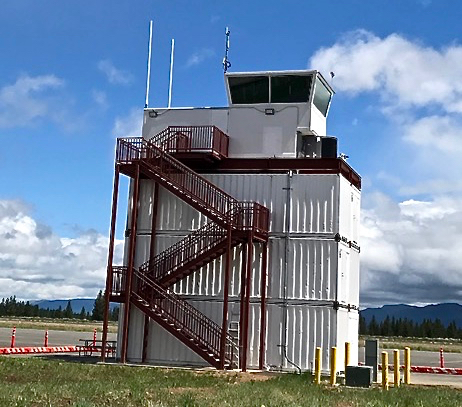
The Truckee airport traffic control tower looks like stacked cargo trailers. Photo/Carole Bernardi

The tower is owned outright by the airport. It will be operational from June 1-Sept. 15. The structure will remain standing year round.

Midwest ATC staffs the tower with a floating reservoir of certified FAA air traffic controllers. Staffed with never less than two controllers (one air, one ground), from 7am-9pm; the maximum staff moves up to six controllers during peak hours.

There is a voluntary, but strongly requested flying curfew between 10pm and 7am as part of the airport’s good neighbor policy. When the tower ceases to operate come September, it will not be dismantled. The cost of the structure was $500,000, which included the hiring of FAA controllers. Because the tower is already assembled, the cost to operate next year will be at least half this amount.

In October, staff will report to the airport board and present the metrics based on the success and/or failure of the tower’s presence. They will be looking for fewer incursions (range of error) and reduction in noise and annoyance complaints.

Before the temporary tower was built, flight operations were run out of the universal communication viewing bay in the main airport building. Through radio frequency all air traffic control took place. Besides small aircraft flight the airport also deals with the glider operations, sky diving and flight instruction school on the property.

The airport serves 35,000 full-time residents and 60,000 peak period visitors, covers 1,200 acres at an elevation of 5,900 feet above sea level in the Martis Valley region (7 miles north of Lake Tahoe), straddling the Nevada and Placer county lines.

Classified as a general aviation airport (no TSA), it services charter and private aircraft only (less than 30 seats) and no commercial flights. The popularity of member airline travel companies such as Net Jet, Wheels Up, Red Stripe and Surf Air (Surf Air has a reception space in the airport lobby) have shown enormous growth reflecting the demand.

—–

Note:

·      The Truckee Tahoe Airport invites the community to come learn about the new temporary tower every Friday from 4-5pm through June. These Q&A opportunities will take place in the administration building.




Opinion: EDC supes pay for mystery consultant

By Larry Weitzman

An innocuous item appeared on the El Dorado County Board of Supervisors’ June 20 consent calendar, Item 20.

Item 20 was for a two-year extension of a consulting contract (a renewal) with Shannon L. Lowery, doing business as Lowery Consulting. The services performed were nebulous, calling for “continuing technical and analytical services related to business operations, procedural analysis, and project management for replacement of outdated permitting applications and systems.”  

Larry Weitzman

More glaring in the item description was an increase of the prior contract’s $70,000 ceiling (over two years) and a billing rate of $60 an hour to a $100 an hour billing rate and a not to exceed amount of $190,000; an increase of 67 percent in the hourly rate and an increase in total compensation of more than 250 percent for essentially continuing to do the same services.

Board Chair Shiva Frentzen pulled the item on the basis of this huge increase in consulting costs (administrative costs) while at the same time the CAO in concert with the director of Health and Human Services, Patricia Charles-Heathers, was attempting to cut one of the best service programs in the county, senior legal. Because there was no acceptable explanation to the huge increase in compensation, Frentzen voted no, but the rest of the board voted yes.

Who is this Shannon Lowery and where did she come from? We are going to pay her about $100,000 a year over the next two years and for what? In a nutshell, it appears to be absolutely nothing and it may have violated Government Code Section 3500 et seq. and more important the case of Rialto Police v. San Bernardino County to inform the union before such a contract was signed.

In two emails to Carla Hass, EDC’s PIO, and CAO Don Ashton, I asked two questions and the following is the response (with the questions):

Q: When did you inform Local One that you were intending to contract with Lowery Consulting? Was that done in writing?

A: The scope of work Ms. Lowery was originally hired to do didn’t require union review. When her scope of work was changed in June 2015, Local 1, Manager’s Association and Trades and Crafts were contacted by HR in writing on June 8, 2015. and Local 1 was contacted in writing again on June 15, 2015; no response was forthcoming.  

Q: How was Lowery selected by the county (EDC) originally?

A: Professional services have no competitive bid requirement. It’s unclear how the county came to know about Ms. Lowery, but it’s reasonable to believe that she and the then-CAO were professionally acquainted.

The county administration knew by the first answer of the requirement to notify the union, Local One. Why not for this third contract? While it can be called an extension, it is a new contract as the old contract expired as of June 22, 2017. And the new contract terms have changed significantly. By the PIO’s own admission, Government Code Section 3500 has been violated by the failure to inform the union. The contract can be voided and should be. Where is our county counsel on this or our new administration dotting the I’s and crossing the T’s?

But the answer to question two is even more important. The county administration, including our highly paid deputy chief administrative officer (over $150,000 in annual compensation), Creighton Avila hasn’t a clue as you can see by the answer. There was nothing on the background on Lowery in the file at the time this contract was placed on the agenda a few days before the board meeting. But it gets worse. The county obviously has no documented reason for hiring Ms. Lowery. Is this the case for other consultants hired by the county?

A simple Google search should tell us something of this consultant’s professional qualifications, right? Guess what, a search turned up absolutely nothing. No professional qualifications and no references. It gets worse. A search of Lowery Consulting turned up a website or actually no website with the following appearing on my screen: “SORRY! This site is not currently available.” Who are we paying $190,000 to, an amount which probably could fund senior legal for a year? Does Lowery have a legitimate consulting practice or is she in the witness protection program?

Three years ago, the Mountain Democrat reported: “Assistant CAO Kim Kerr hired her friend to investigate, analyze and prepare a report on the efficiency of the county’s Building and Planning departments. The woman has no experience in the specialized area she was hired…The problem is, Ms. Lowery is void of any credentials or experience in this area.”

More discovery turned up the following. It appears that Shannon Lowery was from Amador County and was friends with guess who? That’s right Terri Daly and Kim Kerr. You remember them. It was Daly who put the county in its current financial predicament and Kerr who spent good money after bad and created the climate of fear within the county. Kerr was also hired by Daly. Both Lowery and Kerr were “FODs” or “friends of Daly.” It appears to be Daly and Kerr (then head of the CDA) who hired Lowery in 2013.

Frentzen is the only board member who seems to protect the citizens, residents and taxpayers of El Dorado County. As to the others, Mike Ranalli and Sue Novasel are coming up for re-election if they choose to run in a year. Changes need to be made.

Larry Weitzman is a resident of Rescue.


Were Calif. officials ‘crying wolf’ with electric alerts?

By Ivan Penn, Los Angeles Times
 
As record-setting temperatures surged into the triple digits in parts of California last week, the manager of the state’s electrical grid put out an urgent plea: Turn down the AC and conserve power to avoid rotating outages.

The two-day flex alert by the California Independent System Operator drew headlines from dozens of media outlets across the state and country. It also sent electricity prices on the wholesale market soaring four to five times higher than normal — a cost that will be passed on to utility customers.

There was no statewide shortage of electricity — not even close, according to a Times analysis of federal and state energy data.

Even as the mercury climbed, consumers used 44,184 megawatts Tuesday — 3,656 fewer than the forecast. But the system can generate about 71,000 megawatts, which means there was 38 percent unused capacity. That’s well above the 15 percent reserve required by the state for emergencies.

Read the whole story