Nature becomes a prescription for healthy living

By Molly Coolidge

Recovering from a major joint surgery doesn’t usually inspire the idea of snowshoeing by moonlight, but that’s exactly what Carol Bennis, age 75, was asked to do during her recovery last February.

Bennis had never been on snowshoes before, or hiked at night, but when she heard her surgeon and other patients at a similar stage of recovery would be there, she decided to try it out.

On a clear night at Tallac Historic Site, she and 12other patients joined Barton Health clinicians and U.S. Forest Service rangers on a “wellness walk” through the snow. Bennis loved the experience.

“This opportunity enabled me to step out of my comfort zone, make new friends, and learn the history of the area from the ranger,” she said. “Lucky me.”

This winter “wellness walk” and the idea of “nature as medicine” spurred the creation of Wellness Outings, one of Barton Health’s newest wellness programs. Orthopedic surgeon, Stephen Bannar noticed that while South Lake Tahoe is surrounded by public land and plenty of opportunities to enjoy nature, his patients were often too nervous to head outside and incorporate physical activity into their recovery.

Research indicates that time in nature lowers blood pressure, heart rate, and cortisol levels. It increases concentration, memory, and attention spans. It has been shown to boost immunity and is particularly beneficial for at-risk populations, such as those recovering from surgery, who often spend less time outside. These benefits were something Dr. Bannar wanted his patients to experience.

“Can I prescribe nature as medicine?” he asked.

Indeed, he can. In fact, there are a number of researchers and medical providers who support this idea. Nature prescriptions have been commonly used in Japan since 1982 to reconnect people with the outdoors. Bannar and Khristy Gavigan, a registered nurse, saw an opportunity and partnered with the Lake Tahoe Basin Management Unit to provide a unique healing experience for their patients.

“Our idea was to unite health providers with public land managers to facilitate health benefits for those at-risk populations,” said Gavigan. “Partnering with the Lake Tahoe Basin Management Unit rangers provided that interpretive piece where they could support the logistics, help identify the appropriate outings, and deliver a message about the connection between community wellness and ecosystem health.”

Participants were inspired by their experience, not only reconnecting with nature, but connecting with other people. Isolation is often an issue for those who are recovering at home, especially if they’re concerned that they may injure themselves further by heading out.

“Having Barton’s medical professionals on-hand gave folks the confidence to come out and join the walk, whereas they previously may have been worried about leaving home,” said Bannar.

Though the program just launched, it has already been recognized as an innovative way for the U.S. Forest Service and health care organizations to improve community health. In June, Bannar, Gavigan, and Joseph Flower from the U.S. Forest Service, were asked to share their idea at RecX, a conference run by the U.S. Department of the Interior in Washington, D.C.

The focus of the conference was Great Ideas for the Outdoors and the Barton team shared the successes of the Wellness Outings and the implications for health across the country.

“We need to change our mindset from treating disease to promoting wellness,” said Bannar. “A prescription for nature can enable accessibility for at-risk groups as well as preventive medicine for other members of the community.”

For Bennis, she saw both the physical and emotional health benefits.

“Public lands are special treasures and not to be taken for granted…but appreciated and respected, not only for their beauty, but for their power to heal,” she said. “The land is truly a gift that must be re-gifted to each generation.”

Wellness Outings are scheduled monthly with Barton Health and the Lake Tahoe Basin Management Unit.

Molly Coolidge works for Barton Health.


Writers have become a community at Squaw Valley

By Stephanie Taylor, Sacramento Bee
 
There’s something infectious about 150 or so creative people, all chattering at once. This is a weeklong annual conference of writers, established and aspiring, who come from all over to Squaw Valley, some every summer, year after year. If ideas and genius are tangible molecules floating in the air, I can only hope they’ll land on me.

The operative word is “community,” chosen on purpose by the founders in 1969, when the novelists Oakley Hall and Blair Fuller gathered to build an institution that’s thrived ever since. Some of the writers have passed – sort of. I say sort of because their spirits linger. Some are declining gently into old age. Their children carry on, and their children’s children. It’s an honor to be here, to be included in what has evolved as a family.

It’s also difficult not to be intimidated by those who have been here before, studying and discussing the craft of poetry, fiction, nonfiction and screenwriting: Peter Matthiessen, Richard Ford, Michael Chabon, Robert Hass and Ann Rice, to name a few. In 1985, Amy Tan arrived with stories that became “The Joy Luck Club.” This year, Janet Fitch’s novel “Paint It Black” is her second movie. Anne Lamott’s “Bird by Bird” is every writer’s classic.

Read the whole story


Eclipse turning into a social event

By Mike Wolterbeek

When some people hear that 83 percent of the sun will be blocked, they might assume it’s just another day in January. However, when 83 percent of the sun is blocked in the middle of August, people will notice.

During the late morning hours (9:04-11:43am of Aug. 21) residents in the greater Lake Tahoe Tahoe area, along with the rest of North America, will be in the path of a solar eclipse, an astrological event where the moon passes between the sun and the Earth, blocking Earth’s view of the sun. 

This is a rare event, with the last total solar eclipse in North America took place in 1979, during the Carter administration, and the next total eclipse expected to come in 2024.

While this region will not be in the 70-mile-wide path stretching from Oregon to South Carolina where the sun is completely blocked, Reno is expected to see more than four-fifths, 83 percent to be exact, of the sun blocked. This means that you don’t need to travel to get some moon shade. 

At this point, director of UNR’s  Fleischmann Planetarium and Science Center Dan Ruby would advise against traveling. In an email, he said people who haven’t already booked hotel rooms and planned ahead of the solar eclipse shouldn’t travel to see the full eclipse in that 70-mile ribbon because the crowds are expected to overrun the communities and stress their resources.

David Bennum, a physics professor with the university’s College of Science, cites the increased amount of travel during this time as another piece of proof of the social nature of the solar eclipse. “Most of the people who are traveling are not scientific people,” he said. “It’s a great social event, it’s a dramatic event.”

While Bennum’s teaching duties won’t allow him to travel to see the total eclipse, Ruby is planning on traveling to Oregon to view and study the eclipse. He is planning on taking pictures, filming videos, and posting to various social media channels of the University and the Fleischmann Planetarium.

Ruby said the solar eclipse is a useful scientific tool because it allows for the study of the corona, the outer ring of the sun since the rest of the sun is so bright that the corona cannot be seen. Even though, Bennum said, modern technology, like solar telescopes, can allow for the corona to be seen anytime.

The morning hours prove to be an added bonus for the solar eclipse since it allows for student’s class time to be devoted to observation, something both Ruby and Bennum are excited about. As a part of the eclipse celebration, the University’s planetarium has teamed with the Washoe County School District to give all students in the district a pair of safe solar viewers.

A major precaution and a minor investment for people who want to view the solar eclipse is to obtain a pair of viewers specifically designed to look at the solar eclipse. Going without visors, or even standard sunglasses, would cause significant damage to the eyes. Fleischmann Planetarium is offering specially designed eclipse glasses with the University and Fleischmann Planetarium logos on it for $2 each, and plain white viewers with no logos or designs for $1 each, when bought in bulk, 25 or more, for educational and non-profit purposes. Ruby cautioned against buying viewers online, as it is hard to verify the viewers are certified and suitable for safe solar viewing.

“The importance of eye protection cannot be stressed enough,” he said, equating the sun to a giant nuclear reactor in space. Even 15 percent of the sun, which will be viewable in Reno at its peak coverage, is enough to cause permanent eye damage. When asked for any last comments on the solar eclipse, Bennum also cited the need for eye protection. Aside from glasses, he also noted that solar telescopes, like the ones the University has, can block out more than 99.9 percent of the sun.

In the Fleischmann Planetarium Dome Theatre is a special show about solar eclipses that will be shown daily at 1, 3 and 5pm, with an additional 7pm show on Mondays through Saturdays in August.

Mike Wolterbeek works for UNR.


Snippets about Lake Tahoe

·      The South Lake Tahoe iHop and Applebee’s locations are not on the list to close. The local pancake house is slated to reopen this weekend after undergoing a remodel.

·      Lakeside Inn in Stateline is hosting an NFL kickoff party outside on Sept. 9 from 5-9pm. Music will be by Drought Relief. There will be food and beverage options, corn hole, and a raffle for ski equipment.

·       Here are the El Dorado-Tahoe and Sierra roadwork schedules for the coming week from Caltrans.

·       “Broadway at the Park” returns to Truckee Regional Park Amphitheater on Aug. 19 at 7pm. The concert will feature live musicians and a chorus. Bring a picnic, low lawn chairs, a blanket and some wine, or purchase crepes and wine, beer, coffee and hot chocolate from the bar. Go online for tickets.

·       Truckee is having a meeting to discuss cannabis on Aug. 22 from 6-8pm at the airport.


Workforce housing a priority for Placer County

Placer County Board of Supervisors this week approved a comprehensive plan to address the growing lack of affordable and workforce housing.

In North Lake Tahoe as much as 65 percent of the housing stock is vacation homes, often occupied only seasonally. Since much of its local workforce is employed in the service industry, providing workforce housing is a requirement for new housing development in the region.

The one-year work plan includes actions to increase the supply of affordable housing in the near- and long-terms and further reduce the regulatory barriers to build housing.

Staff will inventory all recent or planned housing developments in the county to assess where each stands on meeting its affordable or workforce housing obligations.

The plan includes: creating more incentives to build affordable and workforce housing, changing regulations to make building easier, advocating for state and federal assistance and furthering partnerships for meeting regional housing needs, and creating a funding strategy to build more affordable housing.

Options include dedicating transient occupancy tax revenue to fund workforce housing, or possibly developing an in-lieu fee program as an alternative way for developers to satisfy their affordable housing obligations.

Several board members expressed reluctance to pursue a fee program right away, favoring regulatory changes and incentives as better first steps.

— Lake Tahoe News staff report


Nev. approves opening pot distribution rights

By Sean Whaley, Las Vegas Review-Journal

CARSON CITY — The Nevada Department of Taxation decided Thursday that there are an inadequate number of liquor distributors interested in transporting marijuana to Nevada’s retail establishments, opening up the business to others.

The decision came after a telephone conference hearing bringing the industry, agency officials and the public up to date on whether the alcohol industry alone is sufficient to distribute pot to points of sale around the state.

Read the whole story


STPUD getting better grasp on all well use

By Kathryn Reed

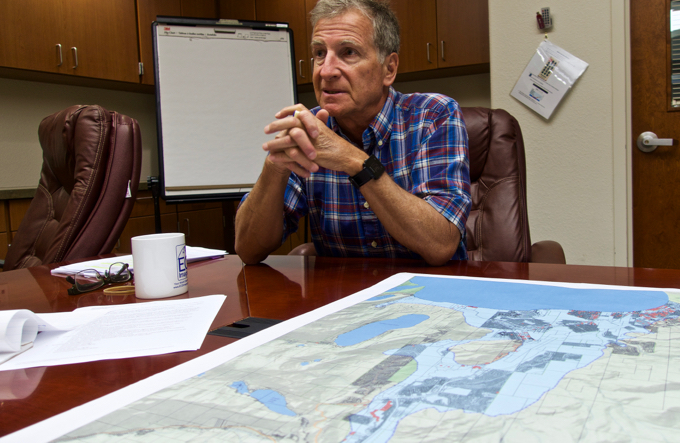
Red dots fill a map; with most being located in Christmas Valley and near the state line. They represent the more than 600 private wells within South Tahoe Public Utility District’s boundaries.

Most are at residences, while others are at campgrounds, a school, trailer parks and other commercial entities.

Per state requirements South Tahoe PUD is trying to get a firm understanding on how many are operational, exact locations and if people have any issues.

Ivo Bergsohn, a hydrogeologist with the district, is tasked with overseeing all of this. A survey with 19 questions is being sent out to the well owners this month to gather some basic data, see if they have questions, and let them know the district can help where appropriate.

“The information we gather will be used to help guide the groundwater management plan,” Bergsohn told Lake Tahoe News.

Ivo Bergsohn with STPUD is overseeing the groundwater program. Photo/Kathryn Reed

During the drought California thought it would be a good idea to start regulating groundwater. It was one of the last states to do so. With laws that were passed in 2014, different jurisdictions had to create groundwater management plans. STPUD is in charge of that mandate for much of the basin on the South Shore, though El Dorado County has oversight in some areas.

Groundwater management pertains to the water level, storage, quality, land capability, and ensuring there are no adverse effects to surface water from pumping.

In 2016, per state mandate the district performed a stress test to determine how much water it had. At that time – which was before last year’s record snowfall and at the height of the drought – there was enough water in the aquifer for 31 years.

This figure is based on the demand from 2013, 2014 and 2015 which averaged 6,173 acre-feet per year.

The district is not looking for new customers or even to tell people how to use their well or regulate the use in any way.

What employees can do is provide tips about maintenance, share how to properly disinfect a well and other related information.

“If we have a properly managed well, there is potentially one less conduit of contaminate into the aquifer,” Bergsohn said.

People keep their wells for various reasons – for historical purposes, not wanting to pay a water bill, not wanting anything added to their water, and staying off the grid, so to speak.

STPUD was well ahead of the state in monitoring groundwater issues. It has been doing so since about 2000, three years after the gasoline additive MTBE (methyl tertiary butyl ether) was found in wells. The district won a multi-million-dollar lawsuit against several gas companies as a result of that contamination.

Contamination, though, remains the No. 1 threat to the district’s water supply, according to Bergsohn. PCE (tetrachloroethylene) is an issue today with wells in the Tahoe Keys and Lukins Brothers water districts being contaminated. STPUD is providing those two entities with water.

Arsenic is a naturally occurring contaminate, for which public districts regularly test.


Letter: Yoga group gives back to community

To the community,

A gold star for outstanding Adopt A Day of Nourishment volunteer service goes to Still Water Yoga. This limber and very kind and thoughtful group of women was a joy to have hosting Bread & Broth’s July 24 meal. 

To Karen Eberlin, Shannon Liebel, Lucy McLaughlin, Susan Glasson and Liz Norman, B&B would like to thank you and would love to have your yoga group back any time.

The $250 donated for the sponsorship meal enabled the B&B cooks to offer pulled pork and roast beef sandwiches, broccoli, cole slaw, and fruit salad on the evening’s menu.

In addition to serving the meals to the dinner guests, the Still Water Yoga crew helped bag fruits, vegetables, dairy products and baked goods to send home with the diners to help supplement meals later in the week.  

At the end of meal, this hardworking crew helped the B&B volunteers with the meal’s breakdown and cleanup.

“It was a pleasure to be able to help serve the community,” said Shannon Liebel. “Thank you for being so organized and allowing us this opportunity.”  

B&B is so pleased to have the support and help of our community partners like Still Water Yoga who take this opportunity to help ease hunger and improve the lives of those in need.

To partner with B&B as a donor or sponsor, contact me at 530.542.2876 or carolsgerard@aol.com.

Carol Gerard, Bread & Broth


Grant allows low-income in Calif. to shop at farmers markets

By Hannah Knowles, Sacramento Bee
 
A $3.9 million federal grant awarded to the California Department of Food and Agriculture will help the state expand a program that encourages low-income people to shop at farmers markets, state officials announced this week.

In July, the department launched the California Nutrition Incentive Program, or CNIP, which rewards recipients of CalFresh food stamps who buy fruits and vegetables grown in the state by doubling the value of their vouchers when they purchase at 339 farmers markets throughout the state.

The program’s latest infusion of funds, a three-year Food Insecurity Nutrition Incentive grant from the U.S. Department of Agriculture, builds on several million dollars in private funding and $5 million initially allocated by the state Legislature in 2016 to match federal dollars.

Read the whole story


SLT bird tests positive for West Nile virus

A bird in South Lake Tahoe has tested positive for West Nile virus.

The Stellar’s jay was found on July 31.

West Nile virus activity has been reported in 28 California counties, including Placer County.

Last year, four West Nile virus positive birds were identified in El Dorado County on the western slope. One human case was reported.

West Nile virus can be transmitted to people through the bite of an infected mosquito. Mosquitoes get the virus when they feed on infected birds. The illness is not spread from person-to-person. While most people infected with the virus show no symptoms, some may have high fever, severe headache, tiredness and/or a stiff neck that can last several days to several weeks. The most serious cases of West Nile virus infection can lead to encephalitis, an inflammation of the brain, which can be fatal.