California ads highlight vaping dangers

By Jeremy B. White, Sacramento Bee

California has taken another step in its campaign against electronic cigarettes, with the Department of Public Health on Friday releasing video advertisements calling the devices toxic and warning they are being marketed to kids.

While cigarette use has plummeted in California and nationwide as the dangers of tobacco have become well known, electronic cigarettes – also known as e-cigarettes – have emerged in recent years as a popular alternative. Vaping lounges, in which customers can sample different flavors of the liquid within vaping devices, have sprung up around Sacramento.

Public health officials have sounded the alarm, emphasizing that e-cigarettes contain both addictive nicotine and chemicals linked to cancer and birth defects. They warn that the sweet flavors contained in vaping devices, which function by heating a chemical liquid into a mist that can be inhaled, appeal to young Californians.

Read the whole story


Tahoe Tails — Adoptable Pets in South Lake Tahoe

Cheerio

Cheerio

Cheerio is a 5-year-old, 8-pound Havanese mix who just arrived at the Meyers shelter along with 12 other dogs from Contra Costa County shelters.

Cheerio is very shy, but she does not have a mean bone in her body. She is part of a group of more than 75 dogs who were rescued last week by Umbrella of Hope and other groups from a backyard breeder in Sutter County. We have three dogs from this rescue. All are shy and will need extra help in adjusting to life outside of a cage and dark barn, but all are sweet little dogs.

Cheerio is spayed, microchipped, tested for heart worm, and vaccinated. She is at the El Dorado County Animal Services shelter in Meyers, along with many other dogs and cats who are waiting for their new homes. Go to the Tahoe animal shelter’s Facebook page to see photos and descriptions of all pets at the shelter.

Call 530.573.7925 for directions, hours, and other information on adopting a pet.

For spay-neuter assistance for South Tahoe residents, go online.

— Karen Kuentz


Low lake level changing life at Lake Tahoe

No water is flowing from Lake Tahoe to the Truckee River. Photos/Kathryn Reed

No water is flowing from Lake Tahoe to the Truckee River. Photos/Kathryn Reed

Publisher’s note: Lake Tahoe News spent March 22 driving around the lake looking at and documenting more than 20 locations to show what the drought looks like throughout the basin all on the same day.

By Kathryn Reed

It’s not unusual for Lake Tahoe to drop below its rim. What is unusual is when the spring runoff doesn’t bring it back up and above that 6,223-foot mark.

“This year the way things look it would take some pretty big precipitation to get back above its natural rim this year,” Scott McGuire, meteorologist with the National Weather Service in Reno, told Lake Tahoe News. “The projection is for Lake Tahoe to be significantly below its rim by fall 2015.”

ANALYSIS

When it fell below the rim in October 2014, this was the first time in five years. Some of the other times it was below the rim were 1977-78, 1961-62 and 1930-36.

On March 22, Lake Tahoe was at 6222.83 feet.

The record low of 6220.25 feet was set in 1992. (Records have been kept since 1900.)

In 2014, the snowmelt added 3 inches to Lake Tahoe. With substantially less snow falling this winter, it is near impossible the lake will rise by that much this spring.

Seasonal businesses were hurting last summer as documented by Lake Tahoe News.  For many of those same businesses it will only be worse this year.

Business owners may need to rethink how and when they do business because the model used even three to five years ago isn’t going to work today.

Instead of trying to get a jumpstart on Mother Nature with opening ski resorts pre-Thanksgiving, it might be time to have an intense, stellar shorter ski season. Then crank up the public relations to woo out-of-towners here for spring – a season often ignored.

If the weather patterns of the last few years are the new normal, it will mean learning to adapt to less snow and more summer-like days. In some ways this could be good for the Lake Tahoe Basin because summer has always been the busiest season. It may mean that season is now longer.

And if it’s hotter in the Central Valley and Bay Area sooner and longer, people may drive to Tahoe to cool off and recreate. This might solve the shoulder season blues.

Driving around the lake on Sunday was at times reminiscent of a summer weekend. Parking lots were full of people enjoying the outdoors. Restaurants were busy – at least the ones that were open.

Jumping in off piers and docks at Lake Tahoe is not advised.

Jumping off piers and docks at Lake Tahoe is not advised.

Signs of drought

For those in California, there will be much more beach access this year. (Nevada has different rules when it comes to public access on private beaches.) Sand and rocks are exposed in places that have not seen the light of day in years.

So many piers have little or no water under them. Signs saying “no diving, no jumping” are posted in some locales. It’s advice that will need to be adhered to at all piers and docks this year to avoid injury or worse.

Floating docks will have an easier time accommodating people. Many marinas have a combo of fixed and floating structures. This means the ramp between the two keeps getting steeper. Some are clearly not in compliance with the Americans with Disabilities Act. It would be tricky to walk down them carrying a cooler or small child.

Water marks on bulkheads and boulders are visible symbols of just how far the lake level has fallen.
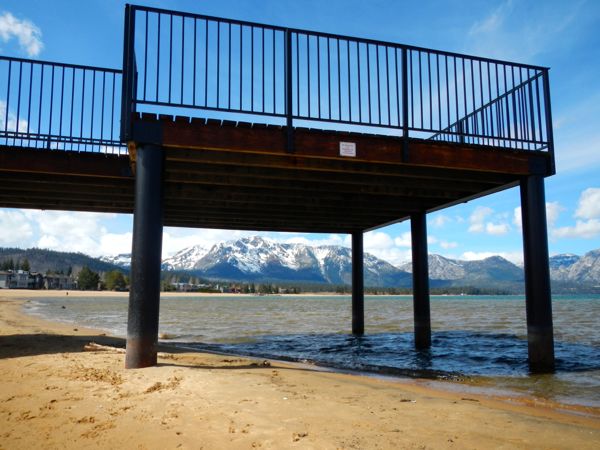
Tahoe piers-drought: Tahoe KeysTahoe Keys Property Owners Association Pier

Four of the six pilings making the extended seating area at the pier are in water – 6 inches at the deepest.

A small sandbar has been created near the shore, which has allowed pooling to occur between the beach and lake. The area nearest the water is muddy and uninviting.

Across the channel is Cove East, which extends even farther into the lake. But it, too, has a large swath that is more swampish than beach-like.
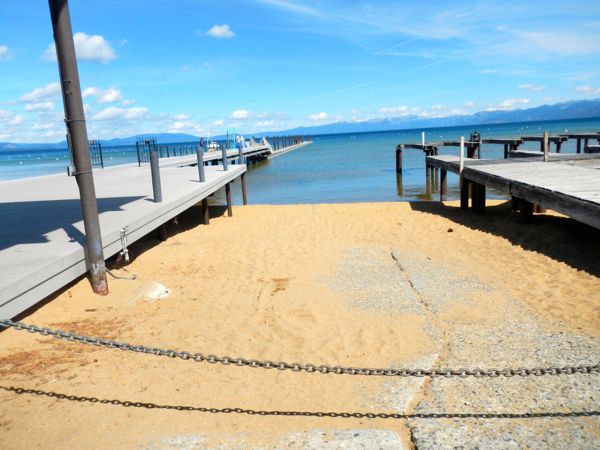
Tahoe piers-drought: Camp RichCamp Richardson

Much of the boat ramp is sand. The water level by the gas pumps looks as though not many boats would have clearance to get to them. They are on the fixed dock, so they seem even higher as the lake gets lower.

Looking down Jameson Beach, most of the private docks are covering only sand.

Tahoe piers-drought: Emerald BayEmerald Bay

Navigating the entrance to the bay was tricky last boating season. It’s only going to be worse this year, with some boats not able to get in.

It’s as though most of the bay is rimmed by sand. At the end by Vikingsholm and below the swath of mountain that decades ago sustained a landslide is debris from that slide that had been under water.

Tahoe piers-drought: Meeks BayMeeks Bay Resort

The sand, even near the water, is silky white. The water is incredibly clear, at times reflecting various hues of blue. It’s Caribbean-like.

The end of the walkway is now far from the water.

While the channel inside the bulkhead leading to the docks and boat launch is deep, the lake level outside this area is not going to permit all boats to come and go.

Tahoe piers-drought: Sugar Pine PointSugar Pine Point State Park

With all the rocks and pine cones on the beach, it won’t beckon sunbathers like the beach down the road does. Many more rocks are visible than last fall.

The last rung on the swim ladder at the end of the pier is no longer in the water.
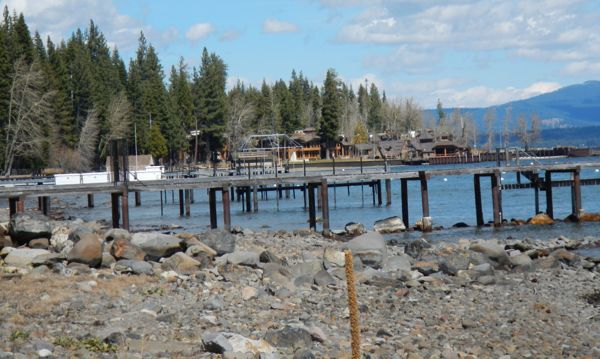
Tahoe piers-drought: West ShoreBetween Tahoma and Homewood

White moorings bob in the lake, only time will tell if they will be filled with boats. Not all marinas will be accessible for launching, and then some of the moorings will be in too shallow of water for deep-hulled vessels.

So many private docks along this stretch of the West Shore as well as ones closer to Tahoe City are covering rocks instead of water.
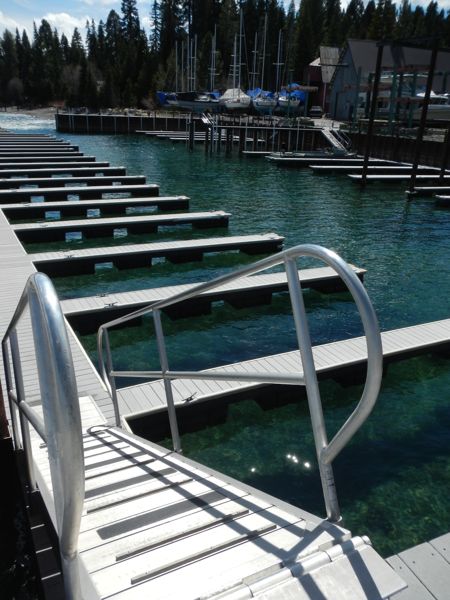
pier-obexersObexer’s

Water is no longer touching the concrete on the boat launch. Trailers will be backing onto rocks.

The ramps here have some of the more extreme angles going from the fixed pier to the floating docks.

Tahoe piers-drought: Tahoe City Dam, Truckee RiverTahoe City Dam

It’s possible to walk near the base of the dam because of the lack of water on the Lake Tahoe side of the dam. Buoys that say “Danger Dam” seem silly and sad without water.

On the other side of the dam there is water, but looking farther down the Truckee River it is more rocks than water.

This means the rafting season on the Truckee River is likely a no-go.
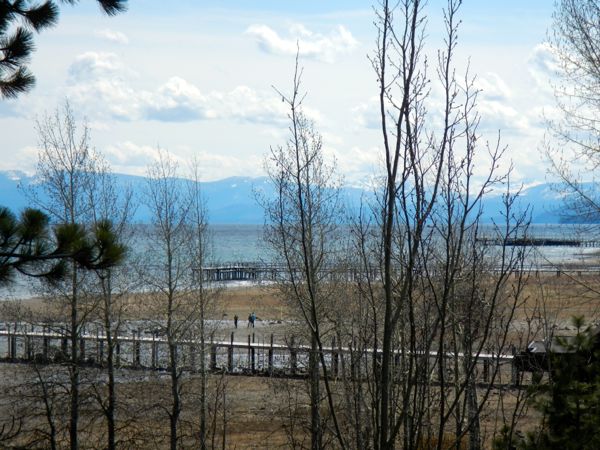
Tahoe piers-drought: Tahoe CityCommons Beach/Tahoe City Marina

Walking along the Lakeside Trail the lake is a little farther away. People don’t seem to mind as they wander along the rocks.

Tahoe piers-drought: Tahoe Vista Recreation AreaTahoe Vista Recreation Area

No boats will be launched here anytime soon.
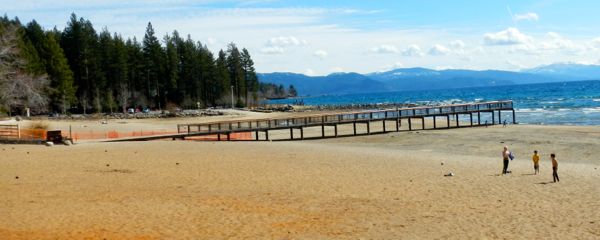
Tahoe piers-drought: Kings BeachKings Beach

The pier covers more sand than water.

California Tahoe Conservancy and California Department of Parks and Recreation are hosting a workshop April 1 from 6:30-8pm seeking input on the feasibility and design for a reconstructed public pier.

Tahoe piers-drought: Lone EagleLone Eagle Pier

The gate on the dock preventing people from walking to the end is over sand so it’s useless right now.

Tahoe piers-drought: Sand HarborSand Harbor

While this area is always rocky, now large boulders are exposed. Plenty of sand exists. The canvas Mother Nature is working with keeps getting more beautiful.

Tahoe piers-drought: GlenbrookGlenbrook

The creek running into the lake near the pier is rippling across a rocky beach. The pier looks more like something out of bygone Tahoe than a functioning structure today.

Tahoe piers-drought: Cave RockCave Rock

One of the few boat launches in the basin that is useable. Rocks, though, continue to be exposed near the beach area.
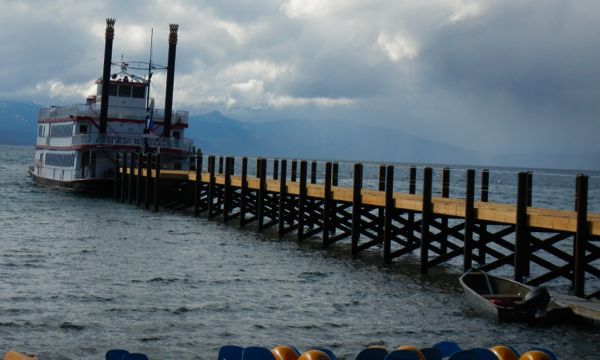
 

Tahoe piers-drought: Zephyr CoveZephyr Cove

The new dock is installed. The M.S. Dixie II wil run again after it is rehabbed.

Tahoe piers-drought: Ski RunSki Run Marina

The Tahoe Queen will be able to run again when the channel is dredged.
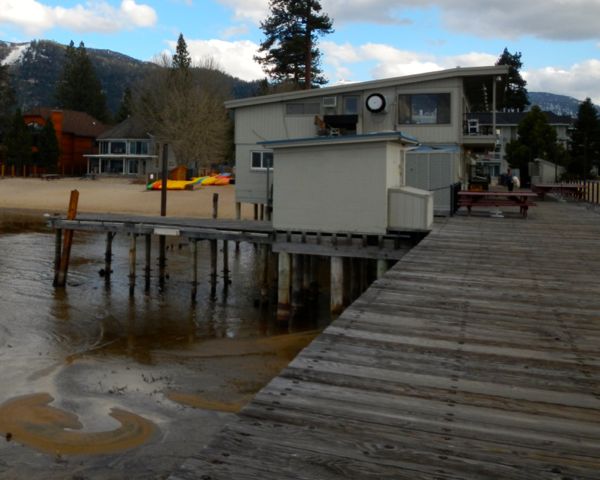
Tahoe piers-drought: Timber CoveTimber Cove Marina

Access via Bal Bijou Road still isn’t available because of Tahoe Beach Retreat’s lingering construction project. (The hotelier is also still arguing with South Lake Tahoe about signage on the beach.)

It would be hard to get a kayak under most areas of the pier because of the shallow water and sand bars. The gas pump on the dock is completely inaccessible.
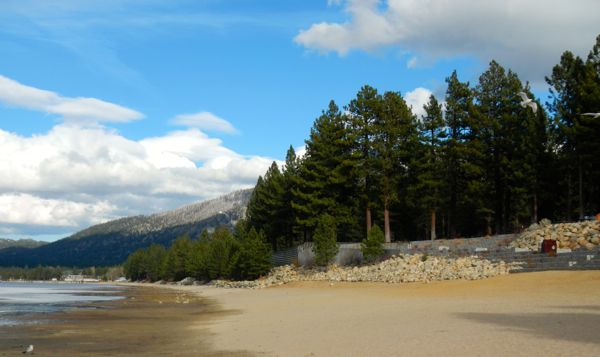
 

Tahoe piers-drought: Lakeview CommonsEl Dorado Beach Boat Launch/Lakeview Commons/Regan Beach

This launch has been off-limits for years. Now there is no chance anyone will drive onto the dirt to get to the water because of the boulders at the end of the launch.

With the amount of beach area, a much larger stage could be erected for Live at Lakeview Commons.

Pilings from piers of eras gone by can be seen from here down Lakeview Avenue past Regan Beach. At Regan Beach the dog beach used to be mostly water – not so anymore.




Opinion: EDC supes not balancing budget

By Larry Weitzman

Public Safety is the primary function of county governments. Before the expansion of governments 60 to 70 years ago, the sheriff’s department was the majority of county spending. Currently in El Dorado County, the sheriff’s department is about 20 percent of general fund spending. Other departments directly related to public safety are District Attorney, Public Defender and Probation, which is perhaps the least heralded but the most important public safety department.

It is a probation officer (with at least a bachelor’s degree) who makes the sentencing recommendations of people convicted of crimes, which judges usually follow. A big responsibility. Their combined (DA, PD and Probation) general fund budgets are about 10 percent of the general fund budget.

Larry Weitzman

Larry Weitzman

With our current general fund budget out pacing revenues by about $20 million a year and growing, one would think the Board of Supervisors would look to find the cause and cure the problem by ridding EDC of these deficits which for the past two years are approaching $40 million combined. That would require a budget analysis to determine the cause. The county has burned through about $40 million of surpluses in the last two years. If spending were to continue at that rate, EDC would be out of money before the end of this calendar year. In the years before the deficits the county was running surpluses and had no debt.

What changed in general fund spending? It’s pretty simple. For four continuous years ending June 30, 2013, general fund salaries and benefits remained at a constant of approximately $118 million annually. In the following two years, salaries and benefits ballooned by $38 million. Do you see any correlation between overspending and salaries? One other area of over spending appears to be excessive consulting contracts amounting to millions of dollars a year. If the county has such productive and knowledgeable employees, why the need for so many consultants? Especially the use of consultants to shield the county employees from direct questions from the public in outreach events.

Not only did the prior CAO, Terri Daly, hire dozens of people to fill new or long vacated general fund employee positions (possibly a 100 or more) in the last couple of years prior to her departure in November, it was admitted by the administration that county service levels remain about the same. In addition to the hiring, Daly recommended and the BOS agreed to a 15 percent raise, 10 percent which is currently in effect and 5 percent more to come shortly. It was confirmed recently that the union was asking for less, some sources say 40 percent less. The budget is out of balance almost exclusively because of the hiring and raises given and/or recommended by Daly that the county couldn’t afford.

It is interesting to note that of all the new hires since June 30, 2013, Probation has grown zero, the Sheriff’s by two, the PD by five and the DA by minus two, while the CAO office grew by 10 and perhaps a bit more. Daly did a county reorganization adding a total of 57 employees under the CAO umbrella, while the CDA lost a net of 30 employees although from the data after 33 employees were put under the CAO’s umbrella from the CDA, the CDA appears to have still grown by four employees. While this is a bit confusing, the point is that the vast majority of the county employee growth is in administration, not in public safety.

Instead of solving the problem by reducing county staffing levels with an appropriate analysis of the recent county hiring, the BOS has taken the easy way out, cut each department by 6.25 percent. At the Feb. 24 BOS meeting that lasted until well past 9pm, Supervisor Shiva Frentzen wanted an analysis by the CAO’s office of the recent hiring. Although Supervisors Sue Novasel and Doug Veerkamp paid some lip service to the Frentzen proposal, the Frentzen motion didn’t get a second and no vote was taken by the BOS for such a proposal. It never saw the light of day. The result was that the BOS voted for an across the board 6.25 percent budget reduction which appeared to the BOS as the most palatable proposal brought to the BOS by the CAO.

Perhaps partial responsibility rests with the CAO in that she didn’t even suggest such a targeted, priority based budget proposal even though she was advised well before the BOS meeting of such an idea. Her ideas were a series of across the board cuts ranging from 13.5 percent, 10 percent and 6.25 percent. About five months ago EDC formed an ad hoc budget committee to analyze and make recommendations to the BOS on how to deal with the projected $100 million plus five-year budget deficit that would actually be about $150 million when you add in the spending of $50 million in savings.

While at these meetings I kept hammering the idea that the cause of the deficit was the prior CAO’s excessive recent hires and the first, smartest and fairest place to cut should be an elimination of some of the new hiring. The committee decided to spend most of its time in the half a dozen or so meetings on priority budgeting. Our Current CAO along with Supervisors Veerkamp and Frentzen led the meetings.

CAO Pam Knorr wrote on a chalkboard a list of priorities and there was no question in the room that public safety was No. 1. I even took a photograph of the chalkboard. What a waste of time as the result of the hours and hours of study, discussion and agreement meant nothing as the eventual CAO recommendations to the BOS was an across the board, blanket percentage cut. So much for priority budgeting. A fifth-grader learning fractions and percentages could have done this across the board cut. It is the least effective and worst possible solution to solve the budget problem, as the disease has not been excised. A second priority of cutting suggested at the ad hoc meetings was the elimination of EDC deadwood, or those employees who spend time at the county to accomplish as little as possible but for taking home a paycheck. No one cared.

The public should know that the vote to accept the county budget back in September was 3-2 with Ron Mikulaco and Frentzen voting no and Ron Briggs, Norma Santiago and Veerkamp voting yes. As to the across the board cut direction given to the CAO, while Frentzen wanted an analysis of new hires that the BOS paid lip service to, they did reject it, with an across the board direction to the CAO of a 6.25 percent cut with only one board member voting no, Mikulaco. Without a change in leadership as reflected here, the problems within the county are likely to continue.

Larry Weitzman is a resident of Rescue.


Watching cooking shows leads to weight gain

By Roberto A. Ferdman, Washington Post

Food television has been something of a revelation. As Americans cook less and less, they seem compelled to watch people cook more and more. The mouthwatering viewer experience — which features cooking shows and competitions, food travel adventures and other gustatory escapades — has captivated people around the country.

The Food Network, the genre’s most coveted brand, alone gathers an average audience of more than 1 million viewers each night. And it’s just one of a growing number of networks that routinely feature series about food and eating. Chefs — some professionally trained, others less formally practiced — are increasingly bringing new, exciting and delicious culinary ideas into living rooms.

Mostly women watch these shows, often to learn specific cooking skills. But when people watch more of these food shows on television, it turns out they’re also gaining more weight, according to a new study by researchers at Cornell University. And they’re even more likely to gain weight if they also cook.

Read the whole story


North Shore ready to celebrate Easter

Eggs hunts and Easter bunnies are springing up in the mountains, and lakeside venues are offering family-friendly activities throughout the weekend.

There will be an underwater egg Hunt at Incline Village Recreation Center on March 28 from noon-1:30pm. The pool at the Recreation Center will be filled with weighted and floating eggs. The Easter Bunny will make an early appearance to cheer on swimmers and stay for pictures.

Tahoe City’s Spring Eggstravaganza & Egg Hunt starts at 10am April 4 at Commons Beach in Tahoe City.

West Shore will host two Easter Egg Hunts on April 5, one for children and one for adults. Children can run around the venue’s expansive lawn scavenging for eggs with sweet treats, while adults hunt on paddleboards for eggs tied to buoys.

Gar Woods in Carnelian Bay will be hosting a traditional Easter Egg Hunt for children beginning at 11am on Easter Sunday. The bottle hunt event for adults ages 21 and over will start at 11:30am.

Northstar hosts daylong festivities on Easter Sunday in the village and on the mountain. Beginning at 10:30am is an Easter Egg Dash on the Village Rink at 10:30am.

Alpine Meadows’ two Easter egg hunts for kids and adults beginning at 9a on Easter Sunday. Alpine also welcomes the use of technology during its Beacon and Eggs Avalanche Beacon Scavenger Hunt.


Editorial: Time to talk about low snowfall future

Publisher’s note: This editorial is from the March 22, 2015, Reno Gazette-Journal.

They are dropping like flies: Ski resorts closing early because of high temperatures and lack of snow.

This could be just another wild swing in the Sierra Nevada’s historically fluctuating weather. Or it could be a sign of things to come.

For the past four years, something has caused high-pressure weather systems to sit off the coast of California and then be pushed north, away from northwestern Nevada.

It is too soon to tell if global climate change is responsible for this pattern, but some scientists think climate models show such winters will become more frequent.

This would be significant for Northern Nevada. It would be so significant, in fact, that it is difficult to know where to start. But start we must.

Read the whole story


Drought alters the face of Tahoe tourism

By Dale Kasler and Matt Weiser, Sacramento Bee

Drought is reshaping Lake Tahoe and its all-important tourism industry.

Seven ski resorts have shut down early for the season because of a shortage of snow. The latest is Sugar Bowl Resort, which will turn off its chairlifts at the close of business Sunday.

The long-term impact goes deeper. As California’s drought stretches into its fourth year, ski resorts, hotel owners and others are scrambling to find new ways to get tourists to the lake. They’re relying less on snow and putting greater emphasis on entertainment, fine dining and other forms of recreation. With climatologists predicting long-term declines in snowfall throughout the Sierra Nevada, some resorts are building zip lines, mountain bike trails and even wedding venues, all in hopes of broadening their customer base.

Heavenly is on track to expand its offerings with more year-round activities that don't depend on snow. Photo/Carolyn Wright/Copyright

Heavenly Mountain Resort is on track to expand its offerings with more year-round activities that don’t depend on snow. Photo Copyright 2015 Carolyn E. Wright

“Resorts have been looking at their business models and seeing we have to be in the mountain recreation business, not the winter business,” said Bob Roberts, head of the California Ski Industry Association.

Tahoe isn’t giving up on traditional winter activities. Squaw Valley Resort, for instance, has spent tens of millions of dollars upgrading its facilities in the past few years, including a $5 million investment in additional snow-making equipment.

Nonetheless, the tourist attractions are conjuring up different ways to lure visitors. It’s telling that Squaw Valley is hosting its first-ever bluegrass and craft-beer festival this weekend, just a few weeks after it canceled a World Cup skiing and snowboarding tournament because of the poor conditions.

The closures are particularly painful for two reasons: One, the season had gotten off to a good start, thanks to two strong storms in December. Two, the Tahoe tourism industry was just beginning to climb out of a long period of hibernation prompted by the recession and fierce competition from California Indian casinos. Developers have been pouring millions into ski resorts, hotels and other amenities in hopes of weaning Tahoe from its historic dependence on gambling and turning the lake into an international destination and not just a day trip from Sacramento.

Read the whole story


Snippets about Lake Tahoe

barton• Barton Auxiliary is having a blood drive May 1 from noon-5pm at the South Lake Tahoe Recreation Center, 1180 Rufus Allen Blvd. Bring a photo ID, eat well and drink plenty of fluids.

• Earth Day is being celebrated April 25 at Bijou Community Park in South Lake Tahoe from 10a-3pm.

• Lake Tahoe Shakespeare Festival will put on Shakespeare’s “Romeo and Juliet” and “The Fantasticks” from July 10-Aug. 23 in Incline Village. Tickets range from $15 to $89. For more info, go online.

• Newport Beach based real estate investment firm TwinRock Rock Partners is buying the multifamily Nevada Royale property in Stateline.

• The public is invited to tour Sierra House Elementary School’s growing domes on April 15 from 5-7pm.


World water shortfall expected in 15 years

By Associated Press

NEW DELHI — The world could suffer a 40 percent shortfall in water in just 15 years unless countries dramatically change their use of the resource, a U.N. report warned Friday.

Many underground water reserves are already running low, while rainfall patterns are predicted to become more erratic with climate change. As the world’s population grows to an expected 9 billion by 2050, more groundwater will be needed for farming, industry and personal consumption.
The report predicts global water demand will increase 55 percent by 2050, while reserves dwindle. If current usage trends don’t change, the world will have only 60 percent of the water it needs in 2030, it said.

Having less available water risks catastrophe on many fronts: crops could fail, ecosystems could break down, industries could collapse, disease and poverty could worsen, and violent conflicts over access to water could become more frequent.

“Unless the balance between demand and finite supplies is restored, the world will face an increasingly severe global water deficit,” the annual World Water Development Report said, noting that more efficient use could guarantee enough supply in the future.

The report, released in New Delhi two days before World Water Day, calls on policymakers and communities to rethink water policies, urging more conservation as well as recycling of wastewater as is done in Singapore. Countries may also want to consider raising prices for water, as well as searching for ways to make water-intensive sectors more efficient and less polluting, it said.

In many countries including India, water use is largely unregulated and often wasteful. Pollution of water is often ignored and unpunished. At least 80 percent of India’s population relies on groundwater for drinking to avoid bacteria-infested surface waters.
In agriculture-intense India, where studies show some aquifers are being depleted at the world’s fastest rates, the shortfall has been forecast at 50 percent or even higher. Climate change is expected to make the situation worse, as higher temperatures and more erratic weather patterns could disrupt rainfall.

Currently, about 748 million people worldwide have poor access to clean drinking water, the report said, cautioning that economic growth alone is not the solution — and could make the situation worse unless reforms ensure more efficiency and less pollution.

“Unsustainable development pathways and governance failures have affected the quality and availability of water resources, compromising their capacity to generate social and economic benefits,” it said. “Economic growth itself is not a guarantee for wider social progress.”