Docents needed for Tahoe enviro ed centers

Residents who would like to help people learn about the region’s environmental assets and challenges are needed to serve as volunteer docents at the UC Davis Tahoe Science Center in Incline Village and the Eriksson Education Center in Tahoe City.

Docent training will take place  June 2, 4 and 6; culminating with a trip on the UC Davis research vessel on June 12. Attendance at all three training sessions is strongly recommended.

No science experience is necessary.


To RSVP, contact Carley O’Connell at 775.881.7560, ext. 7474 or email coconnell@ucdavis.edu.

For more information about the docent program, go online.


SPF number on sunscreen may not be accurate

By Alena Hall, Huffington Post

When it comes to skin care products, it’s important to know about any unwanted chemicals lurking in that ingredient label. But when it comes to sunscreen specifically, it turns out that we have to worry about what’s not in the bottle, too.

In preparation for the sunniest of seasons, Consumer Reports recently tested 34 different sunscreen products to see if the sun protection factor strength claimed on the label actually matched the SPF protection in the cream. Sadly, almost a third of the brands tested didn’t hold up to their own standards, missing the mark by anywhere from 16 to a whopping 70 percent. What’s more, eight of the 11 failed products had an actual SPF of less than 30, which is the level of protection recommended by most dermatologists and other skincare experts.

“The Food and Drug Administration requires sunscreen manufacturers to test their products and label them correctly,” Trisha Calvo, Consumer Reports’ health and food deputy content editor said in a statement. “Our findings are troubling becauseconsumers may not be getting the amount of SPF protection they think they’re getting. On top of that, people often do not apply the right amount of sunscreen, fail to reapply it frequently enough, and don’t minimize their sun exposure, which could potentially put them at risk for overexposure to the sun’s rays.”

Read the whole story


LTN subscriber to meet Foreigner

Foreigner will be rocking MontBleu on June 6 and Lake Tahoe News subscriber Ellie Waller will be part of the audience. Not only that, she and a guest will get to meet the band before the show begins.

Waller is the winner of a contest that was open to Lake Tahoe News subscribers.


If you fill out this paid subscriber form, you will be eligible for the next contest. Subscriptions help Lake Tahoe News continue to provide the only daily news in the Lake Tahoe Basin.

“My husband has been a Foreigner fan for many years. This would make a great early Father’s Day present from myself and two daughters,” Waller said. “I’m ‘Hot Blooded’ and he was ‘Waiting for a Girl Like You’. Together we are ‘It Feels Like the First Time’ — now married 26 years and together 31 years.”

For those who didn’t win tickets, they are still available online.

The Blue Ribbon choir from South Lake Tahoe will be performing with the band on the band’s classic hit “I Want To Know What Love Is.” Foreigner will donate $500 to the choir for appearing with the band and the choir will sell Foreigner CDs at the concert to raise money for Foreigner’s charity partner, the Grammy Foundation.


‘Papa Fry’ leaves legacy at Barton Health

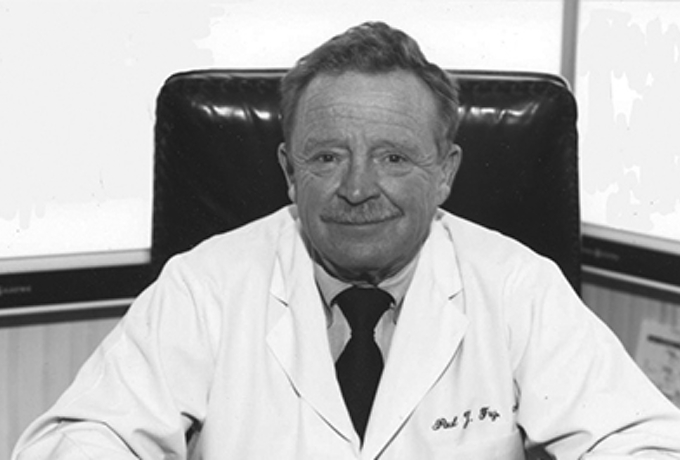
Dr. Paul J. Fry II helped define medicine on the South Shore. Photo/Provided

Dr. Paul J. Fry II helped define medicine on the South Shore. Photo/Provided

By Clint Purvance

On behalf of the entire Barton family, I wish to express my deepest condolences to the Fry family on the passing of Dr. Paul J. Fry II.

Dr. Fry made significant contributions to the  health and wellness of our community, and his impact has improved the lives of many.

“Papa Fry,” as he was known by many members of the community, was a beloved orthopedic physician in Lake Tahoe and Carson Valley for nearly 50 years. He opened Tahoe Fracture Clinic in 1964, and propelled the orthopedic program to a nationally recognized level.

Dr. Fry touched many both personally and professionally through this philanthropic efforts. He was recognized by the Barton Foundation as Philanthropist of the Year in 2012.

Dr. Fry was also an active physician even in his free time. He organized formal medical coverage for the US Alpine Ski Team and was an Assistant Clinical Professor at the University of California, Davis. He presented and published multiple works on the bones and joints, including toboggan injuries. A dedicated volunteer, Dr. Fry also supported sports programs at South Tahoe High School and provided orthopedic care in Africa, Asia, and Central and South America.

Dr. Fry continued to play an important role in our community’s journey to better health since his retirement from Tahoe Fracture. He served on the Barton Governing Board of Directors from January 2000 to May 2010 and from May 2011 to May 2014 as well as numerous committees during his tenure. Additionally, Dr. Fry was a Board member of Carson Valley Medical Center since 2008. He integral to development of the Robert Maloff Center of Excellence, which will break ground this fall, and was always looking out for the future of health, wellness, and sports medicine in our community.

This is truly a deep loss for our community. In lieu of flowers, Dr. Fry’s family has suggested donations be made to the Barton Foundation to support the future Center of Excellence.

Clint Purvance is chief medical officer for Barton Health.


Road beat: ’16 Mazda 6 has style, performance

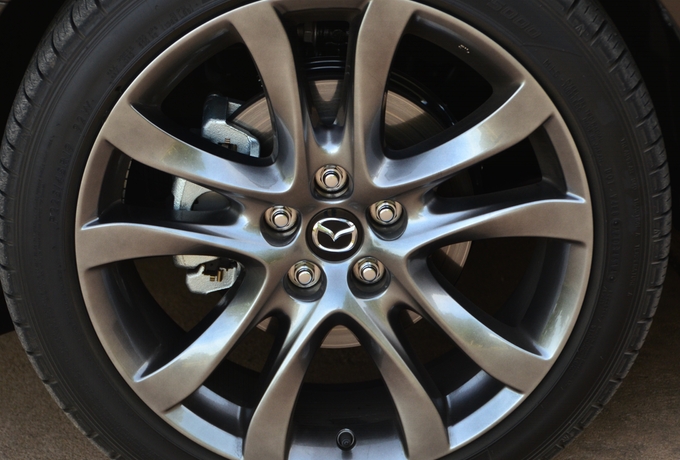
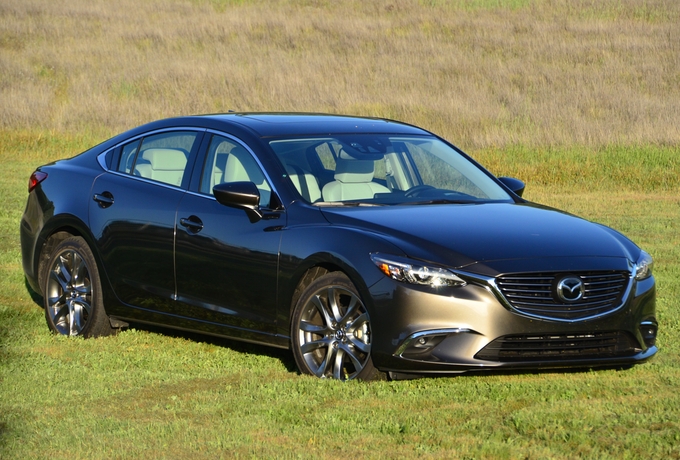
The 2016 Mazda 6 does not disappoint. Photos/Larry Weitzman

The 2016 Mazda 6 does not disappoint. Photos/Larry Weitzman

By Mitchell Weitzman

Let’s be clear on this, buy a new Mazda 6 and you won’t be disappointed. It’s possibly the best car in this heavy segment of boring and bland mobile human-transporters, and for many good reasons. If you’re on your way now to pick up a new Camry, you ought to be kicking yourself for not first test driving the new Mazda 6; it would’ve saved you a trip to the Toyota dealer.

A Mazda what? Six, the oft overlooked other Japanese sedan that your neighbor three doors down has. And he’s the only one in the neighborhood with one. Now in its umpteenth iteration, the 6 is back better than ever, with svelte, swooping yet sharp curves as if sculpted by a katana. In fact, if a Camry is the car equivalent of store-bought, prepackaged California rolls, the 6 is fresh, samurai-cut sashimi; nothing else compares.
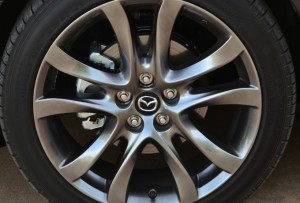
Specifications Price $21,495 to about $33,400 Engine  DOHC, 16 valve inline 2.5L four 184 hp @ 5,700 rpm                                                          185 ft-lb of torque at 3,250 rpm Transmission Six Speed torque converter automatic, with paddle shifters Configuration Transverse mounted front engine/front wheel drive Dimensions Wheelbase 111.4 inches Length 191.5 inches Width 72.4 inches Height 57.1 inches Track (f/r) 62.8/62.4 inches Ground clearance 6.7 inches Weight 3,232 pounds Weight distribution (f/r) 58/42% Fuel capacity 16.4 gallons Cargo capacity 14.8 cubic feet Passenger volume 99.7 cubic feet Steering lock to lock 2.81 turns Turning circle (curb to curb) 36.7 feet Wheels 19X7.5 inch alloys Tires 225/45X19 all season radials Co-efficient of drag 0.26 Performance  0-60 mph 7.32 seconds 50-70 mph 4.10 seconds 50-70 mph uphill 6.38 seconds Top speed 140 mph electronically limited Fuel economy 28/40/32 mpg city/highway/combined. Expect 32-33 mpg in rural country driving and over 40 mpg on a level highway at legal speeds.

Specifications
Price $21,495 to about $33,400
Engine
DOHC, 16 valve inline 2.5L four 184 hp @ 5,700 rpm
185 ft-lb of torque at 3,250 rpm
Transmission
Six Speed torque converter automatic, with paddle shifters
Configuration
Transverse mounted front engine/front wheel drive
Dimensions
Wheelbase 111.4 inches
Length 191.5 inches
Width 72.4 inches
Height 57.1 inches
Track (f/r) 62.8/62.4 inches
Ground clearance 6.7 inches
Weight 3,232 pounds
Weight distribution (f/r) 58/42%
Fuel capacity 16.4 gallons
Cargo capacity 14.8 cubic feet
Passenger volume 99.7 cubic feet
Steering lock to lock 2.81 turns
Turning circle (curb to curb) 36.7 feet
Wheels 19X7.5 inch alloys
Tires 225/45X19 all season radials
Co-efficient of drag 0.26
Performance
0-60 mph 7.32 seconds
50-70 mph 4.10 seconds
50-70 mph uphill 6.38 seconds
Top speed 140 mph electronically limited
Fuel economy 28/40/32 mpg city/highway/combined. Expect 32-33 mpg in rural country driving and over 40 mpg on a level highway at legal speeds.

First, what car in this $30K and under segment is prettier? Got one? Nope? Thought so. The Mazda 6 is the type of sensual object that requires a double take. Grant you, it’s no Aston Martin, but in the style per dollar stakes it’s tough to best. The way they use chrome to connect the headlights around the grill and also another strip to join together the rear taillights is a coherent master class.

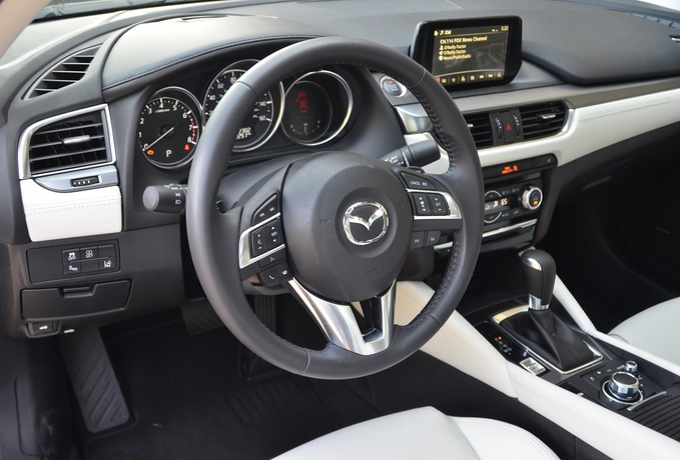
And it doesn’t stop there. Open the door and the designers clearly did not spend all their time on just the outside. With the optional Grand Touring package, an abundance of leather is employed throughout. Most important, all the materials do not feel cheap, possessing the invaluable touch of luxury everywhere in the cabin, from the dash to the plush leather seats. The interior is easily the best of its segment and rivals German’s that cost $50K. In fact, this car does Mercedes better than Mercedes themselves did with their similarly priced CLA250. But this isn’t any CLA on the inside; we’re talking E and S class here. Though for this one, you don’t need to second mortgage your home.

So what’s it actually like to drive? In short, brilliant. The 6 easily fulfills the requirement of being idiot-proof for all drivers, while also offering an extra level of fun unheard of in this segment for those that seek it. It likes to be driven hard, in other words. The chassis exhibits wondrous characteristics of neutrality coupled with more grip than anyone sane will ever need. The ride is spot-on too, not being too firm to be harsh, but neither floundering about, with great body control if things do get too out of hand. On a good twisting country road, it just begs to be driven harder than you would first think, with swift, communicative steering, asking for more. Though some enthusiasts may deride it for being front-wheel drive, torque steer is minimal, and if anything, the power to the front wheels invigorates the electrically assisted steering with feedback and feel. Give it the beans and the 6 then reveals it’s true character: An Armani-clad sports car disguised as a family sedan. Subtle, sporty, classy elegance.

What about Jeremy Clarkson’s favorite, the power? The 6 has a 2.5-liter inline-4 producing a healthy 184 HP and 185 pounds of peak torque, both delivered fairly early in the engines rev range. This results in a very flat power curve, helping the motor belie its modest firepower and capacity, almost giving the impression that it’s boosted by a low-pressure turbo. Though not the last word in absolute speed, giving up 7 seconds to reach 60, it delivers easy drivability and never a wanting for more speed or power, especially when connected to its quick, foolproof 6-speed automatic cog-swapper, keeping it in the wide powerband whenever you ask it. A manual is also available for purists seeking the ultimate driving connection. Would more power be nice? Sure, but it’s wholly unnecessary, that is, unless Mazda decides to create another Mazdaspeed 6. That reminds me, Mazda, please build a Mazdaspeed 6. Fuel economy is exceptional also, burning a measly 32 mpg in everyday driving and returning 42 on the highway at 70. How the motor is able to combine still respectable performance with such efficiency is a stellar piece of the bargain, and maybe attributable to the trick i-ELoop system. This acronym recovers kinetic energy from braking and turns it into electricity to power all components the alternator usually would, relieving the engine of this tedious task when back accelerating and resulting in increased fuel economy.
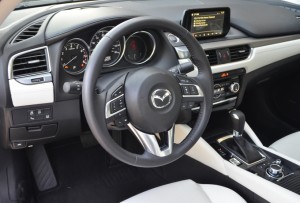
All the modern convenience's at the driver's fingertips.

All the modern convenience’s at the driver’s fingertips.

Sure, a V6 Camry will blow its doors off, but that’s about the only thing exceptional a V6 Camry can do. And when exactly is speed important in cars of this class? These are family sedans after all. You’re not taking this to the Sunday morning drag races; you’re taking it to work, picking the kids up from school and running to the store. Doubtless with the 6 though, you’ll always be taking the longer route. But also, whenever you and your friends are carpooling places, they’ll all want to take this one every time, again because of the class-oozing interior. But do remember, 7 seconds to 60 means it will keep up with a BMW E30 M3 just about, and that’s regarded as one of the greatest drives ever.

So, to sum up, if you’re looking to buy a sedan for around the $30K mark, buy one of these and you won’t regret it. You’ll only regret buying something else, something safe, something because it’s a Toyota. Oh, and that fast V6 Camry? That’ll cost $35K when properly equipped, or, $5K more than the 6. I would even say that because of the superb upscale interior and exuberant styling, the closest rival to the 6 is the new, also front-wheel drive Mercedes CLA 250, which starts at about the same price as the top-level 6 ends. Except, surprise, surprise, buy the 6 instead. Sure, the CLA offers greater straight-line performance, and only in a straight line, but that’s about all besides badge snobbery, and it’s neither as nice to look at or be in. While Mercs are a status symbol, the 6 is the car for those who care about driving. Would you rather have the nicest Mazda sedan you can buy, or the cheapest, basest Mercedes? Thought so. Don’t even think about that Camry.

Mitchell Weitzman has been around cars most of his life. He is college majoring in English.


USFS concerned nasty fire season approaching

By Kathryn Reed

Despite the rains this month, it’s dry out there and will just get worse now that 70-degree days have returned. This has agencies on heightened alert in what is expected to be a dangerous fire season.

U.S. Forest Service firefighters are reporting to work three weeks earlier than normal.

“Every day we get a reprieve with the weather, it buys us more time. It also delays the inevitable,” Kit Bailey, the Lake Tahoe Basin Management Unit’s chief firefighter, told Lake Tahoe News. “It gives us more time to prepare and train.”

While the Forest Service is the main body dealing with wildland fires, it works in conjunction with the other fire districts in the basin, including CalFire. The mantra this season is “one less spark, one less wildfire.”

Illegal campfires are something the USFS is going to have zero tolerance for.

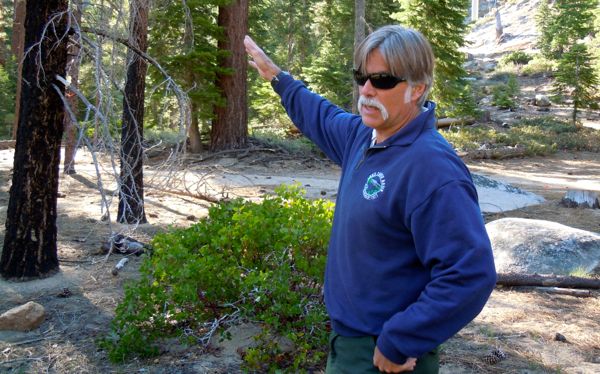
Kit Bailey with the U.S. Forest Service has been in the firefighting business for 36 years. Photo/Kathryn Reed

Kit Bailey with the U.S. Forest Service has been in the firefighting business for 36 years. Photo/Kathryn Reed

“Ninety-five percent of the fires here are human caused and most are from abandoned campfires,” Bailey said. “I don’t understand it. It’s frustrating. I’ve seen numerous times where there really wasn’t an effort to put it out.”

He said building, maintaining and extinguishing a campfire is a lost art. That is why his agency puts on a program at Taylor Creek to educate people about campfires.

It was an illegal abandoned campfire that started the devastating 2007 Angora Fire, which reduced 254 houses on the outskirts of South Lake Tahoe to ash.

The unfortunate thing is people who have left the smoldering campfires are seldom caught and even when they are it’s a hard case to prosecute.

While the entire Western United States is in a drought, California is at the “exceptional” level – making it at the top of the chart. Nevada isn’t much better off.

While staffing is always an issue, the agency has more people on the ground enforcing the rules, and will have access to numerous people to patrol the basin and backcountry during Fourth of July weekend.

Bailey is concerned, though, that there will be multiple fires at once that will stretch the firefighting ranks to the point that a fire will not be well staffed. Locally, the USFS has a cadre of on-call firefighters to call. Plus, there are the local government agency crews who have wildland experience. They were all used during Angora. The Forest Service is also training California Conservation Corps members to be a type two hand crew.

“The best way to fight a fire is to prevent it,” Bailey said. Education is one form of prevention. All fire agencies are doing their part to get the message out about the need to be diligent when it comes to all things fire related. The problem, as Bailey points out, is that often the people who need to hear the message most aren’t listening.

He said homeowners can start by making their residences less susceptible to fire. The Living with Fire website provides a wealth of information. Bailey believes the built zone – using flame resistant materials – is more important than defensible space.

When people see smoke, it’s imperative they call 911. The theory is that it’s better to get multiple calls than no call.

The fire cameras that are gradually being installed around the basin are another tool agencies can use.

It’s possible fire restrictions will go in place earlier than most years. June 15 is the likely date. The rules impact campfires, smoking and off roading. (The 2002 Gondola Fire was started from a cigarette being thrown from the Heavenly gondola.)

The forest is being stressed with the lack of moisture, which makes it more susceptible to a wildfire. The trees haven’t had enough to drink since this is year four of the drought.

“We are seeing a significant amount of tree mortality in the southern Sierra. It’s doubling every year,” Bailey said. A dead tree is more fuel for a wildfire.

The Forest Service has models to measure the fuel moisture content of trees. It should be in the 20s now, but it’s only in the teens.

“It’s a good indicator of what the season will look like,” Bailey said – hot, dry and prone to fire.


Opinion: The tyranny of constant contact

By Henry Alford, New York Times

Everything I know about the Internet, I learned from my 87-year-old mother.

Like, the harder you hit “Send,” the faster the email travels. If you want wholly to colonize your reader’s subconscious, just end your email or text right in the middle of the. If you’re still not sure your reader is fully invested, simPLY LEAN ON YOUR CAPS LOCK TO IMBUE YOUR MISSIVE WITH A THROBBING IMMEDIACY.

But Mom’s larger message is that the Internet and cellphones have created a kind of tyranny of connectedness: Even those of us who don’t have small children or jobs with the State Department, it seems, now need to be accessible at all hours of the day. It’s as if we’re doctors on call.

Like Madonna confessing that during her marriage to Guy Ritchie each kept a BlackBerry tucked under their pillows at night, we have to keep up standards. If you go to the theater and discover your phone has died, you better borrow a seat mate’s phone and pre-emptively call the last five people you spoke to; if there’s a glitch in Gmail, you better start checking all your other portals with an assiduousness that verges on the robotic.

Read the whole story


ZCTC to host tennis mixer

All things beach related is the theme of the Zephyr Cove Tennis Club’s 2015 inaugural Hump Day Mixer on June 10.  This means dressing in beach or summer attire.

Camel Hump Day MixerMixers include a barbecue, raffle prizes, and an adult doubles round robin for all ability levels. Play starts at 5:30pm.

The Hump Day Mixers are $10 for club members, $15 for non-members, and $5 for spectators (meal only). Membership is $80 per year. To join, go online or do so the night of the event.

Participants of Hump Day events are encouraged to bring a side dish or dessert, as well as beverage of choice that does not come in a glass container. No advance sign-up is required.

Zephyr Cove Tennis Club is on Warrior Way off Highway 50 in Zephyr Cove.


Californians turning to fake grass

By Rob Kuznia, Washington Post

HERMOSA BEACH — Christopher Knight makes no apologies: He likes a green lawn. But the actor best known for playing middle son Peter on “The Brady Bunch” also wants to do his part to conserve water.

The solution? Fake grass.

“It feels totally different,” Knight, 57, marveled one day last week, stepping barefoot onto a deceptively lifelike expanse of newly installed plastic turf. “Frankly, I’m not really sure why more people haven’t started doing it.”

After four blistering years of drought in California, more people are doing it. The fake grass business is booming, much to the chagrin of some environmentalists and live-grass purists.

Comprehensive numbers are hard to come by, but makers and installers of synthetic turf say they are experiencing an unprecedented spike in residential business in California. From middle-class families who don’t want to forfeit the patch-of-green part of the American dream to megawatt celebrities who are mortified by TV coverage of their sprawling water-hog lawns, homeowners across the Golden State are ripping up sod and replacing it with plastic.

Read the whole story


Parents continue to bankroll adult kids’ lives

By Akane Otani, BloombergBusiness

Jordana Gilman, a 24-year-old Ivy League graduate, is studying to be a doctor at SUNY Upstate Medical University. She has worked part-time jobs since she was 15 years old, balancing babysitter, restaurant hostess, and camp counselor gigs with heavy course loads to save money and carve out a little bit of financial independence. Yet as an adult living away from home, she gets an occasional check from her parents to cover the cost of groceries, movie tickets, and meals out.

“I feel embarrassed that I can’t support myself,” Gilman says, adding that she’s “immensely grateful” for the help. Her investment in medical school left her strapped for cash and time, she says, and it would be nearly impossible to make ends meet without her parents supplementing her income.

Gilman has plenty of company. In 2015, 36 percent of parents said in a poll published this week that they expect to support their child for more than two years after graduation, up from 18 percent the year before. More than 16 percent think that arrangement will last more than five years, according to the poll, conducted by massive education lender Sallie Mae. According to a report published last month by Bank of America, 40 percent of millennials regularly receive financial assistance from their parents. Financial advisers have taken to warning clients their grown children may destroy their hope for a secure retirement.

Read the whole story