Barton on leading edge with enhanced equipment
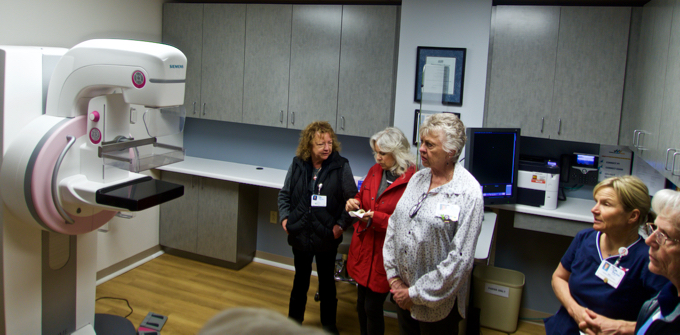
Barton Auxiliary members view the mammogram machine they helped buy for Barton Memorial Hospital. Photo/Kathryn Reed

By Kathryn Reed

South Lake Tahoe and its environs are not immune to the reality that breast cancer strikes 1 in 8 women in the United States.

Early, accurate detection can save lives. The right equipment can make a world of difference.

While Barton Memorial Hospital has had a 3D tomosynthesis mammogram machine for about a year, it wasn’t until this week that the women’s suite was officially dedicated.

If it weren’t for the Barton Auxiliary, the hospital likely would not have the machine.

“We thought this would help so many people at one time,” Vikki Egry, Auxiliary president, told Lake Tahoe News.

This volunteer group through its various fundraising efforts provided the hospital with $230,000 for the machine. This represents a fraction of the $7.5 million the group has raised through the years. The machine cost $402,000.
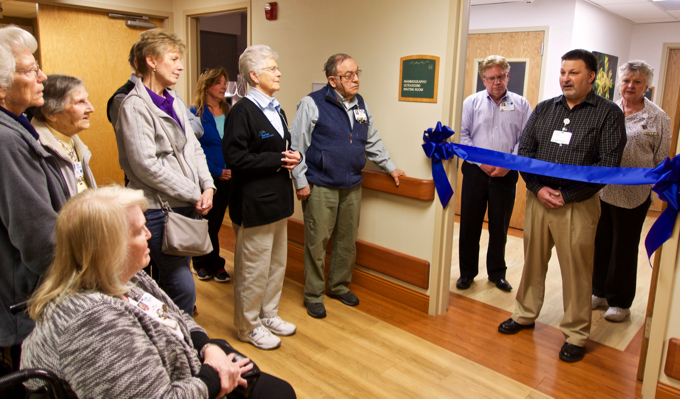
Tom Davis, head of medical imaging at Barton, talks to Auxiliary members and others on April 18 about the significance of the mammogram equipment. Photo/Kathryn Reed

“We get a lot of new equipment in radiology. It’s not often we get new technology that changes the game. This is the piece of equipment that will change the game,” Len Holmgren said. He is the lead radiologist at Barton Memorial Hospital.

Siemens, the manufacturer, has upgraded the machine at no cost so there won’t be a separate 2D image. A synthesized 2D image will be able to be created out of the 3D image.

“It will cut the radiation almost in half,” Holmgren said.

This technology was recently approved by the FDA. Barton is the first hospital on the West Coast to have it. It will be online in the coming weeks. Holmgren said it should also make the exam slightly faster.

“This should not be in a hospital this size,” Tom Davis, who heads medical imaging at Barton Memorial Hospital, said of the entire imaging machine. He added that Siemens wants to make Barton a show site with the added device, which is in large part why it was free.

The entire area where the mammogram machine is located has been remodeled into a women’s suite.

Davis said a goal was to get rid of the “institutional feel.”

In a separate room is the outpatient ultrasound room. This is used for obstetrics and other women’s care.

A plaque in the suite explains how all of this came into being because of the generosity of the Auxiliary volunteers.


Editorial: Bankrupt public-employee pensions a looming crisis

Publisher’s note: This editorial is from the April 16, 2018, edition of Investor’s Business Daily.

As the media relentlessly focus on the federal government’s burgeoning debt, a new report says that states face their own ticking debt bomb: the exploding liabilities for lavish state and local public-employee pensions. Reform won’t be easy, but there is no choice.

A new report by the Pew Charitable Trusts shows that the problem is getting out of hand. In 2016, the most recent full year for which data are available, states were more than $1.4 trillion in the red. Pension debt has increased for 15 straight years, and shows no signs of abating.

Indeed, as Reason blogger Eric Boehm notes, “The really scary part is that pension debt keeps increasing despite the fact that taxpayers’ contributions to state-level pension plans have doubled as a share of state revenue in the past decade.”

Read the whole story


Calif. car culture killed promise of 20-minute commute

By Meghan McCarty Carino, KPCC

As an innovator and early adopter of freeways, California became the symbolic capital of car culture. But the ease of movement conferred by the massive postwar freeway building boom was short-lived, turning the dream of car travel into a nightmare of congestion and long commutes.

The story of how Californians went from getting around to getting stuck behind the wheel is deeply entwined with the history of the urban freeway, an enterprise that advanced earlier and on a larger scale here than anywhere else in the country.

Half a century ago, there was reason for optimism about cars. Los Angeles native Michael Alexander remembers the days when the old saying about getting anywhere in Los Angeles in 20 minutes actually held true.

Read the whole story


Nev. ranked last in public health disaster readiness

By Jessie Bekker, Las Vegas Review-Journal

Another piece of Nevada’s health care system – its ability to respond to a public health crisis — is drawing unwelcome attention.

A Robert Wood Johnson Foundation report released late Monday found Nevada was tied for worst among U.S. states in preparedness for health disasters, including disease outbreaks, natural disasters and terrorism.

The state’s biggest issue: delivering care — particularly mental heath care — during and after a disaster like the Oct. 1 shooting, which killed 58 and wounded hundreds more.

Read the whole story


Drought returns to huge swath of U.S.

By David Montgomery, Governing

Less than eight months after Hurricane Harvey pelted the Texas Gulf Coast with torrential rainfall, drought has returned to Texas and other parts of the West, Southwest and Southeast, rekindling old worries for residents who dealt with earlier waves of dry spells and once again forcing state governments to reckon with how to keep the water flowing.

Nearly a third of the continental United States was in drought as of April 10, more than three times the coverage of a year ago. And the specter of a drought-ridden summer has focused renewed urgency on state and local conservation efforts, some of which would fundamentally alter Americans’ behavior in how they use water.

In California, for example, officials are considering rules to permanently ban water-wasting actions such as hosing off sidewalks and driveways, washing a vehicle with a hose that doesn’t have a shut-off valve, and irrigating ornamental turf on public street medians. The regulations, awaiting a final decision by the California State Water Resources Control Board, were in force as temporary emergency measures during part of a devastating five-year drought but were lifted in 2017 after the drought subsided.

Read the whole story


Promoting a greener Nevada by reducing plastic pollution

By Samantha Thompson

In recognition of Earth Day on April 22, the Nevada Division of Environmental Protection’s Recycling Program is helping to educate communities about the threats posed by “plastic pollution” throughout the state, and how to lessen the impact of plastic pollution to Nevada’s unique natural environment.

Plastic pollution refers to the accumulation of plastic waste that has negatively impacted the natural environment in the form of air, water, and land pollution. Plastic is composed of numerous toxic materials, and when not properly disposed of or recycled, can damage our natural environment. Plastic pollution harms plants and trees, endangers wildlife, degrades waterways, and poses threats to our overall public health.

The U.S. discards more than 30 million tons of plastic each year, but only 8 percent of this waste gets recycled. The rest, nearly 27,600,000 tons, ends up in landfills, is burned, or litters the environment.

Even plastic properly discarded in landfills impacts the environment and consumes energy resources. Many plastic items take up to 1,000 years to decompose, even in landfills where precious water resources are used to help facilitate the natural decomposition process. As the driest state in the U.S., it is critical to manage Nevada’s limited water resources carefully, and one way to achieve this is by reducing plastic pollution in our landfills and encouraging greater recycling of plastic waste. Plastics dumped in Nevada landfills or discarded into our natural environment will never break down easily (or ever), and the effects can be irreversible. But you can help reduce plastic pollution in Nevada. 

The Nevada Recycles program, which strives to achieve a 25 percent recycling rate statewide, offers the following tips to help reduce plastic pollution and support public health:

·      Opt for reusable shopping bags, rather than single-use plastic bags.

·      Keep reusable eating/drinking utensils on hand – including forks, spoons, knives, straws, and cups – and avoid using single-use plastic utensils.

·      Forgo to-go containers; even paper coffee cups are often lined with plastic.

·      Avoid storing or microwaving foods/beverages in plastic containers whenever possible.

·      Replace plastic baggies, plastic wrap, and other food storage with reusable glass containers or jars.

Some of the evidence-based, long-term effects of plastic pollution include, but are not limited to, the following:

·      Plastic has negatively affected wildlife, as animals often become entangled in plastic, or they may eat it and/or feed it to their young.

·      Burning plastic releases toxic chemicals into the air, which can cause respiratory issues.

·      Plastic pollution can affect the economy, due to the impact on public health, wildlife, the environment, and more.

“The Nevada Recycles program is dedicated to reducing waste generation and increasing recycling throughout Nevada,” said Eric Noack, bureau chief of Nevada Waste Management within the Nevada Division of Environmental Protection. “By reaching out to our communities and collaborating with local jurisdictions, schools, and partner agencies, our goal is to help educate people of all ages about steps they can take – both big and small – to actively recycle and reduce their plastic pollution and carbon footprint. We can all be part of the solution to end pollution, and foster a healthy, sustainable, and eco-friendly planet for generations to come.”

Samantha Thompson is with the Nevada Department of Environmental Protection.


NDOT to start Centerville-Hwy. 88 roundabout

Daytime single lane closures, followed by a 10-day intersection closure, will begin April 23 on Highway 88 at Centerville Lane in Douglas County as the Nevada Department of Transportation installs a traffic roundabout.

Daytime single lane closures will take place on Highway 88 at Centerville Lane April 23-27 from 7am-6pm with a pilot car alternating directions of traffic through the intersection.

An approximately 10-day closure of the Highway 88 and Centerville Lane intersection will then begin April 30 at 10an, with nearby detour available via Mottsville Lane and Foothill Road. Following the full intersection closure, drivers will again see weekday daytime single lane closures until major construction wraps up directly before the Memorial Day weekend. Travel delays of up to 30 minutes are to be anticipated.

Minor finishing elements of construction such as light pole installation will take place in future months.

A compact traffic roundabout will be installed at the intersection of Highway 88 and Centerville Lane west of Gardnerville.

When complete, the posted speed limits on Highway 88 will be reduced to 45 mph approaching the roundabout, with an advisory speed of 20 mph through the roundabout.

In coming years, NDOT will evaluate the potential of purchasing neighboring land to expand the size of the roundabout.


Bike-share companies are transforming U.S. cities

By Douglas Johnson, The Conversation

Residents of major U.S. cities are becoming used to seeing docks for bike sharing programs nestled into parking spaces or next to subway station entrances. Adorned with stylish branding and corporate sponsors’ logos, these facilities are transforming transportation in cities across the country.

The modern concept of bike sharing – offering bikes for short-term public rental from multiple stations in cities – was launched in Copenhagen in 1995, but U.S. cities only started piloting their own systems in the past decade. Washington, D.C., led the way, launching SmartBike DC in 2008 and an expanded network called Capital Bikeshare in 2010. This program now boasts over 480 stations and a daily ridership of 5,700.

Within a few years, bike-share systems launched in Boston, New York, Chicago, San Francisco, Seattle and dozens of other cities. In 2016 there were 55 systems across the country with a total of over 40,000 bikes.

And momentum continues to grow. In 2017 Citi Bike in New York City added 2,000 bikes, increasing its fleet to a total of 12,000. San Francisco is expanding its system from just 700 bikes to 7,000, thanks to a sponsorship deal with Ford.

Going dockless

The newest twist in this rapid expansion is dockless bike sharing, which lets users park bikes anywhere within defined districts and lock and unlock their bikes with smartphone apps. Users don’t have to locate docking stations or worry about whether space will be available at their destination. These systems also are cheaper to set up, so providers can charge lower user fees. Some dockless bike-share companies offer rides for as little as $1 for the first half hour.

Dockless systems are also helping to address equity issues posed by public dock-based systems, which often are located in more affluent and predominantly white urban neighborhoods. Because dockless systems don’t require stations, they can be rapidly deployed in zones that dock-based systems may be slow to reach.

Students at Beijing University developed this approach in 2014 to improve campus mobility. Dockless bike-share companies have flooded Chinese cities with bikes in the past two years, leading to massive piles of discarded bicycles in public spaces.

 Seattle turned to dockless companies to fill the gap after a publicly funded dock bike-share system there failed in 2016. The city could soon have one of the largest bike-share systems in the country. Cities around Boston that are outside of the service area of Hubway, the area’s public bike-share system, just reached a deal to provide dockless bike-share service, expanding access to hundreds of thousands of people. And in San Francisco, Uber recently purchased Jump Bikes, a dockless electric bike-share startup, and soon will allow users to reserve electric bikes with their Uber app.

If recent examples are any indication, bike sharing in the United States will be a mix of complementary dock-based and dockless systems, run by both public entities and private companies. The humble bicycle, aided by smartphone technology, is resurging as an urban transportation option.

Douglas Johnson is a public involvement specialist and an adjunct professor at Boston University.


Wrong-way driver arrest in El Dorado County

By Cathy Locke, Sacramento Bee

The suspected driver of a stolen pickup was taken into custody Thursday afternoon after traveling the wrong way on Highway 50 in El Dorado County in an apparent effort to evade law enforcement officers.

The El Dorado County Sheriff’s Office and California Highway Patrol received a report about 11:20am April 19 that a stolen silver 2017 Chevrolet pickup had been seen heading west on Highway 50 from Myers in the South Lake Tahoe area.

Read the whole story


Snippets about Lake Tahoe

·      Sierra State Parks’ Centennial Gala will be June 9, 5:30-9pm at Donner Memorial State Park. It will start with a cocktail hour, followed by a catered dinner paired with fine wines selected by the chef. Tickets are available online.

·      The final of three one-hour episodes of the 2017 STIHL National Championship Air Races in Reno will air on NBC Sports Network on April 21.

·      Jennifer Quashnick, local author of the Mountaingirl Mysteries series, on April 22 will read excerpts and share stories from her books, in which Rachel Winters, a Lake Tahoe resident often accompanied by her dog Bella, finds herself embroiled in murder, mystery, and romance. The free talk is at 11am at the Camp Richardson General Store Café.

·      Kahle Community Center will be hosting a family roller skating night on April 27 from 6-8pm. Bring your own skates with no metal wheels or rent a pair. Skate rental is $2. Cost is $5 for children ages 12-adults and $3 for seniors and children under 12 and younger. For more information, call Kahle at 775.586.7271.

·      Nevada Wildfire Awareness Month is May. This year’s theme is Prepare Now – Wildfire Knows No Season.