

Affordable housing complex may be S. Tahoe’s last


By Kathryn Reed
The nearly $9.5 million Aspens affordable housing project is likely to be the last such project to be built in South Lake Tahoe for decades.
This 48-unit development at the corner of Pioneer Trail and Ski Run Boulevard has been talked about for years. Then the state did away with redevelopment agencies. With that maneuver went $2.5 million the local redevelopment agency was going to put toward the project through the housing authority.
Then for a time it was thought the project would not get off the ground.
“The community should understand it has been a really long, arduous, expensive process,” Shellan Rodriguez, with Idaho-based Pacific Companies, told Lake Tahoe News. But in the same breath she praised the city and other agencies for staying at the table to make this a reality.
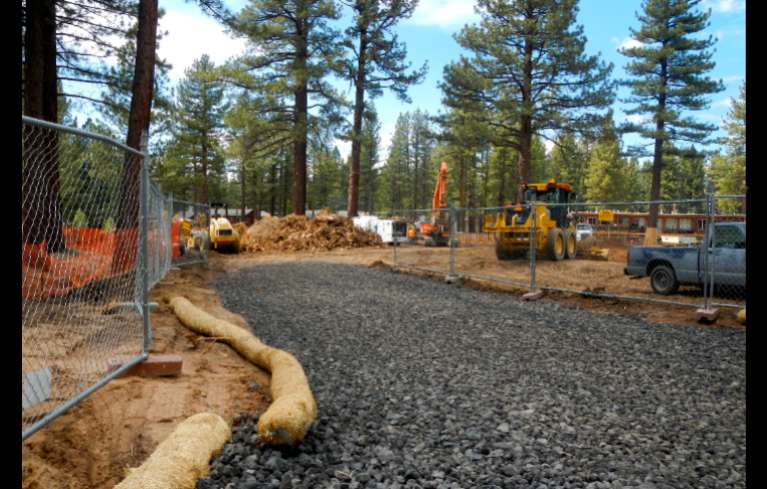
Work is under way on a 48-unit affordable housing complex in South Lake Tahoe. Photo/LTN
Ground was broken in May. It’s anticipated all the grading-type work will be done by the Oct. 15 deadline to stop moving dirt. During the winter the interiors will be completed, with the best-case scenario that leases could be signed in late spring 2014.
City Manager Nancy Kerry hopes this project will encourage others to step up their game to be more competitive. The neighboring Bart’s Tahoe complex has long been an eyesore and subject of fines, and was condemned at one time because several units were a health hazard.
Some of the more desirable affordable housing complexes in the city have waiting lists. Rodriquez anticipates that happening at Aspens, too.
This will bring the number of affordable housing units in the city to a little more than 300.
“We have more people who need that kind of low rent than we have supply,” Kerry told Lake Tahoe News. “I think people have varying perspectives for the need for controlled rent, which is what affordable housing is.”
There will be multiple buildings at the Aspens, with three-stories the tallest. The dormered roof is designed so it doesn’t appear that tall. They are energy efficient and being built to California’s Build it Green criteria.
“A community doesn’t want housing that looks low income and low income folks don’t want housing that looks low income,” Rodriquez said. This is a rendering of the Aspens project.
The company also has similar completed projects in Truckee, Mammoth and Carson City, as well as Jackson Hole, Wyo.
There is almost an equal number of one-, two- and three-bedroom units. Based on today’s formula, which is set by the state and federal governments, the apartments would rent from between $330 and $840 a month.
To qualify for one of the units, people will have to meet certain income requirements. Service industry workers are most likely the people who will qualify to live at the Aspens. But it’s also possible a single parent at an entry-level professional job could meet the requirements.
Half of the project site will not be developed; it will be open space.
Other amenities include bike storage and bike parking, play structures for little and bigger kids, a community building that will have laundry facilities and a common fitness area.
While high-end appliances and the like are not being installed, neither is the cheapest product. After all, Pacific Companies expects to own the complex for the next 55 years, so it wants things that will last a reasonable time. That is the time period in which these units are deed-restricted low income.
Because these types of projects are government subsidized and California eliminated its funding mechanism when it dissolved redevelopment agencies, the projection is these types of projects are a thing of the past.

“The community should understand it has been a really long, arduous, expensive process,”
This statement, in a nutshell, sums up the problems with Lake Tahoe.
If we continue to place barriers to entry in front of business, there will be no jobs and no better times ahead.
With all of the problems SLT has, just leave it to them to subsidize housing and provide incentive for more low income individuals to come and live here beyond their means. Best example ever of good intentions paving a very different road. If folks can’t afford to live here, and make a wage to do so, shouldn’t they just consider living somewhere else?
There are so many things wrong with government project housing like this that it’s difficult to know where to start. But as the headline indicates, raw economics usually, eventually, trumps such foolishness. Sad that SLT managers are the last to get it, if they will ever.
What’s that hissing sound I hear? Oh yeah, its the value of my property being deflated, because someone just installed property next door that is worth half of what I paid for mine.
Doug, just wait until you tell the purchaser that the city is going to be eagerly writing your friends tickets when they park in front of your house. But hey, its good for me, I don’t live near the parking or the projects.
Doug, congratulations! You sir are officially a member of the NIMBY club. Thank goodness YOU do not reflect the TRUE human spirit!
Bigger, read up on housing projects. It may seem like a good idea but it is far far better to provide assistance so that low income folks can move into middle class neighborhoods. Projects depress property values and then the neighborhood declines. It happens every time.
This is a minimum wage town. Many workers here have to work hours on their job without being paid just to have the privilege to keep their minimum wage jobs. These low income minimum wage workers are found at hotels, casinos, retail and commercial businesses, Heavenly Valley Ski Resort and just about every business you can think of. Most fireman, police, and hospital workers live off the hill because they can not afford decent housing. Stating that the city subsidized this project to allow low income individuals move into a middle class neighborhood is misleading. The cities redevelopment agency didn’t loan or give a dime to this project. Depressed property values brought on by low income projects in the inner city have been documented but there is no documentation that affordable housing projects in resort cities like Aspen, Truckee, Mammoth, Jackson Hole or others resort cities have had this effect on the surrounding property values. Affordable Housing projects in our city like Sky Forest, Tahoe Senior Plaza I & II, have not lowered the property values in their area. Pioneer Trail and Ski Run Blvd has been a blighted area for over twenty years. In the last few years the city enforced code violations of apartment owners who do not maintain their properties. Before that, many surrounding apartment buildings were plagued by criminal activity, mold, roach infestation and countless nuisances. Not all owners acted negligently disregarding their properties and tenants, but many did. There are still multiple problems of that sort in the area. This project will bring pressure on those owners to raise their standards and improve their properties to compete in the market. This project will be held accountable by city, state and federal agency standards and inspected by each agency every year. It’s unfortunate that some of the loudest voices often heard are angry, cynical, uninformed and mean people, who do nothing to help this town prosper. Redevelopment agencies and their ability to finance affordable housing have been eliminated and that means that South Lake Tahoe may not see an affordable housing project for decades. That’s the truth. Many people do not realize how hard it was to get this project off the ground and how many people it took to accomplish this. This project has provided jobs to the community and will continue to create jobs in the future, will generate valuable tax revenue for the cities General Fund, and provide much needed housing for people who make this city operate as a resort.
Whitt33:
Thank you for being informed on this matter and for eloquently explaining this very complicated subject. You have actually given me hope that there are some informed individuals in this town and that there is one less misinformed talking head that just repeats inaccurate rhetoric.
The city redevelopment agency did nothing for most of these projects. When they displaced people, living in motels the city could relocate these people or pay them off. They paid $2,000.00 to apx. $6000.00 to each individual for moving, instead of providing housing for them. Some of the people move to another motel to collect more money. The city only gave these people money to spend, any way they wanted, instead of providing housing. Redevelopment in this town was for the developers and attorney to make the most money possible. If they displace people for the loop road where would these people move to?
Figured I’d get the predictable name calling as a response. Mean ol’ me. No doubt that this project is done with the best of intentions, as all variants of it have been, since the initiation of the war on poverty in the 60’s. Be truly great if we could push a button and move all minimum wage earners into such up scale housing. But the economics just never pan out. If done on a large enough scale to make a real impact, huge taxpayer sums are needed, and the local market is distorted to the downside. If just onesie twosie are done in Aspen or Incline or such places, sure will make the millionaire backers of it feel better about themselves, and adjacent rates won’t be impacted, but then the very few tenants who get to live there are deemed worthy how? And Whitt, you’ve got the motivation to fix your place up backward. If I’m renting the place next door (I’m not here, but do with a similar setup in a different town.), and am barely covering costs with my rental, and the new neighbor lowers his rates, all I can do is lower my own which further reduces the likelihood of me doing any kind of major remodeling. And if I decide to unload it, the selling price just sank as well.
I know of another very similar project where I used to live. There the cheap units were purchased at bargain rates, and then rented out at full market rates benefitting only the owners who got in on it. Not quite the good initial intention.
Sorry I don’t have a quick fix to replace it with, but the reason this may be the last such project is that the charitable funds for it do need to come from somewhere. Doesn’t grow on trees. Good at least that it will be completed and look nice for a while. Better than another hole in the ground.