Affordable housing complex may be S. Tahoe’s last
By Kathryn Reed
The nearly $9.5 million Aspens affordable housing project is likely to be the last such project to be built in South Lake Tahoe for decades.
This 48-unit development at the corner of Pioneer Trail and Ski Run Boulevard has been talked about for years. Then the state did away with redevelopment agencies. With that maneuver went $2.5 million the local redevelopment agency was going to put toward the project through the housing authority.
Then for a time it was thought the project would not get off the ground.
“The community should understand it has been a really long, arduous, expensive process,” Shellan Rodriguez, with Idaho-based Pacific Companies, told Lake Tahoe News. But in the same breath she praised the city and other agencies for staying at the table to make this a reality.
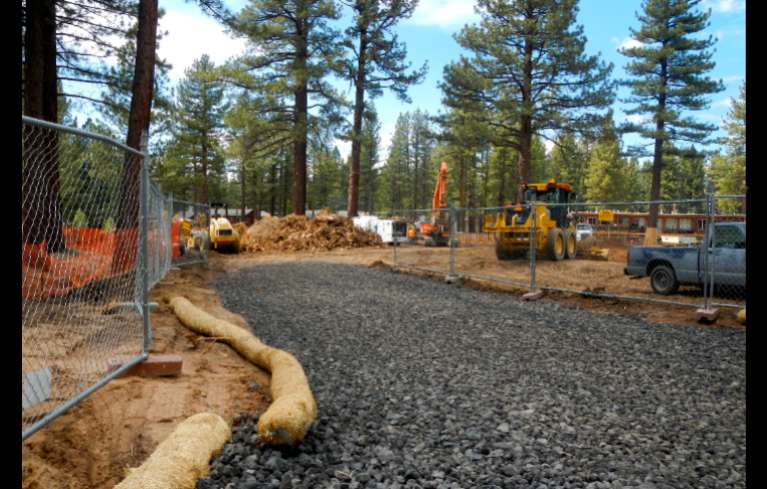
Work is under way on a 48-unit affordable housing complex in South Lake Tahoe. Photo/LTN
Ground was broken in May. It’s anticipated all the grading-type work will be done by the Oct. 15 deadline to stop moving dirt. During the winter the interiors will be completed, with the best-case scenario that leases could be signed in late spring 2014.
City Manager Nancy Kerry hopes this project will encourage others to step up their game to be more competitive. The neighboring Bart’s Tahoe complex has long been an eyesore and subject of fines, and was condemned at one time because several units were a health hazard.
Some of the more desirable affordable housing complexes in the city have waiting lists. Rodriquez anticipates that happening at Aspens, too.
This will bring the number of affordable housing units in the city to a little more than 300.
“We have more people who need that kind of low rent than we have supply,” Kerry told Lake Tahoe News. “I think people have varying perspectives for the need for controlled rent, which is what affordable housing is.”
There will be multiple buildings at the Aspens, with three-stories the tallest. The dormered roof is designed so it doesn’t appear that tall. They are energy efficient and being built to California’s Build it Green criteria.
“A community doesn’t want housing that looks low income and low income folks don’t want housing that looks low income,” Rodriquez said. This is a rendering of the Aspens project.
The company also has similar completed projects in Truckee, Mammoth and Carson City, as well as Jackson Hole, Wyo.
There is almost an equal number of one-, two- and three-bedroom units. Based on today’s formula, which is set by the state and federal governments, the apartments would rent from between $330 and $840 a month.
To qualify for one of the units, people will have to meet certain income requirements. Service industry workers are most likely the people who will qualify to live at the Aspens. But it’s also possible a single parent at an entry-level professional job could meet the requirements.
Half of the project site will not be developed; it will be open space.
Other amenities include bike storage and bike parking, play structures for little and bigger kids, a community building that will have laundry facilities and a common fitness area.
While high-end appliances and the like are not being installed, neither is the cheapest product. After all, Pacific Companies expects to own the complex for the next 55 years, so it wants things that will last a reasonable time. That is the time period in which these units are deed-restricted low income.
Because these types of projects are government subsidized and California eliminated its funding mechanism when it dissolved redevelopment agencies, the projection is these types of projects are a thing of the past.