

Star Guide: Our place in the galaxy


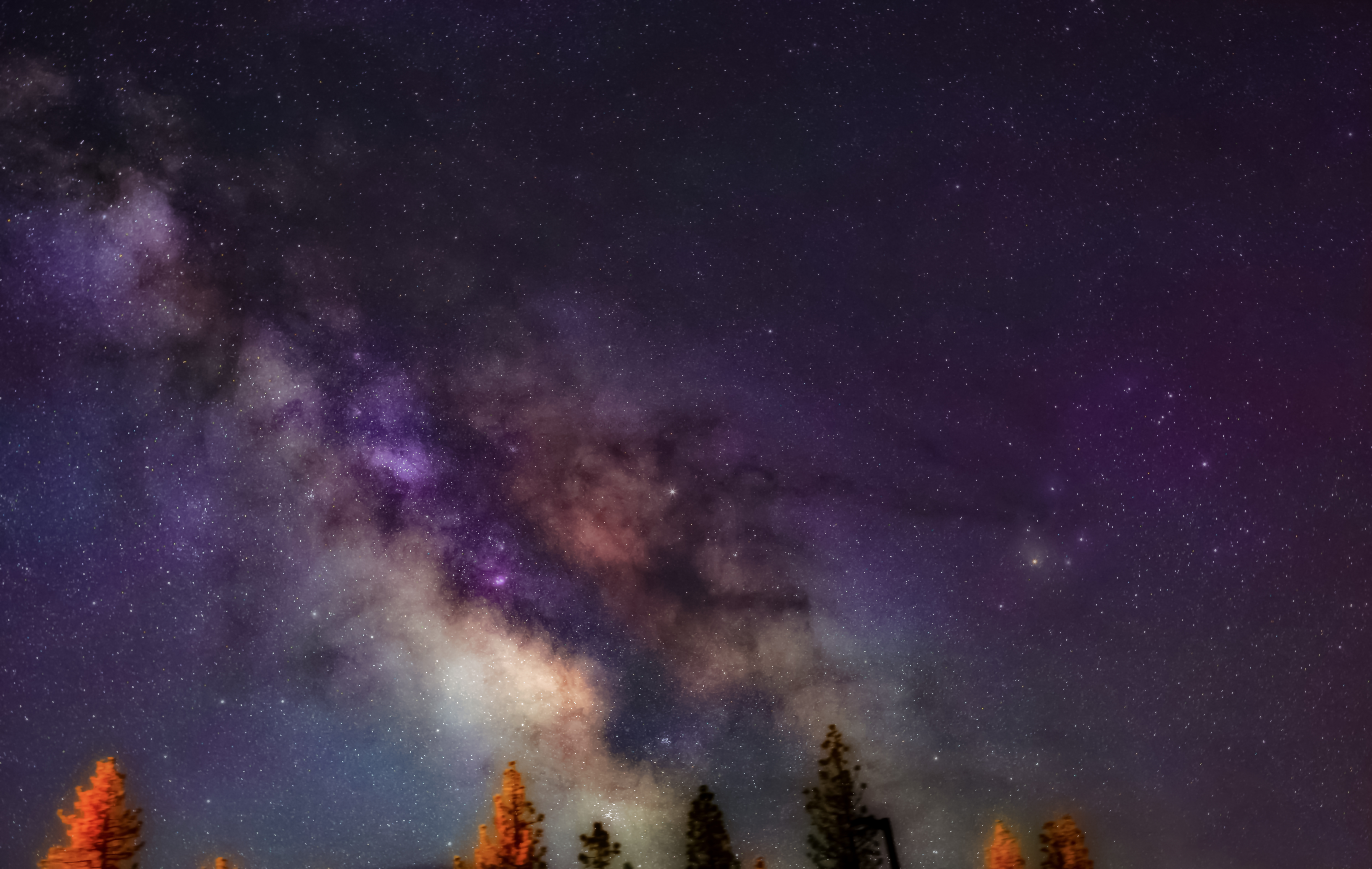
Time to look up at the sky to see what else is out there. Photo/Ryan Berendsen
By Tony Berendsen
“The contemplation of celestial things will make a man both speak and think more sublimely and magnificently when he descends to human affairs.” — Cicero (106BC-43BC)
Our view of the cosmos is hidden by the light scattering of the sun during the daylight hours causing the illusion of a blue sky celling. Sunset is the beginning of the transparency of our magic window view into space. We live on the edge of space and can safely lookout into it protected by invisible magnetic fields and transparent gasses. We are so close to the cosmos we can touch it with our minds.
During the month of August find a comfortable dark spot outside on a moonless night with a view of the southern horizon to watch the sun relinquish its grasp on the day and replaced by the dark quiet vision of the stars. A couple bright stars in the south will become visible on the horizon as the sky darkens: a reddish colored star, and a little to the left, a yellowish wandering star.
The reddish star is Antares, the heart of the Scorpion, over 500 light years away. Its volume would swallow the orbit of the Earth and Mars if placed where our star the sun is, and it will end its life someday as a brilliant supernova bright enough to be seen during the day.
The yellowish wandering star really isn’t a star at all, it’s the planet Saturn at 880 million miles away. Even a small telescope will resolve its round disk and beautiful rings. It is the second largest planet in our solar system and revolves around the sun every 29 years.
Stay in your comfortable spot for a while, try to keep the phone and pad a bay, to watch and wait as the hazy band of the Milky Way begins to show up just below Saturn.
Saturn is just above and to the right of the dark center band of the Milky Way and its galactic center. The darkness is caused by thousands of light years of gas between us and the galactic center obscuring our view of it over 25,000 light years away.
Through the eyes of astronomical instruments imaging in the infrared, X-ray, and radio wavelengths we have seen the center of our galaxy. We have watched stars orbit near a gigantic black hole that marks the center we orbit around every 250 million years.
Lean back in your chair and look up to follow the Milky Way to the north. Notice it surrounds us and has wrapped its hazy band upon us for we are inside of our galaxy in-between a couple of its gigantic spiral arms.
Our place in the galaxy is a small place, an oasis for our kind of life, orbiting around a star that will supply us with light and energy for billions of years to come. Our technology has helped us understand where we are within the Milky Way and with that little bit of knowledge, a bright star and a planet in the evening sky to point the way, we can see where we are with our naked eyes.
Tony Berendsen runs Tahoe Star Tours. He may be reached at 775.232.0844 or tony@tahoestartours.com.
