

South Lake Tahoe council to vet future of VHRs


By Kathryn Reed
The much anticipated vacation home rental study commissioned by South Lake Tahoe doesn’t say much that people didn’t already know.
On July 11 the study titled Socioeconomic Impacts of Vacation Home Rentals in South Lake Tahoe will be the subject of a workshop by the City Council.
The council will likely discuss whether a cap should be placed on the number of vacation home rentals allowed throughout the city or in particular neighborhoods, if the permitting process should change, enforcement procedures, fines, and other related topics.
The public will have an opportunity to offer comments, suggestions and feedback. The workshop will follow the regular meeting which starts at 9am, but it is not time certain when the VHR discussion will commence.
Source: South Lake Tahoe VHR study
The report, which cost taxpayers $77,000, had its first public airing on June 13 when the consultants who put it together gave an overview for the council.
The purpose, as stated in the report, was “to examine the wide range of factors that may be influenced by the growth of the sharing economy, and evaluate the socioeconomic impacts of those factors.” This study was a partnership between faculty at California State University, Sacramento and Michael Baker International.
The report acknowledges that the city’s data on VHRs was “incomplete or inconsistent and required a great deal of processing.” Recent data was abundant, long-term wasn’t.
This led the researchers to use public data such as the Census, American Community Survey, multiple listing service, and economic and tourism reports.
Surveys and public meetings provided other content. Twenty-three percent of respondents to the resident survey identified themselves as VHR owners or operators.
In the report is an alarming admission by the consultants: “To the extent possible, data was verified for correctness and completeness; however, none of the data is guaranteed for accuracy, and the study team makes no warranties or guarantees on the validity of the data used in this report.”
Researchers also analyzed VHR related studies done in other locales.
South Lake Tahoe is not unique in losing long-term rentals when owners start using the property for short-term rentals. One study showed when restrictions were placed on where VHRs were allowed, the value of the property went up somewhat in VHR-allowable areas, while the decrease in value was greater where VHRs were not allowed.
This is what the data shows for South Lake Tahoe regarding the effects of VHRs on home values:
· A VHR with an average allowed maximum occupancy of nine sells for about 8.5 percent more than a similar house not licensed to be a vacation home rental.
· The presence of the average number of VHRs within a zero to a tenth mile of a home, and a tenth to quarter mile of a home, respectively raise the home’s selling price by 2.9 and 3.6 percent.
· The presence of the average number of VHRs with a quarter to half mile of a home, and a half to one mile of a home, respectively lower the home’s selling price by -5.3 and -9.1 percent.
To the question of what would happen if VHRs were to go away, the research found, “The most dramatic impacts that phasing out VHRs in the city will have is the significant loss of TOT, and a shrinking of the city’s tourist economy. Occupations that support the VHR industry will follow the VHR market, and move into neighboring jurisdictions where VHRs are still allowed. While the city will still be the primary location for much of the region’s entertainment and recreation, there will likely be less diversity in the tourist economy as tourists staying in VHR accommodations outside the city look for recreation options closer to their VHRs.”
Many people claim if VHRs were reduced this would help locals with having more choices to live. Not true, says the study.
“VHRs make up less than 25 percent of the city’s vacant housing stock. Addressing problems with the currently operating VHRs treats only a part of the problem facing the city in regard to the lack of affordable housing and the mismatch between incomes and housing costs experienced by residents employed in the tourist industry,” the report states.
One potential way to loosen up the housing market would be to assess a fee on vacant houses.
Researchers looked at hybrid policy ideas such as:
· Property transfer fee for properties that are not primary residences or intended for long- term rental.
· Vacant property impact fees for properties that are left unoccupied for more than a certain number of days each year.
· Regulatory relief or other incentives for absentee property owners who elect to offer their property as a long-term rental.
· Partnership with the TRPA to explore opportunities for creating a new commodity market that addresses the environmental impacts resulting from tourists moving out of hotels/motels and into the neighborhoods.
· Establishing a means for motel owners to convert units to permanent housing.
When it comes to finances transient occupancy taxes have long been one of the city’s top three revenue sources. This tax assessed to hotel rooms as well as VHR units equated to $8.67 million in 2011 and $15.686 million in 2016.
In that same time span, TOT from property-managed VHRs increased by 90 percent, from $1 million in 2011 to $1.9 million in 2016.
“The most dramatic increase, however, is in owner-managed VHRs, which increased 210 percent over the same time frame, from $299,146 to $927,238,” the report says.
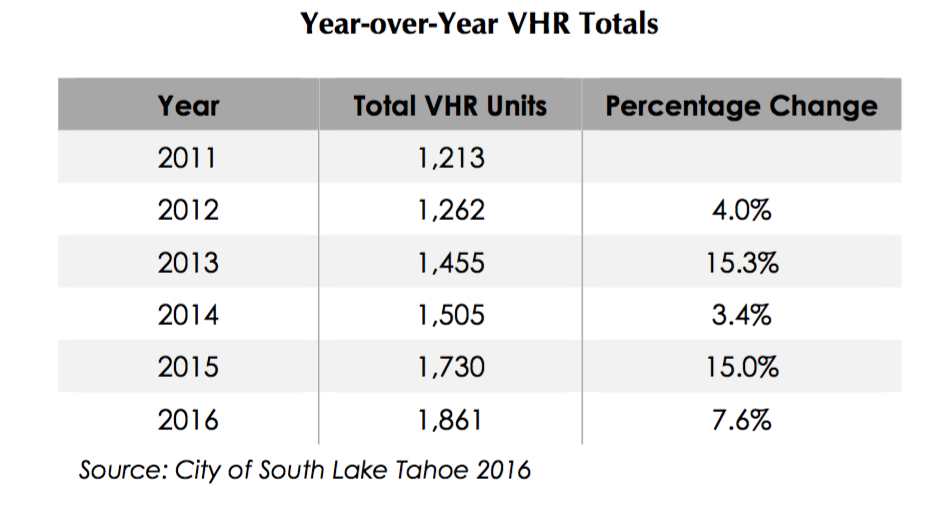
The report used data from the 2015-16 Lake Tahoe Visitor’s Authority Visitor Profile Study, that says 19 percent of tourists stay in VHRs. Of all the lodging units available throughout the South Shore, VHRs in the city limits account for 12.8 percent of the market.
The report says almost half of the housing stock in the city is owned by people who don’t live here full time. At one time that figure was more than 70 percent. The shared economy is increasing the numbers, especially as platforms like VRBO and Airbnb make it easier for the owner to rent their home without a middle manager.
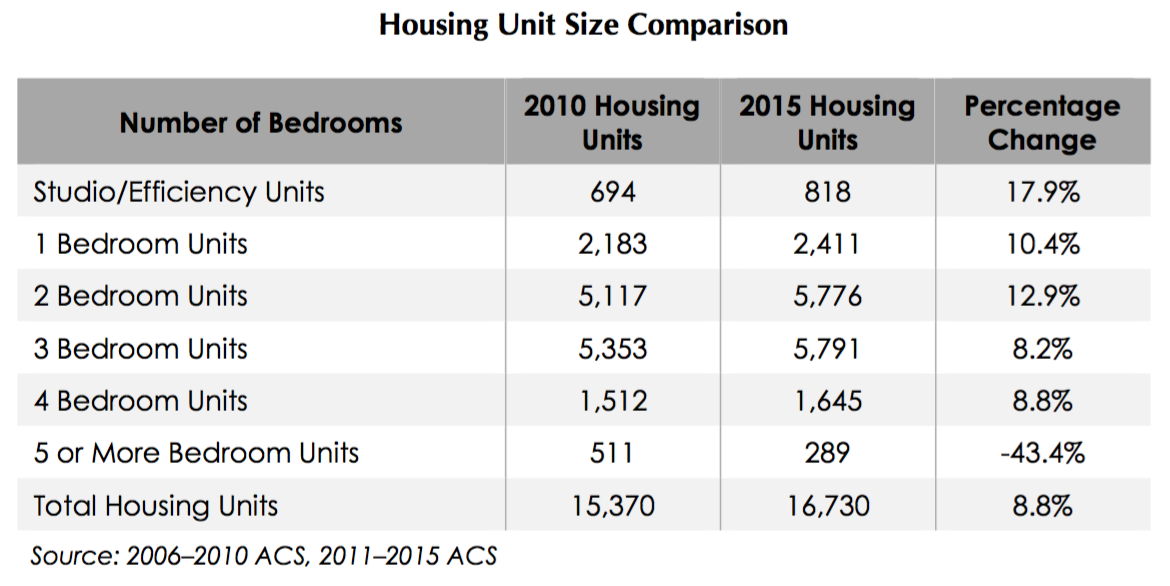
The city lost about 400 rental units for full-time residents between 2010 and 2015, the report states.
The report says, “About 44 percent of housing is owner occupied in the city, while the remaining 56 percent is renter occupied. … there has been a shift from occupied units to vacant units in the city. Between 2010 and 2015, about 6.2 percent of the city’s occupied housing was converted to vacant. Approximately 5.3 percent of these lost units were rental units and 7.3 percent were owner-occupied units. The conversion of housing units from occupied to vacant has predominantly occurred in the city’s single-family units.”
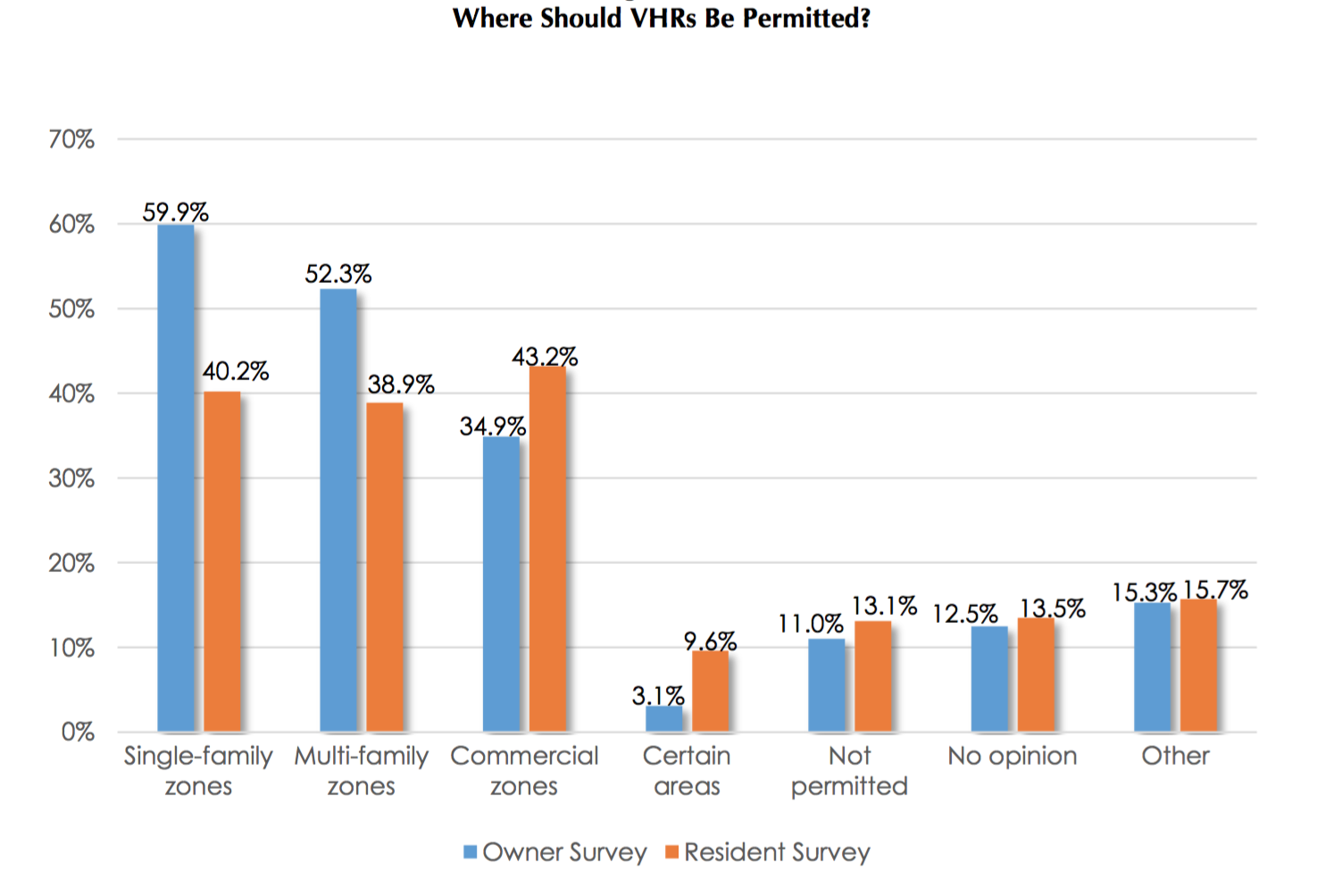
When residents were asked where VHRs should be permitted, 43 percent said commercial zones and 40 percent said single-family zones. The owners of VHRs predictably (60 percent) want them in residential areas, with 11 percent saying they should be allowed everywhere.
Here is a copy of the VHR study.
