

Aquatic mammals thrive at Lake Tahoe


By Kathryn Reed
When you go swimming in Lake Tahoe you aren’t alone. Besides the fish that call this body of water home, so do a handful of aquatic mammals.
Many of these critters are elusive and seldom seen. The work of some, like the beaver, is more apt to be visible than the actual animal.
Will Richardson, co-founder of the Tahoe Institute for Natural Science, gave a talk last week about the various aquatic mammals that call Tahoe home. More than 40 people attended the Friends of the Library lecture.
The criteria he used for aquatic mammal was a “significant portion of their body is in contact with water most of their day.”
Minks are what Richardson called a “semi-aquatic.” They are native to Lake Tahoe, are about 2-feet long and weight 2 to 3 pounds.
“To swim they kind of undulate. They have a long, flexible spine,” Richardson said.
The problem is mink look a lot like river otter so people often confuse the two. The otter have a broader, flatter head than mink. Outside the family unit, mink are solitary, while otter are social. Both are part of the weasel family.
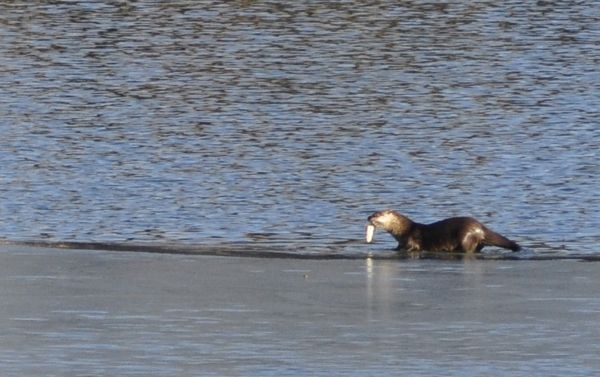
A river otter in January finds plenty to dine on at Lake Tahoe. Photo/Bob Sweatt
River otter were in the basin in abundance prior to 1950. Then they were not seen from about 1950 to 2000. Richardson said scientists don’t know where they went or why.
Otters tend to be about 3½-feet long, with a tail that is 18-inches long.
They have been seen near the Tahoe Keys, Taylor Creek and Fallen Leaf Lake.
Water shrews are rodents that are semi-aquatic.
They eat close to their body weight every day.
“They are incredibly buoyant. They are so buoyant they can run on water,” Richardson said.
Because they are nocturnal, secretive, shy and nervous, they are seldom seen.
Mountain beavers are not actually beavers. They make burrows instead of dams. They were the least aquatic of the animals Richardson spoke about. However, they always need to have their feet wet, he said.
Their closest relative is a squirrel, they have opposable thumbs, and the only place they are found in Nevada is at Lake Tahoe.
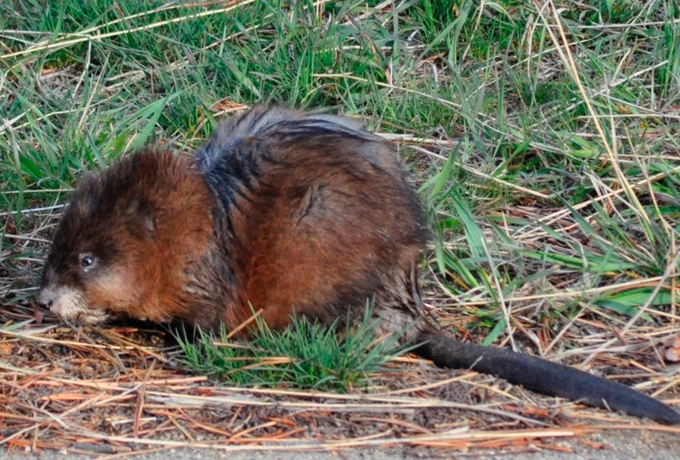
A muskrat in South Lake Tahoe. Photo/Bob Sweatt
Muskrats are about 2-feet long and weigh approximately 4½ pounds. They close their ears when they swim and they have partially webbed feet.
Stories of beavers being trapped at Tahoe go back to at least 1785.
“The beaver was trapped out of the Sierra by the mid-19th century.
To help with wetland restoration and erosion control nine beavers from Idaho were released into the Truckee River watershed between 1934-45, according to Richardson. It is descendants of those beavers that can been seen today in the Tahoe basin.
Their teeth never stop growing.
Richardson said beavers can be great for the environment, but they create problems and conflicts with people.

River Otters in Lake Tahoe would be quite a sight.
The “conflicts” between Beavers and Humans is pretty one-sided since the Castor canadensis (North American Beaver) was basically exterminated via fur trapping in the 1800’s.
Recent studies have indicated that Beaver can be very helpful for watersheds during drought years. Perhaps the conflicts with Beaver will abate with this new information.
I truly enjoyed this talk, and learned some things I didn’t have a clue about. Will Richardson is an excellent speaker who is engaging, entertaining, and is very educating. I was also pleased to hear him at the end of his talk give a nice shout out of recognition to my friend Bob Sweatt who along with supplying pics for LTN on this and other articles has many photos used by Will in his presentation, and especially Sherry and Ted Guzzi of the Sierra Wildlife Coalition. I’ve been working with Sherry and Ted as a volunteer to help the Sierra Wildlife Coalition keep the USFS and the beavers happy out a Taylor Creek.
Rock4tahoe here is a link to an article/paper published in the Spring 2012 issue of Fish and Game the scientific journal of the CA Dept of Fish and Wildlife entitled “The historical range of beaver in the Sierra Nevada: a review
of the evidence”:
https://nrm.dfg.ca.gov/FileHandler.ashx?DocumentID=67444&inline=1