

Lake Tahoe search and rescue volunteers regularly risk their lives to save others


By Kathryn Reed
STATELINE – While it’s mostly tourists whom search and rescue teams help, it isn’t always live bodies that are carried out of the wilderness.
Domino is brought in to assist with avalanche and cadaver calls. Through their dog is how Scott and Heather Longoria got involved with the El Dorado County Search and Rescue team.
Because teeth hold a scent for years that is often a tool used to train dogs. Domino showed how well he is trained at Harrah’s Lake Tahoe last week during the weekly Soroptimist International South Lake Tahoe lunch. He sniffed out a tooth under a table after being given the command “seek”.
“We probably bring closure to 10 or 15 families a year in the greater Lake Tahoe Basin,” Scott Gabler said of rescues that turn into recoveries.
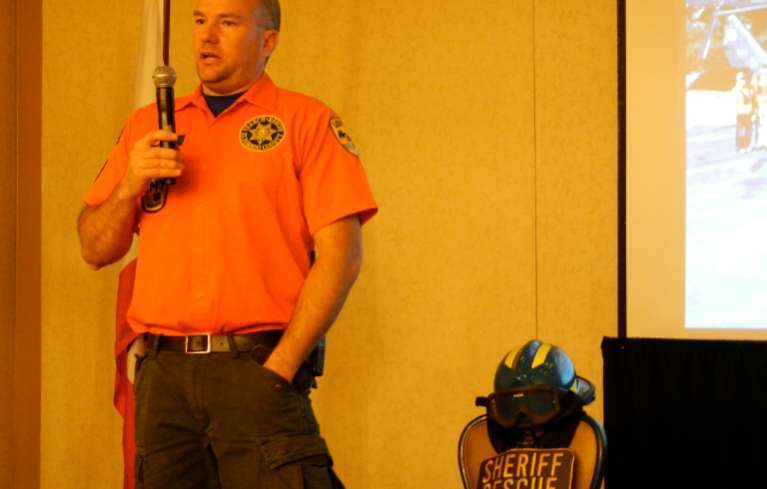
Scott Gabler talks Oct. 30 about the roll of search and rescue volunteers in the Lake Tahoe Basin. Photo/Kathryn Reed
In the three years he has been with SAR he has responded to 150 searches that equated to 2,300 hours. His work earned him state recognition earlier this year.
The Tahoe unit of the El Dorado County SAR is a group of 25 volunteers who drop what they are doing to help strangers – and often at the same time putting themselves in precarious situations. They respond to upward of 100 calls a year.
“The vast majority are urgent in nature,” Gabler said. “Search and rescue operates in the background until it’s needed.”
He said about three-quarters of the people in need are tourists. And because they don’t know the terrain, or understand the winds and temperature of Lake Tahoe, or aren’t prepared SAR often comes to the rescue.
But not all incidents can be prevented. Accidents happen.
Search rescue team members may train for one of the specialized teams. Some are adept at rope rescue. Most often rock climbers find themselves in trouble at Lovers Leap, though the cliffs at Angora can also be treacherous.
Most water rescues are on Lake Tahoe, with very few involving the Upper Truckee River. It’s people on human powered craft and motorboats who call for help.
Ice axes and crampons are standard equipment for the mountaineering team.
Trips to ski resorts are fairly routine for SAR. And many times SAR is out there without backup from ski patrol.
“We get calls typically when someone goes out of bounds. And typically it’s at the end of the day,” Scott Longoria said.
It’s not always easy to find people. The person might not know where they are or the ping from a cell phone could be misleading.
The latter was true last winter when four Stanford students called to say they were lost. Their snowshoe excursion nearly ended with a recovery because one of the women was already taking her clothes off – a sign hypothermia had set in.
They had set out at noon dressed more in workout clothes than winterwear. They had no provisions to stay out in single-digit temperatures.
The cell phone died, but the initial ping showed they were near Angora. The reality is they were near Stanford Sierra Camp. When crews figured this out they chipped ice out of the marina at Fallen Leaf Lake to be able to use the boat that happened to still be in the water. The foursome was rescued about midnight.
SAR is often assisted on rescues by a California Highway Patrol helicopter out of Auburn as well as CalStar stationed at Lake Tahoe Airport.
An annual fundraiser and community donations keep SAR afloat. The fundraiser is the third Wednesday in June at Riva Grill in South Lake Tahoe. For more info about volunteering or donating, go online.
