

No STPUD rate increases —- for now


By Kathryn Reed
Water and sewer rates will not be going up this year for South Tahoe Public Utility District customers. But that won’t be the case in future years if the district sticks to its 10-year capital improvement plan.
The board had a workshop with staff last week to go over the proposed 2013-14 budget and the CIP. No one from the public attended.
At the May 2 board meeting there will be a public hearing on the budget, with the board slated to take a vote May 16.
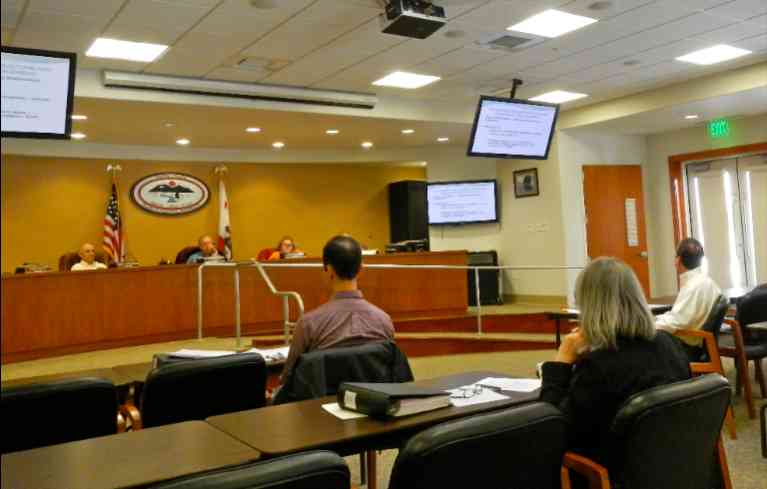
South Tahoe PUD staff members, foreground, discuss the budget March 6 with the board. Photo/LTN
In the fall the board expects to have workshops about rates and meters.
“We have work to do. By the fall we have to have concrete ideas about how to deal with this situation,” board President Eric Schafer said at the March 6 meeting.
Per California law all district customers must be on water meters by 2025. That could require borrowing money if grants are not available.
The continued decline in property values in the district’s boundaries, which are similar to those of Lake Tahoe Unified’s, means less money in the bank. The current budget assumed there would be 1 percent drop, when in reality it has been 1. 9 percent. This comes to a difference of $60,000. But with the district always forecasting 10 years out, cumulatively it equates to a potential $600,000 hit.
Paul Hughes, the district’s chief financial officer, presented a graphic that showed the revenue for water and sewer in 2008 and what is proposed in the coming fiscal year. 2008 was the peak revenue year for STPUD when service charges represented 59 percent of collections. That has grown to 69 percent for 2013-14. Revenue has decreased 4.7 percent in six years.
Connection fees have dramatically dropped as a budget line because people aren’t building. However, the situation was not as dismal as the district had forecast in the 2012-13 budget. It was assumed there would be no commercial connections and 15 residential. Through February, Bob Dogs was the one commercial connection and there has been the equivalent of 31 residential connections.
Hughes said he’d like the board to entertain the possibility of putting out a multiyear announcement so rate increases could take effect back-to-back years. “This would allow for continuity and planning on the engineering said in the CIP,” Hughes said.
As it is now, each year the district proposes a rate increase on either the sewer or water side Proposition 18 kicks in which requires all customers to be notified and given the chance to protest the increase.
Schafer told his colleagues that they better take a hard look at the 10-year capital improvement plan.
“We have been scaling back and we need to decide if that’s right,” he said.
And without continued rate increases, that 10-year plan will just collect dust and never be a reality. The 10-year sewer needs would cost $64.1 million, while the water needs are $57.8 million.
For now, replacing small water lines is the district’s focus so fire suppression will be improved. There are $3.6 million water engineering projects on the books for 2013-14, with bulk — $2.5 million – being spent on the state street waterline.
A sign the local economy is improving is that the number of people seeking a low-income discount has declined. It peaked in 2011 with 325 enrolled, dropped to 307 in 2012 and to 297 for 2013. What isn’t known is if these people are doing better or don’t live in the district any more.
