Opinion: Water conservation still a must-do

By Timothy Quinn, Sacramento Bee

Nine out of ten people believe that Californians need to conserve water, even with this year’s wet weather. This is according to a new survey conducted on behalf of the state’s public water agencies. The study also reported that four out of five are willing to reduce their household water use by 20 percent. They just need to learn how.

That’s good news for state and local water managers. For the past few years, we have been working hard on a comprehensive, long-term fix to our state’s aging water supply and delivery system. Last fall, the Legislature passed, and the governor signed into law, a historic water reform package that recognizes the need to invest in both conservation and 21st century water infrastructure. While that effort was a huge step forward, many of the fixes will not begin to affect our water supply for years, if not decades.

Read the whole story


Kudos for sports physicals help

To the community

Barton Family Medicine has been hosting the annual Free Sports Physicals for two decades now and we simply couldn’t do it without a whole lot of help. Please accept our heartfelt thanks to all the volunteers at our 2010 Free Sports Physicals held at Barton Family Medicine on June 9. This year we completed 155 free physicals for students and athletes from in and around the Lake Tahoe basin. We were so impressed with the high energy level and all the smiling faces, even after a long day. We truly appreciate your hard work and we all look forward to next year.

Our sincerest thanks goes to the physicians, practitioners, physical therapists and staff from Barton who made this event a success. Also a great big thank you to South Tahoe High School; Pop Warner; Whittell High School; St. Theresa Catholic School; South Tahoe Middle School; Grocery Outlet; and the Kiwanis Club of South Lake Tahoe.

Cindy Cosmi, Barton Family Medicine supervisor


DOJ explains Meyers Landfill settlement

To the community,

A settlement with El Dorado County will ensure the beginning of the cleanup, at an estimated cost of approximately $7 million, of the Meyers Landfill Site, located outside of the city of South Lake Tahoe, the Justice Department and U.S. Department of Agriculture, Forest Service announced June 29.

The agreement, lodged in U.S. District Court in Sacramento, resolves certain federal claims against El Dorado County for clean up of the Meyers Landfill site. In addition, the agreement resolves certain counter-claims made by the county against the United States for cleanup of the site.

Under the settlement, El Dorado County will be responsible for consolidating the waste mass at the site and placing it under an impervious cap. The cap and associated drainage features around the cap will prevent the infiltration of precipitation and snowmelt into the landfill waste mass thus eliminating or significantly reducing additional groundwater contamination. A landfill gas venting and monitoring system will also be installed.

The U.S. Forest Service is continuing to investigate groundwater contamination related to the site. Several years of study will be required after the landfill cap is constructed to determine the effect on the groundwater, and what remedy may be required to address any remaining groundwater contamination.

The Meyers Landfill site is a former municipal waste dump and is located wholly on National Forest System lands administered by the Lake Tahoe Basin Management Unit of the U.S. Forest Service. The site is located in an unincorporated portion of El Dorado County approximately 4.5 miles south of Lake Tahoe. The site was operated as a landfill from about 1946 through 1971 under a series of Forest Service special use permits that were issued to private parties and since 1955 to El Dorado County.

Between 1991 and 1994, volatile organic compounds (VOCs), likely produced by degradation of organic material within the landfill waste mass, were detected in the groundwater beneath the former landfill disposal area. In August 1996, VOCs, including vinyl chloride, were detected down gradient of the site, including in Saxon Creek, a tributary of Lake Tahoe. The Forest Service initiated a response action under the Superfund law or the Comprehensive Environmental Response, Compensation, and Liability Act to determine the extent and impacts of the VOC contamination, and in 2001 it filed litigation against El Dorado County and the city of South Lake Tahoe.

“This settlement outlines specific steps that will be taken to ensure that the contamination at the Meyers Landfill site will be cleaned up and contained,” said Ignacia S. Moreno, assistant attorney general for the Environment and Natural Resources Division. “It is important that we ensure that longstanding hazardous waste sites are cleaned up and our natural resources are protected.”

“We are excited for construction to begin on the ground; this project will provide for the long-term protection of public health and safety and water quality in the Lake Tahoe Basin,” said Eli Ilano, deputy forest supervisor, Lake Tahoe Basin Management Unit.

The partial consent decree, lodged in the U.S. District Court for the Eastern District of California, in Sacramento, is subject to a 30-day public comment period and approval by the federal court. A copy of the partial consent decree is available on the Justice Department website.

U.S. Department of Justice


Bomb warning from Douglas County sheriff

To the community,

The Douglas County Sheriff’s Office would like to make the public aware of an explosive hazard known as a “works bomb”.

Although the presence of these devices has not been reported in Douglas County, citizens should be aware of their danger.

A “works bomb” is described as a mix of water, aluminum oxide and sodium hydroxide (found in many chemical drain openers) enclosed in a container. The chemical reaction creates a volatile build-up of gases and subsequently detonates the container. The resulting explosion can be severe enough to mangle fingers, or cause second or third degree chemical burns or blindness from the dispersed liquid.

These types of mini bombs have been around for many years, but have recently seen resurgence in several U.S. states. In one instance, one of these devices was left in the yard of an unsuspecting person who luckily called law enforcement officers to investigate it. The bottle was found to be set as a boobytrap, so that anyone picking it up would cause the contents to mix, resulting in the inevitable explosion.

For further information on these incidents, citizens can check news stories from Washington Heights and Junction Park, NY; Eudora, KS; and Detroit and York Township, MI.

DCSO advises citizens that if they should find such a device, to leave it alone and call law enforcement to investigate it further.

Parents should warn their children of the dangers of crafting or playing with such devices.

In most states, including Nevada, it is a criminal offense to construct or set such a device. In the state of Nevada it is a felony crime punishable by imprisonment in the state prison for one to four years, with fines of up to $5,000.

Anyone with any information regarding persons assembling such devices is asked to call the Douglas County Sheriff’s Office at (775) 782.5126, or the Douglas County Secret Witness line at (775) 78.CRIME.

Ron Pierini, Douglas County sheriff


Time fails to diminish the power of the Angora Fire

Publisher’s note: Read the Lifestyle section for details about the Angora home tour.

By Susan Wood

A slight breeze and blue sky marked a stark contrast in the Upper Truckee region this June, three years and two days after South Lake Tahoe’s Angora Fire that in a wind-whipped inferno burned 254 homes, displaced hundreds and caused more than $160 million in damage.

The 2010 AAUW Home Tour on Saturday brought out many people to tour seven homes rebuilt since the South Shore’s tragic event. And although much healing has occurred, the moments of drama, helplessness and fear are charred into my memory forever.
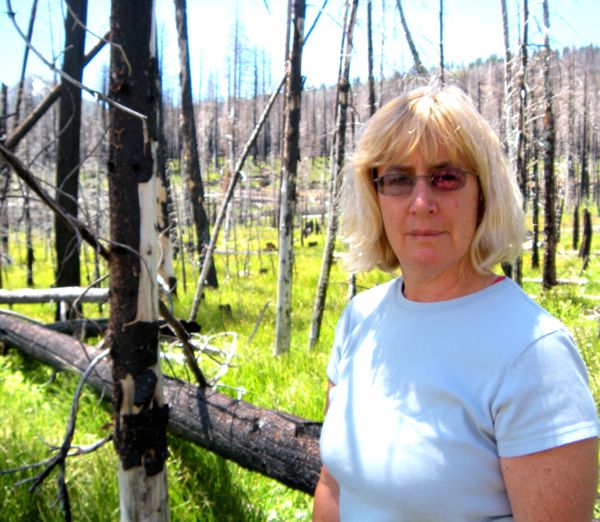
Susan Wood three years after the Angora Fire. Photo/Kathryn Reed

Reporter Susan Wood three years after the Angora Fire. Photo/Kathryn Reed

Chatting with Norma Sprague, the co-owner of a Lake Tahoe Boulevard home on the tour, took me back.

“The flames seemed far away,” she recalled saying to her husband, Warren. This was relatively true until minutes later a fire truck roared up to the curb and a firefighter yelled for the couple to get out. That was the scene on several streets branching off Lake Tahoe Boulevard, North Upper Truckee Road and Tahoe Mountain Road.

“We’re lucky to be alive,” she said with a steely look in her eye. I recognized the look as one from someone who really lived the fire.

As the first news reporter to the over 3,000-acre fire that fateful day, I would agree.

When the 2:14pm call came into the police scanner at the Tahoe Daily Tribune, I had almost wrapped up the reporting for the day. It was a tough day. I had discovered that morning one of my nephews had died. I had no plans other than to decompress and grieve.

Unbeknownst to me, I would mourn for my community that day.

There’s a level of urgency dispatchers conveyed June 24, 2007, that told me to hop in my truck and head west.

I could not believe the plume of smoke would be so large and so close to the Y. I remembered thinking and calling my editor to say: “This is big. It’s in the neighborhood.” I believe the word “unprecedented” came across my lips.

I was grateful I had put on a full fire suit. I beat the police barricade at Sawmill Pond and drove the truck up Lake Tahoe Boulevard and, knowing the drill of covering fires, turned it around to park. The wind was raging, blowing embers so hard that a small one lodged between my safety goggles and right eye. I swatted at it but kept walking toward the orange-blackened haze. I’ll never think of a crackling fire the same way. The low moan I recognized as the life of the fire.

With embers blowing from roof to roof, houses erupted into flames about 10 to 30 feet around me. People were crying, screaming and running for their lives in the opposite direction of my route. A motorcyclist turned his bike over long enough to stomp on a blaze. Residents were throwing belongings in their vehicles with just minutes to get out.

A wall of fire headed toward Mule Deer Circle with a vengeance and between occasional calls into the newsroom I wondered if the fire would climb up Tahoe Mountain Road and over Angora ridge to the Fallen Leaf Lake community.

I flagged down a U.S. Forest Service truck driven by Kit Bailey, the Lake Tahoe Basin Management Unit’s fire management officer. He said at least 100 homes had gone up in flames.

I performed an about-face to get in front of the fire. On the way down at the base of Sawmill Pond a police barricade had been established and residents were pleading with sheriff’s deputies and highway patrol officers to let them into the fire zone. One woman got in the face of one deputy because she wanted to retrieve her dog. He threatened to arrest her. Her look of desperation made me sympathetic. She looked like she was going to make a dash for it.

From there, I picked up news photographer Cathleen Allison and headed up Fallen Leaf Lake Road while fire officials had barked out the suggestion of evacuating the Sawmill Pond area. This was the first time I thought the town could be in danger. The second time came two days later when a back burn jumped Highway 89.

Allison and I were stopped by another barricade, so we parked down the road from the Tahoe Mountain Road intersection with Fallen Leaf Lake Road. We hiked up the ridge to a surreal state of emergency. A tactical tour de force of multi-agency fire units armed with shovels and bulldozers set up a barrier wall to keep the fire from coming up and over the ridge. Fire burns faster up hill. Flames shooting 30 feet in the air had engulfed at least one home off Uplands Way. My heart sank.

Upon my return to the office, a few dozen emails from concerned homeowners and citizens greeted me because my name appeared on the fire updates. They wanted to know if their homes were still standing.

Solange Schwalbe, whose rebuilt home on Zuni Street was featured on the home tour, was out of town at the time of the fire. She had a captive audience as she recalled returning to find the fire burned so hot through her neighborhood it melted the blue tarp to her Jeep.

Her demeanor has changed drastically in the last three years — from those early days of attending those sobering community meetings, trying to pick up the pieces reduced to ash and plotting her next move.

Healing has occurred. But that doesn’t mean we forget the pain that started near Seneca Pond, where an illegal campfire smoldered from the night before and erupted into the Angora Fire.

Even the squeal of a fire engine in summer on windy days puts me on alert these days.

“You’re never healed completely. It’s like losing a parent. You never quite get over it. You just learn to live with it,” Schwalbe explained to the home tour group gathered to hear her story.

As one reporter who has covered the Gondola, Showers and Angora fires, I just hope we’re humbled enough to learn from them.



Opinion: Who owns California’s water?

By Bob Williams, Record Searchlight

Most of us have always believed that water flows downhill. We were recently corrected by Len Richardson, editor of the California Farmer who said, “Water tends to flow toward wealth.”

Richardson has good reason for this cynical view and it’s time for all Californians to take notice. Wealth has moved to take more and more control of California’s waters. The rise of water oligarchs is nothing new and was brought home to anyone who saw the movie “Chinatown.”

The action has now shifted to the San Joaquin Valley and to maneuvers there for privatizing control of water in the massive State Water Project. These are not work-a-day farmers we are talking about. One or two may own a broad-brimmed hat but their offices are in Sunnyvale and Beverly Hills.

Read the whole story


DA lashes out at Dugard’s biological father

To the community,

Our office has received several inquiries to respond to reports that Kenneth Slayton – Jaycee Dugard’s biological father – has filed a lawsuit against her to “establish parental relationship.” Any such action by Mr. Slayton and his attorneys is greatly disconcerting.

Back in 1991, Mr. Slayton was contacted regarding the disappearance of 11 year old Jaycee Lee Dugard. At that time, Mr. Slayton showed no apparent interest or concern in the disappearance of his biological daughter.

Frankly, it’s disgusting. First, a man abducted and then forced himself upon Jaycee for 18 years. Now, her biological father seeks to force himself upon Jaycee using his attorneys and the legal system. It’s a sad commentary on our society that a man who professes that all he wants for his now 30 year old daughter is to love and protect her, and damn it, he’ll sue her for the right to do it.

Jaycee Lee Dugard is 30 years of age and has the right to decide who she meets and when.

Vern Pierson, district attorney El Dorado County


Crawford: Time to sort out ethical issues on council

To Lake Tahoe News,

Webster’s Ninth New Collegiate Dictionary cites the first definition of the word ethic as the “discipline dealing with what is good and bad and with moral duty and obligation.”

As a member of the City Council, I believe we have ethical issues that the council should deal with. At the center of my concern is the presence of Bruce Grego on the council. It appears that he has conflicts of interest.

Bill Crawford

Bill Crawford

When the council approved the creation of RD Area Two, I raised the issue that Mr. Grego, who voted yes on RD Area Two, may be in conflict because his office is in Area Two. The city attorney said there was no conflict because Mr. Grego has a month-to-moth lease with his landlord.

After the meeting, I asked the city attorney to show me the lease. The city attorney said the lease was verbal. Thus, the city attorney had taken Mr. Grego’s word on the subject.

Several times I have requested to know the exact terms of the lease. And I have been told several times by the city attorney that he is working on my request. As of June 23, 2010, nothing has been disclosed.

The important point is this: If Mr. Grego is in conflict, the vote on RD Area Two most likely is not valid and would be nullified. So it is a serious matter and full disclosure of the terms of the lease is needed.

And Mr. Grego’s landlord is a client of Mr. Grego and has been for several years.

Another possible conflict for the council with Mr. Grego is that his landlord has property on Ski Run Boulevard. The so what is this: Councilman Grego voted on the Ski Run Boulevard BID. Thus, the situation is complex and tricky. His landlord is his client and is involved on Ski Run Boulevard. A tangled web, perhaps.

Thus, it is not beyond reason to suggest, or believe, that if Councilman Grego’s landlord benefits, then the councilman might benefit monetarily. And the appearance is there.

I am saying all of the above because I am tired of waiting for the city attorney to demand disclosure. The pubic interest is at state.

And it is Time for Mr. Grego and the city attorney to read Webster’s definition of ethic[s] and do their duty and obligation.

Bill Crawford, South Lake Tahoe city councilman


What Nevada is doing isn’t working

Publisher’s note: This editorial is from the June 20, 2010, Reno Gazette-Journal.

Nevada has been at or near the bottom of so many national rankings over the years that residents seemingly have stopped paying attention.

Everyone should sit up and take notice, however, of Friday’s news that the state now leads the nation in unemployment.

Until this month, Nevadans could take at least a small amount of solace in the fact that things were even worse in Michigan, which was hard hit by the troubles of the automobile industry.

No longer. We are now No. 1, with a 14 percent unemployment rate in May (the latest numbers available), and the state’s political and business leaders should be embarrassed.

Read the whole story


‘Pay it Forward’ in South Tahoe

To the community,

Help Pay it Forward by volunteering with your neighbors at several projects around the South Lake Tahoe community. Painting, gardening, assembling, cleaning up and much more. Families of all ages are encouraged to participate.

Contact Paula at tahoepaula@sbcglobal.net to sign up.

Paula Peterson, South Lake Tahoe