Opinion: Redevelopment in S. Tahoe is dead

To the community,

On March 11, my wife and I drove around the hole in the ground. I call it the crater, like in bombed out. Nearby properties, former motels, etc. are fenced off. The area is double ugly, like a hurricane smacked it. There’s no telling how much money it will take to clean it up, if and when, something happens to move it “forward” as a redevelopment project.

On redevelopment in SLT

The convention center project from Cedar Avenue. Photos/LTN

The convention center project from Cedar Avenue. Photos/LTN

At this time it is impossible for the city to sustain its subsidy of $4 million a year to the Redevelopment Agency’s debt and stay solvent. Why? Because the source of revenue for the subsidy is shrinking. Without the subsidy, the Redevelopment Agency cannot pay its debt service of $8 million a year. Without the city’s subsidy, redevelopment is bankrupt.

To salvage city services at a decent level, the city should stop propping up redevelopment with transient occupancy tax dollars. Redevelopment is a bust and city officials, elected and otherwise must stop devaluing themselves that redevelopment is a godsend.

The Redevelopment Agency is misdirected. Since 1995 the combined tax increment revenues [property taxes] and TOT dollars used for debt service is somewhere between $80 million and $100 million. And the city is left with an empty bag.

It is time to stop dreaming and cut the cord to a stillborn misconception that redevelopment has made this city a good place to live, to work and to visit.

Bill Crawford, South Lake Tahoe

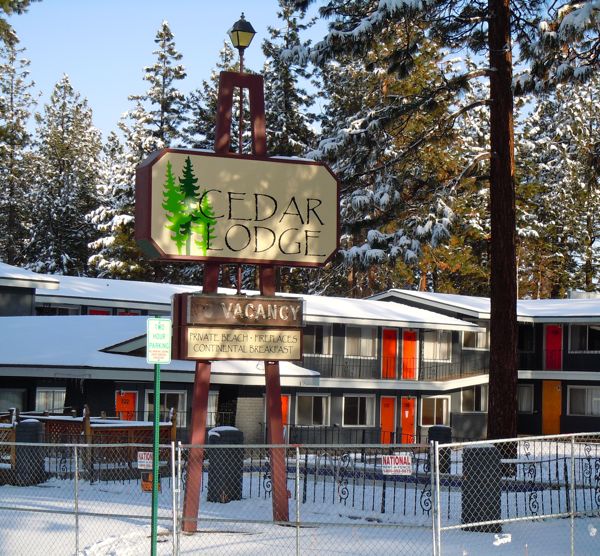
Fenced in Cedar Lodge at Cedar and Friday avenues.

Fenced in Cedar Lodge at Cedar and Friday avenues.

Grafitti on the Blue Jay Lodge on Cedar Street.

Graffiti on the Blue Jay Lodge on Cedar Street.

Grafitti and boarded up windows at The Block.

Graffiti and boarded up windows at The Block.


Opinion: TRPA and city working together on redevelopment

By Julie Regan

A recent article on LakeTahoeNews.net has created unfortunate speculation and misinformation about TRPA’s role in redevelopment. Having moved to Lake Tahoe in the early 1990s, I know firsthand that public discourse can tend to jump to the negative. I believe we need to take every opportunity to promote informed, civil dialogue, so here are five key facts to add to the conversation.

Fact No. 1: TRPA supports environmental redevelopment projects that prove to be beneficial to the local economy and the environment. Consider the fact that our staff in recent years has recommended approval of affordable housing near Ski Run, the Red Hut plaza redevelopment, and the Heavenly Gondola Village.

Julie Regan

Julie Regan

In addition, we are recommending approval of the Boulder Bay redevelopment project at the present Tahoe Biltmore site in Crystal Bay. I mention this project because the city, TRPA, and the community can learn from the innovative design principles being proposed by Boulder Bay to help us revitalize the Y area.

Fact No. 2: TRPA is part of this community. Our dedicated employees live here, raise families here, and support the economy and the community in innumerable ways. While the habit of blaming TRPA as the scapegoat for all occasions will always be the orientation of some, the causes of the dismal state of the Tahoe economy are far more complex than any single source. Widespread problems are affecting tourist towns across the country. Closer to home, the rise of Native American gaming throughout California and the resulting loss of casino jobs is a significant driver of our current economic turmoil. Add to that shifting demographics with second homeownership spiking, the national recession, the bubble bursting in our real estate market, and the facts tell the story. TRPA certainly has a role to play and we take responsibility that our environmental regulations are a factor in the mix. But TRPA is updating itself and changing with the times — we are trying to be part of the solution now, not the problem.

Fact No. 3: No one has applied for a permit to redevelop the Mikasa site at this point. The entire discussion about a potential $160,000 fee is based purely on speculation. When a permit application does come in, there may in fact be no fee at all. The city will be working with any prospective businesses at the Y and TRPA’s transportation specialists will assist in making the project work for our community.

Fact No. 4: When a business comes forward with a permit application for the Mikasa site, the city will be the permit review entity – not TRPA. Assuming the outcome in the absence of facts generally does not move our town forward. If there were any air quality/traffic mitigation fees, they would go back to the city, not to TRPA, for transportation or air quality improvements. Such funds are legally restricted to on-the-ground environmental improvements like bike trails, intersection improvements, or sidewalks.

Fact No. 5: Ten years of scientific research has shown that stormwater runoff from developed areas is causing the lake’s clarity decline. Doing nothing and leaving run-down, vacant buildings as they are actually hurts the Lake more than redeveloping the built environment. TRPA wants to see the economic revitalization of our town, especially considering the lake and community will benefit as well. This means we all have to work together to get the job done. I’m committed to this because I care about my community and the lake. I know you do too.

Julie Regan oversees External Affairs – media, public outreach, and legislative affairs — for the Tahoe Regional Planning Agency.


Opinion: Solar cookers making a difference in Darfur

By Mandy Kendall

In these economic times it is often hard to imagine what difference we can make, especially when there seems so little to go around to those nearest and dearest to us. However, sometimes it takes the plight of others to realize just how lucky we are.

Consider the horrors of the genocide in Darfur, a region of the Sudan, and the adversity of the refugees who have had to flee their homes. Since 2003, black Africans have been driven out of their villages and it is estimated that at least 400,000 people are dead and 2.7 million people have been displaced. About 250,000 refugees live across the border from Sudan in Chad, with 80 percent of them being women and children.

Like you, the Soroptimist International of Tahoe Sierra are all about peace and, together with the Jewish World Watch, we are raising funds to protect refugee women and children from rape, beatings, and other forms of violence. Women and girls who have fled the genocide in Darfur, Sudan are particularly vulnerable while performing the critical task of collecting firewood for cooking. Our mission is to reduce the frequency of these heinous crimes by providing women in refugee camps with an alternative cooking option: the solar cooker.

Usually, to cook a meal, the women and children leave the safety of the refugee camps to collect wood. As firewood is depleted, the walk to obtain it greatly increases, also increasing the risk or attack, rape and even death. Providing women with a Solar Cooker Kit can enable them to prepare meals without risking their safety.

Each kit includes two solar cookers, two pots, two pot holders, a year’s supply of plastic cooking bags and skills training for refugee women and children.

The Solar Cookers also provide more than safety. Two solar cookers can save one ton of firewood each year, which also reduces greenhouse gases and as there is no need to tend a fire, women are free to do other tasks in safety and caring for their children. The solar cookers create an environmentally sustainable solution using renewal energy of the sun. There are also health benefits related to reducing smoke produced by a fire including respiratory issues.

The Solar Cooker Project also has an income-generating aspect as well for the women. Raw materials are sent to the camps and refugee women are hired to assemble them on site. Others train the women and children over 15 years of age in the cooker’s proper use. After a camp is trained, a maintenance program is instituted to repair and replace cookers as needed.

One woman’s story

Imani now lives in the Iridimi refugee camp in Chad. After her harrowing escape from her village in Darfur, where she witnessed the murder of her husband and two sisters, she hid for days from the savage Janjaweed militia and survived with only water in the unforgiving sun. Imani walked over 300 miles until crossing the border into Chad, finally arriving at the Iridimi refugee camp. Without sufficient fuel to cook her meals, she had to leave the relative safety of the camp to collect firewood. At the refugee camp, she learned to use a simple sun-cooker to prepare her meals and no longer has to risk her safety. Imani told us that because she no longer has to leave the camp she now feels protected and secure.

We can’t stop the political problems of their country, but we can make it safer for them through their struggles. Soroptimist International of Tahoe Sierra is doing all it can to buy as many solar cookers as possible to send to the women of Darfur.

One solar cooker kit costs $30.

The Junior S Club girls at South Tahoe Middle School is helping with a collection at the school, planning to spend their lunchtimes over the next two weeks encouraging fellow students to donate any of their spare change. They are calling it Small Change for a Big Change.

Consider purchasing a solar cooker kit as a gift on behalf of a loved one’s birthday, or a combined gift from the whole family for Mother’s Day, Father’s Day, Easter, or whatever days you celebrate for a special occasion. You will receive a gift card outlining the Solar Cooker project that you can give to that ‘special someone’ to show them the gift that you made on their behalf.

Mandy Kendall is a member of Soroptimist International Tahoe Sierra. Contact her about donations before April 1 at SolarCookerDonation@gmail.com.


Opinion: Test scores alone not best judge of teachers

By David A. Sanchez

There are those who think the best way to determine teacher effectiveness is by looking only at students’ test scores. The simplicity of this approach can be seductive, but it is inherently flawed. This approach only makes sense if you assume all children come to school with the same abilities, have the same educational resources and opportunities and return home to the same support systems. As a kindergarten teacher for more than 30 years, I can confirm what you already know to be true: Every child is different.

The fact of the matter is student achievement and teacher effectiveness aren’t simple to measure, and the results of one test are not going to offer a complete assessment of either. Many different measures must be used in order to determine true effectiveness.

So how do you define teacher effectiveness? How to evaluate it? How to reward it? These are all good questions. Most research will tell you an effective teacher is one of the most important factors in a student’s education, and I would agree. Research will also tell you that many other factors can and do influence student success: poverty, hunger, homelessness, language skills, parental involvement and education, the learning environment, hormones and personal motivation.

The California Education Code allows for the use of “state adopted criterion referenced assessments” as it “reasonably relates” to a teacher’s evaluation. How those tests become part of the greater teacher evaluation program at each school district is agreed to by local stakeholders through collective bargaining. This allows for the buy-in and trust of principals and teachers and ensures that local conditions and student needs are considered.

David A. Sanchez is the president of the California Teachers Association, which represents 325,000 educators in California public schools.

Read the whole story


Opinion: The human face of church’s lack of respect

By Brian Cahill

I am a Catholic who voted against Proposition 8 in 2008 and contributed $1,000 to the No on 8 Campaign, a Catholic who is sustained by regular Mass, scripture and prayer. I am also the father of a gay son, from whom I was slow to learn how painful, debilitating and denigrating are the constant legal and social reminders that he and those like him are not fully accepted members of the human community.

In their statement supporting Prop. 8, the California Catholic Bishops declared that marriage is “intrinsic to stable, flourishing and hospitable societies.” Ironically, this is one of the compelling reasons gay and lesbian couples wish to be joined in civil marriages. They are seeking a structure and context for their love, commitment, fidelity and mutual support.

Many believe that the ideal for children is to be raised by a mother and a father, yet we know what the divorce rate is among heterosexual couples. We know there are 75,000 children in the California foster care system, a quarter of them waiting to be adopted. We know that these children have been victimized by the inability, neglect or abuse of their heterosexual parents. These mothers and fathers are living proof that sexual orientation is not a reliable indicator of good parenting.

Our bishops are clear that gays and lesbians must be respected and not disparaged, and I know they mean it. The archbishop of San Francisco, regardless of his position on Prop. 8, means it. His first response to specific issues regarding gays and lesbians is always pastoral.

Brian Cahill is the former executive director of Catholic Charities in San Francisco.

Read the whole story


Opinion: Truckee Meadows’ water quality among the best

By Mark Foree

Recently, an inaccurate story regarding the quality of drinking water in the Truckee Meadows surfaced again.

You may remember that back in December 2009 a report from the Environmental Working Group ranked the quality of our water as among the worst in the nation. Truckee Meadows Water Authority responded to that story, stating that the report was inaccurate and misleading. That is still the case today, and we are again in the position of defending our great water quality.

We thoroughly reviewed the data that EWG used over a year ago, when the initial report was issued. We found that much of its data on TMWA’s water was inaccurate. An example of one major error is that EWG was rating drinking water, yet it used test data from untreated sources (samples taken prior to treatment) and reported it as water delivered to our customers.

We immediately spoke with EWG regarding its numerous inaccuracies, and they assured us that they would correct the data. That was a year ago. Because EWG has since stopped all communication with TMWA, I sent a certified letter to it last August, pointed out all of the errors and again asked it to correct the data and modify its report. This inaccurate information is very upsetting, as no one takes our water quality more seriously than me and our entire staff at TMWA.

Mark Foree is general manager of the Truckee Meadows Water Authority.

Read the whole story


Tahoe resident: Tsunami no big deal on Maui

Publisher’s note: The following is from a South Lake Tahoe resident who experienced the tsunami in Maui.

By Cookie Rork

Sorry to take so long to respond … must be this Maui lifestyle.

Anyway, our tsunami experience was quite uneventful where we are in Kihei. We, of course, watched TV all night, and listened to the tsunami sirens every hour or so for about four hours before the time when the big wave was supposed to hit.

We basically just received big surges here on our side of the island. Other parts received some flooding and boat damage in the harbors. So, no big story here.

Our condo is also up high – so we weren’t evacuated — even though everything just below us was.

Hope all is well in Tahoe.


Tahoe resident reports in after Hawaii tsunami

Publisher’s note: The following is from a South Lake Tahoe resident writing from Hawaii to a friend on the South Shore — with permission to pass it along.

By Pat Oliveira

We’re fine. Thanks so much for emailing. Someone please pay a fine for me next week with my “tsunami update”.

We were evacuated at 10pm Thursday and allowed to return at noon Friday.It was a very long night since the sirens where blaring all night long. Not a lot of sleep and a very serious and tense situation.

We went to our Tahoe friends’ home at the 1,200 foot elevation, so no problem having a place at higher ground. Other people weren’t so lucky and many slept in their cars along the roadways.

We arrived home today to no power, though. In this climate, that can be a big food loss very rapidly. But all was well.

Quite a bit of damage on all islands including some very impressive surge/recede at our nearby beach area. Apparently here on the island of Hawaii (the Big Island), we have suffered the most damage.

One beachfront house in an area where we just barbecued a few nights ago was washed away to sea. Several surrounding homes and vehicles sustained a lot of damage, some crunched into each other just like you see on the news, with complete loss or their cars went into the ocean never to be seen again.

The restaurant where we celebrated Carol’s birthday just a week ago is next door to a large hotel complex in “downtown” Kona, which sustained a huge amount of damage. Don’t know about the restaurant though, but the hotel’s first floor, lobby, grounds and pool are a complete loss and a big mess. Many of the shops were flooded.

Mud, debris, water everywhere … anywhere along the shore roadways.

This is now two years in a row we’ve experienced a tsunami evacuation. This time was a zillion times more serious than last year’s experience. During my years living here and our 16 wintering here, never before. Now two years in a row.

We’re fine, just a huge loss here on the Big Island and a lot of destruction with recovery work ahead, including statewide.

Aloha to everyone!


Opinion: Unintended consequences of online taxes

By George Runner

They’re at it again.

Lawmakers in California, in a desperate attempt to generate revenues are again seeking to force out-of-state retailers to collect taxes for online purchases made by California shoppers. If they are successful in passing this legislation, not only will they fail to raise even one more nickel in tax revenue, they will cost the state thousands of jobs.

It’s a bit complicated, but allow me to explain: California has a cutting edge industry of internet entrepreneurs called “affiliates.” You’ve seen “affiliates” while surfing the web: blogs and websites that provide “click through” ads to online retailers. If you click through and make a purchase, the affiliate gets a small percentage in payment from the retailer.

According to the Performance Marketing Association, there are nearly 25,000 California-based affiliate businesses that provide information to California consumers and improve the ease and thrift of their shopping experience online or with remote retailers and their catalogs.

One example of a successful California affiliate is Ebates, a company based in San Francisco. Without affiliate relationships, Internet entrepreneurs like Ebates will face a painful choice: cut jobs to keep costs in line with reduced revenue or move out of California to more welcoming states. Either way, California will lose jobs and taxes.

Affiliates like Ebates can conduct business from any state in the country, but they are choosing to make California home. Likewise, online retailers choose to market their products through affiliates like Ebates because they help make the shopping experience for their customers easier.

If the Legislature passes a so-called “nexus” law, which will require out-of-state retailers to collect and remit California’s sales tax, those online retailers will terminate their relationship with California’s affiliates. They have done it in other states and have said they will do it here.

Paul Misener, Amazon’s vice president for Global Public Policy, recently sent me a letter citing four pending measures aimed at requiring out-of-state online retailers to collect sales tax. He warns: “If any of these new tax collection schemes were adopted, Amazon would be compelled to end its advertising relationships with well over 10,000 California-based participants in the Amazon ‘Associates Program.’”

Misener notes that similar statewide terminations have already occurred in North Carolina, Rhode Island and Colorado after those states enacted similar laws.

A Board of Equalization analysis cautions that the proposed legislation’s projected revenues would fall by 50 percent as a result of Amazon’s action and be “further diminished” if other online retailers also terminated their affiliate programs. The analysis also warns of an “adverse impact on state employment,” resulting in lower corporate and personal income tax revenues for the state.

Thus, the unintended consequence of this tax policy will be to wipe out one of California’s few healthy business industries. That’s not what California needs when we have a statewide unemployment rate of more than 12 percent.

Collectively, affiliate businesses in California last year paid a total of $124 million in state income taxes, plus business, employment and property taxes. If a nexus law is enacted, California can say goodbye to a good portion of those revenues.

With the exodus of affiliates comes a government-sponsored brain drain as those whose mastery of online marketing and entrepreneurial drive have made it easier for California shoppers to find what they’re looking for move their companies elsewhere to find a new home.

How did this whole thing get started? And, why is California even considering a new law that would further damage the economy?

Most people know that they pay a sales tax on typical transactions, but few Californians probably know they have to pay an equivalent tax – the use tax – on their out-of-state purchases. Yet for 75 years, it has been the law. As a member of the Board of Equalization, the publicly-elected tax board charged with collecting this tax, I believe the best course of action is to make it easier for Californians to be aware of their obligations and pay them.

Lawmakers’ efforts aside, neither the Board of Equalization nor the Legislature has the authority to force out-of-state retailers to collect sales tax. In 1992 the Supreme Court ruled that the Constitution prohibits states from asserting taxing authority outside their borders unless the retailer maintains a physical presence in the taxing state.

Let’s not miss the forest for the trees. California’s most pressing problem isn’t tax collection, it’s jobs. When Californians have jobs in a growing and vibrant economy, the state will have ample revenue to fulfill its responsibilities. But when Californians don’t have jobs, we’ll always have budget problems. Rather than chase entrepreneurs like Ebates away, lawmakers need to prioritize jobs.

The unintended consequences of a nexus law would be disastrous for thousands of California families. Killing private sector jobs only worsens our state’s budget crisis. Lawmakers should reject such ill-conceived measures and instead start helping Californians get back to work.

George Runner represents the Second District of the Board of Equalization. Prior to his election to the board, Runner served 12 years in the California Legislature.



S. Tahoe, El Dorado on alert after massive quake

To the community,

At 10:54 (PST) last night, FEMA region IV and the Pacific Tsunami Warning Center issued a tsunami warning for Northern Marianas/Tsunami Watch for Guam, Wake Island and Hawaii which was a result of an 8.8 magnitude quake in Japan. This warning has been expanded to the California north coastal area, Oregon and Washington. the Tsunami Warning center is predicting surf of 6-8 feet along the coast.

Local communities along the California Coast are exercising their respective emergency plans to inform their communities of the activity and are voluntarily moving people away from the beaches and unprotected marinas. The Coast Guard is taking steps to monitor boating traffic off the US coast and providing boating advisories.

Our county is a part of the California Inland Region, California Emergency Management Agency Region IV. Should the forecast from the Pacific Tsunami Warning center change to reflect significant changes in the estimated impacts and the need arise to expand into contiguous inland operational areas (counties), El Dorado County will receive an alert from the Inland Regional Emergency Operations Center of resource needs which might include temporary housing and/or resources in the form of emergency response.

However, it is highly likely that mass relocation would be to immediately adjacent areas to those impacted.

If resources are requested through the California Emergency Management Agency, it would be through activation of the statewide mutual aid system, the State Mutual Aid regions and subsequent operational areas would be notified. If requests are received through the Emergency Management response program, they would be fielded by the El Dorado County Office of Emergency Services in Placerville which manages the El Dorado County Operational Area. If resources are needed, we will be notified of the need and we would fill the request to our capability.

The plan we operate under for such an event is the El Dorado County Emergency Operations Plan which maintains contingencies for mass evacuation and the management of evacuees.

We continue to receive updates from both FEMA Region IX and the USGS/Pacific Tsunami Warning Center on activity in Japan which has included aftershock activity of 6.5-7 magnitude.

Lorenzo Gigliotti, South Lake Tahoe fire chief