Opinion: House should pull the plug on water grab

Publisher’s note: This editorial is from the June 24, 2011, Sacramento Bee.

The first daunting fact about California water is that 75 percent of the state’s water supply comes from north of Sacramento while 75 percent of the demand comes from south of the region.

The other daunting fact is that the water system is dramatically oversubscribed – paper allocations of water are larger than actual availability in most years.

As a result, water-thirsty interests are constantly seeking to secure supplies from others, through proper means (such as water marketing) or less savory methods. The latter is at play with House Resolution 1837, proposed by Reps. Devin Nunes of Tulare, Kevin McCarthy of Bakersfield and Jeff Denham of Atwater. It would explicitly favor one set of water users – farmers on the west side of the southern San Joaquin Valley – over all the others.

So what has been the reaction of Northern California members of Congress?

Oddly, Rep. Tom McClintock, R-Elk Grove, has promoted the bill as chairman of the House Water and Power Subcommittee.

But every other Northern California member of Congress opposes it.

Read the whole story


Opinion: The dos and don’ts for Fourth of July weekend

By Lisa Herron

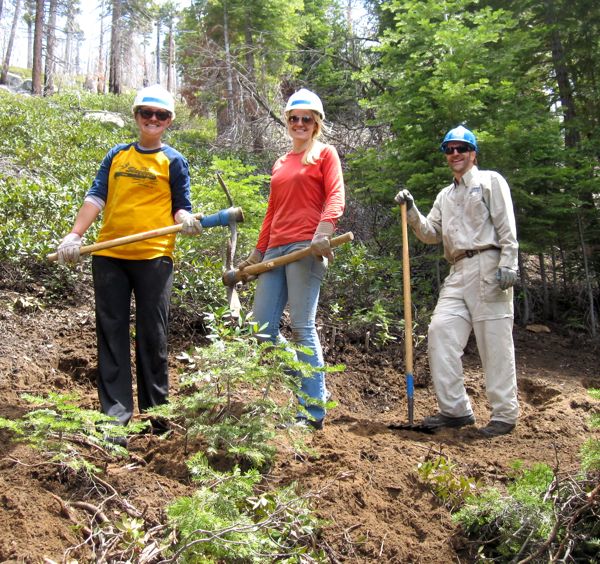
With the busy Fourth of July weekend here, the U.S. Forest Service Lake Tahoe Basin Management Unit asks residents and visitors to help protect public safety and our environment.

We ask that the public keep wildfire prevention in mind during Fourth of July celebrations. Despite the fact that snow remains abundant in the backcountry and stream and river flow is high, it only takes one out of control campfire or careless individual to ignite a wildfire. Possession of fireworks of any kind, including sparklers, is illegal in the Lake Tahoe Basin. Campfires and charcoal barbecue grills are not permitted on Forest Service beaches or in the general forest.

USFSThis year, an additional safety concern is the volume of runoff from snowmelt causing rivers, creeks and waterfalls to run high, fast and cold. Water that you may have crossed easily at one point in the day may not be crossable when you’re ready to return.

The annual alcohol ban will be in effect on Nevada Beach, within Zephyr Cove Resort and Zephyr Shoals (the former Dreyfus Estate). These areas will be patrolled by law enforcement personnel from the Forest Service, and Douglas County and Carson County sheriff’s deputies, and by private security staff. County and state laws also ban the possession or consumption of alcohol on the Truckee River from Tahoe City to Alpine Meadows over the holiday weekend.

If you’re parking on the side of the road to access Forest Service facilities, make sure you’re parked completely on gravel or dirt, not on vegetation. Parking on vegetation may result in a citation for resource damage, plus there’s a chance your car’s catalytic converter could spark a fire. Even better, consider public transportation if you’re going to the beach that day. The Nifty Fifty Trolley stops at Forest Service beaches along the South and West Shores.

Please keep in mind that in developed recreation sites, such as Kiva, Tallac and the Taylor Creek Visitor Center, parking is allowed only in designated parking spaces, not along the roadway. Do not park where you will block access or narrow lanes, which could impede response in an emergency.

Day-use fees for the Fourth of July at Pope, Baldwin, and Nevada beaches are again $20 this year to cover increased security and facility maintenance costs on the holiday. The beaches have become increasingly popular for Tahoe visitors and locals on the Fourth of July. Please note beaches close when the firework display is over.

Finally, please respect the rules on where dogs are allowed. Dogs are not allowed at designated swim beaches, including Nevada, Pope, Baldwin, Meeks and William Kent. If you are looking for a place to take your leashed dog, try Kiva Picnic Area from Valhalla Boathouse/Pier to Tallac Point in South Lake Tahoe, Echo Lakes on Echo Summit, Zephyr Shoals on the East Shore (the old Dreyfus Estate located north of Zephyr Cove Resort), Hidden and Chimney beaches on the East Shore, Coon Street Beach (at the boat launch) in King’s Beach, Kaspian and 64 Acres in Tahoe City.

For more information, visit the Lake Tahoe Basin Management Unit website or call (530) 543.2600.

Lisa Herron works for the USFS Lake Tahoe Basin Management Unit.


Opinion: Viking Stadium turning into the community’s gridiron

By Angie Keil and Lizzy Latenser

Lake Tahoe Unified School District is excited to announce the latest donors to the South Tahoe High School Viking Stadium Renovation Project. With Phase I under way, Heavenly Mountain Resort and the South Tahoe Alliance of Resorts (formerly the Lake Tahoe Gaming Alliance) have announced they intend to match community donations for the Friday Night Lights drive up to $20,000.

Heavenly and STAR each intend to contribute $10,000 to the stadium construction and are challenging other community members to get their donations in by Aug. 15 to contribute to the donation match.

Viking Stadium is on schedule to be ready for the 2011 season. Photo/Steve Morales

Viking Stadium is on schedule to be ready for the 2011 season. Photo/Steve Morales

“These generous donations are an example of how local organizations are making a difference in the revitalization of community facilities and spirit,” Superintendent Jim Tarwater said.

At a ground-breaking ceremony at South Tahoe High School this week, football players, cheerleaders, coaches, faculty, administrators, and board members applauded the initiative of both organizations and other community members.

“We want to see our students thrive in Lake Tahoe and know how excited the community is to help renovate the stadium at South Tahoe High School,” Pete Sonntag, general manager of Heavenly Mountain Resort, said. “In an effort to challenge the community and contribute to the fundraising goal, we are partnering with the South Tahoe Alliance of Resorts to match all cash community donations up to $20,000. We want this matching gift to be a strong gesture of support from us to every student, athlete, cheerleader, parent, and community supporter in Lake Tahoe.”

Last year, the South Lake Tahoe community overwhelmingly embraced the Friday Night Lights concept when almost a thousand spectators turned out for two football games that were played under rented portable lights. Using $1.1 million in developer fees that are specifically set aside for school construction, LTUSD is now renovating the almost half-century-old stadium with an artificial turf field, permanent stadium lighting, a concession stand and restrooms. LTUSD is actively seeking grants and donations to help cover the approximately $340,000 cost for the permanent lighting and artificial turf through its Friday Night Lights drive.

“The new lights are a big part of this great community enhancement project that will provide a quality facility for our residents to enjoy for years to come,” Mike Bradford, CEO of Lakeside Inn and Casino and member of South Tahoe Alliance of Resorts, said. “Not only will this be an incredible facility for the students but it will also attract a wide variety of sporting events that bring visitors to Tahoe with the end result being a positive economic impact to our city.”

The deadline to purchase a commemorative brick has been extended to July 8. Donations from the brick sale and other contributions have yielded $65,000 and a Tire-derived Product Grant of $92,000 has been awarded by California.

The Gooding Family Foundation and Tony Gooding have contributed $30,000 to the project, while Stephen Bannar has donated $5,000.

For more information on how to donate, contact Angie Keil at (530) 541.2850, ext. 225 or go online.

Angie Keil works for LTUSD and Lizzy Latenser works for Heavenly.


Opinion: Where is the food safety?

By Mark Bittman, New York Times

I’m eager to cover some curious and less depressing topics here — did you know Asian multi-millionaires are cornering the market on first-growth Bordeaux? — and equally eager to stop throwing mind-numbing numbers around. But as long as those pesky Republicans keep attacking the food supply for low-income people and food safety for all of us, and as long as most Democrats put up toothless defenses instead of actually trying to make things better, I gotta pay attention. If we needed further evidence that the party of “family values” only values wealthy families, we have it now; when these guys say “women and children first,” they mean “first to throw overboard.”

The House’s reactionary majority wants to dismantle two aspects of the Federal system that serve the majority of us not perfectly but decently: the Women, Infants and Children Program (WIC), one of the most effective of all social welfare programs, and the Food and Drug Administration (FDA), among whose jobs is the increasingly difficult one of protecting us from the kind of outbreak of E. coli that just killed at least 39 people in Germany, gravely — perhaps mortally — sickened another 800 and gave another couple thousand a few of those days none of us ever wants.

As I wrote two weeks ago, we’ve had our share of foodborne illnesses in the past, but have not kept up with the increasing threat of E. coli. One in six Americans gets sick from the food we eat every year — that’s about 48 million people, or enough to fill your average baseball stadium a thousand times with people having extremely unpleasant symptoms — and there are 3,000 food-related deaths annually. This is a food system that Georgia Congressman Jack Kingston calls “99.99 percent safe.” I guess he wasn’t one of the 16 percent last year who fell ill, but maybe he should talk to a million or two of them; they should be easy enough to find.

As we near the 10th anniversary of 9/11, we’re going to be reminded more and more of how much 3,000 deaths from hostile attackers can hurt. Yet put aside the questionable decisions we made in anger and sorrow that have cost us $1.2 trillion — and another 6,000 or so American lives — in wars whose benefits are far from clear. Think, instead, that the annual costs of food-borne illness are estimated to be around $152 billion a year, and consider that the entire proposed FDA budget is around $4 billion (three percent of that $150 billion), and that a measly $280 million or so of that (about one-fifth of one percent of that $150 billion) was destined for the Food Safety Modernization Act, which would expand activity geared toward protecting us from E. coli and other foodborne threats.

Read the whole story


Opinion: Endangered Species Act creating false drought for farmers

By John Harris

Higher crop prices, an increase in acres and more water helped boost Kings County’s overall crop value to $1.7 billion in 2010, an increase of 30 percent over the previous year.

As a farmer and rancher gravely concerned with the health of agriculture in California — and as a citizen who wants a strong recovery for our state’s recession-burdened economy — I’ve enjoyed reading the precipitation surveys out of the Sierra this year.

Snow depths were more than twice the long-term average at some measuring stations, and reservoirs are brimming.

As a result, there has been a pronounced short-term change in outlook for farmers and communities that were seared by a three-year drought. More acres are being planted, more workers are being hired, more farm machinery is being purchased, and a world-class food supply is being produced.

As the Wall Street Journal reported recently, “California’s farm economy is on the rebound.”

Just one acre of vegetable production in my area can generate more than $5,000 in incremental jobs. My on-farm payroll has gone up $4 million over the past year. Local businesses, such as car dealers, have seen their sales soar. This shows that if the farm economy has money, it will be spent and help grow the economy.

However, while we are all thrilled by the dramatic turnaround in water supply, there are justified fears about future years. Although the natural drought has ended, we’re still faced with harmful regulatory barriers to getting the needed water to those who grow the food and provide the stimulus our economy needs.

Most of the regulatory restrictions are part of a misguided federal scheme to help fish on the Endangered Species Act list. The cutbacks in pumping from the Sacramento-San Joaquin Delta were based on federal “biological opinions” that too often involved junk science, as Fresno-based U.S. District Judge Oliver Wanger found.

John Harris is chairman and CEO of Harris Farms Inc. in Coalinga and chairs the board of trustees of Pacific Legal Foundation.

Read the whole story


Opinion: Commerce Department nominee deserves the job

Publisher’s note: This editorial is from the June 21, 2011, Los Angeles Times.

John Bryson’s nomination to be President Obama’s next secretary of Commerce has been met with the predictable combination of delusion and obstructionism that characterizes the modern confirmation process. Some Senate Republicans vow to hold him hostage to the passage of several long-sought free-trade agreements; others insist they will reject him based on his presumed politics, which they wish were more like theirs. None has advanced an argument worthy of defeating this nomination, and though sensible people will withhold a final judgment until after Bryson is questioned, his credentials are encouraging, as are the endorsements of those who know him.

Bryson is a familiar figure in Los Angeles. A longtime chairman and chief executive of Southern California Edison and Edison International, he is a pillar of the region’s business community, admired by the Chamber of Commerce and his fellow executives. He also was a founder of the Natural Resources Defense Council, where his work earned him respect and appreciation from California’s environmental movement. He’s been president of the California Public Utilities Commission and even served as a director of Boeing, dipping his toe into the nation’s military-industrial complex. He is thus the rare nominee to present himself to Congress with endorsements from the Chamber, military suppliers and the nation’s leading environmental organizations.

Read the whole story


Next generation learns importance of trail building

To the community,

The Tahoe Rim Trail received a little “tender care” from the newly formed Tahoe Regional Young Professionals on June 11 and June 14. TRYP members, along with many other outdoor enthusiasts, hiked Daggett Summit to move dirt, boulders, crush granite and clear roots, all while taking in the majestic scenery.

TRYP would like to give a special thank you to the Tahoe Rim Trail Association crew leaders who dedicate their time to teach volunteers and to this tireless project which aims to move miles of trail from pavement to forest, improving the trail experience and eliminating conflicts with vehicles. When complete, the project will add 13 miles of new trail to the TRT system.

TRYP members Ashley Hogue and Lyndsay Bryant clearing the trail at Daggett Summit. Photo/Provided

TRYP members Ashley Hogue and Lyndsay Bryant clearing the trail at Daggett Summit. Photo/Provided

After the trail build, members and crew leaders joined TRYP at Mott Canyon for a relaxing evening of food and drinks.

TRYP is a newly formed organization in South Lake Tahoe and aims to connect Tahoe’s next generation to help the Lake Tahoe region. TRYP encourages members to partake in fundraisers, socials, networking opportunities and most of all … build a better community. The young professional’s next community event is slated for August.

For upcoming events, visit Facebook and search “Tahoe Regional Young Professionals” or email tahoetryp@gmail.com.

Becca Wass, TRYP advocate


Opinion: Why Ensign didn’t face what Weiner did

By Jon Ralston, Las Vegas Sun

So when a creepy congressman who has a sexting disorder becomes a distraction and liability, fretting Democrats line up to defenestrate him. But when an even creepier senator has an affair with a staffer, reveals himself to be a world-class hypocrite and importunes supplicants to hire the cuckold, Republicans say nothing.

Because proportionality is so often lost in politics, especially in the 24/7 Web world where every gesture and expression is analyzed in microscopic detail, the differences between Anthony Weiner, who seems headed for resignation, and John Ensign, who has fled the capital ahead of an expulsion, are lost.

It is nothing short of remarkable to see members of both parties, actually, calling for Weiner’s head — Republicans feeling obvious schadenfreude and Democrats fearing electoral carnage. Contrast this with the reaction, especially by GOP leaders to Ensign, who lasted almost two years after he confessed to an affair with a staffer who was the wife of one of his top aides and who was his wife’s best friend.

On the creepiness scale, Weiner is Pee-wee Herman to Ensign’s Bob Packwood. And as much as both men have dishonored Capitol Hill — no mean feat — their treatment by their colleagues, especially their partisan allies, is noteworthy for its moral bankruptcy. Democrats are not so outraged by Weiner’s behavior as they are about his changing the media horde’s focus from their attempts to terrify seniors over Medicare and Social Security “reforms.” His sin was not texting provocative pictures of himself, but interfering in the narrative the Democrats have been constructing to try to win back both houses of Congress.

Read the whole story


Opinion: Any change to Measure S should only be for bike trails

To the community,

There is an important meeting about bike paths coming up June 30 at 9am at the South Lake Tahoe library. If you support bike paths, you should attend and make yourself heard.

Remember Measure S? Money from it was designated to go to bike paths, ball fields, the ice rink and Tahoe Paradise Park. Well, the money for everything except bike paths has been spent or is allocated, but the bike paths haven’t been built and there is a pile of money there that the ball field people see and they want to get their hands on it.

Now we have the proposed Measure R, written by ball field proponents. Its purpose is to divert money from bike paths to ball fields. The voters voted for bike paths and ball fields in measure S. The ball fields already got their money. We still don’t have our bike paths. We need bike paths. Our economy needs bike paths. We don’t want the bike trail money diverted to ball fields. We need to complete our bike path network.

If the JPA (who manages the money) wanted to do what the voters want instead of what the special interests want, they would have written measure R to allow the unspent bike funds to be spent on bike paths other than the ones specified in the original Measure S. It’s simple. The problem is that they don’t want to do that because they want to divert the money instead to their pet ball field projects.

Measure R should be re-written to re-allocate bike path money for other bike projects that weren’t covered by the original Measure S. Keep bike path money for bike paths like we voted for or thought we voted for in the first place. Please attend the meeting and voice your opinion.

Hank Raymond, Meyers


Opinion: Measure R is right for recreation

By John Upton

The original Measure S was approved by the voters on Sept. 19, 2000. It sunsets in 2030.

Measure S was very specific in limiting the allowed uses and naming exact locations where its funds could be spent.
John Upton

John Upton

Based on a community survey done in 1999, Measure S contained the following:

1. The annual cost per single family home was limited to $18, the two-thirds voter approval level.

2. A $5.8 million bond was issued to construct the following facilities:

• The ice arena on Rufus Allen Boulevard, which was finished in 2002.

• Three new fields, plus a warm-up field, located adjacent to Lake Tahoe Community College. A change in TRPA regulations and higher than expected costs reduced this to one synthetic turf field for soccer, plus the warm-up field. Baseball and softball did not receive expected capacity improvements from Measure S.

• Maintenance improvements to Tahoe Paradise Park, and its opening to the public.

3. Measure S also provided the following maintenance funding, available each July:

• $50,000 per year for the new athletic field located adjacent to the community college.

• $50,000 per year for Tahoe Paradise Park.

• $5,000 per year, per mile for up to 25 new miles of bicycle trails, to a maximum of $125,000.

The maintenance funding was limited to new bicycle trails in order to attract state funds for their construction. The Measure S financial plan expected 25 new miles would be built by 2008. As a result, special tax revenue now annually provides $125,000 in maintenance funding which can be used only on new bicycle trails – those constructed after Sept. 19, 2000.

The current situation can be summarized as follows:

• Due to state budget problems, only 8 miles of bike trails, requiring $40,000/year, have been built. The other $85,000 (of the annual $125,000) has been accumulating. It is unspendable because under Measure S there is no other allowable use for this money without voter approval of the change.

• To address the fields not built for baseball, the JPA proposed Measure B in 2009. Measure B failed when bicycle advocates sought funds for pre-Measure S trails. In their opposition, the Bicycle Coalition specifically indicated willingness to seek a compromise measure.

Measure R is the JPA’s effort at a compromise measure.

• It will equally split an estimated $470,000 available in summer 2012 among pre-Measure S bicycle trails and ball fields.

• In order to promptly finish field improvements, fields will receive the next funds available, up to a limit of $500,000.

• After fields receive the $500,000, all available funds will go to pre-Measure S bicycle trails. We estimate that those trails will receive a minimum of $500,000, and potentially much more, by 2020. Pre-Measure S trails will continue to receive available funds until all 25 new miles have been built. As new bicycle trails are completed, they will have priority use of annual bicycle trail maintenance funds. This will correspondingly reduce the funds available to maintain and rehabilitate pre-Measure S bicycle trails.

• If Measure R is successful, advisory committees for bicycle trails and fields projects will be formed by the JPA in December 2011 to determine priorities for use of available funds.

Measure R unlocks the uses of currently unspendable funds, and makes funding available to improve the quality and safety of trails for users of older bicycle trails, and of fields for the nearly 3,000 local kids who participate in field sports – while we wait for new bicycle trails to be built.

In closing, the JPA wants to stress the following:

• Measure R will not affect maintenance funding for new bicycle trails that have or will be built, nor will it affect funding for the field at Lake Tahoe Community College, or for Tahoe Paradise Park.

• Without voter approval, unused bicycle trail maintenance funds remain unspendable, and nothing can be done with the accumulated funds.

• Measure R will accomplish bicycle trail and fields improvements with no increase in taxes.

The South Lake Tahoe Recreation Facilities Joint Powers Authority will meet and conduct a hearing on June 30 to consider whether to place Measure R on the Nov. 8 ballot. The hearing and meeting will take place at the El Dorado County Library meeting room beginning at 9:30am.

John Upton is the lone staff member of the South Lake Tahoe Recreation Facilities JPA.