Letter: Festival of Trees and Lights a success

To the community,

This year’s Festival of Trees and Lights was once again a huge success. The six-day event is a collaborative effort between Barton Health staff, community and Auxiliary volunteers, and sponsors.

Thank you to everyone who volunteered, decorated a tree or a wreath, donated an auction item, or sponsored one of our many events.

A special thanks to Barton Foundation’s volunteer steering committee who worked all year long to ensure the event was a magical experience. Kudos to Santa for his long hours and constant cheer, to Dreu Murin who has taken our event to “new heights,” and to the designers and schools for creating such gorgeous trees.

Many people braved the Friday and Saturday snowstorm to celebrate the holidays with us. A total of 2,832 people attended at least one of the festival’s activities and an additional 200 patrons enjoyed the Tallac Association’s play “The Best Christmas Pageant Ever.”

At the evening gala we celebrated Barton’s 50th birthday with a gold and red theme – a tribute to the Barton Auxiliary, Barton Health’s dedicated volunteers and hospital greeters. The live auction featured the auxiliary’s famous cheeseballs, a standup paddleboard, an African safari, and an adorable puppy.

All funds raised will support Barton’s cardiology programs. We appreciate all of you who participated and helped invest in the health of our community.

Happy Holidays!

Kindle Craig, executive director Barton Foundation


Letter: Watch out for a certain trio of politicians

To the community,

What goes around comes around, so here goes.

On Dec. 10, Brooke Laine was appointed mayor pro tem for the city. So what? In 1998, I was elected to the City Council, as was Brooke Laine. Without delay Ms. Laine fell under the spell of redevelopment and its advocates Tom Davis and Hal Cole. Thus, there was a ready majority to support any plan for redevelopment regardless of the merit or lack of merit.

Bill Crawford

Bill Crawford

Example: The trio supported the American Skiing Company until the bitter end. They refused to collect a $5 million letter of credit of the American Skiing Company. The ski company had breached its agreement with the city. On the issue to collect, I was in the minority.

Also, the trio didn’t exercise oversight over the redevelopment manager who was a loose cannon working for the private side of redevelopment. She was in lockstep with the private party’s attorney. It wasn’t a secret.

So, 13 years after Ms. Laine was elected to the City Council, she’s back by appointment united with Tom Davis and Hal Cole. There will be serious blowback because they are unrestrained boosters of commerce; any commerce and they will gamble with the city’s welfare to seal a deal. On Dec. 10, Hal Cole said, grants are drying up and the city needs more and more private money to be pumped into the city’s economy. Mr. Cole was the main player in the Hole in the Ground. So go figure. People only change in novels.

The trio isn’t the three stooges. They are the three moneys who see no evil, hear no evil, who speak no evil. They ignore the past and their role in harming the city’s welfare. I think of the city’s parking garage that they voted for.

So what comes around has come around. After 13 years, the city is back to square one governed by the same worn and tried trio. We know where they have taken the city from the parking garage to the Hole in the Ground in the past. So what can we look forward to? Place your bets.

Bill Crawford, South Lake Tahoe

PS: Dec. 16 is the anniversary of the Battle of the Bulge.


Letter: Weidinger PR gives back to Bread & Broth

To the community,

The staff of Weidinger Public Relations provided both a warm, cheerful greeting and a hot salmon meal to over 90 dinner guests who had braved the frigid weather to attend Bread & Broth’s Monday evening meal on Dec. 9.

By sponsoring an Adopt A Day of Nourishment Weidinger Public Relations’ volunteer crew members experienced firsthand the many “thank yous” and appreciative words from the grateful guests.

The goal of Bread & Broth is to feed the needy of our community of both South Lake Tahoe and Stateline. Through generous donors and sponsors like Weidinger Public Relations, B&B has been providing Monday evening full course meals at St. Theresa Church’s Grace Hall and Friday evening soup and pasta servings at Lake Tahoe Community Presbyterian Church to all who come to our doors.

B&B appreciates the monetary donation of $250 made by Weidinger Public Relations and thoroughly enjoyed the enthusiasm of its team members Jenn Boyd, Christina Proctor, Tiara Wasner and owner Phil Weidinger. Speaking for his crew, Weidinger said, “Thank you for the opportunity to help out. What a great group in the kitchen. Congrats on what you do every week for the community.”

B&B congratulates the evening’s sponsor for their outstanding achievement in their field of communications and their supportive involvement in the south shore community.

Bread & Broth would like to also thank Barton Memorial Hospital for their donation of Christmas cookies as part of the evening’s give-away bags.

To help B&B as a donor or sponsor, contact me at (530) 542-2876 or carolsgerard@aol.com.

Carol Gerard, Bread & Broth


Opinion: California budget surplus is misleading

By Autumn Carter and Adam Tatum

Apparently, all is well in California. However, politicos and average citizens probably disagree on that point.

Last month, a report by the California Legislative Analyst’s Office said we should expect annual budget surpluses through 2019-20, including nearly $10 billion surpluses each year starting in 2017-18.

Essentially, based on tenuous predictions that have traditionally missed the mark, the LAO is arguing that California’s fiscal troubles are over. Nothing could be further from the truth.

One problem is that the optimistic forecasts rely too heavily on big assumptions while discounting the extent of existing problems.

For instance, they assume that from now to 2019-20, the economy and real estate markets will grow robustly, that the stock market will steadily improve each year, and that legislators will keep their spending under control. Perhaps most concerning, they assume that policymakers will continue ignoring the growing unfunded liabilities associated with public employee retirement benefits, thereby allowing those rising costs to further crowd out public services in the budget.

As Gov. Jerry Brown recently stated, “We have deferred maintenance on our roads, that is serious; we have unfunded and growing liabilities in our pension and retiree health – state, university and local level. That’s real.”

Indeed, it is real. Unfortunately, health, retirement, corrections and debt costs are expected to grow in the coming years, placing continued strain on any California budget – surplus or not.

There is an inherent problem with relying too heavily on long-term forecasts. While they provide value, they merely illustrate a picture of what the future would look like if all assumptions hold true. To their detriment, forecasts are fundamentally rooted in unreliable assumptions.

Further, the LAO took an outdated, 20th-century approach to budget forecasting. It restricted its forecast to money in the general fund, or main operating budget, and ignored special funds. Years ago, special funds accounted for only 20 percent of the state budget. Today however, they account for 33 percent of total state spending. Thus the forecasts completely ignore an increasingly significant portion of the budget.

The LAO has no economic crystal ball, so as with any long-term forecast, error is virtually inevitable. Yet, LAO’s forecasting history is littered with inaccuracies.

For instance, in 2006, the LAO predicted that California would have $128 billion in general fund revenue in 2012. In actuality, the state had only $87 billion in 2012, reflecting a 32 percent shortfall. While the LAO’s short-term forecasts have underestimated revenue by an average $1.4 billion since it began three- to five-year forecasts in 1998, its long-term forecasts have overestimated them by an average $8.8 billion.

Consistently inaccurate forecasts bring into question how well the LAO can claim to assess the condition of the underlying economy they reflect.

The report outlines a possible approach to using the forecasted surpluses. It suggests using the additional revenue to fund infrastructure, increase funding to existing programs, create new programs, pay down the state’s “wall of debt,” build an $8 billion reserve by 2016-17, and reduce taxes.

While it acknowledges the state’s massive outstanding retirement liabilities, the report suggests committing only an additional $500 million each year – or $3 billion by 2019-20 – to address them. That is nowhere near what’s actually required to stabilize the state’s severely underfunded retirement systems.

Today, the California State Teachers’ Retirement System and the state’s retiree health care program have unfunded liabilities of $71 billion and $64 billion, respectively. CalSTRS expects to deplete its money by 2043, and many estimate a date closer to the 2020s. To fully fund these plans, the state would have to begin paying an additional $4.5 billion to CalSTRS and an additional $4.9 billion for retiree health care each year starting today.

These retirement systems are expensive, but legally, the state is bound to pay the guaranteed benefits they provide to retirees. Finally funding the systems fully would consume the annual forecasted surpluses, transforming them into deficits. Leaving the systems chronically unfunded would raise their annual costs and crowd public services even more. Surplus or not, there is no painless solution here.

California still has serious obligations that its policymakers have ignored and neglected for too long. Californians now pay substantially more to receive substantially less, and repairing the extensive damage goes far beyond predicting higher revenue that may never materialize. Even if the forecasts prove true, all is certainly not well in California.

Autumn Carter is executive director of California Common Sense, a nonpartisan nonprofit think tank specializing in government fiscal policy and analysis. Adam Tatum is California Common Sense’s research director.


Letter: Sick people should not fear government

To the community,

When my friends and I wrote and passed The Compassionate Use Act, otherwise known as Proposition 215, we never, in our worst nightmares, could have imagined that 17 years after its historic passage, medical marijuana patients would still be living in fear.

Steve Kubby

Steve Kubby

During all those years I’ve seen countless sick people arrested, humiliated, bankrupted, indicted, prosecuted like common criminals, and sent off to prison for decades at a time, all over a healing herb. I’ve also seen the exhausted faces of patients who must endure long rides, sometimes through dangerous blizzard conditions, because they have run out of the strain of cannabis that works best for them and are forced to travel to the Bay Area to get their preferred strain of medicine and the real relief it provides for them.

Right now, here is South Lake Tahoe, there are sick people who live in constant fear that the city will come in unannounced, turn off their power, fine them $1,000 per day and leave them to die. They live in terror of low flying aircraft, especially helicopters, convinced that they are about to be discovered and evicted. They avoid going out into public and hide in their homes and apartments instead. Yes, they are horribly sick and living in fear each day.

You don’t ever see them, or hear from them, but I do. Some have obvious disabilities, others appear to be fine, but are in terrible pain and suffering. Most of all, however, they are in fear that enforcers from the city will find them, issue demands they can’t meet, shut off their power and destroy their lives.

Source: California Attorney General's Office

                   Source: California Attorney General’s Office

Regardless of how you or anyone else feels about marijuana, I think we can all agree that genuinely sick people do not deserve to live in daily fear of their city government.

Sadly, there are those who just don’t understand and choose to spread falsehoods instead. Don’t believe the nonsense about how our initiative “will result a pot store on every street corner.” It’s just phony propaganda by a small minority of opponents. Even the city attorney had to remove his comments about “Unlimited Dispensaries” and issue a new title and summary.

Only those who have been residents for over a year in South Lake Tahoe can qualify to operate a dispensary. And the City Council retains the right to ban signage or ban new dispensaries after six months. So don’t buy into the hype and propaganda that people are making up about this compassionate attempt to provide safe access for patients who genuinely need this extraordinary medicine.

In order to protect dispensaries, we also created a clause about making it a crime to conspire with federal authorities to violate state medical marijuana laws. The city attorney balked at approving this clause, alleging that this is an illegal attempt to prohibit the police from enforcing marijuana laws, but we are firmly convinced that it is just the opposite and our initiative is intended to force police to uphold our state medical marijuana laws instead. We know that 99 percent of the federal raids on dispensaries begin with some local official or officer contacting the DEA and telling them that their local government or police have been unable to legally ban or evict certain dispensaries. So from our perspective, it is vital that we have a clause that upholds state medical marijuana laws, by making it a crime to conspire with federal agents intent upon violating state laws.

On Monday, I spoke with the city attorney about our objections to the title and summary he issued which included allegations such as “prohibits police from enforcing marijuana laws” and “allows for unlimited dispensaries.” After a frank exchange of views, the city attorney then issued a second title and summary Dec. 9 that removed these fraudulent claims about our initiative.

Of course, there are those who will assert that dispensaries will mean more weed ending up in the hands of kids. That is certainly the claim that the drug czar, Barry McCaffrey, made after the passage of Prop. 215. These are the haters and bigots who want us to believe that throwing kids caught with wee into a jail cell with sexual predators and hardened criminals is the answer to our drug problems.

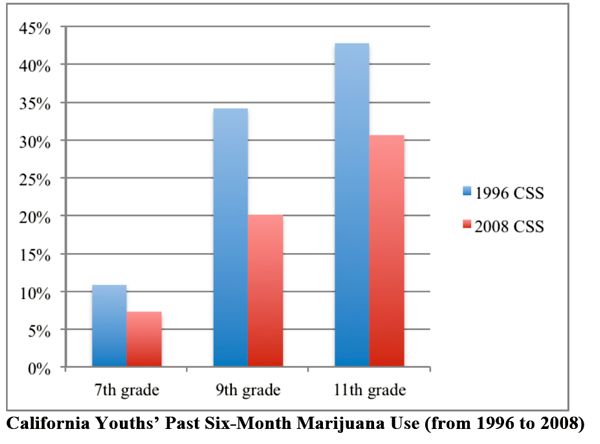
Now, more than 17 years after the passage of California’s Prop. 215, a considerable body of data exists on teen use of weed and the evidence is clear. No state with a medical marijuana law has experienced an overall increase in youth marijuana use since the law’s enactment. All have reported overall decreases — in some cases exceeding 50 percent in specific age groups — strongly suggesting that the enactment of state medical marijuana laws does not increase teen marijuana use. See details here.

So don’t pay attention to the vocal minority who oppose us and try to paint medical marijuana as some sort of fringe issue. The fact is that every national poll done, including by Fox News, shows 80 percent support for medical marijuana. Here in South Lake Tahoe, voters supported legalization in 2010 with a whopping 58 percent “yes” and a pathetic 42 percent “no”.

The time has come to ignore those who tell you that South Lake Tahoe doesn’t want medical marijuana in our community because this town clearly supports the medical use of cannabis and we have the polls to prove it.

Watch and you will see that those who oppose medical marijuana have no real arguments and must rely instead upon personal attacks against me instead.

With this in mind, my team and I will begin collecting signatures this week, in order to give voters a chance to stop the city from threatening sick people and protect them instead.

Steve Kubby, South Lake Tahoe


Letter: Live Violence Free grateful for Rotary

To the community,

Tahoe-Douglas Rotary’s 2013 Children’s Holiday Party was a complete success thanks to the generous support of all club members, Sealed with a Kiss, and Forever Dance.

Live Violence Free would like to give them a big thank you from the bottom of our hearts for all of the work and support that the Rotarians give to our agency year after year. Your party gives our clients and their children a space where they can focus on enjoying themselves for an evening. It allows them to not have to worry about the hardships they’ve had to encounter in the past.

Thank you,

Diana Cabrera, Live Violence Free


Editorial: California water debate going nowhere

Publisher’s note: This editorial is from the Nov. 22, 2013, San Jose Mercury News.

California is having the wrong debate about the future of one of its most valuable assets, the Sacramento-San Joaquin River Delta, which produces water for much of the state and about half of Silicon Valley.

The battle for the better part of the last two years has been about how big a new conveyance system — probably tunnels — should be, how much it should cost, and who should foot the bill. The result has been a political fight of the worst kind, pitting Northern Californians against Southern Californians and agriculture interests against environmentalists in a battle royal. At its worst, this could be one of the biggest water grabs in state history. And for California, that’s saying something.

The focus instead should be the operating conditions for the Delta, particularly the amount of water that needs to flow through it annually to maintain the health of the estuary. Once that standard has been established, then everything else will fall into place for the two coequal goals of providing a more reliable water supply and protecting, restoring and improving the Delta ecosystem. Before deciding on tunnels, helicopters, whatever, state water officials need to determine how much water can be expected to be delivered. That will drive how it’s allocated and how it should be conveyed.

Why has the debate focused on the conveyance system instead of this basic question? Follow the money.

Read the whole story


Opinion: Holiday cards don’t have to be impersonal

By Eric Hoover

Call me Grinch, call me Scrooge. Call me Lord Voldemort of the Yuletide. None could be worse than sending me a holiday card with glossy photographs of your lovely, smiling family.

My wife, Emily, and I place your cards like trophies on our shelves, continuing an old-school practice that began about 175 years ago as a way of maintaining relationships as families and friends moved far and wide. Today’s cards may appear more personalized — with photos of spouses, kids and pets, and distribution lists much smaller than a sprawling collection of Facebook friends. But when I flip over the photo cards, as if they were postcards bearing a greeting, I usually find no trace of ink, no original message.

Now that our lives involve sharing an abundance of pictures we once kept to ourselves — snapshots of parties we attended, sunsets watched, meals devoured — it makes sense that photos dominate the paper cards in our mailboxes. But these prefabricated greetings seem as empty as a stocking someone forgot to stuff. Are they meant as warm wishes or self-advertisements?

Six or seven years ago, almost every holiday card Emily and I received included a short handwritten note. Last year, half didn’t have a signature. On many, we don’t even find our own names. These mass mailings typically don’t lend themselves to personalized messages. Everyone gets the same greeting: usually just “Happy holidays,” but often accompanied by imperatives such as “dream,” “smile” and “laugh out loud.” Can’t we wish each other well without giving orders?

At the very least, made-to-order card services offer convenience. “We’ll stuff, seal, address and mail your cards for you,” the Tiny Prints catalog says. Sorry folks, your sweet cousin might not have even touched the card she sent you.

Remember your uncle’s obnoxious Christmas letter in which he bragged about his family’s accomplishments? Now this preening happens without a word. Here’s our family at the beach in Maui! Oh, and here we are on the slopes at Aspen! Such prosperity.

The purpose of greeting cards has always been ambiguous. Part gift, part commodity is how a 1999 article in the Journal of Material Culture describes them. As Barry Shank explains in the book “A Token of My Affection: Greeting Cards and American Business Culture,” the nation needed a way to keep people close — but not too close. The greeting-card industry flourished, he writes, “in the hothouse atmosphere of a status competition.”

Just look at the gorgeous card we got last year: a professional photograph of a couple and their three young children, dressed to the nines. It’s affixed to a thick piece of paper with a gold border. Even the font seems smug.

Each year another couple sends us a refrigerator magnet with a picture of their son on it. Were I this youngster’s doting uncle, maybe I’d want to see his mischievous face on my freezer each day. Which makes me wonder: Can licking too many envelopes make you delusional?

Two Christmases ago, some old friends took the child-as-holiday-card theme to a new frontier. The back of their homemade card included — surprise! — a sonogram, their first child’s first glamour shot. Yes, this glimpse inside our friend’s uterus made me feel closer to her. Much too close.

Of course, she was just doing what most of us do online, where a warped intimacy reigns. “Look at me” is the law, and people post photographs to everyone and nobody in particular. But at least you find evidence of reality on social networks, including pictures of crying, frowning and snot-covered toddlers amid the posed selfies and group shots.

Emily and I aren’t blameless in this holiday ritual. Each year we pay an artist a modest fee to draw an image for our holiday cards, based on a scene we dream up. Last year, it was a snowman wearing a Washington Nationals cap. The previous year, it was a sketch of us curled up with our beloved cat while reading a newspaper together. (We’re both journalists, you see.) And similar to our friends advertising their beautiful families, we’re highlighting how clever and creative we think we are.

Still, for us it’s more than that. Emily and I sit down night after night with our pens and blank cards, writing a few messages at a time to the 60-some folks on our mailing list. We don’t say anything profound, but we try to convey our affection for friends and relatives, as if we’re talking to them and nobody else. Perhaps the key to this ritual isn’t what one writes so much as deciding to spend a moment writing anything at all.

We don’t have children, so we have free time that others don’t. Yet even some of the most harried parents we know manage to spend several hours a week on Facebook, usually posting updates about their kids. Why not log off and spend a few minutes writing something personal?

As a writer, I may attach more importance than most to the act of choosing words for someone else to read. I’ve got boxes of old cards and letters from family and friends. One especially moving note, written by a dean at my alma mater, was just two sentences.

It might be naive to think it matters whether a card arrives with or without a greeting. But I know how I feel — good and downright human — when I read someone else’s handwritten words, like the warm note our neighbor Dana sent last Christmas, describing his wish for us to spend more time together in 2013. And you know what? We did.

This season’s cards are starting to trickle in, and most are holding true to form, including one from a family we’ve long known — let’s call them the Davidsons. They placed five photographs of their offspring on a blue background, and the flip side has a dozen three-word commands, including “Thank your mother” and “Try something new.” My favorite: “Write a letter.”

That’s a great idea. I’m going to write a long letter back to them. I’ll include some advice of my own, such as “Drink more eggnog.” Also, “Bring me some figgy pudding.”

I promise to put a picture of myself eating it on next year’s card.

Eric Hoover is a senior writer for the Chronicle of Higher Education.



Opinion: STPUD facing tough decisions

By Richard Solbrig

Your public utility district has the responsibility of safely and reliably delivering water and wastewater services 24/7 to homes and businesses in South Lake Tahoe. Currently, we face the challenge of balancing essential facility repair and upgrades with the resulting need to increase revenue from our customers.

We are considering decisions about three specific challenges:

1. Providing adequate water to fight fires. Some neighborhoods are still not protected. This year there were several ferocious wildfires, including in Colorado, and closer to home in Yosemite, that remind us of the danger of major local wildfires. During our own Angora Fire, we were praised for having enough water for firefighters because we had implemented a series of multi-million dollar investments in the water system.

Today, many of our neighborhoods still do not have adequate water capacity to provide fire flow during a wildfire. We must invest in larger pipelines and upgraded pumps, hydrants and storage tanks to meet firefighting needs in those areas.

2. Legal requirement to install water meters on all customer connections. The state has mandated that we must finish installing water meters on every property by the year 2025.

3. Aging wastewater and recycled water systems must be updated. Our award-winning wastewater treatment system has protected Lake Tahoe and provided needed recycled water for almost half a century. This system includes pump stations that protect the Lake from sewage spills and others that pump recycled water into Alpine County as required by law. These million-dollar pump stations are nearly a half century old and must be updated to avoid sewer spills or loss of recycled water.

Balancing risk and affordability: We must balance between the speed of improvements and the rates customers pay. The faster we go, the more it costs in the short term, but the less risk of a fire catching us unprepared or of a sewer spill, loss of recycled water, or violating a state law before installing the meters.

Developing options and seeking public input: Our engineers have developed detailed plans for completing the needed improvements, prioritized them and estimated the costs.

We are developing various rate change options needed to perform the work promptly to minimize risk as well as provide other options for slowing down the work and adjusting priorities to minimize rate increases. Of course, the slower we go the more affordable it is in the near term, but, the risk of a breakdown or problem increases and long-term costs will rise.

You can learn more in person and provide your input at a public workshop scheduled for Dec. 19 at 10am in the district conference room located at 1275 Meadow Crest Drive, South Lake Tahoe. We will provide numerous additional opportunities for the public to learn more and provide input in the coming months before making any final decisions concerning the facility program and rates. Final decisions will be made in late May.

Richard Solbrig is general manager of South Tahoe Public Utility District.


Letter: EDSO working for you

To the community,

The holiday season is upon us. This is a time of year to reflect on the year that was and the year that soon will be.

From a personal standpoint, it’s a time to reflect on the priorities in life: faith, family, friendship, health and happiness.

From a professional standpoint, it’s a time to take a few steps back and assess our progress, gauge our growth and prepare ourselves for the year to come.

John D'Agostini

John D’Agostini

This season is a time for family gatherings and celebrations. Whether it is families traveling to a relative’s home to celebrate or friends venturing out for their holiday shopping, these trips typically require driving. All of our area law enforcement agencies will be working around the clock to ensure the safety of our community out enjoying Christmas and New Year parties and celebrations, but we also look to each and every person to take responsibility for their actions, drink sensibly, and not drive after drinking.

At all levels of government and private industry we are still facing an uncertain fiscal future. As you know our sheriff’s office and employees have made significant budget reductions doing their part in assisting with a balanced county budget without reducing the level of service to our community.

I want you to know that providing public safety services will continue to be my highest priority and I will insure that when you need our assistance, we will be there.

My vision is to maintain one of the best law enforcement agencies in California, building on the hard work and service provided by the dedicated employees at the sheriff’s office. Your sheriff’s office consists of highly professional, well trained staff, with access to some of the most reliable equipment and technology available to law enforcement. With these tools and a commitment to public service, our level of interaction with the community will increase and I will work hard to protect your rights and our foothill lifestyle.

Please know that we work for you and accept my wishes for a happy and safe holiday season for you and those you hold dear.

Merry Christmas and a Happy New Year to you and all you cherish.

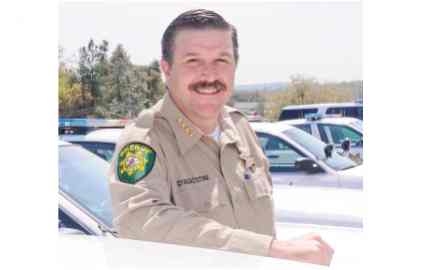
John D’Agostini, El Dorado County sheriff