Letter: Liberty Utilities must rethink its project

To the community,

CalPeco Utility line upgrade — why should the basin ratepayers be responsible?

The inconvenient truth is that this project was proposed and an initial environmental analysis was undertaken by Nevada Energy in 2010 with a customer base of over 2 million. CalPeco/Liberty Utilities then purchased a smaller market share of customers which is approximately 49,000. CalPeco found it easier and of course cheaper to piggy-back off the NV Energy enviro documentation. Why reinvent the wheel?

The EIR documentation should include a couple more alternatives that don’t require an entire looping system. The number of customers and economics of this project must be a factor and additional alternatives be proposed for different independent loop options, and an option for no upgrade to the basin line segments which could minimize or eliminate rate hikes of up to 30 percent for all basin ratepayers. This is a significant impact to the ratepayer.

The environmental documentation must provide a breakdown and needs assessment for the proposed expansions of Northstar and Squaw along with Homewood Mountain needs. And provide a separate needs assessment for the regulated growth needs of the Tahoe basin portion of the project.

There are many other issues that need to be raised:

Noise:

CalPeco will provide notification of construction to all properties owners 300 feet of project and post a phone number within 1,000 feet of residences for disturbances. The flight path of helicopters is a much larger area than just the construction sites and will generate noise levels that could exceed CNEL as could blasting activities which will be heard up to a couple of miles from actual blasting site. CalPeco should, at a minimum, post proposed activities and expected hours of operations on their website and post in all local newspapers a minimum of one week before construction, blasting, etc., activities schedules. Construction activities will occur 8am-6:30pm in TRPA jurisdiction, 6am-8pm and 8aa-8pm weekends in Placer County with certain exceptions for nighttime activities that are required.

Habitat disturbance:

From CalPeco EIR: 4.7.2 Disturbance or loss of sensitive habitats ( jurisdictional wetlands, riparian vegetation, and SEZ). Implementing the action alternatives would result in direct removal and disturbance of sensitive habitats, including waters of the United States, waters of the state, riparian habitat and SEZs. Mitigation Measure 4.7-2a Compensate for unavoidable Loss of Stream and Riparian Habitat.

CalPeco shall compensate for permanent riparian habitat impacts at a minimum of a 1:1 ratio through contributions to a CDFW approved wetland mitigation bank …. This does not correct the damage done. Mitigation Banks do not correct the onsite destruction or loss of habitat. The mitigation bank contribution must mitigate within the Tahoe basin.

Northern goshawk habitat, PACs, and TRPA disturbance zones, overall, implementation of Alternative 4 (Proposed Alternative) would initially result in the permanent loss or disturbance of up to 72.6 acres of potential habitat for northern goshawk over the study area. TRPA code prohibits this disturbance: TRPA Code 62.4.1. Disturbance Zones — Perching sites and nesting trees of goshawks, peregrines, eagles, and osprey as shown on the TRPA Regional Plan Overlay Maps shall not be physically disturbed in any manner nor shall the habitat in the disturbance zone be manipulated in any manner unless such manipulation is necessary to enhance the quality of the habitat. The threshold shall apply not only to the number of known population sites but also to the disturbance and influence zone buffers to sites found in the future.

Ellie Waller, Tahoe Vista resident and Liberty Utilities customer


Letter: LTUSD, Barton partner for healthy kids

To the community,

Congratulations to the 567 students from Lake Tahoe Unified School District who participated in Barton Health’s sixth annual We Can program. We Can, which stands for Ways to Enhance Children’s Activity and Nutrition, is a seven-week program designed for 4th- and 5th-graders that encourages healthy eating habits, activity, exercise, and overall wellness.

We Can is a national program that is implemented locally by Barton Health and the school district’s physical education teachers.

Each week students faced a new wellness challenge. Examples included drinking two 8-ounce glasses of water daily, exercising 30 to 60 minutes per a day, consuming less than two hours of television or video games each day, and avoiding soda and sugar-filled drinks. Each student that completed a challenge was awarded a raffle ticket. The raffle included “active” prizes, such as hula hoops, basketballs, soccer balls, razor scooters and the grand prize – a bicycle from Kmart.

We want to thank and acknowledge the community businesses that supported this year’s We Can program. Big 5 donated gift cards, the Kmart Cares program donated toward prizes, and both the Reno Aces and University of Nevada’s Wolf Pack provided game tickets. The Public Health Institute kindly supplied reusable water bottles for every participant.

A big kudos to the Lake Tahoe Unified School District’s physical education teachers for helping us implement this seven-week program and for encouraging and supporting another group of We Can alumni.

Leanne Wagoner, community outreach coordinator for Barton Health


Opinion: Tips for staying out of the ER this winter

By Warren Withers

Wintertime in Tahoe means skiing and snowboarding for visitors and locals alike. Few other places on earth have the abundance of snowsports opportunities that we enjoy in the Tahoe basin.

With all the excitement and fun, we can sometimes forget the few simple measures that can help us prevent the occasional, but largely avoidable injuries.

Warren Withers

Warren Withers

Consider the following when you’re headed out to your favorite resort so that your après ski plans do not include a trip to the ER.

· Wear a helmet. It is interesting to see the evolution of the use of the helmet in snowsports. It is such a simple device, but it is still used and thought of perhaps the way we thought about and used seat belts in 1965: helpful, but optional. Like a seat belt, it does not protect against all forms of injury, but it will change the degree of injury you endure if you do fall and hit your head. For example, a moderate head injury without a helmet will be a minor head injury if you are wearing one. Once you start wearing it, you will never go back. They are comfortable, they keep you warm, and just like your seat belt, you will feel naked without it.

· Use wrist guards. These simple and inexpensive devices can be purchased at any sports shop, and like the helmet they can make the difference between a normal fall and a trip to the ER. These are especially useful for snowboarders who are just learning.

· Understand resort boundaries and backcountry access gates. This subject has evolved considerably in recent years. Now there are designated gates which you can go through at some resorts to access the “backcountry.” This can be an amazing experience, but it is clearly an activity left to experts who know the full risk involved. When you cross these gates, you enter unpatrolled areas, and if you are injured or become lost, rescue can take a long time to arrive and is quite expensive.

· Avoid “no go” areas at resorts. Resort staff are experts at identifying when an area is safe and when it is not. When they mark an area off, usually with a rope or ribbon, it is for your safety, not because the skiing or snowboarding is so great there that they want to keep you away from it. This is a simple concept, but we see these boundaries ignored and the patient often regrets this decision.

· Prepare for avalanches. Avalanches get a lot of attention in the press for good reason. If you intend to venture into the backcountry, you must first know what you are doing. It is imperative that you take an avalanche course and wear and know how to use a beacon. These actions will reduce, but not eliminate your risk. Avalanches inside resort boundaries are very unlikely, but just beyond that boundary line, the slopes of “steep and deep” snow call out to the powder hounds in all of us. But remember, boundaries are there for your safety.

We wish you all a safe and enjoyable winter.

Warren Withers is the medical director of Emergency Medical Services at Barton Health.


Letter: Community steps up for food, toy drive

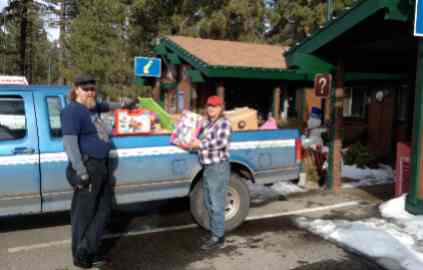
A pickup worth of food and toys was gathered by LTVA. Photo/Provided

A pickup worth of food and toys was gathered by LTVA. Photo/Provided

To the community,

The Lake Tahoe Visitors Authority recently conducted a weeklong “Food and Toy Drive and Drop for Christmas Cheer”. The result was a full pickup load of donated food and toys, as well as cash in excess of $1,800.

We were overwhelmed by the generous response from the Tahoe South community and want to thank the many individuals and business representatives who drove through the parking lot of the California visitor center and dropped goods into the barrels loaned to us by South Tahoe Refuse.

It was a heartwarming example of locals helping locals during the holidays.

Sue Barton, deputy director Lake Tahoe Visitors Authority


Letter: Live Violence Free says thank you

To the community,

Live Violence Free would like to send a huge holiday appreciation to community members who helped out children and families this Christmas season.

LVF extends deep gratitude for the Tahoe Douglas Rotarians and Sealed with a Kiss who hosted their annual Christmas Rotary Party, warmly welcoming 15 families to join the festivities, including a gourmet dinner and a variety of gifts. This year 48 of our clients and their family members benefited from this event.

Also, LVF sends extensive thanks the Tahoe Douglas Elks Club No. 2670 for their immense ongoing commitment and volunteerism at LVF and their generous donation of granting 20 children with Kmart shopping sprees. These children were able to pick anything up to $50 that they desired to take home, making Christmas extra special for children in need.

Lastly, LVF sends blessings and acknowledgement to all of the donors who participated in our 13th annual Adopt-A-Child program. Over 90 children were adopted this year by local residents who profoundly enhanced the Christmas celebration for many families in our community.

Thank you to all the service clubs, citizens, and leaders in the community to bring Christmas cheer and light to clients who are facing dark and challenging life circumstances. LVF is excited for the New Year to come and welcomes all volunteers interested in joining the organization.

Hannah Greenstreet, Live Violence Free


Opinion: Barton working to get residents insurance

By Leanne Wagoner

Signing up for health insurance can be a frustrating and time-consuming process. To ease the insurance buying process, Barton Health has stepped up by partnering with Covered California, California’s Insurance Exchange Marketplace, to assist our community members and provide certified enrollment counselors for the uninsured.

Barton enrollment counselors help California residents navigate through CoveredCA.com, where they can select insurance in an open market setting. Even though Covered California does not reimburse Barton for the enrollment counselors, we felt it was important to donate staff time to support our community during this difficult transition.

So far, counselors have delivered complimentary enrollment sessions at the Family Resource Center, Lake Tahoe Community College and South Lake Tahoe Library. Enrollment Counselors. The English and Spanish speakers have assisted over 75 Lake Tahoe families and households.

bartonBarton enrollment counselors also provide free one-on-one assistance to community members. Additional Barton staff, volunteers, and counselors have fielded nearly 200 phone calls and completed over 60 one-on-one appointments.

I’d like to extend my great appreciation to Barton’s certified enrollment counselors who have taken the extra time to train and then assist our community members. Barton’s 16 enrollment counselors include employees from Barton Community Health Center, patient accounting, customer service and admitting and have taken on this responsibility in addition to their regular jobs. Counselors took part in a rigorous certification process. All counselors completed 20 hours of training, a certification exam, and thorough background checks. As of Dec. 15, Barton has donated almost 600 hours of employee time to help during this major change in our nation’s healthcare system.

Though Barton cannot control the marketplace’s glitches, our enrollment counselors can offer information, assistance, and patience. One local self-employed, small business owner who signed up during Barton’s enrollment session stated, “Thank you from the bottom of my heart, you have helped me so much and saved me hundreds of dollars each month.”

We feel it is important for our community to understand that they have options, and we are proud that we are able to help those who need enrollment assistance.

The clock is ticking to sign up for insurance. To start receiving medical coverage on Jan. 1, uninsured community members must enroll by Dec. 23. California residents sign up here, and Nevada residents here.  If you currently do not have medical coverage, community members can enroll in the insurance marketplace until March 31, 2014, to avoid paying a penalty tax.

Local one-on-one enrollment assistance with Barton is available by appointment, or residents can call local certified enrollment brokers. A list is available online or on Covered California’s website above. Barton Health enrollment sessions in South Lake Tahoe are scheduled throughout January. You can find dates and details online or by calling (530) 543.5537.

Leanne Wagoner is Barton Health’s community outreach coordinator.


Letter: Anti-paid parking petitions in circulation

To the community,

There are plenty of people in this town that would have you believe that South Lake Tahoe is on the road to ruin. The City Council’s vote last December to put parking meters at our beaches and on public streets just fuels that kind of thinking.

Because paid parking is opposed by the majority of the community citizens feel their leaders are not listening or worse don’t care what we think.

Most people that live here believe that this entire paid parking program along with the aggressive ticketing that came with it needs to be eliminated. The problem is: Giving up on this paid parking program would mean that somebody would have to admit that the decision should never have been made and most people would rather be tortured than admit they were wrong.

So here we are one year later, with our citizens lining up to sign petitions to qualify for a ballot initiative to repeal paid parking.

Creating a controversy of this magnitude has the consequence of having the community believe that our leaders can’t get anything right. To be honest, we probably have more things to be proud of in this city than to be ridiculed, but it is always the screw-ups that people remember.

The community’s enthusiasm for an opportunity to vote on this issue is a demonstration of how passionate they are about free access to the lake. For many, it is the reason they live here.

The grass-roots citizen’s group Tahoe 4 Tahoe was born out of this parking controversy and they remain focused on getting this initiative to the voters.

Starting today petitions for the Initiative to Repeal Paid Parking in South Lake Tahoe will be available at the following locations:

Bruce Grego’s Law Office, 2262 Barton Ave.; Gaialicious, 987 Tallac Ave.; The Design Shoppe, 3053 Harrison Ave.; Sessions Salon, 3320 Sandy Way; Sierra Ski and Cycle Works, 3430 Lake Tahoe Blvd; League to Save Lake Tahoe, 2608 Lake Tahoe Blvd.; South Tahoe Standup Paddle, 3115 Harrison Ave.; and Tahoe Keys Office, 356 Ali Wai Blvd.

The challenge will be getting the 940 registered voter signatures that will be needed by the Jan. 13 deadline. We may need our own Miracle on 34th Street this holiday season to reach that goal.

This year I’m asking Santa for peace on Earth and to never hear the words “parking kiosk” again.

Let’s do this and Keep Tahoe Tahoe.

Peggy Bourland-Madison, Tahoe 4 Tahoe committee


Opinion: Tahoe’s environment depends on fewer cars

By Joanne Marchetta

In a year chock-full of positive milestones for the Lake Tahoe Basin, one accomplishment that stands out is the community’s collective drive to create a walkable, bikeable Lake Tahoe. Even while a cold blanket of snow covers miles of Lake Tahoe’s bike trails and paths, significant preparations continue for expanding the bike and pedestrian network throughout the region.

With about 130 miles of the network already built, there have been major improvements to mobility. But with a need for more than 250 miles of facilities to complete the network, seeing it through will take a commitment to change, a willingness to invest resources, and belief in the substantial, across-the-board benefits that will come from it.

Joanne Marchetta

Joanne Marchetta

The terms walkability and bikeability have become part of the vernacular for environmental restoration here at Tahoe because of the clear connection between our reliance on the private automobile and the health of Lake Tahoe’s air and water. More than 50 percent of the nitrogen entering Lake Tahoe every day is coming from local sources of emissions. However, many communities are finding out that these investments more than pay for themselves economically as well as in the health and well-being of their citizens.

Tahoe has its own environmental and economic arguments to make for increased walking and biking, but nationally and globally, the facts and new research are compelling. Communities like Portland that have been investing in walkability and better urban design for decades have experienced measurable economic benefits. In the 1970s, Portland established an urban growth boundary much like Tahoe did, but it also began building “skinny” streets and over 30 years invested $60 million on bike facilities — an amount that could easily be swallowed by just one freeway improvement project.

In an age when communities are competing to attract entrepreneurs and an intelligent work force, young, college educated people are moving to Portland at a rate five times higher than the national average. Attracting this segment of the population is needed here in Tahoe because Census data over the last 30 years shows a 13 percent decrease in people ages 20-45. In tourism-dependent Lake Tahoe, bicycling can also play a much larger role in our economy. The Lake Tahoe Bicycle and Pedestrian Plan estimates that bike recreation already brings between $6 million and $23 million per year in local direct expenditures.

According to Jeff Speck, city planner and author of “Walkable City”, new research is discovering more linkages between walkability and human health than were known before. A study of San Diego neighborhoods found that the likelihood of obesity decreased 25 percent in more walkable neighborhoods. It’s also no secret that air pollution is unhealthy, but across America today, the rate of vehicle travel is being used as a predictor of the population of people with asthma and asthmatic deaths have increased three times since the 1990s. Most of that increase is coming from car exhaust.

Here in Tahoe, since much of our infrastructure and town centers were originally designed around the private automobile, a total transformation won’t happen overnight, but it is year-by-year one mile of trail at a time. Updating the design of transportation in our communities takes more than one organization or agency can deliver, it takes commitment and vision and, as always, there is a place for you to jump in and take part.

A partnership of three local governments on the South Shore have joined forces and are meeting with citizens to design a multi-jurisdiction recreation and trails master plan. Public workshops were in December and a draft of the plan and capital investment strategy are scheduled to be released next year. No matter where you live, bike and pedestrian facilities are being designed and planned. Find out about them, weigh in on them and show your support.

Early next year, the TRPA transportation team will open applications for the On Our Way Community Grant Program. We will begin inviting community members, organized groups, and local governments to use the grants to develop and evaluate localized concepts like streetscape improvements, pedestrian promenades, and simple safety upgrades for pedestrians and bicyclists. The program will be funded through the Tahoe Metropolitan Planning Organization, a special designation which TRPA received from Congress more than a decade ago. Find out more online.

Making Tahoe more walkable and bikeable is a cornerstone of the updated Regional Plan. TRPA remains committed to working collaboratively with you and other organizations to make this vision a reality.

Joanne Marchetta is the executive director of the Tahoe Regional Planning Agency.


Opinion: California deserves better roads

By Dan Walters, Sacramento Bee

Let’s start with the basics about California’s highway network, which a few decades ago was considered to be among the world’s best.

It was mostly constructed in the three decades that followed World War II, as California’s population boomed and vehicular travel exploded.

Dan Walters

Dan Walters

Eventually, however, just about when Jerry Brown began his first governorship, highway construction slowed dramatically for a wide variety of ideological (both left and right) and financial reasons.

Nevertheless, vehicular travel continued to expand, along with population and economic activity. It’s roughly twice what it was 30 years ago, even though California’s population has increased by about 50 percent.

The slowing of capacity-increasing construction and the steady growth of auto travel eventually resulted in California having the nation’s worst traffic congestion, according to the Federal Highway Administration.

Read the whole story


Letter: CTC continues to do good work

To the community,

Tahoe captured my heart as a young man. I raised my family here because I can’t imagine a better place to live. Thirty years ago I helped create the California Tahoe Conservancy. Today, the Conservancy leads California’s efforts to restore and enhance the extraordinary natural and recreational resources of the Lake Tahoe Basin.

Larry Sevison

Larry Sevison

As a founding board member, I am proud of the Conservancy’s role as a valued partner, a respected landowner and the funder of hundreds of water quality, restoration, public access and habitat enhancement projects.

This year, with the help of my fellow board members, passionate staff and dedicated partners we completed the Lower Blackwood Creek Restoration Project and the adjacent Eagle Rock Trails to one of the most spectacular views in Lake Tahoe. We also saw the completion of the Lakeside Bike Trail in Tahoe City, a collaborative project which links 22 miles of trail along the Truckee River and Tahoe’s West Shore.

Our work is not done. The challenges of restoring the Upper Truckee River and other high priority watersheds, completing a comprehensive bike trail network and continuing to proactively manage our lands remain in front of us. In 2013 we authorized $2,300,000 for new project investments to reach these collaborative goals.

I hope you will take a look at the Conservancy’s Annual Report to learn more. Thank you for your continued support.

Wishing you happy holidays and a wonderful 2014.

Sincerely,

Larry Sevison, board chairman of the California Tahoe Conservancy