Opinion: Budget surplus should not be wasted

By George Runner

We’ve all heard dramatic stories of lottery winners acquiring hundreds of millions of dollars only to declare bankruptcy a few years later.

In fact, studies show 70 percent of all individuals who suddenly receive large amounts of money will lose it in a short period of time.

The cause of this problem is impulse spending by people who incorrectly assume they will never have to worry about money again. They spend as much as they want on whatever they want, making permanent financial decisions with their one time earnings.
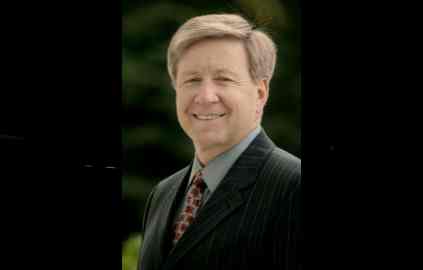
George Runner

George Runner

This year, California essentially won the lottery when it comes to the budget. The governor’s budget proposal shows nearly $20 billion more in revenues will be generated during the next fiscal year than was collected three years ago.

Years ago, during the Davis administration, California found itself in a similar situation. As vice chair of the Assembly Budget Committee at the time, I remember sitting in Gov. [Gray] Davis’s office as he personally promised to show fiscal restraint with the state’s large revenue windfall.

Unfortunately, Gov. Davis ultimately caved to pressure from legislative Democrats and authorized ongoing spending with those temporary revenue dollars. Gov. Davis said all the right things, but his actions spoke louder than his words.

Despite Gov. [Jerry] Brown’s assurances, the messages we are hearing from the majority party indicate we may be on track to repeat these fiscal mistakes. Much like an irresponsible lottery winner, legislators can’t seem to fight the impulse to spend extra money as soon as it’s in the bank.

Our increased revenues are primarily the result of temporary tax increases that will soon expire and volatile capital gains that can disappear at any time. California cannot solve its long-term budget problems by relying on these temporary and unreliable solutions.

However, to go along with this new revenue, we’ve already seen proposals for increased spending. For example, Democrats in both houses of the Legislature have already thrown their support behind SB837 (Steinberg), a bill that will create a completely new school grade. By establishing a “transitional kindergarten” program available to every 4-year-old child in California, SB837 will rack up a price tag of nearly $1 billion by the year 2020.

These kinds of new, permanent spending proposals expand government, but do nothing to invest in the private sector.

Recently, a prominent Democratic elected official even called for the extension of Proposition 30, the temporary tax increases Californians imposed on themselves to get out of the fiscal hole of overspending.

The majority party is already planning on making this latest round of “temporary” tax increases permanent before they expire. Job creation and economic growth is the pathway to preventing future financial trouble for California.

Our long term problems will only be solved if Gov. Brown resists the impulse to spend our new surplus. We need to learn from the budget mistakes of the past, before it’s too late.

George Runner represents more than nine million Californians as a taxpayer advocate and elected member of the state Board of Equalization.


Opinion: White is a champion with special fans

By Mike Wise, Washington Post

KRASNAYA POLYANA, Russia — What happens when the story you came to write doesn’t become the story anymore? What happens when that story does a 180-degree turn in mid-air, then a 540 and finally a dizzying 1260, spinning your perception completely around?

I had heard Shaun White had become too big for his snowboard bindings. He didn’t hang with other members of the close-knit Team USA community. His “people” shut down halfpipes at ski resorts so White could ride by himself. He wasn’t the cool kid we once called the Flying Tomato anymore, a thatch of reddish-orange hair rising 22 feet off a wall of ice.

No, he was now the Descending Diva — S.W.E., Shaun White Enterprises, the $15-mil-per-year action sports icon — the world’s richest, most famous and now most isolated extreme star.

He needed to be put back in place, I thought. He needed to remember the, well, dudeliness that got him here.

Then the story forked. Maybe I should explain.

About an hour before White competed, I met a freckle-faced, St. Louis kid with a stars-and-stripes beanie and a little miniature flag named Ben Hughes, his mother Liz, and their friend, Kaitlyn Lyles. Turns out Ben and Kaitlyn are here because of the Make-A-Wish Foundation.

Ben got a diagnosis of acute lymphoblastic leukemia at 6 years old. He underwent 2.5 years of radiation and chemotherapy. Before he finished his treatments at the end of 2012, he had found two new inspirations in life: snowboarding and Shaun White. He loved both.

Kaitlyn learned of White while watching the 2010 Vancouver Games on television from her hospital bed at Sacred Heart Children’s Hospital in Pensacola, Fla., where she underwent chemotherapy for osteosarcoma, a rare form of blood cancer.

“I was literally in that hospital room for all of February,” she said. “Shaun White is what really got me through. I loved that even after he clinched the gold medal, he still went for it, trying tricks and refusing to coast when he won.”

Kaitlyn playfully vowed not to leave Sochi before she was Mrs. Shaun White.

Read the whole story


Opinion: Retirement security takes planning

By Jason Zweig, Washington Post

By creating a new savings plan this past week called the myRA, President Obama refocused attention on the retirement crisis.

While the myRA is a small step in the right direction, particularly for lower-income Americans, tens of millions of people remain trillions of dollars short of the savings they will need to fund their retirement.

The solution is simple, but it isn’t easy. Americans need to save more — not just a little more, but vastly more, according to a new study by two leading investment analysts.

To be assured of having enough money to fund a comfortable retirement, you should save a total of 22 times the annual income you want to earn when you retire. That is higher than many previous estimates, but it offers near-certainty of hitting your target.

Read the whole story


Letter: Dental group supports Bread & Broth

To the community,

Bread & Broth was very fortunate to have the Genasci/Stigers Family Dental Care group sponsor the Adopt A Day of Nourishment on Feb. 3. It was a busy night for the B&B volunteers and enthusiastically assisting them were Lee Anne Stigers, Jon Helman, Alejandra Quirarte, and Lisa Mascitelli.

Thanks to the evening’s generous sponsors, the versatile B&B cooks provided the evening’s dinner guests with a wide variety of tasty food which included Sloppy Joe’s, stuffed green peppers, veggies, crab salad, fruit salad, crab alfredo and apple salad.

“The food was amazing and delicious,” said Stigers. “The team did a great job.”

According to the B&B volunteers, the Genasci/Stiger’s sponsor crew also did a great job bagging “give-aways”, cheerfully greeting the guests and filling their trays and helping with the dinner’s cleanup.

“Enhancing smiles for a lifetime” is the Genasci/Stigers motto and by hosting the evening’s meal, they also brought smiles to the dinner guests’ faces.

“It’s an eye opener to see how many people are in need in this community”, observed Helman.

By supporting B&B’s weekly Monday evening dinner serving, the Genasci/Stiger’s Family Dental Care group took a positive step to help their fellow community members. B&B would like to salute our evening’s sponsor for their generosity of spirit and financial donation.

Carol Gerard, Bread & Broth


Letter: Veterans still not getting care they deserve

To the community,

The following poem was written in 1971 when I was 19 and in the midst of a quest to see every state, city, national park – all this country had to offer. In every city and town, from New York to Dubuque, and on every highway, there were veterans who served in combat during WWI, WWII, Korea, and Vietnam.

Some I met were very successful business people, ranchers, farmers, and blue collar workers. But tens of thousands were entrenched in our inner-cities and towns, in physical, psychological, and spiritual pain that no amount of alcohol or drugs brought relief from. It was clear to me back then that our government/military had no clue how to deprogram veterans or even treat physical ailments.

Every day I thanked God for my No. 333 in the first draft lottery that allowed me to continue on my journey. I stayed at one military base (Fort Bragg) and visited several others and wondered how many recruits and draftees there would face a similar plight.

Two years later, back home in New Jersey, I shared a place with two Vietnam veterans — a Marine volunteer who withstood two lengthy sieges and an Army draftee who was besieged by crazed South Koreans raiding his warehouse at Cam Ranh Bay. I made several trips with Bill (the Marine) to the veterans hospital in attempts to find out what was in his body attacking it. They were clueless. The conditions there were deplorable.

So here we are in 2014, still reading and listening to news stories about Walter Reed Army Hospital and other facilities around the country and hearing promises to upgrade them and the research into what our veterans have been inflicted with. Kudos to the city of Phoenix and several other cities for developing and funding programs to provide housing to homeless Veterans so they can begin to find the space to heal. A Jan. 17 USA Today story stated there are 48,000 Iraq and Afghanistan veterans who are, or are on the verge, of being homeless. Federal grants have been increased to assist these programs. When a shovel-jumper employed by the city of South Lake Tahoe has more options and better quality health care, the system is flawed.

Veterans Benefits

News-stands stained

with wine and urine

gutters filled

with twice-smoked butts

bus fumes mixed

with soup and coffee

in stomachs hardened

by old floor boards.

Lingering about

downtown hotels

relating old tales

of battles and feasts

while with varying patience

point to scars on their faces

that reveal all the places

they once fought for Peace.

In appreciation,

Ed Mosur, South Lake Tahoe


Opinion: California using up natural resources

By Joe Guzzardi, Lodi News-Sentinel

For decades, federal, state and municipal governments have ignored the consequences of population growth. Despite California’s ongoing battle against too little water, the Club for Growth and Wall Street want more, more, more.

The 2012 birth rate drop triggered a series of near-panic mainstream media stories that a demographic zero hour might be looming. Reporters speculated that too few children would eventually mean fewer workers, less productivity and too many retirees.

That gloomy prediction is baseless speculation. What we know for sure is that, according to the Census Bureau, last year California’s population added 332,000 residents, which brought the state total to 38.2 million. Higher population created a demand for more natural resources, including, most importantly, water.

Read the whole story


Opinion: Inequality fine with conservatives

By Robert Reich

With polls showing that a majority of Americans now believe inequality has grown over the past decade, and favor tax increases on the wealthy to expand help to those in need, conservatives want to change the subject.

Those with presidential ambitions say we should focus on poverty rather than on inequality.

Sen. Marco Rubio of Florida points to the “lack of mobility” of the poor as the core problem. Rep. Paul Ryan of Wisconsin blames their isolation from mainstream America: “On every measure from education levels to marriage rates, poor families are drifting further away from the middle class.”

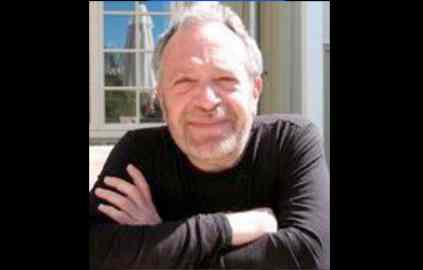
Robert Reich

Robert Reich

Conservative New York Times columnist David Brooks argues that the “interrelated social problems of the poor” have nothing to do with inequality.

Rubbish.

When almost all the gains from growth go to the top, as they have for the last 30 years, the vast middle class doesn’t have the purchasing power necessary to keep the economy growing and generate lots of jobs.

Once the middle class has exhausted all its coping mechanisms — wives and mothers surging into paid work (as they did in the 1970s and 1980s), longer working hours (which characterized the 1990s), and deep indebtedness (2002 to 2008) — the inevitable result is slower growth and fewer jobs.

Slow growth and few jobs hit the poor especially hard because they’re the first to be fired, last to be hired, and most likely to bear the brunt of declining wages and benefits.

A stressed middle class also has a harder time being generous to those in need. It’s no coincidence that the tax revolts that began thundering across America in the late 1970s occurred just when middle-class wages began stagnating.

Helping America’s poor presumably requires some money, but the fiscal cupboard is bare — and the only way to replenish it is through tax increases on the wealthy because the middle class is stretched to the limit.

The shrinking middle class also hobbles upward mobility. Not only is there less money for good schools, job training and social services, but the poor face a more difficult challenge moving upward because the income ladder is far longer and its middle rungs have disappeared.

Conservatives don’t want Americans to draw the connection between widening inequality and unequal political power. Brooks, for example, warns that any discussion of unequal political power will make it harder to reach political consensus over what to do for the poor.

But it’s precisely the concentration of power at the top — which flows largely from the concentration of income and wealth there — that has prevented Washington from dealing with the problems of the poor and the middle class.

As wealth has accumulated at the top, Washington has reduced taxes on the wealthy, expanded tax loopholes that disproportionately benefit the rich, deregulated Wall Street, and provided ever larger subsidies, bailouts and tax breaks for large corporations.

The only things that have trickled down to the middle and poor besides fewer jobs and smaller paychecks are public services that are increasingly inadequate because they’re starved for money.

Unequal political power is the endgame of widening inequality — its most noxious and nefarious consequence.

Big money has all but engulfed Washington and many state capitals — drowning out the voices of average Americans, filling the campaign chests of candidates who will do their bidding, financing attacks on organized labor, and bankrolling a vast empire of right-wing think tanks and publicists that fill the airwaves with half-truths and distortions.

Finally, conservatives would rather talk about poverty than about inequality because they can then characterize the poor as “them” — people who are different than most of us, who have brought their problems onto themselves, who lack self-discipline or adequate motivation. Accordingly, any attempt to alleviate poverty requires that “they” change their ways.

But inequality affects all of us, and dealing with it requires that we acknowledge how distorted our economy and our politics have become. When 95 percent of the economic gains since the start of the recovery go to the richest 1 percent, something is fundamentally wrong

America’s surging inequality requires that we address the growing misallocation of political and economic power in America. That’s exactly what conservatives don’t want us to do.

Robert Reich is chancellor’s professor of Public Policy at UC Berkeley and senior fellow at the Blum Center for Developing Economies. His new film, “Inequality for All,” is now out on iTunes, DVD and on demand.


Letter: Agencies creating a Tahoe residents don’t want

To the community,

Why I went to the meeting Feb. 6:

After reading the Catalyst Project document, I was shocked. This wasn’t a catalyst for commercial growth, it was an immense planned development. I realized that this project could never happen because there wasn’t enough commercially zoned land for a new 4-acre project. Then a Lake Tahoe News’ story came out, magically, 5.78 acres of California Tahoe Conservancy lots are going to be sold, right in the general vicinity of this Catalyst.

So I went back and crunched some numbers, and saw that once again, this project could never get off the ground because of lack of commercial floor area (CFA). Since I have personal experience with this commodity, I understood that there was simply not enough CFA allotted to Meyers. That was until the new TRPA Regional Plan was explained to me. Goes something like this: CFAs, TAUs (tourist accommodation units), hard coverage (asphalt) and soft coverage (compacted dirt), are government commodities that control growth and create revenue. These commodities are very valuable. And if I were to make an analogy, it’s like how gold and silver are to the paper dollar, they fluctuate depending on demand. If the feds went out and printed a gazillion one-hundred dollar bills, it would upset the economy. Well, that’s kind of what the TRPA did.

They are supplying up to six times the commodities like CFAs or coverage for one commodity purchased, or a 1 to 6 ratio, or a 1 to 2 ratio, or a 1 to 3 ratio, depending on location. Also, this surprised me, transferring/converting stuff, residential stuff to commercial stuff? CFAs converting to TAUs? Meyers stuff being sold/traded with North Shore stuff? Really? Answer: Yes.

Yes, they are trading or selling commercial floor area and want to sell or trade more coverage across the lake and across the board. TRPA Code 50, 50.10.1

The TRPA has also changed our zoning title, our commercial area is now a “town center”, increasing density, which basically means, they could cram more stuff (see above) into a smaller space.

With these changes, the numbers work, this mega resort could actually fly. Wow! But wait, neighbors would still have to be notified if something like this was in the planning process, right? No, under the new plan, to add insult to injury, they don’t have to tell us anything.

Lastly, never underestimate the Meyers community. I was so proud to be among all those people who showed up [Thursday] night, reminded me of 20 years ago when we stood up and said, “We will not be the parking lot for Lake Tahoe!”

I was proud then and am proud now. By the way, this Catalyst calls for a 465-unit parking garage to “capture the gasoline vehicles and incentivize them into electric cars”.

Good grief.

Angela Olson, Meyers


Letter: $200 parking tickets in South Lake Tahoe

To the community,

At a time when many locals are struggling to make ends meet and tourists are in short supply, a change to the parking rules have caught some by surprise in the form of a $200 parking ticket.

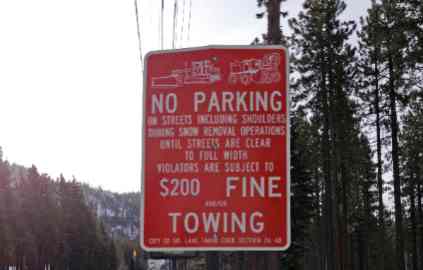
signLast summer the entire City Council with the exception of JoAnn Conner voted in favor of Ordinance 1055 that changed the definition of “no parking on street including shoulders during snow removal operations” to read “city streets and street right-of-way be kept clear of snow and other obstructions (automobiles) during the snow season, which is defined as from N. 1 to April 30 of each year.” This means that large parts of the city, where it is legal to park in the summer months, have been made into no parking zones punishable by a $200 fine for six months out of the year, regardless of snow removal conditions.

As we all know, parking in South Lake Tahoe is a limited commodity. Many homes have no usable driveway. Access to many of the local trails require street parking. Some schools and public buildings have only enough parking to handle staff, and some business rely on street parking for their customers. It is common sense that street parking should be restricted during the snow removal process but simply restricting parking for half of the year makes no sense at all.

Additionally, there is no requirement in the new ordinance to update signage to reflect the new rules. The signs currently reflect the old ordinance, “no parking during snow removal operations.” There is nothing to indicate to the public that they could receive a $200 parking ticket if they park on these streets at any time from Nov. 1 to April 30.

I do not know why it was deemed necessary to make this change to the parking ordinance. But I find it interesting that at a time when the city has expanded its parking enforcement there is a changing of the rules resulting in a substantial fine and the ability for the City to wright more tickets. If you have been affected by this new ordnance or simply do not like idea of not being able to legally park on City streets and right-of-way six months out of the year, please contact your city councilmember or the city manager.

Here is the link to the wording of ordinance 1055.

Mike Keck, South Lake Tahoe


Letter: Liberty explains rate increase process

To the community,

I am writing to address inaccurate information about Liberty Utilities’ current and authorized rates — effective over a year ago — and recently cited by an opponent of Liberty’s proposed 625/650 Electric Lines Upgrade Project.

While some of the information cited is in California Public Utilities Commission documents as claimed, it is misleading when not presented in its entirety. A typical rate case request contains dozens of different components that comprise the rate, and the CPUC takes all those components into consideration when making a decision. Simply using only selected components of a rate case and calculating an increase on that component alone is a misrepresentation of the true overall impact of a rate case decision.

Liberty’s latest rate case filed in 2012 took effect in January 2013 and resulted in about an overall 4 percent average rate increase. The letter’s author is correct in citing this part of the CPUC documents, but his remaining information is flawed.

To understand why these statements are inaccurate, one needs to know what comprises a utility’s overall rate. For Liberty Utility customers, 88.7 percent of their average rate is simply a pass through for costs incurred by the utility to provide service to customers. Liberty recovers dollar for dollar with no profit. And, 50 percent of that is for energy costs alone. Again, with no profit. The balance, or 11.3 percent, is actually the CPUC-allowed return to the stockholders to compensate them for their investment.

Knowing what makes up the average rate helps to understand that simply looking at one of the rate’s component’s increase or decrease is an inappropriate and inaccurate way to present overall rate information,. The CPUC reviewed Liberty’s rate case request in 2012 through an extensive audit and public hearing process, and looked at all the data presented for each of the rate’s components. As is standard in the utility industry, any decrease in the energy costs (or increase) is to be offset (or added) to the base rate to arrive at the average overall rate.

In reference to the future rate impact of the proposed 625/650 Line Upgrade project, as a rule of thumb, Liberty customers can generally expect to see an increase of about 2 percent for every $10 million allowed in rate recovery.

As a regulated utility, Liberty Utilities will continue to have all proposed cost recovery reviewed by the CPUC’s extensive audit and public hearing process for appropriateness.

Ken Wittman, manager of Rates & Regulatory Affairs Liberty Utilities