Opinion: Bears waking from winter slumber

By Carl Lackey

Mid-March is the time for black bears to emerge from their dens and begin their annual search for food. The first bears to emerge are usually males and females who do not have cubs.

Females with cubs usually emerge from the den later in the spring, from mid-April to early May.

The bears are ready to eat as they emerge from their long winter’s nap. They will eat emergent grasses and forbs and will also key in on the carrion of dead and decaying animals that died over the winter period.

Bears in the Lake Tahoe Basin will also be looking toward human garbage as a source of food.

Every year, the first bears to get into trouble are the young males, many of whom are generational garbage bears. These bears are born to females who have taught them that humans are a source of food.

The old warnings from past years are still valid. If you live in bear country, do not allow bears access to garbage. Keep garage doors shut, car doors locked and keep all food sources away from bears.

Another potential problem is people deliberately feeding the bears by placing bird seed, vegetables or other plant matter out in places near their homes. Nevada has a law against feeding big game animals and last year, a person in Incline Village was warned for deliberately feeding the bears.

We had to humanely euthanize a bear last year that was being deliberately fed by humans. The bear had become a threat to public safety. The bear’s behavior was disturbing because it had no fear of humans. The person or persons feeding the bear, through their actions, acclimated it to humans as a source of food and the bear ended up paying the ultimate price for their actions.

Since March 1, NDOW has captured three bears, all young males. An injured bear at Heavenly Mountain Resort was captured and turned over to California authorities for care. On March 7, another injured bear in Incline Village was captured. The nature of the bear’s injuries were not obvious, but the bear had to be euthanized. A third male bear was caught on the west side of Carson City over the weekend while raiding garbage cans. It was tranquilized and later released in the mountains south of Carson City.

Because of the ongoing drought conditions, we are expecting a very busy nuisance bear year. People in bear country need to be ready to do all they can to keep the bears wild and away from human sources of food.

Anyone wishing to report illegal activity can call the Operation Game Thief Hotline at 800.992.3030. The OGT Hotline is a place where persons concerned about the illegal feeding of bears can provide information to NDOW game wardens anonymously.

Carl Lackey is a biologist with the Nevada Department of Wildlife.


Opinion: South Shore Olympians add to area’s history

By Garry Bowen

As we near our celebration of our local Olympic triumph in honor of the glorious efforts of our three Olympians, I thought it might merit a look at Lake Tahoe’s ski legacy over the decades, as its significance is now enhanced, to say the least.

Back in the mid-1950s, with the announcement of the Olympics coming to Squaw Valley, the country said, “Where is that?” It’s by Lake Tahoe. “OK, where’s that?” That’s by Reno. “ Oh, you mean the divorce capital of the U.S.?”

In short, the 1960 Olympics really did a lot to put this area on the map, particularly since the Squaw Olympics was the first to be televised around the world, though not in living color.

Garry Bowen

Garry Bowen

After those Olympics, Lake Tahoe had a relatively strong international ski presence, with many notables hanging out here for various events. And we have had our share of local notables, recognition on the international stage of the FIS (Federale Internationale du Ski), and even our own Heaven(ly) ski joke.

Those were the days of Squaw’s Tamara McKinney and Jimmy Heuga, Billy Kidd, Bill Marolt, Bob Beattie; all from elsewhere but who hung out here. A number of those went on to keep their presence in the ski world (Bill Marolt, for example, is part of the U.S. Olympic Committee and president of the U.S. Ski & Snowboard Association; Bob Beattie became the voice of skiing for ABC’s “Wide World of Sports”). But some were not so fortunate: Jimmy Heuga, who along with Steamboat Springs Billy Kidd, won the Olympic bronze to Kidd’s Olympic silver in the 1964 Olympics in Innsbruck, Austria, suffered the cruel indignity of multiple sclerosis.

As a true Olympic champion Heuga dignified his condition with his long-fought advocacy for the benefit of all MS patients.

Our own closer-to-home celebrity from that era, Vladimir “Spider” Sabich (his dad was the CHP lieutenant at Kyburz) was the victim of a fatal celebrity shooting in 1976 a number of years after winning the World Cup in 1968 here. The traumatic loss of Sabich was especially heart-breaking for me, as I used to ride the school bus everyday to Placerville (El Dorado High) with he and his older sister, Mary (his younger brother, Pinky, was much younger) – an hour and a half round trip journey with a good friend. And the end of many, many escapades on the slopes, at parties, here and in Aspen Highlands.

The World Cup that Sabich won was right here at Heavenly – and was the source of national TV exposure through Beattie and the “Wide World of Sports” – that, plus the FIS event ceremony dinner at Harrah’s South Shore Room, where we were treated to our own Heaven(ly) joke at the expense of a skiing legend.

Told at the World Cup dinner ceremonies at the conclusion of the World Cup: “It seems a long-term, fanatic skier died and ended up at the pearly gates: upon arrival, he’s greeted by St. Joseph, who welcomes him by suggesting a tour of the facilities. He’s promptly shown the brand new sparkling 40-lane bowling alley (open-all-the-time!), then shown the spectacular 27-hole golf course (with no sand traps). Then, as they start off for yet another place, the newcomer stops him, and asks, ‘Hey, what about me? You know I’ve been a life-long skier, don’t you have something here for me?’ At which point St. Joseph takes him a distance where he tells him of ‘the thousands of feet of vertical drop, the several ridges and cornices where he can leap 60-80-100 feet through the air to his heart’s content, the lifts that can take he and five others in speedy fashion up the slopes for an unbelievable number of runs, etc., etc.’ – when suddenly they are both interrupted by this sleek figure in perfect form, zooming by exceptionally fast, incredibly dressed. And the newcomer turns and says, ‘Wow! That guy was great, that must have been Stein Erickson!’ To which St. Joseph responds, ‘No, that was God! But he thinks he’s Stein Erickson.’”

The Lake Tahoe region has a long and strong history in the ski world, and I’ll add yet another local dimension. We also had, for instance, Greg Dorland as the U.S. National Junior Ski champion, Wally Rothgeb Jr. on the U.S. Ski Team (his mom and dad ran Heavenly Valley in the 1960s), and even Julia’s dad, Ciro Mancuso, as part of the South Shore contingent.

After this quick review of those before them, Lake Tahoe’s long-time ski connections are now greatly enhanced by the three young ladies that will be honored this week: Jamie Anderson, Maddie Bowman and Hannah Teter.

Having surpassed all of whatever any expectations there might have been and have outdone and added to all previous accomplishments and skills of those who came before, which, knowing most of them as I do, would most probably be a thrill to them all, it is a great honor to add all of them to Tahoe’s history.

Thanks for all your dedicated work and for bringing this prestige and recognition back home. Welcome!

You’ve outdone them all.

Garry Bowen has a 50-year connection to the South Shore, with an immediate past devoted to global sustainability, on most of its current fronts: green building, energy and water efficiencies, and public health. He may be reached at tahoefuture@gmail.com or (775) 690.6900.


Letter: Filipino community cooks at Bread & Broth

To the community,

Bread & Broth would like to thank the Filipino community for coming together to sponsor an Adopt A Day of Nourishment on March 3. With the generous donation of $250 by an anonymous Filipino community member and the help of a very eager and hard working crew, the dinner guests were treated to a hearty, traditional Filipino dinner that everyone enjoyed.

As the dinner guests were served chicken adobo, rice, chicken chow mien, egg rolls and green beans with bacon, Mila Seals spoke for her fellow Filipino community crew members: “We all have an amazing energy and happiness for serving our community. The effort shown and the great dedication from the Filipino community to the needy was a fantastic experience.”

It was a pleasure to watch the Filipino volunteers joyfully prepare a meal in which they so generously donated their time and skills to provide a meal that was filled with love and caring.

Bread & Broth is very grateful for and humbled by the support that the Filipino community has shown in feeding the less fortunate of the Lake Tahoe South Shore community.

For more B&B information, go online or find us on Facebook.

Carol Gerard, Bread & Broth


Letter: S. Tahoe event subsidies not equitable

Publisher’s note: The following letter was sent last week to South Lake Tahoe City Manager Nancy Kerry.

Dear Mrs. Kerry,

I am Joby Cefalu, director of South Tahoe Basketball Academy. We rent the Recreation Center gym for two tournaments May 24-26 and June 20-22. Each of these tournaments brings over 200 youth basketball teams to our community during the shoulder season.

The Rec Center is one of 11 gyms and 15 courts we use to put on these tournaments. All of the proceeds are put back into the local youth sports, both male and female from elementary school through high school.

This year I have already reserved and paid for the use of the Recreation Center under the direction of Lauren Thomaselli and Cheryl Candiff, both of which are extremely competent and very helpful I might add.

Our tournaments have been sponsored by the LTVA with the help of [Executive Director] Carol Chaplin. Based on the numbers they provide we bring to town over $1,500,000 to the local economy.

Last year’s estimates were closer to $2,000,000 as we did one more tournament that was a bit smaller.

After reading that the SnowGlobe event was going to be subsidized by the city I felt compelled to reach out. Based upon the logic used by the city and the free use of facilities and subsidy, I believe it very unfair that we are charged over $2,500 for the use of one gym. The city of South Lake Tahoe is the primary beneficiary of our event through TOT and sales tax. The other venues which include Lake Tahoe Unified, Kahle Community Center, and Douglas County School District charge a very nominal fee with really no benefit other than indirectly through the youth we serve. Lake Tahoe Community College allows us use of their facility free of charge.

With that said, I would really appreciate your consideration in waiving use fees. Last year there was a Gatorade spilled and we were told it was our responsibility to pay to have the carpets cleaned, which we did. I will be happy to provide a security deposit in case of damage. I very much appreciate your time and consideration.

Sincerely,

Joby Cefalu, South Tahoe Basketball Academy


Opinion: Defensible space incredibly important

By Jeff Meston

The vegetation surrounding a building or structure is fuel for a fire. Even the building or structure itself is considered fuel. Research and experience have shown that fuel reduction around a building or structure increases the probability of it surviving a wildfire.

Good defensible space allows firefighters to protect and save buildings or structures safely without facing unacceptable risk to their lives. Fuel reduction through vegetation management is the key to creating good defensible space.

Jeff Meston

Jeff Meston

Terrain, climate conditions and vegetation interact to affect fire behavior and fuel reduction standards.

• Properties with greater fire hazards will require more clearing. Clearing requirements will be greater for those lands with steeper terrain, larger and denser fuels, fuels that are highly volatile, and in locations subject to frequent fires.

• Creation of defensible space through vegetation management usually means reducing the amount of fuel around the building or structure, providing separation between fuels, and or reshaping retained fuels by trimming. Defensible space can be created removing dead vegetation, separating fuels, and pruning lower limbs.

• In all cases, fuel reduction means arranging the tree, shrubs and other fuels sources in a way that makes it difficult for fire to transfer from one fuel source to another. It does not mean cutting down all trees and shrubs, or creating a bare ring of earth across the property.

• A homeowner’s clearing responsibility is limited to 100 feet away from his or her building or structure or to the property line, whichever is less, and limited to their land. While individual property owners are not required to clear beyond 100 feet, groups of property owners are encouraged to extend clearances beyond the 100 foot requirement in order to create communitywide defensible spaces.

• Homeowners who do fuel reduction activities that remove or dispose of vegetation are required to comply with all federal, state or local environmental protection laws and obtain permits when necessary. Environmental protection laws include, but are not limited to, threatened and endangered species, water quality, air quality, and cultural/archeological resources.

The methods used to manage fuel can be important in the safe creation of defensible space. Care should be taken with the use of equipment when creating your defensible space zone. Internal combustion engines must have an approved spark arresters and metal cutting blades (lawn mowers or weed trimmers) should be used with caution to prevent starting fires during periods of high fire danger. A metal blade striking a rock can create a spark and start a fire, a common cause of fires during summertime.

Vegetation removal can also cause soil disturbance, soil erosion, regrowth of new vegetation, and introduce non-native invasive plants. Always keep soil disturbance to a minimum, especially on steep slopes. Erosion control techniques such as minimizing use of heavy equipment, avoiding stream or gully crossings, using mobile equipment during dry conditions, and covering exposed disturbed soil areas will help reduce soil erosion and plant regrowth.

Areas near water (riparian areas), such as streams or ponds, are a particular concern for protection of water quality. To help protect water quality in riparian areas, avoid removing vegetation associated with water, avoid using heavy equipment, and do not clear vegetation to bare mineral soil.

General Guidelines:

1. Maintain a firebreak by removing and clearing away all flammable vegetation and other combustible growth within 30 feet of each building or structure. Single specimens of trees or other vegetation may be retained provided they are well-spaced, well-pruned, and create a condition that avoids spread of fire to other vegetation or to a building or structure.

2. Dead and dying woody surface fuels and aerial fuels within the Reduced Fuel Zone shall be removed. Loose surface litter, normally consisting of fallen leaves or needles, twigs, bark, cones, and small branches, shall be permitted to a depth of 3 inches. This guideline is primarily intended to eliminate trees, bushes, shrubs and surface debris that are completely dead or with substantial amounts of dead branches or leaves/needles that would readily burn.

3. Down logs or stumps anywhere within 100 feet from the building or structure, when embedded in the soil, may be retained when isolated from other vegetation. Occasional (approximately one per acre) standing dead trees (snags) that are well-spaced from other vegetation and which will not fall on buildings or structures or on roadways/driveways may be retained

Grass generally should not exceed 4 inches in height. However, homeowners may keep grass and other forbs less than 18 inches in height above the ground when these grasses are isolated from other fuels or where necessary to stabilize the soil and prevent erosion.

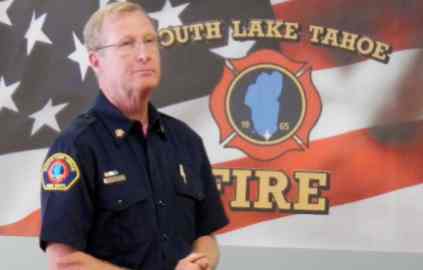
Jeff Meston is the fire chief for South Lake Tahoe.


Opinion: Clarifying the science behind Calif.’s water woes

By Andrew C. Revkin, New York Times

There’s no question that residents of California and much of the West face a collision between high water demands driven by growth and outdated policies and a limited and highly variable water supply.

But that reality hasn’t stopped heated arguments from springing up in recent days over the cause or causes of California’s continuing epic drought. Is one of the drivers the growing human influence on the climate? Or is this drought something we’ve seen before, the result of natural variability?

In the wake of an unusual public debate on this issue between President Obama’s science adviser, John Holdren, and Roger Pielke Jr., a longtime analyst of climate-related disaster losses at the University of Colorado, I received a helpful note from Martin Hoerling, who studies climate extremes for the National Oceanic and Atmospheric Administration.

Hoerling’s conclusions echo those of another longtime student of western drought, Richard Seager of Columbia University, as reported in Justin Gillis’s recent news report on the issue. “I’m pretty sure the severity of this thing is due to natural variability,” Seager told Gillis.

Read the whole story


Editorial: Northern Nevada doesn’t get it

Publisher’s note: This editorial is from the March 2, 2014, Las Vegas Sun.

For several years, Southern Nevada lawmakers have complained about how our region has been slighted by state government and the Legislature, pointing to how taxpayer money and state resources have habitually been diverted north. Those complaints have solicited little more than shrugs or blanket denials from lawmakers from the rest of the state.

But Northern Nevada officials now appear to be changing their tune, at least slightly. In a recent series of reports by KSNV Channel 3 that examined the disparity in higher education funding between North and South, officials from Northern Nevada, without exactly admitting the problem, said things had changed to make funding more fair. They blame the late state Sen. Bill Raggio, R-Reno, for any disparity.

Their message was as clear as it was stunning: If there was a problem, it has been fixed, and don’t blame us, blame Bill Raggio.

Seriously? Blame Raggio? Everything is fixed?

They still don’t get it.

Read the whole story


Editorial: State Parks scandal not all in the past

Publisher’s note: This editorial is from the Feb. 23, 2014, Sacramento Bee.

California State Parks has been under new leadership for more than a year, after the “hidden funds” scandal shredded its public standing.

Parks Forward, a commission established by the Legislature to make recommendations for an overhaul, will come out with a report in April.

With so much turmoil and turnover in the agency in the last few years, the question now is how long it will take to rebuild the department so that we have a California state parks system focused on public enjoyment and preservation of the state’s natural resources and history. Parks Forward already has pointed out that, even under new leadership, many financial problems remain. Financial information still is difficult to obtain, is not consistent across divisions and doesn’t match with the governor’s budget. Budget gimmickry continues, such as holding positions vacant and using the money to fund operations.

Read the whole story


Letter: Successful open house at humane society

To the community,

The Lake Tahoe Humane Society and SPCA thanks South Lake Tahoe for the great turn out at their open house and ribbon cutting on Feb. 25 in honor of World Spay Day. Lake Tahoe South Shore Chamber of Commerce was present to officiate the ribbon cutting and Mayor Hal Cole cut the ribbon. It was a great turn out and a good start in the Lake Tahoe Humane Society’s mission to let the community learn about all their fantastic services, such as spay and neuter vouchers, emergency pet medical care assistance and an emergency pet food bank.

Liz Maul, the Lake Tahoe Humane Society and SPCA education director, showed guests the incredible education programs provided, such as My Reading Buddy (every Wednesday at the South Lake Tahoe Brach of the El Dorado County Library at 4pm) and the new VSI program, which encourages kids to take an interest in science. Additionally, funds for future programs were raised thanks to raffle items donated by local businesses including Tahoe Best Friends, Best In Show Pet Groomers, Heavenly Valley and Tahoe Blue Vodka. This was a great start to what will be an exciting year for the Lake Tahoe Humane Society and SPCA.

Niki Congero, humane society


Letter: City playing games with parking question

To the community,

Is the City Council just silly? It appears so on the subject of parking meters. First, the council created a ballot resolution for the June election that if it passes, would for the most part kill the city’s parking meter program. The vote was 5-0. So the resolution will be on the ballot.

Bill Crawford

Bill Crawford

The on Feb. 27, the council voted to place on the ballot an argument that urges voters to vote no on the city’s ballot resolution. In other words, the City Council wants to keep its parking meters.

The end game is a tricky one. By acting as it did, the council passed the buck to the voters. And that is OK with me. Regardless of the fate of the city’s ballot measure, whether it’s voted up or down, the political calculation is the council will claim it supports the democratic process. Pretty slick game. A can’t lose game the council must think. But what has been the cost in time and money?

And if the city’s resolution passes, something the council doesn’t want, will the council see it as a vote of no confidence, rethink how to govern and stop playing silly games?

Bill Crawford, South Lake Tahoe