Opinion: Growing the economy is a necessity

By Nancy Kerry

On June 17, 2014, the City Council held a workshop regarding the city’s five-year financial forecast and the overall economic forecast for the local community. While the forecast has improved, we need to attract substantial capital investment over the next 10 years to grow the economy, meet the community’s needs and fund projects protecting the natural environment.

Like most state and local government agencies, the city’s revenues are dependent upon a thriving local economy and upon the housing market (property taxes) to fund essential public services. Additional services and capital investment require additional revenues. As a result of the Great Recession the city’s revenues dropped sharply in 2008. By 2010, the city’s five-year forecast projected $3 million deficit annually, which would have drained the city’s reserves within a few years and could have driven the city into bankruptcy.
Nancy Kerry

Nancy Kerry

It is July 2014 and that did not happen. The city is solvent, midway through its first balanced budget in more than five years and closed out last year with positive cash flow.

How did such a transformation in the city’s finances occur in a few short years? In 2010, the City Council changed its course and set sail to establish a local government living within its means. To reduce the majority of expenses, the city eliminated 30 percent of its workforce and focused on delivering quality core services to the community. Since 2011, the city has held the line on expenses to the best of its ability, with the exception of skyrocketing pension and health care costs. City employees agreed to changes in health care benefits and reductions in pay ranging from 7 to 9 percent.

Simultaneously, the City Council began heavily investing in streets, roads and infrastructure such as the Harrison Avenue project, local street improvements, Bijou stormwater project, Linear Park and more.

Although these capital investments create a strain on the city’s limited financial resources, the community investment is worth the risk. Locals and visitors alike expect the built environment to more closely mirror Tahoe’s world-class natural environment. Yet much of the built environment lags far behind the pristine natural beauty of Lake Tahoe.

The City Council’s decision in 2010 to change course by significantly reducing expenses while concurrently investing in capital was a risk worth taking. If those difficult decisions during very tough economic times had not been made, Harrison Avenue and other projects would not be under way today.

Capital investment makes a difference. We need $15 million in public and private capital investment for the next 10 to 15 years to construct the improvements necessary to grow the economy and protect the environment. At first thought, setting a goal of $150 million may seem unattainable. However, we are already 20 percent toward that goal in this year alone: Over $32 million in public and private capital is being invested in the community through the Harrison Avenue, the Bijou Project, and Chateau project. Another $5 million to $10 million in private projects are also under construction in the city.

Clearly, we can attract capital investment. What we need is to more adequately welcome and assist those who want to invest their capital in the community. Government must remove regulations impeding redevelopment of antiquated buildings to encourage modernization, which will benefit the environment and the economy. Growing the economy and protecting the environment are not exclusive goals, but there is a delicate balance. We cannot pursue economic development at the expense of the environment and we cannot protect the environment at the cost of suffocating the economy. When one fails, both fail. Government agencies are the primary funding source of environmental projects. In order to fund those projects, the economy must be thriving beyond the revenues needed for essential public services.

Working together we can develop solutions to welcome capital investment, which will raise the top line across all sectors. As revenues increase, investment in the community will provide long-term sustainability for the next generation. Lakeview Commons was originally just an idea advanced through strategic and visionary leadership. When combined with community engagement and capital investment, we now have a wonderful public facility enjoyed by all.

What’s next? How can we attract community investment and retain and support local businesses? Your voice is important to the discussion, as are the ideas of your friends, neighbors, and those from a generation behind you because it’s their future we are planning for and what we invest in, they will inherit.

Nancy Kerry is the city manager of South Lake Tahoe.


Opinion: Grand jury needs to learn meaning of investigation

By Larry Weitzman

Dysfunction is the key word within the title of the grand jury report published June 25 regarding the El Dorado County Charter. Most, if not all, grand juries are suppose to be fact finders, and although I didn’t examine the entire report to see if other areas of the report had fact finding or opinion, the dysfunction section discussed here was mostly opinion or statements with absolutely no factual basis.

This section of the report is supposed to be the basis for Terri Daly’s campaign to make her the führer of El Dorado County. Führer in German means guide or leader, but most people think of führer as a dictator, and not a benevolent one. The report reeks with Terri Daly’s smell and fingerprints as if she not only wrote the report, but also drafted the Charter changes recommended by the GJ and submitted to the Charter Review Committee. Why? Because the report is full of opinion and statements that have no factual basis, and because of the way the grand jury referred to the CAO within the report. Grand juries are supposed to be fact finders, not opinion writers or editorialists.

Larry Weitzman

Larry Weitzman

Within the six pages are claims for which there is no basis in fact; starting with the “proliferation” of elected officials in El Dorado County. Was that a malapropism or did the GJ not understand what the word “proliferation” means? It sounds like the GJ is trying to find an ant hill in the Himalayas. There hasn’t been any new elected office created in the county since the passing of the El Dorado County Charter in 1994. What proliferation is the GJ talking about, the rapid expansion in the last four years in budget and employees in the CAO’s office?

Then the GJ concludes there should be no elected officials in EDC except those required by California law (the sheriff, DA and the assessor). Their reasoning is that the county’s elected officers, the Board of Supervisors and/or its five members interfere in the administration of county business. Of course they don’t cite one example or fact as to what the interference is, how it occurs, when it happened and why and who did it. Nothing, zero, nada.

The GJ says the purpose of the BOS is to create and implement the vision for the future of EDC. What is the purpose of the General Plan? While Section 210 (a) (1) of the County Charter says the BOS shall adopt a statement of goals annually reflecting the quality and direction of the activities of county government, it is hardly a vision and the only purpose of the BOS.

I have news for the GJ, the ultimate county buck stops with the BOS. They share ultimate responsibility of the administration of EDC business and the BOS can change every two years and some BOS members will have different visions and ideas. It will be ever changing because of term limits and that “vision” creation is not even a part-time job, it is, to use the GJ’s word, “esoteric” baloney.

Here’s a county vision: Better, faster and more service and smoother, better roads all for less money. OK, what is a BOS member supposed to do for the next 8,759 hours left in the year?

As reported in the last Balancing Act, the BOS needs to be involved as Amador County is now saddled needlessly with a $20 million lease obligation because the BOS trusted and did not question sufficiently what the CAO, Terri Daly, snuck through at a BOS meeting via the consent calendar. Yes, it’s the same Terri Daly who is now entrusted with a budget seven times greater than the Amador County budget.

Here are examples of the GJ’s conclusions without a factual basis. The GJ states, “Recently the imbalance and potential for abuse of power by elected officials has been brought to the public’s attention following the County’s Workplace Climate Assessment Survey and ensuing significant criticism of the Auditor/Controller. Whether or not the criticisms directed at the Controller are true…” The GJ makes a conclusion while admitting they don’t know if it’s true or not. In fact, the Climate Assessment Survey said nothing of the auditor/controller and in fact gave the auditor/controller some of the highest marks in the survey, while giving the CAO’s office some of the lowest marks. But the GJ didn’t say a word about of the negative remarks or facts derived by the survey regarding CAO or assistant CAO. The grand jury obviously did not study the report. They were not interested in fact finding.

Want more? At the beginning of the very next paragraph the GJ allegedly wrote, “Although the GJ did not investigate the allegations made against the auditor/controller following the County’s Workplace Assessment, the GJ received substantial testimony from a number of witnesses….”

If they didn’t investigate the allegations against the auditor/controller, they obviously didn’t do a proper fact-finding and therefore shouldn’t say anything that isn’t backed by facts that they again obviously did not ascertain. This GJ report is strictly anecdotal and its recommendations should be disregarded. There is no factual basis for its conclusions. This grand jury report was nothing more than a continuation of a witch hunt, a witch hunt led by the witches themselves.

The GJ’s rant isn’t limited to certain elected officials, it also disses the electorate when it says “the electorate has no valid basis for evaluating the performance of officials performing the specialized and sometimes esoteric (now there is a word to show just how smart the GJ is) duties of these offices.” What, the CAO who wants to select these people herself is an expert? Yeah, sure. Our CAO has already shown herself to be untrustworthy with some of her appointments and a terrible businessperson. Ask Amador County.

As to the grand jury’s idea of a government that is a harmonious love fest, forgetaboutit. If you want a government without disagreement or dissent, try a dictatorship. Everyone is a yes man to the dictator or head of government. That is what makes the American government so different. It is created with checks and balances and competing ideas to most everything and you want that provided for in its structure, such as elected officials facing the voters every four years and that includes the BOS. One thing we don’t want is a runaway government and that’s what you will get with the grand jury’s baseless recommendations. What is surprising is that notwithstanding the Sacramento Bee’s very limited investigation and evaluation of the GJ “Dysfunction” report in its July 5 editorial, the Sac Bee agrees that it is not a good idea to “reduce democracy … for political expediency.”

Larry Weitzman is a resident of Rescue.


Editorial: Calif. needs to do more to save water

Publisher’s note: This editorial is from the July 9, 2014, New York Times.

California is in the third year of its worst drought in decades. But you wouldn’t know it by looking at how much water the state’s residents and businesses are using. According to a recent state survey, Californians cut the amount of water they used in the first five months of the year by just 5 percent, far short of the 20 percent reduction Gov. Jerry Brown called for in January. In some parts of the state, like the San Diego area, water use has actually increased from 2013.

Without much stronger conservation measures, the state, much of which is arid or semiarid, could face severe water shortages if the drought does not break next year. Los Angeles recently recorded its lowest rainfall for two consecutive years, and climate change will likely make drought a persistent condition, according to the National Climate Assessment report published in May.

Yet, even now, 70 percent of water districts have not imposed reasonable mandatory restrictions on watering lawns and keeping backyard pools filled. The State Water Resources Control Board is to consider placing restrictions on some outdoor water uses like washing paved surfaces at a meeting on July 15.

Read the whole story


Opinion: Shrinking middle class worth worrying about

By Robert Reich

A few weeks ago I was visited in my office by the chairman of one of the country’s biggest high-tech firms who wanted to talk about the causes and consequences of widening inequality and the shrinking middle class, and what to do about it.

I asked him why he was concerned. “Because the American middle class is the core of our customer base,” he said. “If they can’t afford our products in the years ahead, we’re in deep trouble.”

Robert Reich

Robert Reich

I’m hearing the same refrain from a growing number of business leaders.

They see an economic recovery that’s bypassing most Americans. Median hourly and weekly pay dropped over the past year, adjusted for inflation.

Since the depths of the Great Recession in 2009, median real household income has fallen 4.4 percent, according to an analysis by Sentier Research.

These business leaders know the U.S. economy can’t get out of first gear as long as wages are declining. And their own businesses can’t succeed over the long term without a buoyant and growing middle class.

They also recognize a second danger.

Job frustrations are fueling a backlash against trade and immigration. Any hope for immigration reform is now dead in Congress, and further trade-opening agreements are similarly moribund. Yet the economy would be even worse if America secedes into isolationism.

Lloyd Blankfein, CEO of Goldman Sachs, warned recently on “CBS This Morning” that income inequality is “destablilizing” the nation and is “responsible for the divisions in the country.” He went on to say that “too much of the GDP over the last generation has gone to too few of the people.”

Blankfein should know. He pulled in $23 million last year in salary and bonus, a 9.5 percent raise over the year before and his best payday since the Wall Street meltdown. This doesn’t make his point any less valid.

Several of business leaders are suggesting raising the minimum wage and increasing taxes on the wealthy.

Bill Gross, chairman of Pimco, the largest bond-trading firm in the world, said this week that America needs policies that bring labor and capital back into balance, including a higher minimum wage and higher taxes on the rich.

Gross has noted that developed economies function best when income inequality is minimal.

Several months ago Gross urged his wealthy investors, who benefit the most from a capital-gains tax rate substantially lower than the tax on ordinary income, to support higher taxes on capital gains. “The era of taxing ‘capital’ at lower rates than ‘labor’ should now end,” he stated.

Similar proposals have come from billionaires Warren Buffett and Stanley Druckenmiller, founder of Duquesne Capital Management and one of the top performing hedge fund managers of the past three decades. Buffett has suggested the wealthy pay a minimum tax of 30 percent of their incomes.

The response from the denizens of the right has been predictable: If these gentlemen want to pay more taxes, there’s nothing stopping them.

Which misses the point. These business leaders are arguing for changes in the rules of the game that would make the game fairer for everyone. They acknowledge it’s now dangerously rigged in the favor of people like them.

They know the only way to save capitalism is to make it work for the majority rather than a smaller and smaller minority at the top.

In this respect they resemble the handful of business leaders in the Gilded Age who spearheaded the progressive reforms enacted in the first decade of the twentieth century, or those who joined with Franklin D. Roosevelt to create Social Security, a minimum wage, and the 40-hour workweek during the Depression.

Unfortunately, the voices of these forward-thinking business leaders are being drowned out by backward-lobbying groups like the U.S. Chamber of Commerce that are organized to reflect the views of their lowest common denominator.

And by billionaires like Charles and David Koch, who harbor such deep-seated hatred for government they’re blind to the real dangers capitalism now faces.

Those dangers are a sinking middle class lacking the purchasing power to keep the economy going, and an American public losing faith that the current system will deliver for them and their kids.

America’s real business leaders understand unless or until the middle class regains its footing and its faith, capitalism remains vulnerable.

Robert Reich, chancellor’s professor of Public Policy at UC Berkeley and senior fellow at the Blum Center for Developing Economies, was cecretary of Labor in the Clinton administration.


Opinion: California no longer a youthful state

By Dan Walters, Sacramento Bee

From its inception – first as a Spanish colony, later as part of Mexico, briefly as an independent nation and finally as a state – California has been a youthful society.

Waves of young immigrants, drawn by its expansive opportunities to find fame and fortune, and periodic surges in its birth rate generated high population growth and kept California relatively young.

Dan Walters

Dan Walters

No more.

Immigration has slowed to a trickle, and with high outflow to other states and a rapidly declining birth rate, California’s once-vibrant population growth has slowed to a walk – just one-third the rate of the 1980s.

The corollary is that those once-young immigrants and their progeny of yesteryear are getting older. As they do, California is growing grayer – fast.

A Census Bureau report reveals that when the 2010 census was taken, California had 4.2 million residents age 65 or older, or 11.4 percent of its 37 million residents.

Read the whole story


Opinion: Caesars headed for the deep end

By Eli Segall, Las Vegas Sun

When drowning in debt, most people know they shouldn’t splurge on a new mansion, buy a high-end sports car or drool over a 150-foot yacht.

Caesars Entertainment Corp. didn’t learn that lesson.

The Las Vegas casino giant, weighed down by almost $24 billion in IOUs stemming from a 2008 buyout, is pushing ahead with major projects in the United States and Asia, despite soured finances and bondholders’ default claims.

Caesars is the parent company of Harrah’s Lake Tahoe and Harveys in Stateline.

The company plans to open the $442 million Horseshoe Casino Baltimore next month with partner Rock Gaming. In New York, executives submitted plans for an $880 million, 115-acre resort about 50 miles north of New York City. CEO Gary Loveman said Caesars wants to raise — and will have no trouble doing it ­— at least $5 billion to build a resort in Japan, where casino owners are salivating over the potential of legalized casino gaming. And in March, South Korea gave Caesars and its partners the green light to build a resort that reportedly will cost up to $2.2 billion.

Read the whole story


Letter: Another successful year at Camp Sunrise

To the community,

The Barton Health staff at Barton Hospice and the Barton Foundation would like to thank the many volunteers and sponsors that helped to make the seventh annual Camp Sunrise, a children’s bereavement camp, a success once again.

Camp Sunrise is a free camp offered to children ages 7 through 14 who have experienced the death of a family member or close loved one. This weekend camp provides grief education and support in a fun, safe and supportive environment on the grounds of Galilee Camp & Retreat Center.

Under the guidance of professional bereavement staff and volunteers, campers have the opportunity to meet with other children who have experienced similar losses and participate in activities involving art, music, and recreation. The children also attend daily support groups, enabling them to further explore their grief and work through any unresolved issues.

Teens and children are often forgotten mourners. And because they grieve very differently from adults, their needs are often overlooked. This is why Camp Sunrise is so important – we assist campers in developing healthy coping skills that will benefit them throughout their lives.

Camp staff wanted to express thanks to all of the volunteers and people who provided donations. Thank you to all of the volunteers, without you Camp would not be possible.

We would also like to thank the local groups, individuals, and businesses who contributed – Randi Arias-Losado, Divided Line Media/CJ Valera, Harrah’s and Harveys resorts, Kiwanis Club of Tahoe Sierra, Middlebrook Media, Niall McGuinness, Optimist Club of South Lake Tahoe, and Officer Jason Cheney and Tara with the South Lake Tahoe Police Department’s K-9 Unit.

Camp Sunrise is sponsored by Barton Hospice and the Barton Foundation. It takes place annually in June and all campers must apply to attend.

Rebecca Phillipsen and Tina Bruess


Opinion: Death to high school English

By Kim Brooks, Salon

Like so many depressive, creative, extremely lazy high-school students, I was saved by English class. I struggled with math and had no interest in sports. Science I found interesting, but it required studying. I attended a middling high school in central Virginia in the mid-’90s, so there were no lofty electives to stoke my artistic sensibility — no A.P. art history or African-American studies or language courses in Mandarin or Portuguese. I lived for English, for reading. I spent so much of my adolescence feeling different and awkward, and those first canonical books I read, those first discoveries of Joyce, of Keats, of Sylvia Plath and Fitzgerald, were a revelation. Without them, I probably would have turned to hard drugs, or worse, one of those Young Life chapters so popular with my peers.

So I won’t deny that I owe a debt to the traditional high-school English class, the class in which I first learned to read literature, to write about it and talk about it and recite it and love it. My English teachers were for the most part smart, thoughtful women who loved books and wanted to help other people learn to love them. Nothing, it seemed to me at the time, could make for a better class. Only now, a decade and a half later, after seven years of teaching college composition, have I started to consider the possibility that talking about classics might be a profound waste of time for the average high school student, the student who is college-bound but not particularly gifted in letters or inspired by the literary arts. I’ve begun to wonder if this typical high school English class, dividing its curriculum between standardized test preparation and the reading of canonical texts, might occupy a central place in the creation of a generation of college students who, simply put, cannot write.

For years now, teaching composition at state universities and liberal arts colleges and community colleges as well, I’ve puzzled over these high-school graduates and their shocking deficits. I’ve sat at my desk, a stack of their two-to-three-page papers before me, and felt overwhelmed to the point of physical paralysis by all the things they don’t know how to do when it comes to written communication in the English language, all the basic skills that surely they will need to master if they are to have a chance at succeeding in any post-secondary course of study.

advertisement

I’ve stared at the black markings on the page until my vision blurred, chronicling and triaging the maneuvers I will need to teach them in 14 short weeks: how to make sure their sentences contain a subject and a verb, how to organize their paragraphs around a main idea, how to write a working thesis statement or any kind of thesis statement at all. They don’t know how to outline or how to organize a paper before they begin. They don’t know how to edit or proofread it once they’ve finished. They plagiarize, often inadvertently, and I find myself, at least for a moment, relieved by these sentence- or paragraph-long reprieves from their migraine-inducing, quasi-incomprehensible prose.

Sometimes, in the midst of this grading, I cry. Not real tears, exactly — more a spontaneous, guttural sob, often loud and unpleasant enough to startle my husband or children. There’s just too damned much they need to learn in such a short period of time. It seems almost too late before we’ve begun.

Read the whole story


Opinion: Daly left Amador in financial chaos

By Larry Weitzman

El Dorado County’s chief administrative officer, Terri Daly, has a history. Before she came to El Dorado County, she was the CAO of Amador County from 2007 to 2010. Prior to that she was the assistant CAO of Amador County for about a year and a half. Before assuming that post she was originally hired by Amador County as director of In-Home Health Services.

In 2006, a lease was negotiated by the apparently inept director of Amador Health and Human Services because the department claimed they had outgrown the two buildings they were currently using (a combined 22,800 square feet) at a total cost of about $200,000 annually (75 cents a square foot per month). A “need” study completed in early 2004 showed that by 2023, because of a projected population growth of 15 percent, the county HHS would need about 44,000 square feet.

Larry Weitzman

Larry Weitzman

Using that study, the director of HHS went looking for new space and what she came up with was a build-to-suit structure that the county would lease. It would be 49,000 square feet at the exorbitant rental price of $2.43 a square foot (plus COLA) per month (more than three times the 75 cents the county was paying per square foot) totaling $1.43 million annually (seven times the prior rental rate). That $1.43 million is 2 percent of the total Amador County annual budget; 2 percent of the county budget on a rental property for one department in a county that employs about 400 people. And although you would think for that kind of money you would get the Taj Mahal, it was a simple single-story structure that was nothing special. In showing the plans and pictures to some builders, it shouldn’t have cost more than $8 million to $10 million to build.

The original lease signed in 2006 (it apparently took effect upon occupancy in December 2007) was for 15 years with three five-year options, and it had a walkout clause seven and half years into the lease (July 2015) where the county could terminate the lease with an additional one-time payment of $500,000. The walk out clause continued for a period of five years until 2020 when the county could cancel the lease without penalty. (Each successive year the termination fee decreased by $100,000. In 2016 the fee would be $400,000.)

Before this lease was signed the highest rental rate for suitable space was about half that amount and today it is that or less. Today the building is underutilized with less than 70 percent occupancy. No departments want to move in as their budgets are charged the abhorrent rate of $3.74 a square foot per month. It makes the EDC Logan building look like nickels and dimes.

It turns out the county never grew and in fact slightly declined in population. There is no need for the building. It’s a $1.5 million annual rental albatross around the neck of a county with a total budget of just $73 million a year. Two percent of the annual budget is spent on a space requirement that should cost at most $360,000 annually. Amador County could have with the difference nine more full time sheriff’s deputies or perhaps a dozen more health professionals. By contrast, the EDC budget is about $500,000,000 annually. Amador County’s population at the time of the initial lease was about 37,000 (including 4,000 involuntary residents at Mule Creek State Prison), which has fallen to about to about 36,000 today, not withstanding a small increase in the prison population.

It is a good thing, that is, it is almost a good thing (“almost” being the operative word) that Amador County is only a year away from the walk-out provision from being effective so it can get out of this albatross and not be stuck for another $10.7 million in rent (7½ years of rent) and step down to perhaps 25,000 to 30,000 square feet for about $360,000 a year which is the current going rate for the area.

But everything is not going to be OK.

Something happened on the way to the asylum. In 2008, Terri Daly was the Chief Administrative Officer of Amador County for about a year with a total of about 2½ years as the No. 1 and No. 2 person in the county. The CAO is where the buck stops with county business. And considering this probably is the single largest monthly expenditure of Amador County and its largest boondoggle, you would want to terminate it as quickly as possible.

While the Amador County Grand Jury report publish on June 25 didn’t name names, there are documents which I obtained from the current Amador County CAO a few weeks ago when I started investigating this debacle, including all lease documents, that have Daly’s signature and name all over them, especially for the renegotiated lease agreement done in March 2008. Yes, Amador County officials renegotiated the original lease taking a bad situation into an abysmal, unforgivable situation.

Renegotiating the lease did two very bad things for the county; first it extended the hard lease from 15 years to 20 years with no reduction in rent. Totally unnecessary as the county already had three five-year options. But second and much worse was the elimination of the walkout clause from the first lease. With the renegotiated lease the county is bound to a nearly $1.5 annual payment for an additional five years or about $7.15 million for a space the county could replace for about $360,000 annually. And what did the county receive as consideration for removing the walkout clause and a hard five-year lease extension — $400,000. Some may say the county was in a cash crunch and needed the money, maybe the CAO wasn’t running the county very well, but to trade $400,000 for another $7.1 million obligation is absolute insanity. But wait, there is more.

The grand jury assessed the “mistake” at $7.15 million, five additional years of rent at $119,070 (not counting the COLA) a month (60 x $119,070 = $7,144,200), but the grand jury failed to account for the elimination of the walkout clause which would have shortened the lease by an additional 7½ years, which adds up to an additional $10.7 million (90 x $119,070 = $10,716,300). The renegotiation actually cost Amador County more than $18 million, not the $7 million as the grand jury report said. While the HHS director may have had something to do with this, it is the chief administrative officer who is responsible to recommend it to the board, which she did. If Daly claims stupidity or she does an Obama “I didn’t know anything about it,” there is absolutely no excuse.

Board member Brian Oneto, who had just joined the board, said he tried to give direction to the CAO regarding the lease renegotiation and did not want the walkout provision eliminated but somehow the modification was done via the consent calendar and slipped through.

“What the modification was portrayed as is not what we were sold,” he said.

While $400,000 may seem like a lot, it is less than chicken feed when compared to locking yourself to an additional $18 million albatross you actually didn’t need. It was the worse deal ever done in Amador County. Daly turned a bad deal into a nightmare deal, a nightmare that will last another 13 years. Something smells fishy.

Recently Amador County tried to buy the structure for $8 million, which is the market value of the property. The lessor countered at $16 million, understanding that they will collect $20 million from the county over the next 13 years. Twenty million dollars at current interest rates works out to a present value of about $16 million. And whom does the county have to thank for this heinous monstrosity? That’s right, Daly, who is now in charge of a $500 million budget. And she wants the EDC Charter changed to obtain complete control for herself, including the elimination of the county’s most important check and balance, our elected county auditor. Daly wants the power to hire and fire all county officials. That would essentially give Daly complete control of El Dorado County. And we, the citizens, would have no direct say with anything to do with county business.

The county auditor-controller is probably the only person keeping us from an Amador County-like debacle. I wouldn’t trust Daly to reconcile my checkbook. The next time EDC hires a CAO (and I hope it happens soon) hopefully the candidate will have some proven business background, perhaps a degree in business or better yet, accounting. Running a county is a numbers game.

Larry Weitzman is a resident of Rescue.


Opinion: Wilderness Act faces midlife crisis

By Christopher Solomon, New York Times

You won’t hear it on your summer hike above the bird song and the soft applause of aspen leaves, but there’s a heresy echoing through America’s woods and wild places. It’s a debate about how we should think about, and treat, our wilderness in the 21st century, one with real implications for the nearly 110 million acres of wild lands that we’ve set aside across the United States.

Fifty years ago this September, Congress passed the Wilderness Act, which created a national system of wilderness areas. Wilderness has been called the “hard green line” for the act’s uncompromising language: Man will leave these places alone. As the law’s drafter and spiritual father, Howard Zahniser, put it, “we should be guardians, not gardeners.”

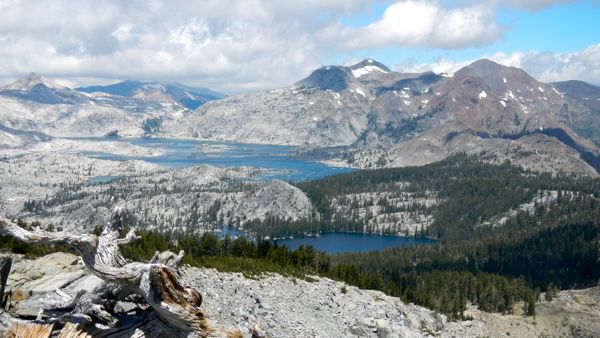
Views from Ralston Peak in Desolation Wilderness. Photo/LTN file

Views from Ralston Peak in Desolation Wilderness. Photo/LTN file

At 50, however, the Wilderness Act faces a midlife crisis.

We now know that, thanks to climate change, we’ve left no place unmolested and inadvertently put our fingerprints on even the most unpeopled corners of the planet. This reality has pushed respected scientists to advocate what many wilderness partisans past and present would consider blasphemy: We need to rethink the Wilderness Act. We need to toss out the “hands-off” philosophy that has guided our stewardship for 50 years. We must replace it with a more nuanced, flexible approach — including a willingness to put our hands on America’s wildest places more, not less, if we’re going to help them to adapt and thrive in the diminished future we’ve thrust upon them.

A great example is Joshua Tree National Park in Southern California, most of which lies within the 595,000-acre Joshua Tree Wilderness. Up to 90 percent of the park’s namesake trees could disappear by century’s end, according to models that factor in expected warming. Should we let that happen as nature’s atonement for our mistake? Or should park managers instead intervene in some way — relocating trees to higher elevations to promote their survival, for instance, or finding or creating a hybrid species that can withstand the hotter temperatures and combating exotic grasses that increase the threat of fires?

Such questions didn’t exist in 1964 when President Lyndon B. Johnson signed the Wilderness Act. Then, the nemesis of wilderness was America’s unchecked appetite — for land, roads, mines, timber — that gnawed away even at the boundaries of government-sanctioned “primitive areas.” Wilderness advocates craved permanence, in the form of legislation that took decision making away from capricious bureaucrats and political appointees.

Read the whole story