Opinion: The cost of paying attention

By Matthew B. Crawford, New York Times

A few years ago, in a supermarket, I swiped my bank card to pay for groceries. I watched the little screen, waiting for its prompts. During the intervals between swiping my card, confirming the amount and entering my PIN, I was shown advertisements. Clearly some genius had realized that a person in this situation is a captive audience.

Attention is a resource; a person has only so much of it. And yet we’ve auctioned off more and more of our public space to private commercial interests, with their constant demands on us to look at the products on display or simply absorb some bit of corporate messaging. Lately, our self-appointed disrupters have opened up a new frontier of capitalism, complete with its own frontier ethic: to boldly dig up and monetize every bit of private head space by appropriating our collective attention. In the process, we’ve sacrificed silence — the condition of not being addressed. And just as clean air makes it possible to breathe, silence makes it possible to think.

What if we saw attention in the same way that we saw air or water, as a valuable resource that we hold in common? Perhaps, if we could envision an “attentional commons,” then we could figure out how to protect it.

The sad state of this commons is on display everywhere; consider the experience of being in an airport. I have found I have to be careful when going through airport security, because the trays that you place your items in for X-ray screening are now papered with advertisements, and it’s very easy to miss a lipstick-size flash memory stick against a picture of fanned-out L’Oréal lipstick colors.

Read the whole story


Editorial: McDonald’s makes a healthy choice

Publisher’s note: This editorial is from the March 6, 2015, Washington Post.

When it comes to familiar icons, McDonald’s ranks high in symbolism around the nation and the world. McDonald’s is also the world’s largest restaurant chain. The company deserves praise for a decision just announced that cannot have been easy to take but is important: to curtail the use of antibiotics in chicken products sold in the United States.

Antibiotics, drugs that fight bacterial infections, came into widespread use after World War II and are now a mainstay of human health. They save lives and enable all kinds of medical advances. But at the same time that antibiotics became known as wonder drugs, bacteria gradually adapted and started to overcome the drugs, a phenomenon known as antibiotic resistance.

 For several decades, it didn’t seem to be a big problem because new antibiotics were being discovered. But now resistance is reaching crisis proportions and the pipeline of new discoveries has dwindled.

Read the whole story


Opinion: Be wary of the travel industry

By Christopher Elliott, Washington Post

It’s for your own good.

Travelers are hearing these words more often than ever, and they are being applied to increasingly unwelcome scenarios. The latest example: being unable to access WiFi in your hotel without incurring an added charge. In August, the American Hotel & Lodging Association and Marriott filed a petition with the Federal Communications Commission asking the government for permission to block wireless devices in hotels.

Marriott, you might recall, last year paid a $600,000 fine for allegedly interfering with its guests’ personal wireless hotspots at one of its large convention properties. The hotel chain argued that its having the authority to disrupt these connections would make customers less vulnerable to hackers and “unauthorized network access.”

In other words, the chain wants to jam your cellular hotspot for your own good.

The hotels fail to mention, of course, that they’d also earn a bundle by charging guests for access when they can’t use their own wireless devices to connect to the Internet.

Airlines, car rental companies and cruise lines are using similar rhetoric to push their own agendas. Customers have come to expect such obfuscation that some travel companies have built their business on opting for straight talk. But with a little digging, you can always unearth the truth and maybe keep your vacation budget in check.

Read the whole story


Opinion: Filipino community cooks at B&B

To the community,

The Filipino community is a very vibrant part of the St. Theresa Church parish and on March 2, in keeping with their involvement in the community, they were the Adopt A Day sponsor for the evening meal served by Bread & Broth. Using their excellent cooking skills, they prepared a tasty and filling Filipino cuisine dinner of pork and chicken adobo, chicken apritada, chicken chow mein, rice and steamed vegetables.

Helping to put on the great evening for the dinner guests were Cecilia DeLeon, Julie, Fajayon, Mila Seal, Ador Manalin, Nora Cabauero, Donna Rojas, Sally Dasalla, Beverly Delos Reyes and Myra Fajilan.

Speaking for her fellow crew members, Seal said, “It is a wonderful feeling for each and every one of us, members of the Filipino community, to be given this opportunity to serve and share our blessings and personal time with our less fortunate members of the South Lake Tahoe community. I would like to express our sincerest appreciation to the Bread & Broth program for allowing us to be a part of this community service. This is such an amazing and a very fulfilling experience.”

Bread & Broth would like to thank the Filipino community members for their AAD sponsorship and for the enthusiasm and joy they brought to the dinner event. Their smiles and warmth were an added treat to the unique meal and the help they lent to the B&B volunteers to provide another meal to those struggling with hunger.

Carol Gerard, Bread & Broth


Opinion: Feminism in the outdoors

By Jennifer Chambers, Women’s Adventure

Feminism, as defined by Webster dictionary, is “the theory of the political, economic and social equality of the sexes”. For two centuries, women and men have interpreted and debated this definition and many others within the social constructs of various cultures, whether it be women’s sameness to men or an interpretation of differences between the sexes with equal freedoms, choices and opportunities (Offen, 1988).

These definitions and the constructs with which they existed (and continue to) have given the word “feminist” and owning that word gave women a negative rap.

Many women of the baby boomer generation owned that word and wore it like a lapel pin. Gen Xer’s and millennial, however, have been more reserved about the feminist label because the fight has been fought and won and feminism has been construed as radical. Even though it is rare to hear a woman today call herself a feminist, women and men have publicly and privately continued the dialogue about equalizing the playing field between the sexes in the context of a wide range of issues.

While the outdoor recreation industry and its participants don’t use the word feminism to discuss equality in the outdoors, this issue is present in the minds of and discussed between people working and recreating in the outdoors. I posit though that feminism is not a radical word but an ideology that provides women and girls the freedom of choice and opportunity without social constructs.

Read the whole story


Letter: Questioning STPUD’s rate increase plan

To the community,

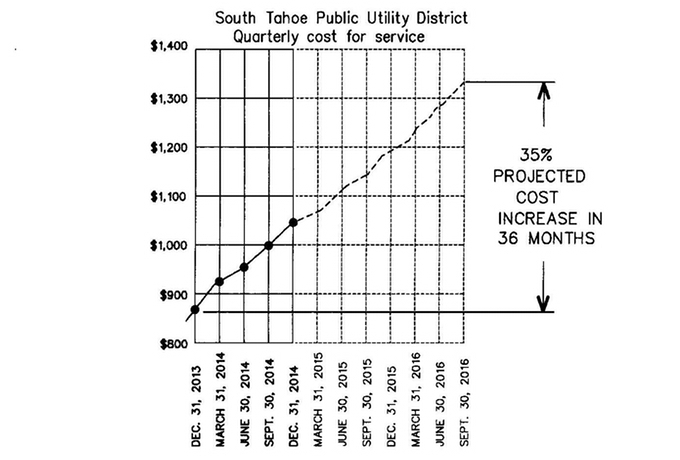
I was so moved by our public utility company’s recent 8½ inch x 11 inch glossy mailer expounding about what a terrific job they are doing that I thought I would share my opinion of their performance.

Regretfully, I do not share their vision or theory. They proudly pat themselves on the back stating that their cost for service as being lower than the cost for similar communities, which may be true, however, I expect that the other communities do not have a 30 percent vacancy rate as ours does. Many of our neighborhoods are filled with second homes that are empty most of the year and yet STPUD still collects real fees for those services, imaginary or not.

It is my opinion that our public utility company appears to be in a race to catch-up to those other communities. Below is a graph of my bill over the past six quarters illustrating a 36 month projected path should the trend continue.

allione graf

Comments welcome.

Mark Allione, South Lake Tahoe business owner


Opinion: We’re all becoming independent contractors

By Robert Reich

GM is worth around $60 billion, and has over 200,000 employees. Its front-line workers earn from $19 to $28.50 an hour, with benefits.

Uber is estimated to be worth some $40 billion, and has 850 employees. Uber also has over 163,000 drivers (as of December – the number is expected to double by June), who average $17 an hour in Los Angeles and Washington, D.C., and $23 an hour in San Francisco and New York.

Robert Reich

Robert Reich

But Uber doesn’t count these drivers as employees. Uber says they’re “independent contractors.”

What difference does it make?

For one thing, GM workers don’t have to pay for the machines they use. But Uber drivers pay for their cars – not just buying them but also their maintenance, insurance, gas, oil changes, tires, and cleaning. Subtract these costs and Uber drivers’ hourly pay drops considerably.

For another, GM’s employees get all the nation’s labor protections.

These include Social Security, a 40-hour workweek with time-and-a-half for overtime, worker health and safety, worker’s compensation if injured on the job, family and medical leave, minimum wage, pension protection, unemployment insurance, protection against racial or gender discrimination, and the right to bargain collectively.

Not to forget Obamacare’s mandate of employer-provided healthcare.

Uber workers don’t get any of these things. They’re outside the labor laws.

Uber workers aren’t alone. There are millions like just them, also outside the labor laws — and their ranks are growing. Most aren’t even part of the new Uberized “sharing” economy.

They’re franchisees, consultants, and free lancers.

They’re also construction workers, restaurant workers, truck drivers, office technicians, even workers in hair salons.

What they all have in common is they’re not considered “employees” of the companies they work for. They’re “independent contractors” – which puts all of them outside the labor laws, too.

The rise of “independent contractors” Is the most significant legal trend in the American workforce – contributing directly to low pay, irregular hours, and job insecurity.

What makes them “independent contractors” is the mainly that the companies they work for say they are. So those companies don’t have to pick up the costs of having full-time employees.

But are they really “independent”? Companies can manipulate their hours and expenses to make them seem so.

It’s become a race to the bottom. Once one business cuts costs by making its workers “independent contractors,” every other business in that industry has to do the same – or face shrinking profits and a dwindling share of the market

Some workers prefer to be independent contractors because that way they get paid in cash. Or they like deciding what hours they’ll work.

Mostly, though, they take these jobs because they can’t find better ones. And as the race to the bottom accelerates, they have fewer and fewer alternatives.

Fortunately, there are laws against this. Unfortunately, the laws are way too vague and not well-enforced.

For example, FedEx calls its drivers independent contractors.

Yet FedEx requires them to pay for the FedEx-branded trucks they drive, as well as the FedEx uniforms they wear, and FedEx scanners they use – along with insurance, fuel, tires, oil changes, meals on the road, maintenance, and workers compensation insurance. If they get sick or need a vacation, they have to hire their own replacements. They’re even required to groom themselves according to FedEx standards.

FedEx doesn’t tell its drivers what hours to work, but it tells them what packages to deliver and organizes their workloads to ensure they work between 9.5 and 11 hours every working day.

If this isn’t “employment,” I don’t know what the word means.

In 2005, thousands of FedEx drivers in California sued the company, alleging they were in fact employees and that FedEx owed them the money they shelled out, as well as wages for all the overtime work they put in.

Last summer, a federal appeals court agreed, finding that under California law – which looks at whether a company “controls” how a job is done along with a variety of other criteria to determine the real employment relationship – the FedEx drivers were indeed employees, not independent contractors.

Does that mean Uber drivers in California are also “employees”? That case is being considered right now.

What about FedEx drivers and Uber drivers in other states? Other truck drivers? Construction workers? Hair salon workers? The list goes on.

The law is still up in the air. Which means the race to the bottom is still on.

It’s absurd to wait for the courts to decide all this case-by-case. We need a simpler test for determining who’s an employer and employee.

I suggest this one: Any corporation that accounts for at least 80 percent or more of the pay someone gets, or receives from that worker at least 20 percent of his or her earnings, should be presumed to be that person’s “employer.”

Congress doesn’t have to pass a new law to make this the test of employment. Federal agencies such as the Labor Department and the IRS have the power to do this on their own, through their rule making authority.

They should do so. Now.

Robert Reich, chancellor’s professor of Public Policy at UC Berkeley and senior fellow at the Blum Center for Developing Economies, was secretary of Labor in the Clinton administration.



Opinion: Preparing for the inevitable wildfire

By Chris Anthony

With the looming expectation of another year of drought, our communities face another challenging year of wildfire threat.

January finished as one of the driest Januaries on record, and while the recent storms were welcomed, they did little to increase snowpack throughout the state. As a result, fire agencies are preparing for another long fire season.

“The drought has set the stage for another busy fire season,” said Michael Brown, fire chief for North Lake Tahoe Fire Protection District. “All the federal, state and local fire agencies are working together to protect the people, property and unique natural resources within the Lake Tahoe Basin.”

In 2014, there were over 1,000 more wildfires in California than the previous year. In fact, fire season never really ended.

The fuels that burn in wildfires, such as grass, brush and trees, remained extremely dry and susceptible to ignition all year. This year is looking to be no different. As an example, the Round Fire, which started on Feb. 6 just north of the town of Bishop, quickly consumed 7,000 acres and destroyed 40 structures.

“A fire of this significance in the month of February should raise our awareness and lead to positive actions to prepare our communities for fire,” said Tim Alameda, fire chief for Meeks Bay Fire Protection District.

Depending on where we live in the United States, natural destructive forces abound, whether they are hurricanes, tornados, earthquakes, floods or fire. It is certainly no secret that we live in an environment where large damaging and costly wildfires occur on a routine basis. While the odds may not seem to be in our favor, our communities can adapt to the threat of wildfire and we can diminish the risks to our livelihood.

“A fire adapted community is one in which the community places a high priority on the common vulnerability to destruction by wildfire,” said Elwood Miller of the University of Nevada Cooperative Extension. “The adapted community is one that includes the perspective of wildfire threat, and the high probability of serious loss, as a routine way of viewing and characterizing the community. As a result we change our behavior and implement measures to mitigate the threat.”

“We can’t do this alone,” said Fire Chief Michael Schwartz of the North Tahoe Fire Protection District. “Motivated residents who work with their neighbors and local fire department to prepare their communities for fire is the key to a successful outcome when wildfire strikes.”

A fire adapted community can survive a wildfire with little or no assistance from firefighters. These communities are characterized by homes that are modified to reduce the chance of ignition and where vegetation and flammable items have been reduced around a home to provide good defensible space. A fire adapted community is buffered by fuel breaks where flammable vegetation has been modified to slow the spread of flames and provide a zone where firefighters can aggressively fight a fire.

“When wildfire comes, fire adapted communities reduce the potential for loss of human life and injury, minimize damage to homes and infrastructure and reduce firefighting costs,” added Miller. “For more information on Fire Adapted Communities, I encourage everyone visit our website.”

Chris Anthony is a division chief with CalFire. He is writing on behalf of the Tahoe Fire & Fuels Team.


Opinion: Research shows white privilege is real

By Ian Ayres, New York Times

The recent reunion show for the 40th anniversary of “Saturday Night Live” re-aired a portion of Eddie Murphy’s 1984 classic “White Like Me” skit, in which he disguised himself to appear Caucasian and quickly learned that “when white people are alone, they give things to each other for free.”

The joke still has relevance. A field experiment about who gets free bus rides in Brisbane, a city on the eastern coast of Australia, shows that even today, whites get special privileges, particularly when other people aren’t around to notice.

As they describe in two working papers, Redzo Mujcic and Paul Frijters, economists at the University of Queensland, trained and assigned 29 young adult testers (from both genders and different ethnic groups) to board public buses in Brisbane and insert an empty fare card into the bus scanner. After the scanner made a loud sound informing the driver that the card did not have enough value, the testers said, “I do not have any money, but I need to get to” a station about 1.2 miles away. (The station varied according to where the testers boarded.)

With more than 1,500 observations, the study uncovered substantial, statistically significant race discrimination. Bus drivers were twice as willing to let white testers ride free as black testers (72 percent versus 36 percent of the time). Bus drivers showed some relative favoritism toward testers who shared their own race, but even black drivers still favored white testers over black testers (allowing free rides 83 percent versus 68 percent of the time).

Read the whole story


Letter: Heavenly workers help at B&B

To the community,

Attending her first Bread & Broth dinner, Mary Cooper, a supervisor of guest services at Heavenly Mountain Resort, was very moved by her volunteering experience.

“Really enjoyed being a part of something that benefits those in our community,” she said. “It was actually fun and the volunteers are great. Really looking forward to the next time.”

On Feb. 23, Heavenly Mountain Resort was the Adopt A Day of Nourishment sponsor for B&B’s evening dinner at St. Theresa Church Grace Hall.

Fellow Heavenly associates helping Cooper serve the evening’s 112 guests were Jolena Hearn, assistant manager, guest services; Kelly Carmichael, product sales and service manager; Chris Barbar, assistant manager scanning; and Paul Hopkins, product sales and service, director.

As a nonprofit, all volunteer organization, B&B appreciates Vail’s EpicPromise grant program that funds a monthly B&B meal and guarantees that a great sponsor crew from the ranks of Heavenly employees will be volunteering alongside B&B volunteers to serve the hungry of the community.

“It is a great feeling to know that I am a part of a community that gives to others in need,” said Chris Barbar.

B&B is very grateful for and welcomes the support we receive from the Heavenly Mountain Resort community.

To help B&B as a donor or sponsor, contact me at 530.542-2876 or carolsgerard@aol.com.

Carol Gerard, Bread & Broth