Letter: Public wreaks havoc in Alpine County

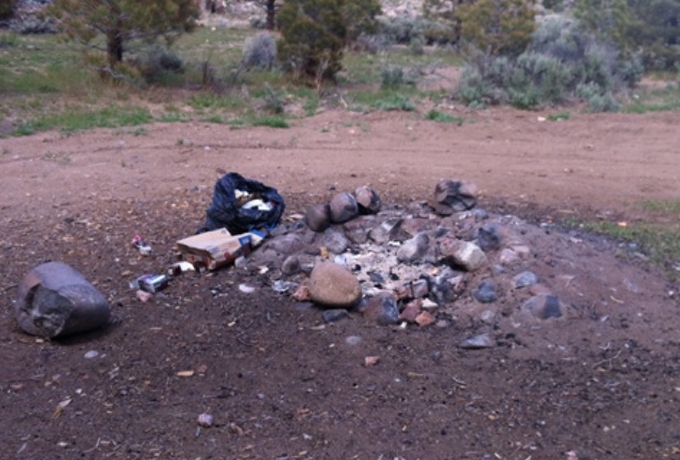
Some of the trash found in Alpine County. Photo/Provided

Some of the trash found in Alpine County. Photo/Provided

To the community,

So sad to have to contact you all under these circumstances, but I felt it important to share with you my most recent experience in Alpine County. On Mother’s Day, we rode our horses into the Carson River Hot Springs from the north on a little used trail as we have done for almost 20 years. Used by hikers, mountain bikes and horses for many years this area is closed to motor vehicle use, but unfortunately vehicles have begun to push from this direction, widening the trail and damaging vegetation. This was only the warm up to what we would find at Markleeville’s big attraction on the Carson River.

The pictures I took speak for themselves, but everybody at the local, state and federal level should be embarrassed by the level of resource destruction, trash and filth that has been visited upon this beautiful place. Live trees are being hacked to pieces for firewood, great piles of trash and broken glass are everywhere, and shooters have left thousands of spent shells littering the ground. Worse, the trash and tire tracks are now beginning to climb the once pristine northern slopes of the canyon, with broken glass and spent casing littering the hillside. We have many more photos and video if you are interested in seeing the extent of the damage. Better yet, drive there and see firsthand what people are capable of.

It is out hope that someone, one or more of you, will make it their mission to restore and protect this special place. Clearly, the unfettered access by thousands of off road users is not working. While most are probably responsible, those who are not need to held accountable. Not only does this precious resource need to be cleaned up, but  also protected for generations to come.

Respectfully submitted,

Bob and Tita Anderson, South Lake Tahoe


Opinion: Promoting positive mental health

By Betsy Glass

According to California’s Mental Health Movement and the Centers for Disease Control, half of us will experience a mental health concern in our lifetime.

It is important to learn how to cope with these challenges. Wellness can be achieved when we implement activities to improve our mental and physical health. When we intentionally plant wellness seeds and nurture them with ingredients outlined below, our wellness and quality of life blossom.

Betsy Glass

Betsy Glass

Mood boosting strategies every person should try:

·         Practice relaxation skills. Try progressive muscle relaxation, focused breathing, guided imagery, or meditation. Take a break each day from activities and people, and focus on yourself and what makes you happy.

·         Socialize. Call a friend or family member, join a group or organization, volunteer, or offer a random act of kindness.

·         Strive for growth. Follow your heart, and try activities or choose occupations which use your strengths and express your passions.

·         Develop a balanced diet of foods which balance brain chemicals responsible for mood regulation, such as foods high in omega-3, vitamin B12, magnesium, vitamin D, and folic acid, including proteins, vegetables, fruits, and whole grains.

·         Try something new and creative. Pick up a hobby, take a class, or explore a new area. Studies show changing your routine can boost your mood.

·         Exercise regularly, particularly with others. Join a gym, community center, or gather friends and family for aerobics, walks, yoga, biking, or other activities.

·         Practice gratitude. Identify something you’re grateful for each day. Demonstrate appreciation towards yourself, others, and for what you have. This improves physical and mental wellness.

·         Aim for at least seven to eight hours of sleep. Develop an evening routine an hour before laying down. Reduce caffeine intake throughout the day, go to bed and wake up the same time each day, and avoid television or other visual electronics.

·         Recognize when you evaluate yourself and others. Remember everything is as it should be and everything is as it is.

·         Do one thing at a time with your undivided attention. Practice letting go of distraction, whether they are thoughts, feelings, or actions. Recognize the distraction without judging it and return to the task at hand.

·         Surround yourself with nature. Place plants or flowers in your home or office, garden, hike, sightsee, or find a quiet place to sit outdoors while soaking in the sun.

Wellness screenings are effective for prevention and intervention. If you are concerned about your wellness for more than a few weeks and find it difficult to complete everyday tasks, consult your primary care provider to discuss treatment options.

If you or someone you know has thoughts of harming themselves or another person or has a sudden and unexplained change in mood or behavior, immediately call a national or local crisis hotline at 800.273.8255 or 800.929.1955, visit Barton Hospital’s Emergency Department, or call 911 and request a “welfare check.”

Betsy Glass provides counseling and social work services at Barton Community Health Center.


Letter: A successful Mom’s Morning Out

To the community,

The Barton Health public relations department enjoyed hosting the fourth annual Mom’s Morning Out on May 2. Thank you to all the women who attended and to our business vendors and Zen room specialists for making the event a success.

The Studio Lake Tahoe and Jazzercise kicked off the event with free morning exercise classes. Attendees then signed up for a complimentary pampering session. A special thank you to the pampering businesses who spent the morning in the Zen room providing complimentary services to the women who attended: Bliss Skincare and Salon, Naccarato Chiropractic, One World Healing Massage, Supported by Angels, Tahoe Health Touch, Tahoe Massage Company, and Transformations Hypnotherapy.

Other businesses that attended with informative and inspiration booths for women were: Arbonne International, BeautiControl, Cloud Nine Childbirth Services, CONNECT Community Education, doTERRA Essential Oils, Patricia Ferraro, Elevate Wellness Center, Elevated Fitness, Jamba Juice, Lake Tahoe Yoga, Mountain Meadow Chiropractic, South Lake Tahoe CDC, South Lake Tahoe Library, Tahoe Best Friends, Tot to Tot Clothing, Barton Women’s Health, Barton Community Health Center, Barton Family Birthing Center, Barton Nutrition, and Barton Rehabilitation.

A special kudos to our partners, Lake Tahoe Community College, Tahoe Daily Tribune, and Barton Women’s Health, for sponsoring the event.  Thank you also to the auxiliary members for volunteering their time and service to help the event run smoothly. We appreciate the local participation and look forward to seeing you at Mom’s Morning Out in 2016.

Sue McLaughlin and Leanne Wagoner, Barton Health public relations


Letter: EDC supes, CAO not dealing with budget

To the community,

On Sept. 30, 2014, the [El Dorado County] Ad Hoc Budget Committee was formed to address a serious budget shortfall of about $18 million. The committee had two open volunteer positions from outside the government. In the hope of learning how the system works, I applied and was accepted as a committee member. The first meeting was in December. Joe Harn outlined the seriousness of the task and Larry Weitzman offered the most likely solution. Chief Administrative Officer (CAO) Pamela Knorr directed the meetings and she and Laura Schwartz gave a capsule look at the budget process.

The next meeting Pamela and [Supervisor] Brian Veerkamp directed the group into first developing an “Eldorado County Budget Policies” paper. This took four months (four meetings).  No attempt was made with this committee to determine what cuts needed to be made to get to a balanced budget, in spite of the concerns of Joe and Larry.

At the recent Board of Supervisors (BOS) meeting on April 28 [Supervisor] Ron Mikulaco expressed concern that the Ad Hoc Budget Committee did not get to the cuts necessary to balance the budget that he thought was its expressed purpose. I, too, thought the purpose of the committee was to deal with the problem, but unfortunately I did not fully understand how the process works and had even less control of county activities.

The CAO working with staff appears to dictate what the budget will be. Per the CAO, the elected BOS only deals with policy issues, not the specific issues that deal with the budget crisis.  Pamela made it clear on the April 28 review that she has the duty to recommend an annual budget. The one proposed is $10 million short and reduces some senior programs that no supervisors want cut. On top of that she basically said to the BOS, stay out of my sand box.  She will present a budget on June 30, which we already know will carry the deficit over until the 2016-17 budget and beyond. [Supervisor] Shiva Frentzen is not happy with the lack of cooperation.

It appears to me that the tough decisions are being postponed by endless studies. Since Pamela is not making the tough calls, I would hope that the BOS could step in and meet with the department heads directly and solve the problem. Pamela quickly squelched that idea by quoting policy 304C that gives the CAO the power to develop the budget, plus she stated that she does not want to be bothered by the Ad Hoc Committee in this process. On that point I agree, if we cannot deal with the budget issues, then the committee is not serving the purpose I believe it was created for.

Policy 304 also states that the “CAO shall be responsible to the BOS for the proper and efficient administration of such of the affairs of the county”…  Proper and efficient is not a $10 million deficit.  Perhaps the CAO should be reminded that her position is temporary, and not balancing the budget has consequences.

[Supervisors] Mike Ranalli and Sue Novasel recommended “patience”. Joe Harn, our auditor–controller, is predicting dire consequences from the lack of action on cutting spending. Who do you believe? We need more than two supervisors, willing to take charge of the county.

Paul Freeman, Cameron Park


Opinion: Is Tahoe a glass half full?

By Garry Bowen

Consolidating what seems to be a frenetic effort to actually define South Lake Tahoe, especially in the last few months, for this article we’ll start with Feb. 21, when South Tahoe officials strategized about a future (not the future as originally titled).

As moderator, Ted Gaebler (co-author of “Reinventing Government”, 1992), asked them each to offer an unalloyed expression of a vision, and, as subsequent meetings like the very recent tourism forum tried to do the same, twice now, with Park City presentations (the first was last summer at a leadership forum at MontBleu), an appropriate vision would seem to be rather cloudy or opaque, at best, as our best minds need a most-needed added focus to bring any vision to fruition. The best will be their own persuasion.

Garry Bowen

Garry Bowen

To that end, I remain entranced with yet another book title: Joan Baez’s brother-in-law Richard Farina wrote a book called “I’ve Been Down So Long, It Looks like Up to Me”, which is why I used the word frenetic above, as someone still thinks of Tahoe as in the doldrums, needing a significant boost so as to be able to look up.

In spite of one leader’s earlier idea that “South Shore is poised for growth”, this was somewhat fortified by City Manager Nancy Kerry’s comment at the strategy session that, “South Shore is starting to take hold”, although the question of what exactly its taking hold of mirrors Lake Tahoe News’ report — “barely touched upon was how to turn the ideas into reality”, tabled, as a lot of things are, for yet another “(budget) meeting in April”.

The running theme from that and the one just concluded is a lack of vision as Kerry stated in February, “Until we know who we are, we won’t know why we are doing it” and there is “no shared agreement of who we are”. This ironically coincides with the message that Park City emphasized (perhaps led by forum organizers as subject matter), also fortified by yet another forum, that of Tahoe Regional Young Professionals, as Jamie Orr and Scott Fair on that panel said that Tahoe “needs to decide”, respectively, “what it wants to be when it grows up” and “what it wants to look like”. So, what’s been envisioned so far?

We are in the ramp-up to South Lake Tahoe’s 50th birthday. In 1965, the slogan was “America’s All-Year Playground”, eerily reminiscent of the current vision proffered. The major difference is in the corporate leadership we continue to rely on, as they went decidedly covetous of their customer base over the years, not really understanding Tahoe’s real attractions, for the sake of job and bottom-line profit protection.

Harrah’s, for example, gained prominence by what real estate still knows as “location, location, location” – being the first place encountered as the state line was crossed, they placed a very-wide parking entry there, the better to welcome those coming to patronize. The mistake was in making that subservient to hotel interests (on both sides), shifting significant cash flows away from their own business model.

Today’s re-emphasis on recreation is partly due to not understanding how it worked back-in-the-day. If someone no longer wanted to “play” at the casino corridor, they could very quickly redeem their car and be on their way to whatever other Tahoe attraction beckoned, as there was almost immediately five or six cars entering to take their place to everyone’s benefit, resident and visitor alike with a much higher experiential value.

Also misunderstood was Harrah’s commitment to its visiting clientele (comprising the now-decimated lodging community), as the South Shore room bookings were designed to “make hay while the sun shines” (i.e., the reason the best-known entertainers were always three weeks in July), thereby filling most of the motels in town for the entire summer, not being able to trust the other seasons to build the numbers up, or not to be able to adequately access the South Shore due to Echo closures, etc. That was their strategy – the roads may be closed or be inaccessible; family school years that shifted, etc., but business went on, at least partially by a Harrah’s-Greyhound bus system I had a hand in organizing – as shift work demanded customers, if full employment were to be: food-on-the-table, clothes-to-buy, etc.

As corporate ownership came about (remember, Harvey Gross and Bill Harrah were entrepreneurial), bottom-line issues became higher concerns, corporate leaders in their brilliance ended up “exporting” gaming everywhere, which also ended up being a cause celebre for ill-managed civic and tribal municipalities to satisfy beyond their means. This of course was at the expense of a place like South Shore, absent other business vitality, but where it all began.

Lake Tahoe South Shore Chamber of Commerce Executive Director B Gorman has stated that this decline was in 1997, but it actually started with the above-mentioned shift (late 1970s and on), as the momentum was great enough to not have anyone notice any abrupt change, therefore not making needed adjustments, until the lodging industry kept turning over and over as earlier expectations of buying one were not met.

That turnover included a continual rotating cast change so it became difficult to conjure up a vision, absent knowing what the issues really are from a historical perspective, one that I’m intimately familiar with. For example, the shift in Harrah’s ownership from a five-star hotel sold to an essentially very large motel company shifted the service aspects to the detrimental side, as some entering are not checking in at a hotel, so parking valets didn’t ordinarily have to cater to those with luggage, to be staying in the limited number of rooms. More of a major shift than is noticed by the average person.

There are other examples of strategic missteps, in wait.

In the current day, Lake Tahoe generally, and South Shore especially, doesn’t have the perspective necessary to create a vision, as they watch the casino industry stumble around. Now even winter weather doesn’t cooperate as yet another changing cast of ownership keeps trying to find its way back to “year-round”.

It is said that the word “obvious” is actually a conundrum, as what is obvious to one is not to another – that’s why communication is needed, and in South Shore’s case, a historical perspective to “right-the-ship”, in putting the “wind back-in-the-sails” is navigating in a language of the future, if we truly want one.

Vision has the connotation of a long-view, which itself might seem obvious, but the last few decades here have been definitively short-sighted, absent any real marketing message eliciting Lake Tahoe’s timeless qualities, with more of a “slot promotional” approach due to its need to cover itself in mostly a “short-term” manner. This contributes to the churning feeling of anxiety in the middle of humanity’s impending need for more serenity and space, not less – that a place like Tahoe can provide if done well.

There are ways to share Tahoe naturally that are not explored, but can result in its reviving a global cachet – what is natural beauty, if not for its ultimate attraction, from however far away on the planet.

Now, the city hopes to engage the public (yet again), but in my own experience, unless they firmly have in mind really listening (being able to both discern, then act on), any learning will follow an already outlying response pattern: “that’ll never happen here”. And its professional’ version, exemplified by a vivid reminder when a city department head was called to answer a question by the City Council, the response was in the same mode as “not happening here” and “our consultant came up with a number of ideas, but our decision was that our people were not ready for that”.

Why then the need to consult if the consultation is rendered moot via existing biases as inadequate?

The same question concerns the engagement of the citizens – and my counsel in past candidacies – the key to success is both “trust and transparency”, and an adequate perspective with which to judge, now still in short supply.

From my long-term perspective, consider this my “speak up”, as inaugural to another 50 years or more.

Depending on queries and response here, a next installment might be: A glass half-empty.

Garry Bowen has more than a 50-year connection to the South Shore, with an immediate past devoted to global sustainability, on most of its current fronts: green building, energy and water efficiencies, and public health. He may be reached at tahoefuture@gmail.com or 775.690.6900.
Letter: Questioning parking lot at Kirkwood

Publisher’s note: This letter is addressed to Julie Saylor with El Dorado County and was sent to Lake Tahoe News.

Dear Julie,

I request that my comments be read, and made available, during the TC-TAC [Tri-County Technical Advisory Committe] meeting (Item G.1) on May 8, 2015.

To Whom It May Concern:

I have owned a home, and adjacent lot, on Dangberg Drive in Kirkwood since 1987 and am very opposed to the large parking lot being proposed. I am co-founder of the Friends of Kirkwood Association and spent several years, working more than full time, on the Kirkwood Specific Plan and the Mountain Master Development Plan (MMDP) for the Kirkwood Ski Resort. During this time, I attended countless public
meetings and became well versed in the public planning process, CEQA and the environmental review process for federal lands. Friends of Kirkwood Association has hundreds of members who support thoughtful development and preservation of Kirkwoods’ natural environment. I am concerned, and I am certain that hundreds of other Kirkwood “regulars,” are concerned about several aspects of this
significant proposal, which would create long term, irreversible, negative impacts to the Kirkwood area.

Simply put, there is no good reason to allow a parking lot on the School Site. “Saving” (i.e. not cutting down) the large trees would still allow the area to effectively become solid pavement. Please let’s not destroy the incomparable beauty of Kirkwood by believing the statement, set forth by the project proponent, that trees will be “saved.”

The current plan for development in Kirkwood should be followed. This Specific Plan was put into place by the county Boards of Supervisors for the Kirkwood area after several public meetings seeking public input, hundreds of thoughtful letters from the public, a few rounds of CEQA reports, and dozens of other meetings. This occurred during a several year period.

The Kirkwood Specific Plan, if I correctly remember, specifically states that the School Site is to remain
undisturbed if not used as a school. Further, the Kirkwood Specific Plan calls for multi-level parking
structures on existing parking lots. Therefore, this type of structure should be built before allowing a new
parking lot to sprawl out onto a relatively undisturbed natural area.

Please remember that the CEQA review for Kirkwood involved several parking and traffic studies — and that various parking options were considered. Many other environmental impacts were considered and reviewed
including, but not limited to: water quality run-off from paved/developed areas, air quality, visual impacts to public lands, among many others.

The truth is that we (the public) were promised by the Kirkwood developer/ski resort that parking would be
sufficient, when we raised traffic and parking concerns during the public planning process, about building
multi-family units on the then-existing Timber Creek parking lot. The Kirkwood ski resort (“Project Proponent”) assured us there would be enough parking and that traffic problems would be limited to a very few ski days.  However, now that the project proponent has made profits (millions?) by selling the Timber Creek parking lot for development, it is asking to re-zone a couple acres to effectivlely replace the Timber Creek parking lot.

Instead, the Kirkwood Specific Plan should be followed and the profits made by selling the Timber Creek parking lot should be used, if truly needed, to build multi-level parking in existing parking lots. The public should not have to pay for this by enduring diminished environmental quality at Kirkwood.

Further, the need for additional parking should be firmly demonstrated by the Project Proponent, before *any* additional parking is approved, considering the well-known and documented down turn in skiers days, likely caused in part by record low snowfall the past several winters.

The piecemeal approach to planning is strictly forbidden by CEQA. Approving a zoning change for the School Site would definitely constitute such an approach. Let’s not start down that path.

If additional parking is truly needed: it should be accomplished by multi-level parking, thoughtfully done. More not-well-thought-out construction and “improvements” should not be allowed. Let’s not allow, as the popular folk song by Joni Mitchell goes, “They paved over paradise, put up a parking lot!”

Sincerely,

Reid D. Bennett, president Friends of Kirkwood Association


Opinion: Locals Taking Action — Lighting the way

By Rebecca Bryson 

This column highlights examples of locals making positive change in our community and steps – large or small — that all of us can take to make Tahoe a better place.

The latest in a series of actions to improve our schools’ sustainability occurred quickly and quietly over spring break. Several months prior, the Lake Tahoe Environmental Magnet School PTA was pondering how to spend some extra year-end money. They proposed funding a LED lighting retrofit that would not only be good for the environment, but also save money for the school district and, ultimately, taxpayers.

lt sustainability logoThe PTA contributed $12,121 to replace the existing fluorescent tube lighting in every classroom with super efficient LED lights. The school decided to focus on classrooms first because the LEDs offer a better quality light and none of the visible flickering that can be associated with increased behavioral issues. Lake Tahoe Unified School District will also receive a rebate from Liberty Utilities, which will go toward installing LEDs in the remaining halls and cafeteria area.

Through this project, 870 15-watt tubes were installed, replacing the older 32-watt fluorescent tubes. It was no small feat to get a project of this scale and size completed during the school year without disrupting students. In early spring, district Facilities Manager Steve Morales and Principal Joel Dameral met with Liberty Utilities to assess the options. The Facilities Department then researched current technologies — consulting with various utility and manufacturer representatives, chose several products to test pilot, negotiated the pricing for the selected product, and mapped out a strategy for installing all tubes during spring break and replacing some older ballasts where necessary.

However, the selected tubes only arrived the Thursday before spring break started. School district staff then worked tirelessly over the break and even during their weekends to install all 870 lights before classes started again. The team was led by Eric Voelker and included Jeff Collier, Genaro Gutierrez, Chris Lauer, Adon Pulido, Juan Marquez, and Tim Torpin, who all worked one or both of the weekends to complete the work. Thanks to their efforts there was no disruption to the students.

While LED lights are definitely more expensive than standard non-efficient lights, the price has dropped dramatically in the past few years. In general, LED tubes use 12 to 14 watts less than conventional fluorescent tubes or 45 percent less energy per tube. This results in a fast financial payback and a high return on investment. The payback time for LED tube conversion should be in the one to two year time frame for the typical business. With an LED lifespan of 10-20 years, savings really begin to add up over the years.

Other benefits of LEDs are that they turn on instantly and work better with occupancy sensors than traditional fluorescent tubes, which tend to burn out faster if they are turned on and off frequently. In addition, LEDs typically have a longer lifespan than fluorescents, which reduces the maintenance costs associated with removing and replacing the bulbs. LEDs also do not contain mercury, and thus are better for the environment, and offer significant savings on waste disposal fees (currently set at $1/per fluorescent tube).

PTA members will be at the May 12 school board meeting to present the project and officially “donate” the lights to the school. This project is a test pilot and will hopefully be replicated at other Tahoe schools over time.

The great news is that what’s good for our schools is also good for our homes. So what are you waiting for? Liberty Utilities offers free residential and commercial energy audits. Their residential audits provide CFL and LED free lights as well as other energy and water-saving devices. Commercial customers can get rebates for upgrading the efficiency of their building. Contact Liberty Utilities at 800.782.2506, Monday through Friday 8am-5pm.

If you would like to get involved in supporting an LED retrofit at another school or your place of work, contact the Energy, Water and Waste Workgroup at eww.ltsc@gmail.com.

Rebecca Bryson wrote this in collaboration with members of the Energy Water and Waste Workgroup of the Lake Tahoe Sustainability Collaborative. The Collaborative is a group of more than 100 community members, business owners, agency representatives and nonprofit employees committed to supporting and accelerating the changes necessary to create a thriving, vibrant future for Lake Tahoe.


Letter: TACCD expresses appreciation

To the community,

As chairperson of the Tahoe Area Coordinating Council for the Disabled (TACCD), I would like to take a moment to thank all of the people who attended our meeting last month at the Department of Rehabilitation.

David Kelly

David Kelly

The meeting was excellent and it was gratifying to see all of you who took time out from your busy schedules to attend and contribute. I feel grateful to be able to collaborate with each of you and to see that our work to improve the quality of life for our community’s seniors and the those with disabilities continues. In my opinion, the group that attends TACCD meetings is an exceptional one, made up of dedicated professionals and caring parent advocates.

Thank you.


Letter: Involvement in Meyers critical

To the community,

With the upcoming Meyers Area Plan meeting on May 6 the residents of Meyers have an opportunity and a responsibility to help our future.

El Dorado County is hosting a meeting and we have to let them know what we want in terms of planning, development, recreation, safety and beyond. Now is the time as we have reached a stage where decisions will be made. Speak now, please, as the voices of many reasonable citizens will have an impact.

The area plan will govern long-term land use community plan and proposes revisions to building design and other standards while consolidating County and TRPA permitting requirements. It identifies community improvements like bike trails, signage and safety issues for pedestrians.

Everyone needs to be involved in these planning decisions. Please plan on attending the meeting this Wednesday, 5:30 to 7:30pm at the Lake Tahoe Environmental Magnet School, 1095 E. San Bernardino Ave.

Thank you,

Jim Lira, Lira’s Market


Opinion: Commercializing Cinco de Mayo

By José M. Alamillo

What’s with Cinco de Mayo, anyways?

Corporate advertisers treat it as the de facto Mexican Day, if not Latino Day, in this country. In 1998, the U.S. Postal Service issued a Cinco de Mayo stamp featuring two folklórico dancers. In 2005, Congress passed a resolution making Cinco de Mayo an official national holiday to celebrate Mexican-American heritage. And it’s customary for presidents to celebrate Cinco de Mayo on the White House lawn with margaritas flowing, mariachi music playing, and dancers in brightly colored traditional costumes.

Don’t they all know that Mexican Independence Day is actually Sept. 16?

Growing up in rural Zacatecas, Mexico, in the early 1970s, holidays and festivities were big community-building affairs. I attended fiestas with tamborazo-style band music, rodeos with charros showing off their roping and riding skills, and the religious procession honoring the town’s patron saint. What I remember most, though, was El Grito, the traditional cry of “Viva Mexico!” to commemorate Mexico’s independence from Spain on Sept. 16. Like Christmas, the holiday is celebrated on the eve of the big day, and the day itself. But I have no memory of Cinco de Mayo, at least not before migrating to the United States.

It was in my elementary school’s bilingual education classroom in Ventura that I first learned about the holiday, which had been incorporated into lesson plans and school assemblies on cultural diversity. In high schools at the time, Mexican-American students began organizing their own Cinco de Mayo celebrations to show off their cultural pride and make a public claim of belonging.

But what does Cinco de Mayo commemorate originally? It is indeed a holiday in Mexico, to be clear, but a lesser holiday not associated with any particular form of revelry. It is the anniversary of the famous battle of Puebla, in which Mexican liberal forces defeated an occupying French army and its Mexican conservative allies during one of Mexico’s serial 19th century civil wars. By helping to impose an unemployed Hapsburg prince as Mexican emperor, the French were hoping to gain a new beachhead in the Americas while the U.S. was distracted with its own epic civil war.

There are a number of competing (but not mutually exclusive) theories as to why this, of all Mexican holidays, was the one to stand out on this side of the border, in the face of ostensibly stronger contenders. One theory is that it would have been awkward for Mexicans in the U.S. to be too eager to celebrate the official independence day of another country. The generations of Mexican immigrants who came to America weren’t necessarily on best terms with the authoritarian Mexican governments of yesteryear, and weren’t keen to celebrate as if they were those governments’ blind followers. Better to select a different one: Cinco de Mayo.

There is an additional, more prosaic, explanation for Cinco de Mayo’s stature on this side of the border — and that is the fact that it is a more convenient time for migrant farmworkers to celebrate, as was driven home to me when I did doctoral research on the holiday’s popularity — going strong since 1923 — in Corona.

The Southern California town once known as the “Lemon Capital of the World” was one of the earliest to celebrate Cinco de Mayo in the U.S. Mexican workers made up the majority of the labor force working in the 2,000 acres of lemon groves, 11 packinghouses, and lemon processing plant in 1930s Corona. Lemons were grown in winter months but harvested in springtime, just in time for Cinco de Mayo. The timing of the lemon harvest made Cinco de Mayo a well timed holiday, when people would welcome a reason to rest and celebrate and have a little more disposable income than usual, not to mention ideal weather. When May 5 fell on a weekday, employers paid workers early, and students were dismissed from class early to attend the festivities. As early as 1939, the Los Angeles Times reported, “All work in the citrus industry was suspended for the Cinco de Mayo holiday and several thousand persons came to participate in the celebration.”

Corona is typical of other agricultural communities in California that rely on Mexican farm labor during harvest time, where Cinco de Mayo became an entrenched holiday both because of what it represented and when it fell on the calendar. For example, La Habra’s Spring Citrus Fair incorporates a full day of Cinco de Mayo activities, and thousands attend the Fallbrook Avocado festival during harvest season to sample delicious guacamole and attend Cinco de Mayo festivities.

Corona’s Cinco de Mayo celebration — which continues to this day — has long sought to keep its events local, intimate, and inclusive. The morning parade still features local heroes and role models as grand marshals — for instance, the mother of a World War II hero killed in action or a Latina superior court judge — rather than outside celebrities. The town limits sponsors to local businesses and nonprofit organizations, continuing the spirit of the late 1940s, when the holiday was used to raise money to finance the first youth community center that later became the Corona Boys and Girls Club, which provided recreation programs for kids and teenagers. Proceeds from the celebration provide college scholarships to local Latino high school students. The crowning of the Cinco de Mayo queen is not simply a beauty contest, but a way to encourage young Latinas to gain public speaking skills, gain confidence, and take on a leadership role in their communities. When organizers had trouble raising funds during the recent recession, the city stepped in to make it an official civic event — fully incorporating the Mexican holiday into American public life.

There is no beer or alcohol sponsorship of Corona’s Cinco de Mayo, even though you can’t talk about the popularity of the holiday everywhere else without talking about the other Corona. The corporate marketplace started pushing Cinco de Mayo as a daylong happy hour when we’re all supposed to down cervezas and margaritas when it recognized the demographic growth of the Latino population in the 1980s. Corporations thought that advertising, sponsorship, and promotion of Cinco de Mayo events would enable them to tap into that young consumer market. Beer and alcohol companies led the charge by spending millions on marketing the holiday. Corona Extra (the beer — no relation to the town) alone spent $91 million in 2013, according to Kantar Media, advertising around the holiday in both Spanish and English, calling itself “the original party beer of Cinco de Mayo.”

I don’t think that means there were kegs on the battlefield in Puebla, but it’s an amusing image. So go have a drink on Cinco de Mayo. But when you do, take a moment to reflect on the evolution of this holiday that commemorates the Americanization of a Mexican diaspora eager to assert its own identity—and, increasingly, the Mexicanization of mainstream U.S. culture as well. ¡Salud!

José M. Alamillo is professor of Chicano/a studies at California State University Channel Islands and author of “”Making Lemonade out of Lemons: Mexican American Labor and Leisure in a California Town. He wrote this for “What It Means to Be American”, a national conversation hosted by the Smithsonian and Zócalo Public Square.