Battle brewing over national monuments

By Gary Martin, Las Vegas Review-Journal

WASHINGTON — A battle is brewing among activists across the political spectrum over a Trump administration review of recently established national monuments, including Gold Butte in Nevada, and a 1906 law that permits presidential protection of public lands.

In the most recent salvo, 71 environmental and natural resource lawyers sent a letter to the administration saying a White House executive order that authorized the review incorrectly implied that President Trump has the authority to rescind or modify national monuments created by previous presidents.

It does not, the lawyers insisted: “Congress retained that power for itself.”

Read the whole story


New Upper Truckee River channel being tested

By Kathryn Reed

With the Upper Truckee River being about two weeks out from reaching its peak flow and the river well beyond its banks, it is too soon to completely assess what worked and what didn’t in regards to the new channel near Lake Tahoe Airport.

It will likely be mid-July before officials are able to access all areas, with work not being able to start until mid-August.

The river hit 979 cubic feet per second on June 4. The channel was designed to handle 375 cfs. The winter storms and subsequent runoff are equivalent to a 10-year storm – as in, this amount of water will occur once every 10 years.

“For the most part the project has been a success. Part of the goal was to increase floodplain inundation and frequency,” Theresa Cody, restoration hydrologist with the U.S. Forest Service, told Lake Tahoe News. “The project was meant to overbank, to do so about every year or two.”

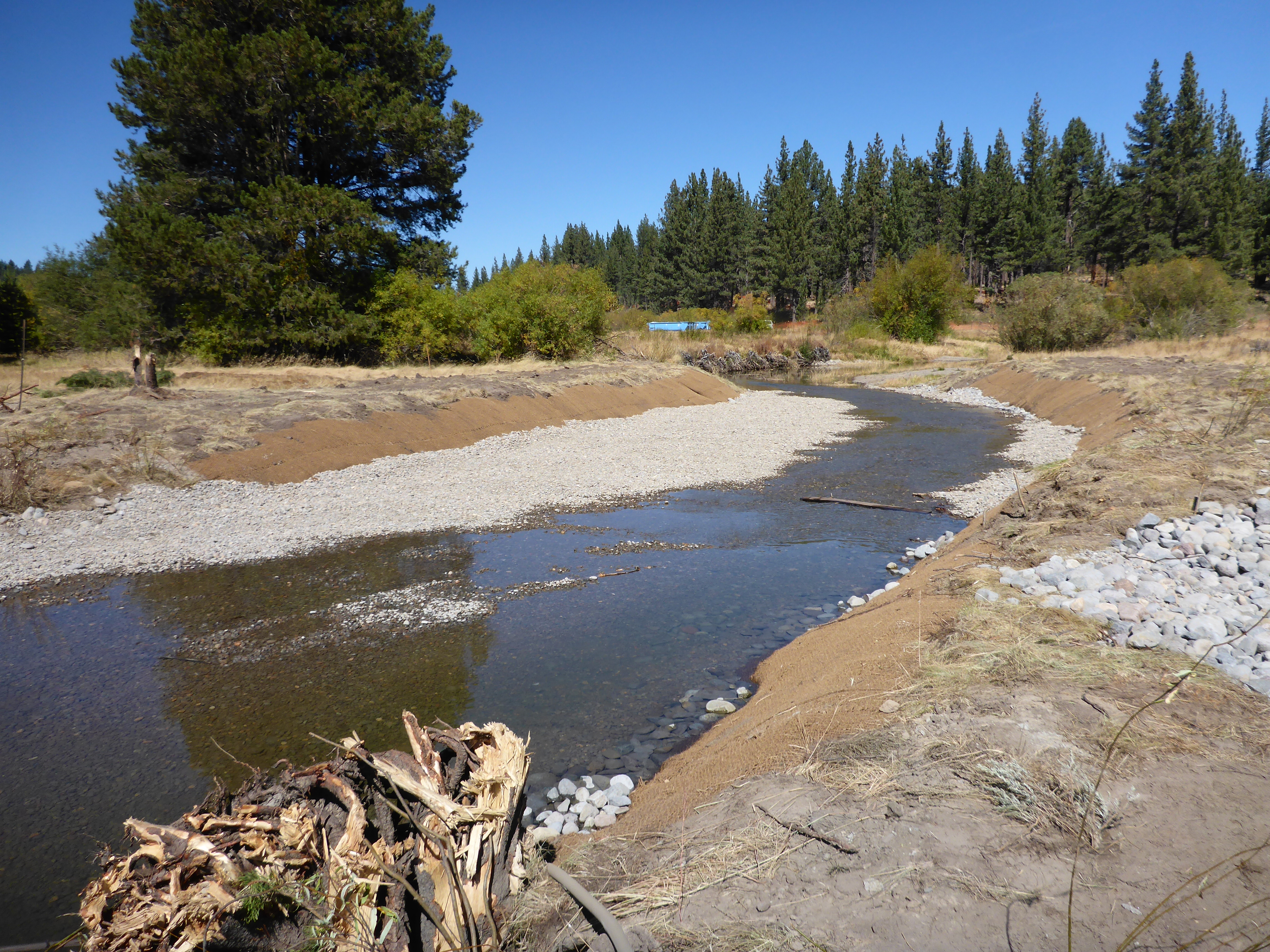
This is a view of the northern tie-in of the new channel of the Upper Truckee River in August 2016 after construction was completed. Photo/USFS

In a perfect situation, restoration work like what the U.S. Forest Service did would have a couple years to settle in and for vegetation to grow to stabilize the bank before being tested by massive water flows.

Mother Nature, though, doesn’t always cooperate.

Lahontan Regional Water Quality Control Board is the main overseer of the project because this state agency is tasked with maintaining water quality for the public.

“The storm water runoff really changed things out there, but we don’t have a good handle on what changed,” Doug Smith, supervising engineering geologist with the Lahontan Water Quality Control Board, said. “We don’t know the full extent (of damage) because it is flooded. I’ve sent them a couple letters saying that things didn’t go as planned and to get them to work on some plans. Last (month) I sent a lengthy technical comment letter on the interim plan. It was just a comment letter, not a fine or citation.”

With the water everywhere, even looking like it might reach the runways at Lake Tahoe Airport, in some ways it appears like the project failed. Just the opposite is true; the bank breaching is a good thing and is what would occur if humans never messed with the river.

To reach the runways the river would have to rise at least another foot; this would likely happen in a 50-year storm.

This is what the new channel of the Upper Truckee River looks like now from nearly the same spot as the above photo. Photo/USFS

The purpose of the project was to restore the river channel to what it was like before it had been straightened in places decades ago and meadows degraded by years of grazing.

Two-thirds of the work is on USFS land, while one-third is owned by the California Tahoe Conservancy.

The banks were eroding, carrying unwanted sediment to Lake Tahoe. The steepness of the banks was not allowing the river’s water to overflow into the meadows. This then affected plant and animal life.

Last summer the last 1,000 feet of the 7,340-foot channel was built. What is known is that between 50 and 100 feet of bank in that section has eroded. Rock armoring will be put there this construction season to stabilize the area. In some spots the vegetation did not survive, so that will be replanted as well.

This summer the Forest Service plans to do more monitoring than originally planned. Geomorphic, wildlife and geological assessments will be done. Seeing how the mussel relocation worked will also be analyzed. Aerial images will be taken to get a different perspective.

The multi-year project was supposed to be completed last fall, but October storms prevented that from happening. The upstream portion of the former channel did not get completely filled in.

“We underestimated the amount of dirt we would need to backfill the full former channel. The largest lesson learned is we should have included a larger contingency to make sure we had enough dirt. At the end of the season we ran short on backfill material,” Cody said.

This means there is water collecting in the back channel.

“The bottom line is they were not able to finish as planned,” Smith told Lake Tahoe News. “We need to see if the original permitted design or a different design needs to be implemented out there. That will be determined down the road. The Forest Service and us agreed the restoration project on the Upper Truckee River is very important and it needs to be done for the long haul and it needs to be done right.”

The price tag was $7 million for this project. That was before the winter storms. Most of the money came from the Southern Nevada Public Lands Management Act.


Former MLB player Byrnes embraces a different sport

By Kyle Magin, Tahoe Quarterly

A mountain lion stalked Eric Byrnes during the 2016 Western States Endurance Run.

Somewhere around mile 55 of the 100-mile course, the 11-year Major League Baseball outfielder and former Oakland Athletic fled from the big cat. This was immediately before Byrnes, then 40, ran past a pack of trailside photographers situated squarely in the middle of nowhere (Michigan Bluff, Calif., population 672) to capture his sweaty face, and just before he saw an orangutan hanging between two pines in the Sierra Nevada’s foothills.

“It was the hottest part of the day; it was 100-plus degrees,” Byrnes, a part-time Truckee resident, says. “Once I saw the monkey, I was like, ‘OK, my mind is playing tricks on me now.’”

Byrnes, a little better than halfway through the legendary June footrace that stretches from Squaw Valley to Auburn, had begun to hallucinate.

Read the whole story


Squaw to host NASTAR championships in 2018

Squaw Valley will host the 2018 Liberty Mutual Insurance NASTAR National Championships on March 21-25, the first time the event returns to the Sierra since 1981.

NASTAR participants qualify for the championships by earning a top 10 national ranking or a top five state ranking within their age, gender and ability group by Feb. 19. Racers can also qualify by earning a top ranking at their favorite resort or at the regional championships.

NASTAR continues to bring greater awareness to the sport, motivating participants of all ages to get involved in alpine racing. The program’s integration with the U.S. Ski Team gives racers the opportunity to meet and interact with racers.

In addition to the Alpine Ski division, the NASTAR National Championships will also host snowboard, telemark and physically challenged disciplines.

NASTAR stands for National Standard Race and is the largest public grassroots ski racing program in the world.


Endangered Species Act can’t save whitebark pines

By Maya L. Kapoor, High Country News

U.S. Forest Service research ecologist Bob Keane has studied whitebark pine, a coniferous tree of the high country, for more than thirty years. Still, when asked to describe a whitebark to someone who’s never seen one, he takes a breath and pauses for a moment. “Gosh,” he says.

The shape of the tree is very distinctive, Keane says. Instead of growing cone-shaped like other conifers, whitebarks branch like hardwoods. “A lot of the undergrowth is very small, so you see these open park-like stands of beautiful spreading trees,” he says. This shape is an adaptation that shows Clark’s nutcrackers flying past that a tree below has many nutritious cones and might be worth a travel stop.

Clark’s nutcrackers cache thousands of whitebark seeds, dispersing the pine across the high country, where the tree is a keystone species. Whitebark pine is one of the first trees to break ground after a fire, thanks to those nutcrackers, and it stabilizes soil and snowpacks at timberline. Living a millennium or more, whitebarks shape the West’s high mountain ecology in countless ways.

Read the whole story


Wet winter creates hazards on Tahoe trails

By Ryan Canaday, KTVN-TV

A record-breaking winter has damaged many trails in Lake Tahoe. As a result, experts are working to repair the beaten path.

Chris Binder, director with the Tahoe Rim Trail Association, says there’s no hiding the fact that Tahoe’s hiking paths need some care.

“We’re seeing some evidence of erosion on the trails particularly steep sections where the rapid snow melt has put more water on the trail than we’re used to seeing,” says Binder. “Some tripping hazards and some other things that aren’t conducive to hiking, biking and riding on the trails, so that’s something that we’re going to have to address and fix this year.”

Read the whole story


Squaw redefines ski season with summer schussing

So much snow remains at Squaw Valley that the ski season may never end. Photo/Kathryn Reed

By Kathryn Reed

OLYMPIC VALLEY – Warmth and skiing are seldom two words that go together. But these are not ordinary times.

The abundance of available terrain at Squaw Valley is astounding. There is so much snow that resort officials hope the 2016-17 ski season blends into the 2017-18 season without interruption. If this happens, it could be the first time anywhere for a resort to never close.

With a high of 69 degrees last Monday, one might think it would be more slush than snow. Not true. It was spring skiing, for sure. Soft, with patches that grab and a few slick spots. No corn snow, though.

From two wheels to a mono ski. Photo/Kathryn Reed

What was most impressive about the runs off Siberia, Shirley Lake, and Gold Coast was the coverage. No rocks, no obstacles of any kind.

It was shocking on May 29 to be able to ski from the top of Siberia Ridge to the village. With the mountain run open, no need to down lift – at least for now. There are spots on the lower part where dirt is visible, and even a section where it’s about 8 feet wide. But, still, the coverage is better than it was at times at other resorts in the middle of winter during the drought.

“Through the strategic movement of snow using grooming machines, Squaw Valley mountain operations team members will transport snow from areas with ample snow to areas with lower amounts of snow, effectively maximizing the snowpack long into summer,” Liesl Kenney of Squaw Valley told Lake Tahoe News. “The Shirley zone also benefits from a northwest aspect, limiting sun exposure and snow loss due to melting.”

Squaw is redefining spring skiing – especially with summer just days away.

And people are dressed for the weather – with varying degrees of undress.

The terrain crew at Squaw is ready to keep the features in pristine condition. Photo/Kathryn Reed

On Memorial Day the base was about 192 inches. This is what’s left after the resort received a record 724 inches of snow. Depending on what Mother Nature does, those numbers could increase and there might even be a summer powder day.

There is so much snow that the resort has a half pipe and terrain park open. The park crew is busy even during the day keeping the features up to par. One guy is known as the salt monkey. He has what resembles a leaf blower on his back. It’s really a salt blower, which helps keep things slick. Rakes and other tools are employed by the rest of the gang.

Skiers and snowboarders are appreciative of their efforts as they fly over the ramps, doing tricks in the air.

For Tim DeGraff of San Francisco he is more interested in the moguls off Siberia Express.

“I skied here last year on July 3. It was nothing like this,” DeGraff told Lake Tahoe News. That’s because there is so much more snow and the conditions dramatically better.

Adjacent to what DeGraff is on is a mogul course constructed for the junior ski team. Their agility looks like they could be ready for PyeongChang, South Korea, in 2018.

Top to bottom skiing is made possible by the grooming team. Photo/Kathryn Reed

This will be the fourth time Squaw has been open on July 4, but it will be the first time it has been open beyond that date. Mother Nature will help dictate if and when the resort closes.

“It will all depend on how the snow pack holds up. It’s typically a week to week decision,” Kenney said of deciding if and when to close.

While the upper mountain is awash in the white stuff, it really does seem like spring-summer at the base.

Through June, Squaw will be open on weekends. The resort will be open July 1-4. After that it, it’s all unchartered terrain and snow-weather dependent. What will be open remains to be seen. The plan is for the Shirley Lake area to be open, even if it means having to walk there from High Camp.

It is possible to create a Tahoe-Squaw triathlon of sorts by skiing/snowboarding, then adding on swimming, hiking, roller skating, snowshoeing, or cross country skiing.

The pool at High Camp opens this month, with the hot tub having opened in May.

“We are planning to renovate High Camp this summer. Snow is not impacting those plans yet,” Kenney said.

Check the resort’s website for up-to-date info, as well as special events like the Freedom Festival from July 1-4.


4-wheel drive group looking for members

Lake Tahoe Hi-Lo’s 4WD Club is having a meet and greet membership drive June 3 from 9am-2pm in the TJ Maxx parking lot  in South Lake Tahoe.

The nonprofit promotes family recreation, social activities, enjoyment and protection of natural resources. The group meets the fourth Tuesday of each month at Round Table Pizza at the Y in South Lake Tahoe from 6-8pm. Non-members are welcome.

The meeting is always open to the public as are all of their club outings. Families coming to the Tahoe basin to enjoy “wheeling” in a safe and supportive manner are welcome to participate.


Coasties hope to avoid deadly Tahoe boating season

Safety is a concern for motorized and non-motorized boat users at Lake Tahoe. Photos/Kathryn Reed

By Terra Breeden

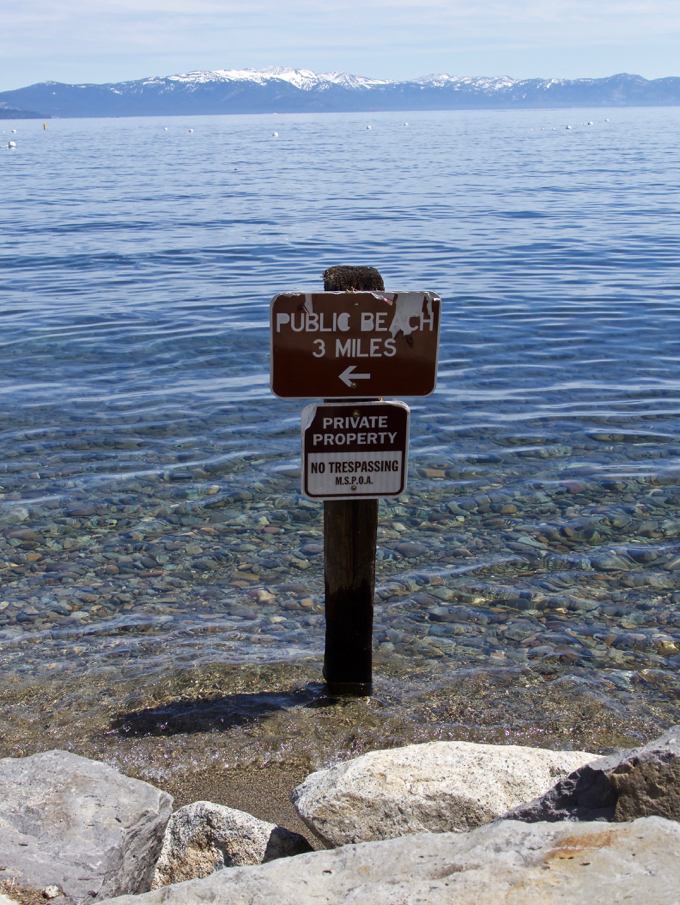
Summer weather has finally arrived in Lake Tahoe and with it, recreational users are heading to the lake, rivers and beaches to enjoy the water. But this past winter, with its record-breaking snow accumulation, has caused extremely low water temperatures, high water levels and hazards where previously there was none. Users of motorized and non-motorized vessels should be extra cautious this season.

“Lake conditions change quickly and that’s something to understand. Water temperatures are rather bracing and altitude also plays a part in how people feel in the water,” Carol Chaplin, president-CEO of Lake Tahoe Visitors Authority, told Lake Tahoe News.

It is important to exercise caution on the water whether conditions are different or not. But this summer, cold water temperatures may last longer due to the vast amount of snow lingering in the upper elevations.

“Recreational users such as boaters, rafters and beach-users should remember that snow melt water is very cold and hypothermia can develop quickly if exposed to it for even short periods of time,” Lisa Herron, with the USFS Lake Tahoe Basin Management Unit, said.

According to the U.S. Coast Guard, the water temperature in Lake Tahoe will remain frigid until late July, making it dangerous for recreationalists. Last year, there were nine boating fatalities on Lake Tahoe. Seven of those victims were on kayaks or paddleboards.

Nationwide from 2015 to 2016, deaths increased 12 percent from 626 to 701, injuries increased 11.1 percent from 2,613 to 2,903, and the total number of accidents increased 7.3 percent from 4,158 to 4,463, according to the Coast Guard.

“The No. 1 cause of fatality was water-shock and hypothermia,” Luke Berghuis, petty officer first class of the Tahoe City Coast Guard, told Lake Tahoe News. “Most of the fatalities last year were in less than 10 feet of water, and the water temperature is going to remain colder this year due to snow melt. It’s going to take a long time for this snow to melt off.”

According to Berghuis, paddleboarders are a main concern of the Coast Guard because often they don’t wear life jackets or leashes.

“Paddleboarders are our highest fatality rate on the lake,” Berghuis said.
Safety and advice
Beach users
· Plan ahead – Check out beaches ahead of time so you know what to expect and whether or not your favorite area is open. If you can’t get to your favorite place, think of it as an opportunity to explore new areas.
· Arrive early – In order to secure a spot for your outing, you may want to arrive early, particularly on busy weekends. Have a backup location in mind in case some areas are too crowded.
· Check out – California State Parks and Lake Tahoe Nevada State Parks for advice about what to expect when visiting their locations.
Boaters
· If you are on a kayak or paddleboard, always wear a lifejacket.
· Have a float plan.
· Know where you are going and where you are on the lake. If you need to be rescued, it is important to know where you are and have familiarization with the area.
· Make sure your radio or cellphone is charged. For cellphones, put in a dry bag to keep it operable in case you do fall in or capsize.

High wind and choppy waves can knock a person off of a paddleboard and make it nearly impossible to get out of the freezing water. Lake Tahoe is well-known for its windy afternoons, and when the wind picks up, the Coast Guard receives a high volume of emergency calls, usually between 4 and 6pm.

According to Berghuis, watercraft-borne authorities such as the El Dorado County Sheriff’s Department will be issuing tickets to paddleboarders and kayakers who don’t have a life vest. The fine can be up to $350. They don’t have to be wearing it, but in needs to be close at hand, easy to reach.

“The sheriff’s office will be pushing that this year because of the high number of paddleboard fatalities last year,” Berghuis said.

Another danger boaters should be aware of are obscured boulders in the water. The water level of the lake is currently at 6,228 feet, that’s 5 feet above the natural rim. While high water levels are great for a lake recovering from a four-year drought, huge boulders which were once exposed in places like Sand Harbor and Logan Shoals are now completely under water, some just inches below the surface. Boaters can easily run into rocks in many areas and should scan the water carefully when boating near the shoreline.

The rising water has also diminished Tahoe’s beaches, eating up the shoreline and everything on it. Logs that were previously on the shore are now bobbing in the water, creating more hazards for boaters to be wary of.

“All of the dead trees that used to be on the beach are now floating, so there’s a lot of debris in the water,” Berghuis said.

But there is some good news for Lake Tahoe boaters: every one of the launches and marinas on the lake will be open this summer. Last year, only three launches were fully operating.

However, the Coast Guard anticipates that there will be less boating activity on the lake than in previous years.

Lake Tahoe isn’t the only lake in California with high water levels, all of the lakes and reservoirs are overflowing with water, and brimming lakes such as Folsom Lake are expected to draw visitors away from Lake Tahoe.

“Because all of the lakes are full, people will stay down in the valleys and recreate in reservoirs. We hope that will cut down on Lake Tahoe visitors this year,” Berghuis said.

Whitewater is a danger for river rafters and hikers exploring the backcountry. This year, Lake Tahoe’s rivers and streams are swollen and flooded with high water moving at breakneck speed. Recreationalists should exercise care when rafting or crossing the rivers.

“Avoid areas that are flooded, especially if the water is flowing fast, and try not to cross swift-moving rivers and streams. Water levels can fluctuate rapidly, so a stream crossed earlier in the day may not be able to be crossed later in the afternoon as the temperature rises,” Herron said. “In the backcountry, hikers may encounter snow bridges across rivers. Be sure to test them thoroughly before crossing as they might collapse under you weight.”

But for adventure-seekers, the rushing water in Lake Tahoe’s rivers and streams adds fun and spectacle to their experience.

“On a positive note, waterfalls are impressive right now and the rafting season may be extended longer than in previous years,” Herron said.


Important to be bear-aware in Lake Tahoe

There are an estimated 10,000 to 15,000 American black bears living in the Sierra Nevada and sharing habitat with the human population. Spring is the time of year when bears emerge from their winter dens in search of food. Bears are attracted to anything edible or scented. 

Once they get access to human food and trash, bears lose their fear of humans and can cause property damage and threaten public safety.  Residents and visitors can help keep our bears wild and reduce potential conflicts between bears and humans by properly storing food and trash.

The following are tips for safe-guarding dwellings against a bear encounter:

·         Purchase, store all trash in, and properly close bear-resistant garbage containers.

·         Freeze strong smelling left overs, such as fish, until trash day to reduce the smell.

·         Wait to put trash out until the morning of collection day.

·         Keep garbage cans clean and deodorize them with bleach or ammonia.

·         Don’t leave trash, groceries, or animal feed in your car.

·         Keep barbecue grills clean and stored in a garage or shed when not in use.

·         Refrain from putting out bird feeders from April through October.

·         Don’t leave any scented non-food products outside or in your car, such as suntan lotion, lip balm, insect repellent, toothpaste, soap or candles.

·         Keep doors and windows closed and locked when the home is unoccupied.

·         Consider installing motion-activated outdoor lights, sprinklers and alarms, as well as electric fencing.

·         Harvest fruit off trees as soon as it is ripe, and promptly collect all fruit that falls.

·         Securely block access to potential hibernation sites, such as crawl spaces under decks and buildings.

·         Vegetable gardens, compost piles, orchards and chickens may attract bears. Use electric fences to keep bears out.

Tips for safe-guarding your campsite against a bear encounter:

·         Never feed wildlife.

·         Always store food (including pet food), drinks, toiletries, coolers, cleaned grills, cleaned dishes, cleaning products, and all other scented items as soon as possible after use in the bear-resistant containers (storage lockers) provided at your campsite.

·         Clean the barbecue grill after each use and store properly.

·         Always place trash in bear-resistant dumpsters in campground or in bear-resistant containers at your campsite and close and lock after each use.

·         Never leave scented items unattended in your campsite, tent, or car.

·         Never leave trash at your campsite.

To report bear conflicts in California, call 916.445.0380; in Nevada call at 775.688.2327.