Telemark skiing may become Olympic sport

By Megan Hughes, In The Snow

The International Ski Federation (FIS) has officially proposed the inclusion of telemark skiing at the Beijing Winter Olympics in 2022, to the International Olympic Committee.

The FIS have proposed the telemark parallel sprint and the mixed-gender team parallel sprint events to be included in the 2022 games.

Telemark racing differs from alpine ski racing in many aspects of course design.

Read the whole story


ZCTC to host husband-wife tournament

The Husband Wife Hard Court National Championships returns to ZCTC in September. Photo/Provided

Zephyr Cove Tennis Club for the second consecutive year will host the USTA Husband Wife Hard Court National Championships.

Teams from all over the country are expected to descend upon the South Shore for this hard court tournament.

The tournament will be Sept. 10-16.

This is one of four tournaments that is part of the Husband Wife Grand Slam Circuit. Each event is played at a different location and on a different surface: grass in Palm Springs, clay in Charlotte, N.C., and indoors in Denver. Champions receive a gold ball, finalists receive a silver ball, and the bronze ball is awarded to third place. 

Any husband-wife duo may participate. There are four divisions, three based on combined ages – 100, 120, 140 and then open. The combined age of the team must equal or exceed the age requirement by the end of the calendar year. No age requirement in the open division. 

For more information or to sign up, go online.


Mental, emotional benefits to alone time in nature

By Brad Daniel, Andrew Bobilya and Ken Kalisc, The Conversation

Today Americans live in a world that thrives on being busy, productive and overscheduled. Further, they have developed the technological means to be constantly connected to others and to vast options for information and entertainment through social media. For many, smartphones demand their attention day and night with constant notifications.

As a result, naturally occurring periods of solitude and silence that were once commonplace have been squeezed out of their lives. Music, reality TV shows, YouTube, video games, tweeting and texting are displacing quiet and solitary spaces. Silence and solitude are increasingly viewed as “dead” or “unproductive” time, and being alone makes many Americans uncomfortable and anxious.

But while some equate solitude with loneliness, there is a big difference between being lonely and being alone. The latter is essential for mental health and effective leadership.

We study and teach outdoor education and related fields at several colleges and organizations in North Carolina, through and with other scholars at 2nd Nature TREC, a training, research, education and consulting firm. We became interested in the broader implications of alone time after studying intentionally designed solitude experiences during wilderness programs, such as those run by Outward Bound. Our findings reveal that time alone in nature is beneficial for many participants in a variety of ways, and is something they wish they had more of in their daily life.

Reflection and challenge

We have conducted research for almost two decades on Outward Bound and undergraduate wilderness programs at Montreat College in North Carolina and Wheaton College in Illinois. For each program, we studied participants’ experiences using multiple methods, including written surveys, focus group interviews, one-on-one interviews and field notes. In some cases, we asked subjects years later to look back and reflect on how the programs had affected them. Among other questions, our research looked at participant perceptions of the value of solo time outdoors.

Our studies showed that people who took part in these programs benefited both from the outdoor settings and from the experience of being alone. These findings build on previous research that has clearly demonstrated the value of spending time in nature.

Scholars in fields including wilderness therapy and environmental psychology have shown that time outdoors benefits our lives in many ways. It has a therapeutic effect, relieves stress and restores attention. Alone time in nature can have a calming effect on the mind because it occurs in beautiful, natural and inspirational settings.

Nature also provides challenges that spur individuals to creative problem-solving and increased self-confidence. For example, some find that being alone in the outdoors, particularly at night, is a challenging situation. Mental, physical and emotional challenges in moderation encourage personal growth that is manifested in an increased comfort with one’s self in the absence of others.

Being alone also can have great value. It can allow issues to surface that people spend energy holding at bay, and offer an opportunity to clarify thoughts, hopes, dreams and desires. It provides time and space for people to step back, evaluate their lives and learn from their experiences. Spending time this way prepares them to re-engage with their community relationships and full work schedules.

Putting it together: The outdoor solo

Participants in programmed wilderness expeditions often experience a component known as “Solo,” a time of intentional solitude lasting approximately 24-72 hours. Extensive research has been conducted on solitude in the outdoors because many wilderness education programs have embraced the educational value of solitude and silence.

Solo often emerges as one of the most significant parts of wilderness programs, for a variety of reasons. Alone time creates a contrasting experience to normal living that enriches people mentally, physically and emotionally. As they examine themselves in relation to nature, others, and in some cases, God, people become more attuned to the important matters in their lives and in the world of which they are part.

Solitary reflection enhances recognition and appreciation of key personal relationships, encourages reorganization of life priorities, and increases appreciation for alone time, silence, and reflection. People learn lessons they want to transfer to their daily living, because they have had the opportunity to clarify, evaluate and redirect themselves by setting goals for the future.

For some participants, time alone outdoors provides opportunity to consider the spiritual and/or religious dimension of life. Reflective time, especially in nature, often enhances spiritual awareness and makes people feel closer to God. Further, it encourages their increased faith and trust in God. This often occurs through providing ample opportunities for prayer, meditation, fasting, Scripture-reading, journaling and reflection time.

Retreating to lead

As Thomas Carlyle has written, “In (solitary) silence, great things fashion themselves together.” Whether these escapes are called alone time, solitude or Solo, it seems clear that humans experience many benefits when they retreat from the “rat race” to a place apart and gather their thoughts in quietness.

In order to live and lead effectively, it is important to be intentional about taking the time for solitary reflection. Otherwise, gaps in schedules will always fill up, and even people with the best intentions may never fully realize the life-giving value of being alone.

Brad Daniel is a professor of outdoor education at Montreat College; Andrew Bobilya is an associate professor and program director of parks and recreation management at Western Carolina University; and Ken Kalisch is an associate professor of outdoor education at Montreat College.


Plan ahead for fun in the outdoors with your dog

By Angela Rudolph, Reno Gazette-Journal

Reno/Tahoe is a highly active region with many residents who enjoy getting outdoors to hike and camp. Most dog owners love to take their four-legged best friend with them for all the fun adventures – so, here’s how to make sure you and your pooch stay safe together.

Be sure that your dog is wearing proper identification (and preferably also has a microchip), and that your dog is fully vaccinated, before taking her on a hike or camping. Remember to always bring water with you, even if you’re just going on a short hike. Higher altitudes and hot weather can cause rapid dehydration. Bring enough water for you and your dog, as she can get dehydrated just like you. Be sure to avoid hiking during the heat of the day, and if you’re at a lake or on a beach, be sure there is shade for you and your pooch. Some light-coated pets might also do well with sun screen, since their fur might not provide the same protection that pets with thicker coats often enjoy.

Read the whole story


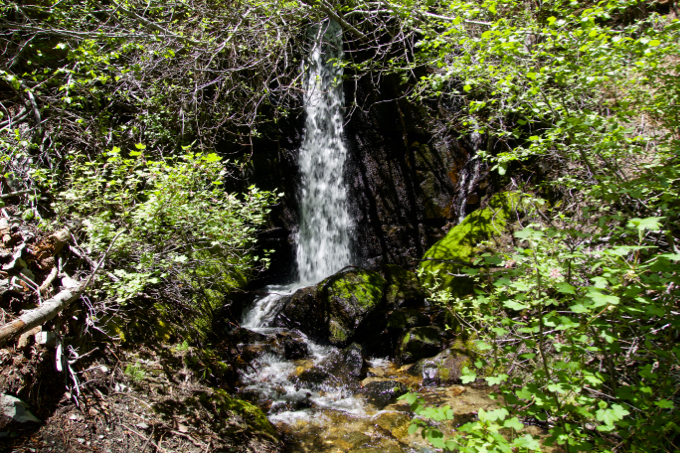
Genoa Falls dances from the rugged brush

Genoa Falls at about 10-feet-high tumbles from the mountainside. Photo/Kathryn Reed

By Kathryn Reed

GENOA – There is something about a waterfall that always brings a smile to my face even it isn’t very big. Something about the magic of Mother Nature; showing who’s boss, mixing up the contours of the landscape. I’m never disappointed.

A week ago eight people and two dogs set off to see the Genoa Falls for the first time. Considering it was a holiday weekend, we were pleasantly surprised not to come across that many people.

This is the time of year when hiking at lake level is still iffy because you don’t have to go up far in elevation to still hit snow. That is why starting lower is a safe bet.

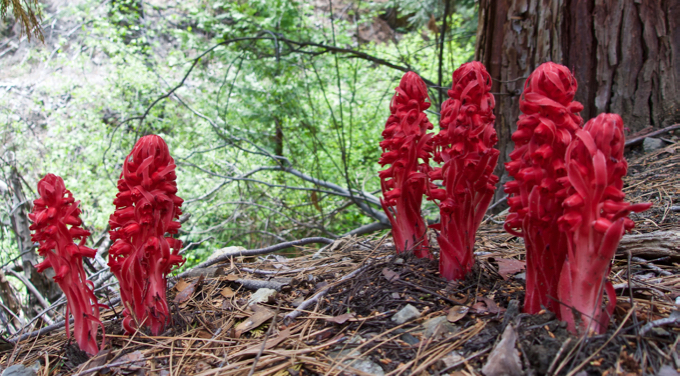
Vibrant snowplants just off the trail. Photo/Kathryn Reed

The distinctive yellow flowers of mule’s ear are already sprouting on the Carson Valley side of the range. Snow plants are in their glory.

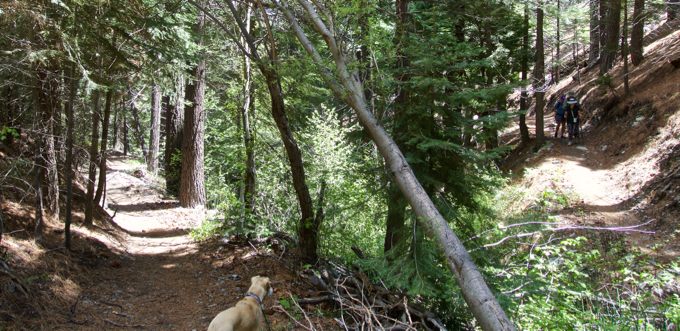
This trail that begins on the outskirts of Genoa is a bit steep at first. More than one person complimented the trail builders. It’s single-track almost all of the way as the switchbacks wind their way up about 1,400 feet.

A mix of hardpack dirt and loose rock fill the trail. While I’m not big on using poles, I was glad I had them for the ascent, and especially for the descent. My footing slipped in a couple places and the poles kept me upright.

Switchbacks are necessary to ease the steepness. Photo/Kathryn Reed

It’s understandable why signs recommend cyclists and equestrians stay off this trail – it’s the verticle. Still, that didn’t deter a couple mountain bikers who passed us. Fortunately, we all shared the trail respectfully.

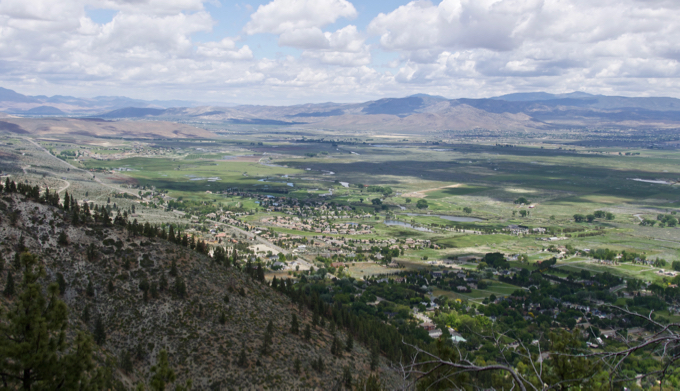
It doesn’t take long until sweeping views of the Carson Valley come into view. With the moisture we had in May, it was still amazing how verdant this farmland is. Living in Tahoe it’s easy to forget how lush areas can become with rain.

There was a little bit of water at times for the dogs, but definitely bring some along for them. Wiley had no problem plopping himself down in the water that ran from the falls. It was like a private bath for him.

The tree canopy provided plenty of shade, which was a good thing. While I was in shirtsleeves, I wish had been in shorts.

We turned around at the waterfall, but the trail kept going. There are longer loops. The trail hooks up with the Tahoe Rim Trail at 13.4 miles from the parking lot. Our out and back was just shy of 6 miles total.

Plenty of lush green grass for the cattle in Carson Valley. Photo/Kathryn Reed

—–

Getting there:

From South Lake Tahoe, take Highway 50 east to Stateline. Go right on Kingsbury Grade. Go left on Foothill Road. Go left on Carson Street. The road dead ends at the Genoa Canyon Trailhead.


Sage grouse now a proxy for control of Western lands

By John Freemuth, The Conversation

The Trump administration is clashing with conservation groups and others over protection for the greater sage grouse (Centrocercus urophasianus), a bird widely known for its dramatic mating displays. The grouse is found across sagebrush country from the Rocky Mountains on the east to the Sierra and Cascade mountain ranges on the west.

This region also contains significant oil and gas deposits. The Trump administration is revising an elaborate plan developed under the Obama administration that sought to steer energy development away from sage grouse habitat. Conservation groups are suing in response, arguing that this shift and accelerated oil and gas leasing threaten sage grouse and violate several key environmental laws.

This battle is the latest skirmish in a continuing narrative over management of Western public lands. Like its Republican predecessors, the Trump administration is prioritizing use of public lands and resources over conservation. The question is whether its revisions will protect sage grouse and their habitat effectively enough to keep the birds off of the endangered species list – the outcome that the Obama plan was designed to achieve.

Sage grouse under siege

Before European settlement, sage grouse numbered up to 16 million across the West. Today their population has shrunk to an estimated 200,000 to 500,000. The main cause is habitat loss due to road construction, development and oil and gas leasing.

More frequent wildland fires are also a factor. After wildfires, invasive species like cheatgrass are first to appear and replace the sagebrush that grouse rely on for food and cover. Climate change and drought also contribute to increased fire regimes, and the cycle repeats itself.

Concern over the sage grouse’s decline spurred five petitions to list it for protection under the Endangered Species Act between 1999 and 2005. Listing a species is a major step because it requires federal agencies to ensure that any actions they fund, authorize or carry out – such as awarding mining leases or drilling permits – will not threaten the species or its critical habitat.

 In 2005 the U.S. Fish and Wildlife Service declared that an ESA listing for the sage grouse was “not warranted.” These decisions are supposed to be based on science, but leaks revealed that an agency synthesis of sage grouse research had been edited by a political appointee who deleted scientific references without discussion. In a section that discussed whether grouse could access the types of sagebrush they prefer to feed on in winter, the appointee asserted, “I believe that is an overstatement, as they will eat other stuff if it’s available.”

In 2010 the agency ruled that the sage grouse was at risk of extinction, but declined to list it at that time, although Interior Secretary Ken Salazar pledged to take steps to restore sagebrush habitat. In a court settlement, the agency agreed to issue a listing decision by Sept. 30, 2015.

Negotiating the rescue plan

The Obama administration launched a concerted effort in 2011 to develop enough actions and plans at the federal and state level to avoid an ESA listing for the sage grouse. This effort involved federal and state agencies, nongovernmental organizations and private landowners.

California, Colorado, Idaho, Montana, Nevada and Wyoming all developed plans for conserving sage grouse and their habitat. The U.S. Forest Service and Bureau of Land Management revised 98 land use plans in 10 states. And the U.S. Department of Agriculture provided funding for voluntary conservation actions on private lands.

In 2015 Interior Secretary Sally Jewell announced that these actions had reduced threats to sage grouse habitat so effectively that a listing was no longer necessary. A bipartisan group of Western governors joined Jewell for the event. But despite the good feelings, some important value conflicts remained unresolved.

Notably, the plan created zones called Sagebrush Focal Areas – zones that were deemed essential for the sage grouse to survive – and proposed to bar mineral development on 10 million acres within those areas. Some Western governors, such as Butch Otter of Idaho, viewed this element as a surprise and felt that it had been dropped on states from Washington, without consultation.

The Trump administration wants to cancel creation of Sagebrush Focal Areas and allow mining and energy development in these zones. Agency records show that as Interior Department officials reevaluated the sage grouse plan in 2017, they worked closely with representatives of the oil, gas and mining industries, but not with environmental advocates.

Can collaboration work?

If the Trump administration does weaken the sage grouse plan, it could have much broader effects on relations between federal agencies and Western states.

Collaboration is emerging as a potential antidote to high-level political decisions and endless litigation over western public lands and resources. In addition to the sage grouse plan, recent examples include a Western Working Lands Forum organized by the Western Governors’ Association in March 2018, and forest collaboratives in Idaho that include diverse members and work to balance timber production, jobs and ecological restoration in Idaho national forests.

There are two key requirements for these initiatives to succeed. First, they must give elected and high-level administrative appointees some cover to support locally and regionally crafted solutions. Second, they have to prevent federal officials from overruling outcomes with which they disagree.

When the U.S. Fish and Wildlife Service announced in 2015 that an endangered listing for the sage grouse was not warranted, the agency committed to revisit the bird’s status in 2020. To avoid having to list the grouse as endangered, the Trump administration must provide enough evidence and certainty to justify a decision not to list, as the Obama administration sought to do. If Interior changes land management plans and increases oil and gas leasing, that job could become harder. It also is possible that Congress might prohibit a listing.

Finding a lasting solution will require the Trump administration to collaborate with states and other stakeholders, including environmental advocates, and allow local land managers to do the same. Then, whatever the outcome, it cannot reverse their efforts in Washington. As Matt Mead, Wyoming’s Republican governor, warned in 2017, “If we go down a different road now with the sage grouse, what it says is, when you try to address other endangered species problems in this country, don’t have a collaborative process, don’t work together, because it’s going to be changed.”

John Freemuth is a professor of public policy and executive director of the Andrus Center for Public Policy, Boise State University.

Interior secretary calls for rebuilding national parks

By Associated Press

Interior Secretary Ryan Zinke reiterated his support for addressing a maintenance backlog at national parks during a visit this month to the one named for a U.S. president known for championing conservation.

Zinke toured the Peaceful Valley Ranch at Theodore Roosevelt National Park, a former dude ranch that is on the National Register of Historic Places but in disrepair and in the middle of a $4.3-million rehabilitation project. Zinke said it exemplified the types of projects needed at parks nationwide.

“We want to make sure that we focus on rebuilding our parks,” Zinke said. “The president is a builder. He loves the idea of rebuilding.”

Read the whole story


Help needed on National Trails Day

Tahoe Rim Trail Association, Tahoe Area Mountain Biking Association and U.S. Forest Service are organizing a morning community trailhead cleanup on June 2.

This is part of National Trails Day.

Volunteers are needed to remove graffiti off of massive granite boulders and remove garbage on a trail connector into Van Sickle Bi-State Park.

The event is from 9am-noon.

Register online.


Free fishing derby for kids on South Shore

South Lake Tahoe Optimist Club will be having its annual Kids Fishing Derby on June 2 at Sawmill Pond in South Lake Tahoe.

It is free to everyone 14 and younger.

Fishing tackle and bait will be available, as well as instruction from Tahoe Fly Fishing guides. There will also be a free fish cleaning stable.

The event is from 8am-noon.

Food will be provided.


California’s $4 billion plan to get people outside

By Jake Bullinger, Outside

The phrase “the great outdoors” evokes certain landscapes: towering spires, roiling cascades, undisturbed deserts. Yosemite, Moab, Acadia, and the like. These are places diverse in flora, fauna, and geology, but the outdoor spaces Americans cherish and have accordingly preserved often share one trait: For most people, they’re hard to visit.

“We’re increasingly urban as a population,” says Rue Mapp, founder of Outdoor Afro, an organization bent on getting more black people outside. “We have to imagine conservation that doesn’t look like the more traditional viewpoints.”

In June, California will have a chance to shift the state’s policy in that direction. If voters approve Proposition 68, the state will dedicate $1.3 billion to creating and maintaining parks in underserved communities, many of them low-income where residents are people of color.

Read the whole story