Study highlights economic impacts of ‘quiet’ recreation

By Amy Joi O’Donoghue, Deserest News

SALT LAKE CITY — Some quiet time in the great outdoors in a portion of Utah delivered a sizeable chunk of change to local economies, with an estimated $17 million in impacts logged in one year alone.

A first-ever study devoted to an exclusive analysis of “quiet recreational activities,” looked at what was taking place on 2.1 million acres of Bureau of Land Management lands in Iron and Beaver counties, or those lands within the purview of the agency’s Cedar City field office.

 The report released Thursday details that out of 492,000 recreation visits logged in 2015 by the BLM, 364,000 — or 74 percent — were for quiet recreation that includes hiking, hunting, biking, fishing, camping or wildlife viewing.

Quiet recreation is generally nonmotorized activity that excludes off-highway vehicle use, power boating, snowmobiling or driving for sightseeing.

Read the whole story


Race to ski world’s most dangerous mountain

By Devon O’Neil, Outside

Among the countless peaks around the world that have yet to be skied, one stands alone in prestige and allure: the 28,251-foot K2. The reasons it remains unskied are many—fatal exposure on much of the route, notoriously harsh weather, an oxygen shortage—but they do not include a lack of interest.

Over the past 25 years, a handful of the most accomplished steep skiers in history have tried to notch the first descent of K2—skiing off the summit and continuing uninterrupted as far as conditions allow back to base camp. All have failed.

In recent weeks, two more aspirants began trekking into the Karakoram Range in northern Pakistan to try to notch the historic first descent, which could happen anytime from mid-July through early August. One is Davo Karnicar, a 54-year-old father of seven from Slovenia who made the only complete ski descent of Mount Everest in October 2000, five years after he completed the first full descent of Annapurna with his younger brother, Drejc. The other is 29-year-old Andrzej Bargiel of Poland, who brings an impressive résumé of his own, having skied Shishapangma in 2013, Manaslu in 2014, and Broad Peak in 2015, the first complete descent of that mountain.

Read the whole story


Roaming the Nev. desert in search of rare plants

By Patricia R. Olsen, New York Times

Janel Johnson, 39, is a botanist with the Nevada Natural Heritage Program in Carson City.

“We’re part of the Nevada Department of Conservation and Natural Resources. My group collects information about rare plants and animals in the Great Basin and Mojave deserts. I identify potential plant habitats on a map or aerial photograph, and travel to the plants. I’m also the webmaster. I’ve worked here for 13 years,” she said.

Builders use the information to know if an endangered species exists in a particular location. Findings also serve as a scientific record.

Read the whole story


Human noise pollution disrupting wild places

By Rachel Buxton, Colorado State University

As transportation networks expand and urban areas grow, noise from sources such as vehicle engines is spreading into remote places. Human-caused noise has consequences for wildlife, entire ecosystems and people. It reduces the ability to hear natural sounds, which can mean the difference between life and death for many animals, and degrade the calming effect that we feel when we spend time in wild places.

Protected areas in the United States, such as national parks and wildlife refuges, provide places for respite and recreation, and are essential for natural resource conservation. To understand how noise may be affecting these places, we need to measure all sounds and determine what fraction come from human activities.

In a recent study, our team used millions of hours of acoustic recordings and sophisticated models to measure human-caused noise in protected areas. We found that noise pollution doubled sound energy in many U.S. protected areas, and that noise was encroaching into the furthest reaches of remote areas.

Read the whole story


Inspection is not the end to responsible boating

By Brant Allen

If you are one of the many recreational boaters who enjoys wake sport activities, you may be unwittingly contributing to the spread of aquatic invasive species (AIS). Be sure to fill and empty your boat’s ballast tanks at least a mile offshore over deep water.

The first line of defense against aquatic invasive species is preventing them from arriving in new water bodies. Once established, it is difficult to prevent their spread and nearly impossible to totally eradicate them. This reality is why the Lake Tahoe Basin enacted mandatory boat inspections for all motorized watercraft recreating on the basin’s pristine water bodies. The strategy is to prevent the spread before boaters launch.

This strategy accepts the common, and often true, belief that once a new species is in a lake it will naturally migrate to, and populate all suitable habitat. However, some water bodies have natural barriers that prevent the movement of certain species within their aquatic realm.

Asian clams began to spread around the Lake Tahoe shoreline in the early 2000s. By casting their offspring (veligers) loose on lake currents, the clam population was able to expand. Soon bright white patches of clam shells could be seen on the sandy bottom along the southeast portion of the lake. Over the following four years the density of clams increased, but their range had approached its natural limit. After 15 years in the lake, the clams remained isolated in the southeast.

Lake Tahoe is unique. Its underwater topography (bathymetry), cold temperature, and large-scale lake currents create a natural deterrent to the lake-wide distribution of organisms unable to propel themselves through its clear water. Steep canyons separate its shallow shelves, and its currents form three counter rotating gyres that turn alongshore motion toward the center of the lake.  It is believed the combination of great depth nearshore and Tahoe’s prevailing currents create a natural barrier to Asian clam migration to the north and west shores.

Asian clam veligers need to settle on suitable habitat shallower than 60-feet deep to experience warm enough summer water temperatures to grow and eventually reproduce. Those settling in deeper water will live a long and happy life, but will never enjoy the pleasures of parenthood as the water temperatures are too cold to permit reproduction.

Given that, how did satellite populations of Asian clams end up at the mouth of Emerald Bay and the Sand Harbor State Park boat launch? Recreational boating may inadvertently be the culprit. How is this possible when all boats are inspected prior to entering the lake?

It is believed recreational boats equipped with ballast tanks are responsible for the in-lake transport of Asian clam veligers beyond their natural distribution. About five years ago there was a large increase in wake surfing. The surge in interest was partially due to new boats designed with ballast tanks. After launching, the ballast tanks are filled with as much as 375 gallons of lake water. With this extra weight, a large wake is created, allowing hands free surfing on an endless wave for skilled riders. Once the surf session is complete, the ballast tanks are emptied, rarely in the location where they were filled. It is easy to see how boat ballast tanks may be responsible for moving clam veligers to the satellite locations of Emerald Bay and immediately in front of the Sand Harbor State Park launch ramp, two of the most popular boating destinations on the lake.

While long-established boat inspections are doing their job preventing new species from populating waters of the Tahoe basin, boaters need to be cognizant of in-lake transport and take simple precautionary measures.

Remove and dispose of any aquatic vegetation from your prop, engine intake or keel before exiting the launch or marina. Ballast tanks should only be filled and emptied in the same location or at least one mile offshore. This will keep any hitchhikers over deep water, away from warm shallow habitat. Additionally, the installation of commercially available filters on ballast tank pumps is highly recommended. A joint study by UNR and the Tahoe Regional Planning Agency found the filters to be an effective measure against the transport of aquatic species.

So, enjoy the recreational opportunities Tahoe summers afford, but be a responsible boater. Prevent further spread of the aquatic invasive species already in the lake by filling and dumping ballast tanks at least a mile offshore and removing plant material before leaving marina.

Brant Allen is with the UC Davis Tahoe Environmental Research Center.


Ranger led hikes at top of Heavenly

The U.S. Forest Service Lake Tahoe Basin Management Unit and Heavenly Mountain Resort are putting on  Hike with a Ranger programs this summer. 

Hikes will take place every Friday and Saturday at 11am and 1pm at the top of the Heavenly gondola. The guided hike is approximately one hour and will continue every weekend through Sept. 2.

Hikes are moderate in terms of difficulty. Closed toed shoes and drinking water are required for attendance along with a ticket to ride the gondola. No reservations are required and attendance is on a first-come, first-serve basis. 

Meet the Forest Service ranger at the top of the gondola.

This program aims to provide an enjoyable outdoor opportunity to learn more about the Lake Tahoe environment. Rangers cover a variety of natural history topics.

For more information, contact Megan Dee at 530.543.2618 or email mldee@fs.fed.us.


Climate change could mean a much wetter Calif.

By Carolyn Wilke, Sacramento Bee

Californians have been bracing themselves for a drier future accompanying a warming climate. But research by scientists at the University of California, Riverside, suggests that the state may actually get wetter in the event of severe climate change.

The study, published July 6 in Nature Communications, reports that more years in the state could look like El Niño ones, when California typically has wetter winters.

The authors found that average annual precipitation in California could increase by about 12 percent if nothing is done to curb carbon emissions. Average precipitation in the winter could increase by as much as 30 percent. A wetter climate, however, might not offset the overwhelmingly negative effects of a warming climate.

Read the whole story


Agencies working on Tahoe tree mortality

The Tahoe Fund has started a campaign to raise $36,000 to support a project designed by UC Davis scientists to improve forest health in the basin. 

Because of drought and bark beetle infestations, tree mortality more than doubled from 35,000 in 2015 to 72,000 in 2016.

Tahoe Fund is partnering with scientists at UC Davis Tahoe Environmental Research Center to help repopulate the hardest hit areas along the North Shore with native sugar pine trees.

Scientists at UC Davis Tahoe Environmental Research Center plan to collect seeds from more than 100 different sugar pine trees around Tahoe. Over the course of the next year they will grow these seeds into 10,000 seedlings that can be planted in areas with the greatest mortality rates. The 10,000 seedlings will be distributed to public agencies to be planted along the North Shore in both California and Nevada. The program also includes distribution of thousands of seedlings to private homeowners who have experienced tree loss.  

The Sugar Pine Reforestation Project is one of the Tahoe Fund’s Signature Projects for 2017.  The campaign goal for this project is $36,000. Donations in support of this and other environmental improvement projects around the lake can be made online.


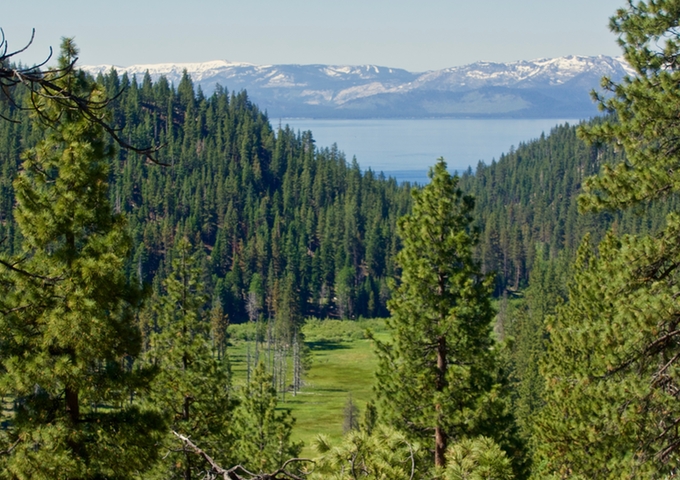
Pray Meadows dazzles with its verdant beauty

Pray Meadows can be seen looking west from Highway 28. Photo/Kathryn Reed

By Kathryn Reed

It’s always an interesting hike when you have to flag down a truck to ask where you are.

And so it was late last month with Rosemary. We knew where we wanted to go. And we got there. We just didn’t know where we were when we went a little farther.

We were in Glenbrook, on Lands End Road.

We got there by going through Pray Meadows, which was our original plan.

I just figured we could get to Lake Tahoe through the meadow. I didn’t realize there would be a subdivision in between the two – and a private one at that. We opted not to even try to deal with getting to the lake; partly because we didn’t know if we’d be breaking some law, and partly because we had gone far enough for one day.

It was about 9.4-miles round trip from the starting point at Highway 28.

Fortunately, there was a creek running through the meadow so the dogs could cool off their bodies and lap up the water. Still, it was good we brought water for them because it was a warm day and we ended up going more miles than expected.
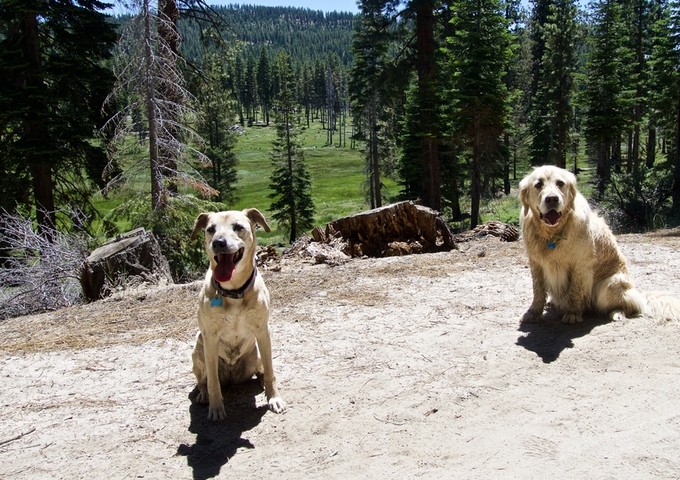
AJ and Cody are content to stick with the trail and not run in the meadow. Photo/Kathryn Reed

At least on June 29 there were no signs of wildflowers, but as the meadow dries out a bit that will change, and may already be doing so.

The lush green meadow is so incredibly vibrant. It looks like it would be wonderful to run through, maybe even bring a blanket for a picnic.

We stayed on the trail, though, which got a little buggy. I can only imagine how bad it would have been in the thick grass.

Tall conifers surround the meadow on all sides. Aspens are in abundance as well, which makes me think this would make for a beautiful fall excursion.

This area of Nevada was once a bustling timber haven that provided wood for the mines in Virginia City during the silver rush in the late 1800s. There are remnants of the old railroad grade. It was nice having it so wide so it was easy to have a conversation. The one mountain biker we saw made us think we might want to revisit the area on two wheels.

According to “The Saga of Lake Tahoe” by E.B. Scott, Capt. Augustus W. Pray was one of the first settlers in Glenbrook in 1860. The two volumes of this book reference Upper and Lower Pray Meadow.

Interestingly, most modern day references for the meadow spell Prey with and E. However, in Glenbrook there is a Pray Meadow Road.

At one time Pray owned hundreds of acres in Glenbrook and was instrumental in the lumber business.

“Pray and his associates — N. E. Murdock, G.W. Warren and Rufus Walton — felled, barked and faced sugar pine to build a crude log cabin, splitting cedar for the shake roof. They harvested the wild hay that grew abundantly on the rich bottom land of the meadow and planted grain and vegetables,” the book says. “In the rarefied mountain air a yield of 60 bushels of wheat and 4 tons of timothy hay per acre was not unusual, while oats grew 7 and 8 feet tall.”
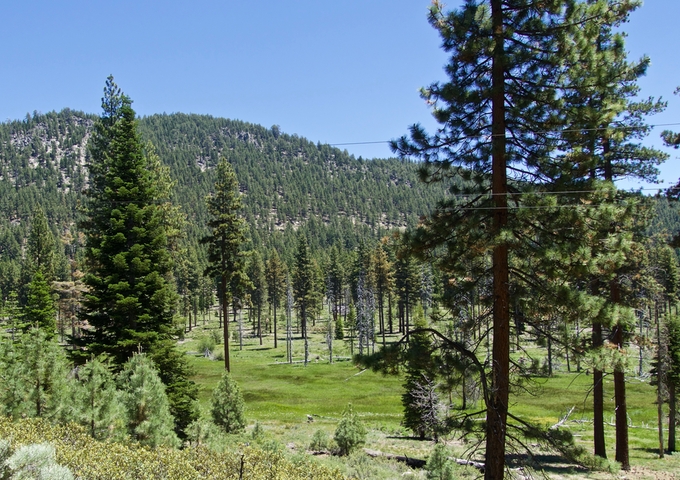
Going to Pray Meadow is the long way to get to Glenbrook. Photo/Kathryn Reed

—–

Getting there:

From South Lake Tahoe take Highway 50 east. Turn left on Highway 28 toward Incline Village. Go about 2.3 miles, park on the left. There is a gate leading down. A trail will intersect with this one, take it to the left. If you go straight, you will hit Skunk Harbor.


Why are coyotes so polarizing?

By Lawrence Lenhart, High Country News

First things first: Coyote. When you read the word, how many syllables do you hear? Your answer, according to Dan Flores, author of Coyote America, may be “immediately diagnostic of a whole range of belief systems and values.” The ki-YOH-tee versus ki-yote divide is one of the best indicators of a person’s coyote politics, a nearly hard-and-fast way that we subconsciously identify ourselves: as defenders of the species, in the case of the former, or as a manager, shooter and/or trapper, in the latter.

In “Coyote America,” Flores occasionally assumes the mantle of coyote’s head of public relations, demonstrating how the species, once “dead last in public appeal — behind rattlesnakes, skunks, vultures, rats, and cockroaches,” overcame its stigma as “varmint” to become a darling among the very people who most infrequently encounter it — modern-day urbanites.

More often, though, Flores is content to serve as a guide to the species, relaying the coyote’s complicated natural, cultural, political and mythological histories. It is why Flores describes his book as, “in most respects, a coyote biography.”

Read the whole story