Eldorado Forest implementing fire restrictions

Fire restrictions go into effect in the Eldorado National Forest on Aug. 18.

Wood and charcoal fires will be restricted to designated recreation sites and other fire related activities will be prohibited until the end of fire season. Gas or propane fires are allowed with a free 2017 California campfire permit.

On USFS lands, fire restrictions mean:

  • No wood or charcoal fires are allowed outside of exempted recreation sites even with a valid campfire permit.
  • No smoking, except within an enclosed vehicle, building or exempted recreation site.
  • Operating a welding or other torch with an open flame is prohibited.
  • Operating an internal combustion engine without a properly operating spark arrestor is prohibited.
  • Lanterns and portable stoves using gas, kerosene, jellied petroleum or pressurized liquid fuel are allowed with a valid 2017 California campfire permit.
  • Those with a valid 2017 wood cutting permit may cut firewood in compliance with the terms of their permit.

Complete details regarding the 2017 fire restrictions, including the list of designated recreation sites, is available online.


Camp Rich bike trail to be off-limits at times

Beginning next week, the Pope Baldwin Bike Path near South Lake Tahoe will be subject to traffic control while crews thin trees around the bike path. Flaggers will intermittently close the bike path for up to 30 minutes at a time for public safety during the tree felling operations. 

This phase of the project will take place Monday through Friday from 6am-3pm and is expected to last several weeks. 

Bicyclists may use the bike lane on Highway 89 to detour around the traffic control areas.

This project involving mechanical cut-to-length thinning near Pope Beach is under way. This involves using a harvester to cut the tree down, remove the limbs and cut the tree into sections in the cutting area. For public safety, the Forest Service advises people to avoid these areas due to the hazards posed by heavy equipment and falling trees.  Hazards may be present even when operations have ceased for the day. Work is expected to continue through mid-October.    

The forest thinning is part of the South Shore Hazardous Fuels Reduction and Healthy Forest Restoration Project, which aims to treat approximately 10,000 acres on the South Shore of Lake Tahoe over the next few years.


Star Guide: Cosmic scavenger hunt

By Tony Berendsen

The Milky Way in August as seen from the North Shore of Lake Tahoe is spectacular to behold on a moonless evening. Breaching as a gigantic silvery whale our galaxy’s shape towers across the sky through the constellation of Cassiopeia and at the South Shore it’s heart is exposed near the constellation of Sagittarius, the galactic center.

To gaze upon our galaxy with the naked eye conjures thoughts of the immensity of the cosmos. To explore its star fields and dust lanes with binoculars is a visual adventure where discovery meets imagination and beckons the realization of our smallness.

A fun way to explore our galaxy’s neighborhood is with a cosmic scavenger hunt. Here is list of items: Swan, Harp, Dolphin, Arrow, Eagle, and Coat Hanger. The best way to find all of these is to head out under the starry sky about 9pm and find the summer triangle stars, Vega, Deneb, and Altair.

You will find the Swan near Deneb, the Eagle near Altair, and the Harp by Vega.

The dolphin (Delphinus) is a little more difficult to find since its stars aren’t as bright as the summer triangle, so grab a star gazing app like SkyPortal and ask it to point the way.

Next try for the Arrow (Sagitta), which is closer to the center of the Milky Way band within the Summer Triangle; an app can help with this too.

Within the summer Milky Way the bright star Vega in the upper left and Altair the lower right. Photo/Ryan Berendsen

Last, the most difficult item: The Coat Hanger (Brocchi’s Cluster). It’s a little asterism shaped like an upside-down coat hanger that is just off the side of Sagitta and below the star Albireo in the Swan. Binoculars will help you find the six stars that form the bar of the hanger, and the another four forming the hook. It’s upside down position in our northern latitude prompts some people to call it the Ski Lift.

Interestingly, the Coat Hanger has been known for more than 1,000 years for its distinctive shape and grouping of relatively bright stars within the Milky Way. It was once thought to have been a galactic cluster (stars bound in gravitational association), but recent measurements by astronomers have determined the stars are just a chance alignment making them look like they are close to one another from our viewpoint.

The reclassification of the Coat Hanger from a cluster to an asterism is just one example of our evolving understanding of our view in to space.

A cosmic scavenger hunt is not your usual hunt because once you have found all these items you don’t really have them in possession as proof you have found them. But you now know where they are and can return to them on any dark cloudless night of the summer. It may be there will be other hunts in your future? There are plenty of items like the Coat Hanger, not easy to find, but rewarding just the same, helping you find your way around the galaxy.

Tony Berendsen runs Tahoe Star Tours. He may be reached at 775.232.0844 or tony@tahoestartours.com.


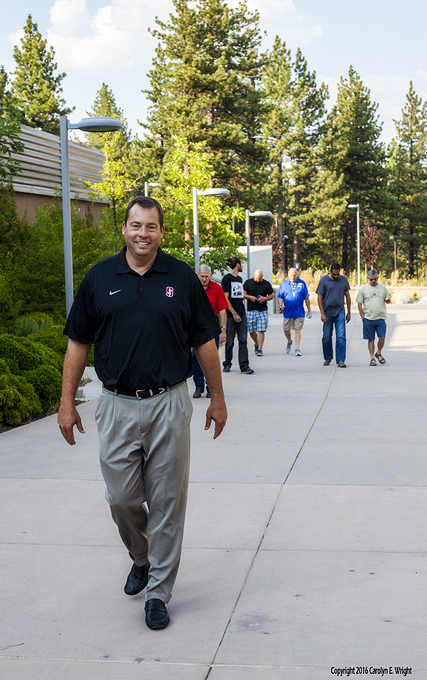
Haase talks about what’s ahead for Stanford basketball

Jerrod Hasse, a South Tahoe High alum, is eager for the 2017 Stanford basketball season. Photo Copyright 2016 Carolyn E. Wright

By Judy Horst, InMenlo

Stanford men’s basketball coach Jerod Haase wanted to play for Stanford while growing up in South Lake Tahoe, but attended Cal before transferring to the University of Kansas, playing for coach Roy Williams.

Haase highlighted Stanford’s upcoming men’s basketball season for the audience at the Menlo Park Kiwanis Club’s luncheon earlier this month, eventually yielding to questions from the audience.

“Since I wanted to play ball at Stanford many years ago, I’m very happy to be here and to start another era of Stanford basketball,” Haase said. “Stanford University is a world-class institution which represents excellence across the board. My goal is to continue this tradition. We will compete for championships by doing it the right way and graduating young men who will go on to accomplish great things in the world.”

Read the whole story


Tourism gurus want Amgen bike race to return

By Kathryn Reed

STATELINE — The South Shore is hoping nine months from now elite cyclists will be racing again on local roads.

The Lake Tahoe Visitors Authority board has given staff direction to try to bring the men’s and women’s Amgen bike events back to town.

The event will be May 10-19, but the route has not been picked. Cities wanting to host a leg are putting their bid packages together now, with an announcement expected in October.

It cost LTVA about $270,000 this year to host two stages for the women. This was more than what was budgeted mostly because additional signs were needed because of all the twists and turns the route took in the Carson Valley. Law enforcement and publicity came in a little above budget as well.

While most events LTVA is involved in are about putting heads into beds, not so with the bike race.

“It is really about the media value and the message that we are a cycling destination,” Executive Director Carol Chaplin told her board last week.

Most of the 5.7 million impressions about the Tour of California being in Tahoe were via social media. The value is worth $1.6 million, which doubled last year’s figure.

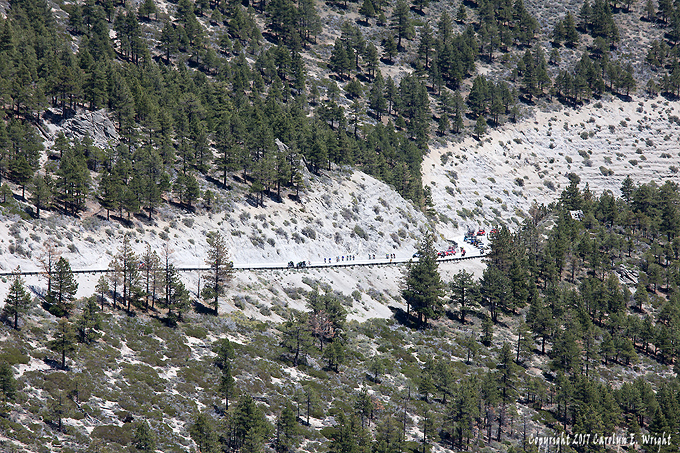
Climbing Kingsbury Grade in May made for one of the most difficult legs of the Amgen bike race. Photo Copyright 2017 Carolyn E. Wright

This event has a good international draw, which is perfect for LTVA which is continually trying to expand that market.

While the women’s event is not televised live, portions of it are woven into the men’s coverage.

The men have a bigger draw in terms of spectators and TV audience. This is in part why LTVA would like another stab at the men. They were here in 2011 for the aborted race (snow was the problem) and finished a leg in 2016. The women have been here the last three years.

LTVA board member Pat Ronan suggested the tourism bureau hire a helicopter to record the race. That might add another $25,000 to the budget. A vote on that idea would come after Tahoe is awarded a leg of the race.

The agency had looked into getting drone coverage, but it is illegal to fly over people.

Bryan Davis, the board member who represents Edgewood Companies, talked about how at the celebrity golf tournament they flew drones to the side and not directly above people. This could be a future option as well. LTVA would then have that footage to use in various marketing endeavors, or just reach an interested cycling community. Contracts with the event’s sponsors would play a role in what is allowed as well.

The idea would be to capture strategic locations that show off what the region has to offer in terms of beauty (Emerald Bay, Sand Harbor, Cave Rock) and intensity for riders (Spooner Summit, Kingsbury Grade, Luther Pass).

With Reno just being awarded the Interbike trade show starting in 2018, local tourism gurus believe this will be a complement to Tahoe’s hosting elite cycling events like Amgen and establishing the region as a cycling destination.


2-day mountain bike-beer event in Meyers

The 5th annual Tahoe Mountain Bike and Brew Festival in Meyers is Aug. 26-27.

The free festival staged at Divided Sky will include live music, beer garden, barbecue, kids zone, vendors, and lots of riding.

The latest bikes from Ibis, Specialized, Trek, Norco, Pivot, YT Industries, Intense, and Rocky Mtn will be available to try. Local breweries include South Lake Brewing Company, Lake Tahoe Aleworx, Coldwater Brewery and 50/50 Brewing.

For more information and to sign up for rides (some cost money), go online.


Reward offered to catch Nev. lake invasive fish dumper

By Scott Sonner, AP

Nevada game wardens who spend most their time hunting down big-game poachers are focusing on a serious threat to nature in a lake: An invasive fish species that eats all the other fish prized by anglers and then turns cannibalistic.

The Nevada Department of Wildlife is offering a $10,000 reward to help nab the culprit who apparently dumped Northern pike in Comins Lake, a popular fishing spot surrounded by mountains near Great Basin National Park.

By all accounts, Comins Lake was well on its way to recovery after the state restocked the fishery with largemouth bass, brown and rainbow trout in 2015.

Read the whole story


Tahoe scientists studying secret travels of thrush

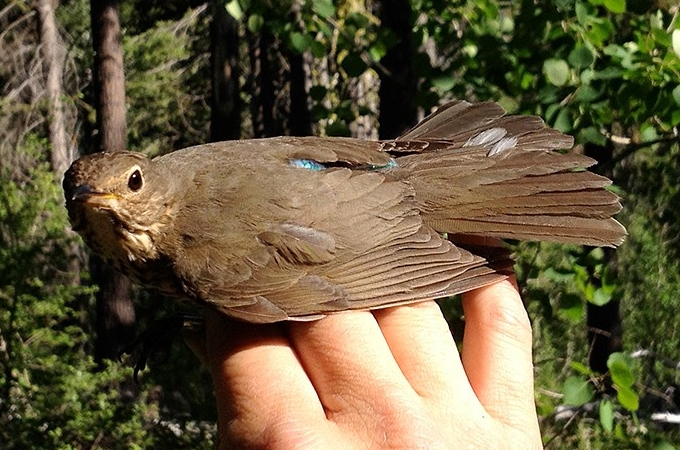
A rare Swainson’s thrush before being outfitted with a tracking device. Photo/TINS

By Jim Sloan

In 2009, Will Richardson was doing some summertime bird-monitoring research in aspen stands in Ward Canyon near Lake Tahoe when he heard an unexpected birdsong.

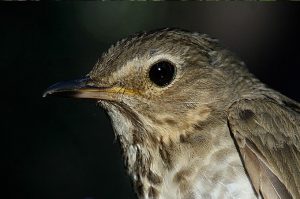
It was a high, pleasing, spiraling song, like a flute, and he recognized it right away as the song of a Swainson’s thrush, a bird that had all but disappeared from Tahoe and the Sierra south of Yuba Pass.

He heard one bird singing and then he heard others responding. To his astonishment, he realized that there was a small colony of the elusive bird.

“It floored me,” said Richardson, executive director of Tahoe Institute for Natural Science. “I always expected to see them and always wondered why they were never there. So, it was pretty thrilling to find a pocket of survivors.”

Richardson had studied thrushes in Vermont and Canada years before and had earned his doctorate in ecology, evolution and conservation biology from the UNR by studying bird communities in Sierra aspen habitats. He knew that Swainson’s thrushes had been common at Tahoe years ago and that their disappearance from Tahoe and other areas of the Sierra was considered “one of the unresolved mysteries of Sierra Nevada ornithology.”

He decided to investigate. He wanted to find out if the birds were declining, stabilizing, or rebounding in the Tahoe region.

He knew that Tahoe had plenty of habitat to attract the bird, which favors aspen forests and dense, riparian thickets. So, to explain its small numbers, he reasoned that he would need to learn if the bird’s wintertime habitat had changed in a way that affected its resiliency. That meant capturing birds twice.

First he had to catch some and attach a tiny tracking device. Then, the next year, he had to catch the banded birds a second time to retrieve the data. Not a simple proposition.
Secret to scientific success: Know how to pick a fight
To capture Swainson’s thrushes for his study, Will Richardson of the Tahoe Institute of Natural Science said he “basically picks a fight with the bird.”
He sets up nets in a bird’s known territory and plants decoy thrush in a tree. Then he sneaks off a short distance and plays a sound of the Swainson’s thrush’s spiraling woodwind song. Other thrushes, intent on protecting their territory, swoop in to drive off the invaders. Some get caught in the net.
Richardson removes them, takes measurements, attaches leg bands and the tracking device, and
releases them. The next summer he plays the same trick and tries to recapture the same birds.
“You basically need to catch the same bird twice, and that’s not easy when you consider how few birds there are to begin with,” Richardson said.
While he’s not sharing the location of his Ward Canyon site, Richardson said birdwatchers can find Swainson’s thrushes along Strawberry Creek just below the Lover’s Leap trailhead (off Highway 50 west of Strawberry Lodge), along General Creek at Sugar Pine Point State Park, and along the Upper Truckee River near Hawley Grade south of Christmas Valley.
Swainson’s thrushes are more likely to be heard than seen. Their song has a “ventriloquial quality” that makes them difficult to track. They also fly around quickly, and sometimes they use a quiet song that sounds like it’s farther away than it actually is. — Jim Sloan

Although Swainson’s thrush has an estimated global breeding population of 100 million birds, the species has lost 38 percent of its numbers since 1966, according to the Cornell Lab of Ornithology.

The bird breeds in the north and migrates in fall to Mexico, Central America, and northern South

America. Birds from the majority of the United States and Canada winter in South America while the

Pacific Coast population migrates to Mexico and Central America.

According to researchers at Cornell, Swainson’s thrush is particularly sensitive to such breeding habitat problems as grazing, development, human activity, and nonnative invasive plants.

Migrating Swainson’s thrushes are killed — in greater numbers than any other bird species — by collisions with windows, radio and cellphone towers, and tall buildings.

In 2014 and 2015, with financial support from the Sierra Foothill and Sacramento Audubon Society chapters, TINS and colleagues at the Point Reyes Bird Observatory captured more than three dozen thrushes from Ward Canyon, Strawberry Creek, and Plumas County locations and equipped them with one of two tracking devices.

In subsequent summers, the team recaptured 15 of the 46 originally tagged birds. What they have learned has surprised them.

The Tahoe birds from Ward Canyon and Strawberry Creek were not migrating to Mexico, as Richardson

had theorized, but were joining eastern birds for a trip to northern South America. The Plumas County birds, meanwhile, were “bopping all over the place,” with some making their way to Central America.

One Swainson’s thrush from the Quincy area spent the winter in balmy Panama.

The conclusion? It’s too early for solid theories yet, Richardson said. His colleagues are still breaking down the data collected from the tracking devices, and another colleague from UC Santa Cruz is doing genetic tests on feathers from the captured birds.

Richardson hopes that additional data will shed some light on the habits of the Swainson’s thrushes spending their summers at Tahoe. He also plans to monitor the thrushes’ nests to determine how many young they produce at places like Ward Canyon. It will be a few more years before any solid theories emerge.

In the meantime, he’s encouraged. “It’s great to know these birds are coming back to the same location each year,” he said. “They are producing young here, and that’s also encouraging. We know babies are produced, but whether there are enough young to sustain the population still isn’t clear.”

This article is republished from the summer 2017 edition of Tahoe In Depth.



Eclipse turning into a social event

By Mike Wolterbeek

When some people hear that 83 percent of the sun will be blocked, they might assume it’s just another day in January. However, when 83 percent of the sun is blocked in the middle of August, people will notice.

During the late morning hours (9:04-11:43am of Aug. 21) residents in the greater Lake Tahoe Tahoe area, along with the rest of North America, will be in the path of a solar eclipse, an astrological event where the moon passes between the sun and the Earth, blocking Earth’s view of the sun. 

This is a rare event, with the last total solar eclipse in North America took place in 1979, during the Carter administration, and the next total eclipse expected to come in 2024.

While this region will not be in the 70-mile-wide path stretching from Oregon to South Carolina where the sun is completely blocked, Reno is expected to see more than four-fifths, 83 percent to be exact, of the sun blocked. This means that you don’t need to travel to get some moon shade. 

At this point, director of UNR’s  Fleischmann Planetarium and Science Center Dan Ruby would advise against traveling. In an email, he said people who haven’t already booked hotel rooms and planned ahead of the solar eclipse shouldn’t travel to see the full eclipse in that 70-mile ribbon because the crowds are expected to overrun the communities and stress their resources.

David Bennum, a physics professor with the university’s College of Science, cites the increased amount of travel during this time as another piece of proof of the social nature of the solar eclipse. “Most of the people who are traveling are not scientific people,” he said. “It’s a great social event, it’s a dramatic event.”

While Bennum’s teaching duties won’t allow him to travel to see the total eclipse, Ruby is planning on traveling to Oregon to view and study the eclipse. He is planning on taking pictures, filming videos, and posting to various social media channels of the University and the Fleischmann Planetarium.

Ruby said the solar eclipse is a useful scientific tool because it allows for the study of the corona, the outer ring of the sun since the rest of the sun is so bright that the corona cannot be seen. Even though, Bennum said, modern technology, like solar telescopes, can allow for the corona to be seen anytime.

The morning hours prove to be an added bonus for the solar eclipse since it allows for student’s class time to be devoted to observation, something both Ruby and Bennum are excited about. As a part of the eclipse celebration, the University’s planetarium has teamed with the Washoe County School District to give all students in the district a pair of safe solar viewers.

A major precaution and a minor investment for people who want to view the solar eclipse is to obtain a pair of viewers specifically designed to look at the solar eclipse. Going without visors, or even standard sunglasses, would cause significant damage to the eyes. Fleischmann Planetarium is offering specially designed eclipse glasses with the University and Fleischmann Planetarium logos on it for $2 each, and plain white viewers with no logos or designs for $1 each, when bought in bulk, 25 or more, for educational and non-profit purposes. Ruby cautioned against buying viewers online, as it is hard to verify the viewers are certified and suitable for safe solar viewing.

“The importance of eye protection cannot be stressed enough,” he said, equating the sun to a giant nuclear reactor in space. Even 15 percent of the sun, which will be viewable in Reno at its peak coverage, is enough to cause permanent eye damage. When asked for any last comments on the solar eclipse, Bennum also cited the need for eye protection. Aside from glasses, he also noted that solar telescopes, like the ones the University has, can block out more than 99.9 percent of the sun.

In the Fleischmann Planetarium Dome Theatre is a special show about solar eclipses that will be shown daily at 1, 3 and 5pm, with an additional 7pm show on Mondays through Saturdays in August.

Mike Wolterbeek works for UNR.


Walk to benefit National Multiple Sclerosis Society

More than 400 people are expected to raise more than $30,000 at Walk MS: South Lake Tahoe on Sept. 16, which will take place at Camp Richardson.

In 2016, nearly 300,000 people at more than 550 locations across the country walked to create a world free of MS, raising nearly $50 million. Since 1988, hundreds of thousands of people have taken part in Walk MS events across the country raising critical funds and awareness for the National Multiple Sclerosis Society. This year, the cumulative fundraising is expected to surpass $1 billion.

Check-in opens at 10am; walk begins at 10:45am.

For more info and to register, go online.