Forest Service seeks comments on invasive species program

The U.S. Forest Service Lake Tahoe Basin Management Unit is seeking comment on a proposal to use a combination of manual and chemical treatments to control, contain, and/or eradicate Terrestrial Non-native Invasive Plant Species throughout the Lake Tahoe Basin Management Unit.

The LTBMU has prepared an Environmental Assessment (EA) in order to evaluate the treatment of known infestations found in 493 locations around the basin. The alternatives include chemical treatment for up to 100 infested acres annually and as many acres as feasible for mechanical, manual, or thermal treatments over the next 10 years.

Non-native invasive plant species reduce the amount and quality of fish and wildlife habitat, increase erosion, and impair recreational access. Invasive plants can spread rapidly, especially where there are soil-disturbing activities, because their populations are not controlled by plant-eating wildlife, pathogens and competitors present in their native habitat.

A detailed description of the project including the EA and map is available for review at the Lake Tahoe Basin Management Unit, 35 College Drive, South Lake Tahoe and online at http://fs.usda.gov/goto/ltbmu/InvasivePlantTreatment. Written, facsimile, hand-delivered, oral, and electronic comments concerning this action will be accepted until mid-August.

For further information, contact Cheryl Beyer at (530) 543.2842 or by email cbeyer@fs.fed.us.


Rubicon Trail users get a lesson in cleaning up waste

jeepBy Carlos Alcalá, Sacramento Bee

Rarely does a humble county road become a legend.

That, however, is the status of the El Dorado County route known as the Rubicon Trail.

Though it is more a collection of granite obstacles than a road as that word is generally understood, the Rubicon is a mecca for those who drive off-highway vehicles.

“We get people from all over the world,” said Vickie Sanders, who coordinates Rubicon programs for the county.

Read the whole story


Land deal could reroute South Tahoe Greenway bike path

By Kathryn Reed

An opportunity to buy the largest remaining parcel of private property along the Upper Truckee River may cause planners to change gears when it comes to the Meyers to Stateline bike path.

The approximately 212 acres known at the Johnson Meadow (in the ranching world a parcel is named after the previous owner not the current one) could be acquired by the California Tahoe Conservancy. It wasn’t until just recently that the landowner indicated a willingness to sell.

“There’s no agreed upon price. We’ve just started talking,” Bruce Eisner, with the CTC, said. But he said it would be in the millions.

Bill Mosher talks about his family's land. Photo/Kathryn Reed

Bill Mosher talks about his family's land. Photo/Kathryn Reed

Bill Mosher, whose family owns the land by the river east of the Lake Tahoe Airport to about Grocery Outlet, has fond memories of his family running cattle on the land for decades.

Standing along the river by the airport, Mosher points to the undeveloped land on the other side. Those 125 acres known as the Lyons Ranch East were sold to the Conservancy in spring 2008 for $6.2 million. The Lyons owned it in the 1800s. The Barton-Ledbetter-Mosher clan had it for more than 100 years.

Now the Mosher family is in negotiations with the CTC to sell another stretch of land. Finding the money puts a big asterisk on the reality of an acquisition ever occurring. Still, if the deal is consummated, it may mean altering the Conservancy’s plans for the 9.6-mile South Tahoe Greenway bike trail.

The much talked about path that at one time had been slated to break ground this summer, originally called for going through the Mosher property that is now being negotiated. This route would bring the trail closer to Highway 50.

In 2006, though, the Moshers would not consider selling.

That sent CTC officials back to the drawing board to scope out a different route. That route has the trail close to Pioneer Trail. The administrative draft Environmental Impact Report for the project has the Pioneer linkage in it.

“The potential for public acquisition on this property brings forward a lot of questions for phase three,” Sue Rae Irelan, who has led the charge on the project, told the CTC board last week.

In order to move forward with the project, the Conservancy wants to build phases one and two while the land issue involving phase three gets worked out.

The first two phases are the eastern portion of the trail, with the latter being the Meyers section.

It will be a Class I trail, meaning the path is separated from vehicles and will accommodate various uses. In most places it will be 10-feet wide, with a grade no steeper than 5 percent. This allows access for wheelchairs and easy passing by cyclists or hikers of people pushing strollers.

Snow removal in the winter is not likely. The trail could be used by cross country skiers or snowshoers.

Irelan said the plan is to have environmental documents ready for public review in early 2011. Construction could begin in 2012. Each phase is likely to take more than one building season.


John Muir Trail hike to bring awareness to rare disease

By Jacqueline Baylon, Sacramento Bee

Hiking all 211 miles of the John Muir Trail from Yosemite to the summit of Mount Whitney is a challenge for any hiker. For Annette De Bow, the difficulty is multiplied.

De Bow, 44, has a rare, chronic blood disease called polycythemia vera, which means her bone marrow makes too many red blood cells that can set off a domino effect of health troubles if not kept in check.

In an effort to raise awareness of her disease – and money for research into polycythemia vera – De Bow will set out on a “Trek for a Cure” along the John Muir Trail.

Read the whole story


Man will attempt swimming length of Tahoe to raise money

By Siobhan McAndrew, Reno Gazette-Journal

It won’t matter if there are record-high temperatures on Aug. 21 and 22. Ken Harmon will be cold.

The 50-year-old will try to swim a dual length of Lake Tahoe, 44 miles, in a nonstop swim for charity. The experienced long-distance swimmer will swim without a wet suit, in water about 70 degrees, for more than 24 hours to raise money for three charities that support the Down syndrome community.

“It is awe-inspiring to swim that lake,” said Harmon, who swam the length of Tahoe in 2005 in a record-setting 11 hours and 19 minutes.

“It makes you feel as if you are a very small part of this world.”

Read the whole story


Upper Truckee River set to meander more naturally

By Kathryn Reed

In many ways, the segment of Upper Truckee River behind Lake Tahoe Airport looks anything but natural.

Guys are out there with what looks like a fire hose watering vegetation. Black berms filled with water are close by. Pumps are draining what will be the new channel.

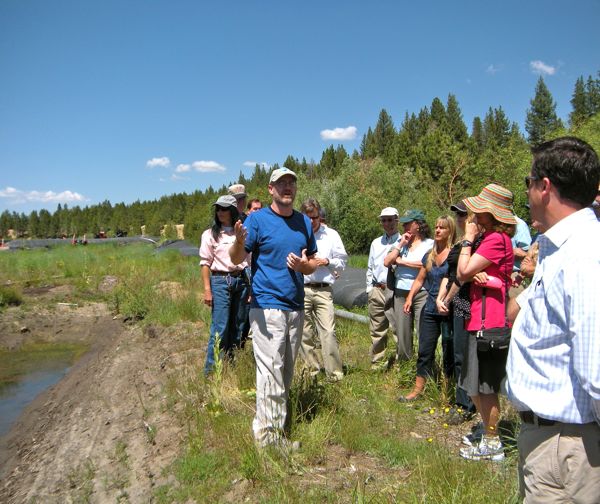
Scott Carroll, center, talks about the new river channel behind him. Photo/Kathryn Reed

Scott Carroll talks about the new river channel behind him. Photo/Kathryn Reed

It has the look and feel of a construction zone because it is one.

It was two years ago this month the California Tahoe Conservancy board took a field trip to this location for the ground breaking of the multi-million dollar project that will re-route the river to its more natural curves and bends. The board re-visited the site as part of this month’s meeting.

“By creating meanders, we create diversity. We will rebuild a whole food web,” explained Scott Carroll, the CTC staff member who led the tour.

Diversity comes in the depth of the channel, the plant species as well as wildlife.

A channel was dug closer to the airport, but not far from the current flow to mimic what the river would have looked like before it was straightened out years ago for ranchers’ needs.

In a matter of days officials are expected to make a decision as to whether the vegetation has taken root enough to start using the new channel.

“This vegetation is like rebar in a concrete building. It’s what will hold the bank,” Jennifer Taylor, assistant engineer with South Lake Tahoe, said.

Planning for the project cost $1.4 million, with construction coming in at $6.6 million.

Two concrete fish barriers farther upstream were removed.

Carroll said this type of project is designed to be sustainable so maintenance is not needed in the future.


Tahoe Rim Trail looking for trail builders

Join the Tahoe Rim Trail Association for volunteer trail building workdays at the Kingsbury North Trailhead in Stateline on the Daggett Summit Trail System Project. Workdays are Tuesdays and Saturdays (9am to 4pm) in July.

Learn new skills, meet like-minded trail enthusiasts, and give back to your community by joining a volunteer trail crew. Volunteers of all skill levels and ages are welcome—no prior experience necessary. To join a volunteer work crew, register online at www.tahoerimtrail.org or contact Amanda at (775) 298.0239 trails@tahoerimtrail.org. Groups are welcome to participate. Registration is necessary,

This is the second trail building season of the multi-year Daggett Summit project, which will connect the Tahoe Rim Trail with the Van Sickle State Park, re-route the TRT off of paved roads, and provide stunning views of Lake Tahoe to more people.Last year we 3.8 miles of trail were built.

Volunteers should bring their own lunch, water, sunscreen, bug spray, and backpack. Volunteers must wear long-sleeved shirts, long pants, boots, and work gloves. The Tahoe Rim Trail Association will provide hard hats, trail building tools and expert crew leaders.

Trail Building Workdays:

July 20 at Kingsbury North Trailhead Stateline

July 24 at Kingsbury North Trailhead Stateline

July 27 at Kingsbury North Trailhead Stateline

July 31 at Kingsbury North Trailhead Stateline.


Tahoe Derby Dames bring a feminism-punk style to oval

By Austin Fay

A blur of black and green whizzes by with clenched fists and bared lime-green mouth guard. She earns one point for each of the five members of the opposite team she laps during a two-minute period, or “jam” in roller derby lingo.

Trying to block Carey “Crazy” Jenkins, several of her opponents hook skates and tumble, arms outstretched they cross the rink and nearly land in the pine cones at trackside.

Roller derby is all the rage at Bijou Community Park. Photos/Austin Fay

Roller derby is all the rage at Bijou Community Park. Photos/Austin Fay

For the past two and a half years, the Tahoe Derby Dames have been colliding with other teams.

The team consists of about 20 Lake Tahoe Basin women who love road rash and full contact competition. In addition to making cash donations to local charities, they raised $10,000 to pay for a cement track in Bijou Community Park through ticket sales at home games.

Three nights a week the Tahoe Derby Dames sharpen their craft in anticipation of the next monthly bout.

At the last bout in Bijou Community Park, more than 400 people showed up to cheer their local derby girls on. At this month’s bout the team is expecting even more people.

Make no mistake about it, this kind of roller derby is real and on its way to becoming officially sanctioned by the Women’s Flat Track Derby Association.

Points are scored by a skater called the “jammer” who passes the opposing team’s skaters in the pack. It’s essentially two skaters racing against each other, dipping and diving through a cluster of women who don’t want them to pass.

That’s where it gets a little brutal as the players try to block one another. There are strict rules about where contact can take place, but roller derby is a physical sport.

Roller derby has been around for much of the past century. It became popular in the 1960s and ’70s as sports entertainment, with scripted matches and action punctuated by good guys and gals beating the evil team.

Drew Barrymore helped bring roller derby back in vogue with the movie “Whip It” in 2009.

Today’s players are an unusual blend of feminism and punk, raw strength and agility. It is a game of strategy, too, and many of the over-the-top track characters contrast the athletes’ meek or highly accomplished real lives.

The games became so popular that the Women’s Flat Track Derby Association was established in 2004 to promote the sport by “facilitating the development of athletic ability, sportswomanship and good will among member leagues.” Not all women’s roller derby teams belong to the league, but the league hopes to offer rookie groups like the Tahoe Derby Dames an opportunity to join.

Former coworkers, loose social connections and enthusiasts now make up a loyal team with a camaraderie not found in many places in the players’ lives. A recent dive taken on the “really, really, really hard track” by Hollie “Jinn Beam” Straubinger caused a gnarly imprint of her fishnet stockings on her hip which later led to a staph infection.

With names like Piratella, Valigator, Ghostface KillHer, Ganjzilla, and Poisoned Peach, derby names become alter egos.

“Typically in your everyday life, you’re a mom, you’re an employee, you’re a wife, that sort of thing. When they come on the track, they put that all aside,” said the hard-as-nails referee Kera “Lepra C” Amsterdam. Some players like Julie “Mad Maggie” Roulain come out three nights a week to relieve stress or to decompress from her daily life.

Christine Mendoza works is a physical therapy assistant at Barton Memorial Hospital by day, but three nights a week assumes a persona on the rink better known as “Fiona Fearless.”

Players maneuver jobs, stress, children and husbands the other four nights of the week. “It becomes a juggling act,” Mendoza said.

“It’s something I’ve wanted to do since I was a kid. I’ve just never lived in a town where there was a team,” said Allison Green, schoolteacher and three-week Tahoe resident clad in mismatched loaner kneepads and wrist guards. “I’m here to allow my inner badass to come out.”

Endurance is what it will boil down to in the upcoming match. The next bout is against the Silicon Valley Killabytes and will probably be one of the toughest teams the league has faced yet.

The Killabytes are a bigger, more advanced, sea-level dwelling team, so taking advantage of the low oxygen concentration in the air along with a strong home team turnout is essential for the team’s win. Last home game a player was suspended for throwing an elbow, which is illegal. There’s a chance she’ll be out for the season.

The team is always recruiting new girls, with newbie practices on Monday nights at 6. Helmet is required.

The Tahoe Derby Dames lock horns with the Silicon Valley Killabytes on July 24 at 6pm. Gate’s open at 5, and there’s a beer garden, a raffle. Bring a lawn chair to Bijou Park off Al Tahoe Boulevard. The cost is $10, with those 10 and younger free. Plus, it goes to a good cause. Relay for Life receives the first $200.

ngg_shortcode_0_placeholder (Click on photo to enlarge.)


Tolliver scores ACC record win; fans turn out in droves

By Emerson Marcus, Reno Gazette-Journal

STATELINE — Even with an 11-point lead, Billy Joe Tolliver refused to change his strategy today in the final round of the American Century Championship at Edgewood Tahoe Golf Course. His final drive was proof.

The 44-year-old former NFL quarterback blasted a 373-yard drive that set him up for a 128-yard approach shot, an eventual eagle and an all-time tournament record score.

Billy Joe Tolliver kisses his third ACC trophy on July 18. Photo/Provided

Billy Joe Tolliver kisses his third ACC trophy on July 18. Photo/Provided

“He rope hooked it and it was the biggest drive I’ve ever seen on that hole,” said actor Jack Wagner.

Tolliver went into the final hole tied with former quarterback Chris Chandler’s 2007 record of 78, but gained six points with the eagle on the 18th hole and finished with an 88. It was his third ACC win (1996, 2005 and 2010).

Read the whole story


Detour leads to tranquil falls near Markleeville

By Kathryn Reed

MARKLEEVILLE — Closing my eyes I’m taken some place more distant than the 1.5 miles I hiked. The rushing water makes hearing difficult unless one speaks in a loud voice. It’s one of those times when listening to Mother Nature seems like music that can never be replicated.

Nothing on my iPod sounds so wonderful.

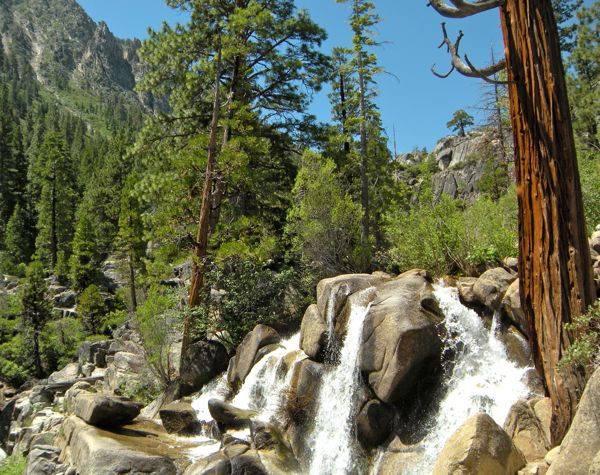
Waterfalls in Grover Springs State Park. Photos/Kathryn Reed

Waterfalls in Grover Hot Springs State Park. Photos/Kathryn Reed

Opening my eyes it’s a sea of blue. The sky above seems to be tickled by some of the distant pine trees. Leaves dance in the, oh, so gentle breeze.

The crystal clear water makes me want to lap it up as though I were a canine.

Granite boulders of all sizes beckon to sit or lie upon. Completely vertical, I don’t want to move. I am so incredibly relaxed.

The few people in the opposite direction along this trail outside the campground at Grover Hot Springs State Park all had smiles. I now understand why.

Others are also dipping their toes into the icy cold and ironically named Hot Springs Creek and her pools that sit above the magical falls.

Our destination for the day came with a detour thanks to Linda, the extremely friendly State Parks employee. If it weren’t for her, we may have never gone to the falls. The $8 entrance fee was worth the trek to the falls, let alone the rest of the hike.

The state park is best known for the hot springs that are 4 miles from the heart of the town of Markleeville. As the county seat for California’s least populated county, Markleeville is a blip on the map. This outdoor mecca is a short drive from South Lake Tahoe via Highway 89 over Luther Pass, with a left on Highway 88. Then, just follow the signs.

Driving into the park, go to the end of the day use area. Start the hike by making a left at the gate. The falls are an easy 1.5 miles up mostly a wide path. Getting closer to the falls, the trail has several offshoots. Just listen to the roar of the water to find them.

It’s easily one of those places where you could spend a lazy afternoon. Unfortunately, that was not on our agenda. We were there to get in a more ambitious hike.

After what I considered a way-too short of a stay by a little wading pool above the falls, we made our descent only to begin our real climb.

Linda, the park employee, didn’t exaggerate when she said the hike to Charity Valley is steep.

Markleeville is at an elevation of 5,500 feet; Grover is at 5,800 feet; we went to 7,267.

The soft, single-track trail is not gradual. It’s vertical. Without the shade of the massive pines and cedars, it would have been unbearable on this Sunday in July.

Surprisingly, it wasn’t that far up for the evidence of the September 2008 Burnside Fire to show its blackened remains. Trees are forever scarred.

A smattering of wildflowers dot the landscape, bringing color to the forest floor – Indian paintbrush, lupine, tiger lilies and snow plants are in abundance. Ferns are at the lower part of the trail.

Butterflies flit about, seemingly oblivious to the only two people on the trial. Hawks soar overhead. A solitary deer stands still between the trees, making me wonder where her family is.

The trailhead had a warning about mountain lions. I didn’t think twice about it until seeing some unfamiliar scat on the trail.

Up, up and away the trail goes, until it’s above the tree line. Then views of the valley below and beyond open up. They make the sweat and heat bearable.

Finally, it’s decision time. Right for 2.5 miles to Burnside Lake, left into Charity Valley or a U-turn to complete an 8-mile day? The latter was the answer. The ridge we came to and the vistas along the way brought us views we are still talking about.

Going down it was a coin toss to know if a beer at the Wolf Creek Saloon in Markleeville or soaking at Grover Hot Springs sounded better.

We experienced both.

ngg_shortcode_1_placeholder (Click on photo to enlarge.)