Lake Tahoe sailing clinic for all levels

The Tahoe Windjammer’s Yacht Club is having its annual Community Sailing Clinic on July 14.

This event includes classroom instruction on basic sailing and boating safety in the morning and on-the-water instruction as a guest on a member’s sailboat in the afternoon. The clinic is open to men and women of all experience levels.

The club tries to match participants to boats according to abilities and interests to ensure the best sailing experience.

The cost of the clinic is $45 for the day and includes morning coffee and lunch. Applications are available online. Advanced registration is required. Space is limited. For more information, call Debbie at 530.318-0223 or Lynn at 530.544.1482.

The club is based out of the Tahoe Keys on the South Shore.


Tips for fire prevention at Lake Tahoe

By Lisa Herron

Summer officially arrived this week and recreational activities are in full swing in the Tahoe basin. The Tahoe Fire and Fuels Team would like to take this opportunity to remind visitors and residents that wildfires pose a serious threat to Lake Tahoe neighborhoods and communities and we need help to prevent any unwanted fires this summer. 

Whether camping, hiking or participating in some other activity in the forest, keep in mind the following advice to keep Tahoe fire safe.

Fireworks

The Fourth of July holiday is right around the corner. All fireworks including sparklers and firecrackers, are illegal in the Tahoe basin because of the wildfire danger they pose to our forests. Please leave fireworks at home and instead attend one of the amazing fireworks shows around the lake this July 4 holiday.

Campfires

Sadly, illegal campfires continue to be the cause of over 90 percent of all wildfires here at Lake Tahoe.  Please remember that campfires and portable charcoal grills are only allowed within metal fire rings and/or standup grills provided in designated campgrounds. Campfires and portable charcoal grills are not allowed on National Forest beaches, in Desolation Wilderness, Meiss Country, along Genoa Peak Road and the Tahoe Rim Trail, or in the general forest. Gas or propane stoves are allowed in all areas with a free, valid California Campfire Permit available at any Forest Service office. 

In addition, during periods of high fire danger, campfires in designated areas may be restricted. Before building a campfire, be sure to check with local fire districts or the Forest Service office to find out if restrictions are in place.

Learn to properly build, maintain and extinguish campfires and always keep a bucket of water and a shovel nearby. Select an open location away from trees and overhanging tree branches, logs, brush or dry vegetation. Keep the fire small and be sure that all logs fit within the fire ring. Never leave the campfire unattended and completely extinguish it using the “soak, stir and feel” method before leaving. Soak the fire with water and stir thoroughly. Using the back of your hand, feel for any remaining heat. Repeat as needed until the fire is completely extinguished and no hot spots remain.  

Sparks

Did you know that 95 percent of all wildfires are caused by human activity? Things like lawn equipment, debris burning, target shooting and vehicles can all cause sparks that may ignite a wildfire when used under the wrong conditions.

Lawn mowers, weed-eaters, chain saws, grinders, welders, tractors, and trimmers can all spark a wildland fire when used during hot, dry and windy weather. This type of equipment should be operated before 10am when the humidity is higher and never when it’s excessively dry, hot and/or windy. 

Residential burning is only allowed under specific conditions and in certain areas with a valid permit. Check with your local fire district to determine if burning is allowed in your area and if restrictions are in place. 

Target shooting under hot, dry conditions can spark a fire. When target shooting, be sure to choose an area free of dry vegetation and avoid shooting on hot, windy days. Use proper targets, such as clay pigeons and avoid shooting at metal targets or rocks. 

Vehicles should be properly maintained with nothing dragging on the ground. Dragging chains or any other type of metal can cause sparks that may ignite a wildfire. Practice proper towing by using appropriate safety devices and hitches that secure chains or other equipment. Don’t drive or park vehicles on dry vegetation. Hot exhaust pipes, mufflers and catalytic converters may ignite grasses and other vegetation. Properly maintain brakes and tires. Exposed wheel rims and brakes worn too thin can cause sparks.

Lisa Herron works for the U.S. Forest Service.


Enforcement being bumped up on water

Operation Dry Water is a year-round boating under the influence awareness and enforcement campaign.

The mission of ODW is to reduce the number of alcohol- and drug-related accidents and fatalities through increased recreational boater awareness and by fostering a stronger and more visible deterrent to alcohol use on the water.
 
Operation Dry Water’s heightened awareness and enforcement three-day weekend takes place annually around July fourth, a holiday known for drinking and boating, and deadly accidents. 

The 2018 Operation Dry Water heightened awareness and enforcement weekend will take place nationwide, June 29-July 1.


North Face joins the used gear movement

By Ariella Gintzler, Outside

As of this month, customers can purchase North Face apparel that’s been worn, torn, washed, and restored to like-new condition through a collaboration with the Renewal Workshop. 

The new site, called the North Face Renewed, launched earlier this month with a limited collection of refurbished items, mostly factory rejects and damaged returns. The items, which previously would have been unsellable, range from technical Summit Series outerwear to lifestyle apparel. Price drops range anywhere from 35 to nearly 50 percent.

“As we address the impacts of our products over their entire life cycle, re-commerce is an important next step in opening new markets and minimizing our impact on the planet,” said James Rogers, North Face sustainability director, in a press release announcing the project. “We are furthering our sustainability goals without sacrificing durability or technical standards.”

Read the whole story


Tahoe yellow cress planting at Baldwin Beach

On June 23 from 10am-noon the Sugar Pine Foundation will co-host a Tahoe yellow cress planting with the Tahoe yellow cress adaptive management working group at Baldwin Beach on the South Shore.

Lake Tahoe Basin Management Unit will host a TYC information booth at the Native Species Festival that day from 9am-3pm at the Taylor Creek Visitor Center. 

Tahoe yellow cress (Rorippa subumbellata) is a rare plant that grows on the shoreline of Lake Tahoe in California and Nevada. TYC exists nowhere else in the world and is on the endangered lists in both states. 

A lake-wide survey conducted in 2017, reported a decline in TYC with only 43 percent of surveyed sites occupied, compared to 80 percent in 2016, when the lake was several feet lower. In 2018, the lake level is expected to remain high throughout the summer. 


Sail boats compete in annual race on Tahoe

The boats start to race June 16 near the Tahoe Keys. Photo/Laura Rasmussen

Lake Tahoe Windjammers Yacht Club had its Southern Crossing race June 16.

This race featured a southwest wind that built to 20 mph, with gusts to 30.

It started just off Tahoe Keys, went to Cave Rock with an increasing breeze, across to Rubicon, a white sail reach to Edgewood, then a beat home to Tahoe Keys in gusts of 30 mph.

The winner was Richard Ferris, captain of August Ice, with a time of 4:57:40.5.

Eight boats started the race, with seven finishing.


Nevada adds patrol boat to Lake Tahoe

By Ryan Canaday, KTVN-TV
 
Boating and Lake Tahoe go hand-in-hand, but not even sunshine and clear waters can make boaters immune to the risks that exist every time they leave the dock.

“Even on a hot day you go into the water and you can get cold water shock,” said Tyler Turnipseed, Chief Game Warden with the Nevada Department of Wildlife. “It can go from glassy to two to three foot swells in a matter of minutes.”

To make sure that all boaters are prepared for sudden wind-events and the icy water is the NDOW Law Enforcement Division. They also monitor Lake Tahoe to ensure all boaters are following the rules.

Read the whole story


Conquering ‘brown pow’ in Tahoe’s backcountry

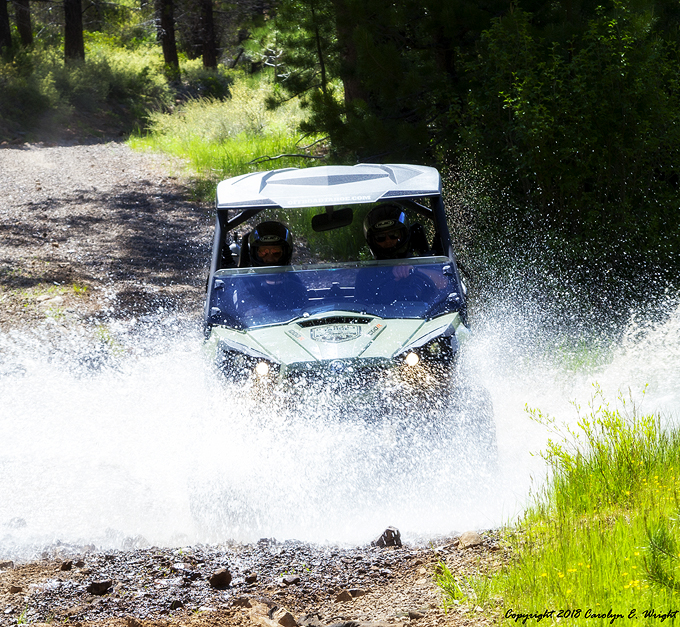
Getting wet and dirty are all part of the fun. Photo Copyright 2018 Carolyn E. Wright

By Kathryn Reed

TRUCKEE – Four-wheeling is often a mix of going faster for the adrenaline rush and slowing down to take in the scenery. This excursion was no different.

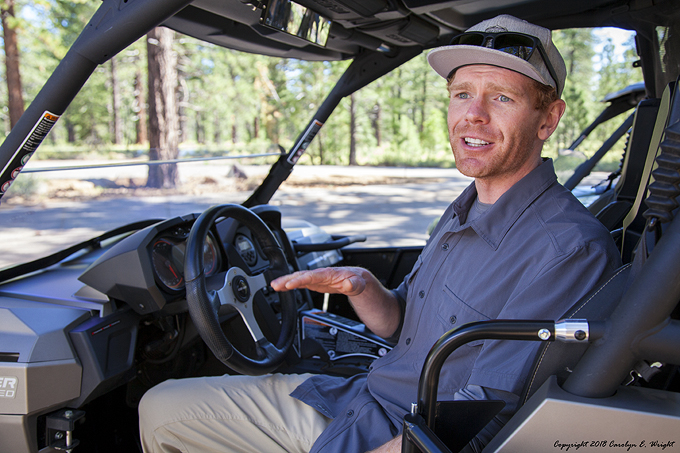
One of the best parts is that guide Sean Field knows this terrain better than most because he grew up in Tahoe City exploring the mountains in every season, in practically every possible manner. Now the three-time X Games skier is slaying “brown pow” as he shares this part of the world with anyone who wants to spend about three hours in the backcountry in a UTV – utility terrain vehicle.

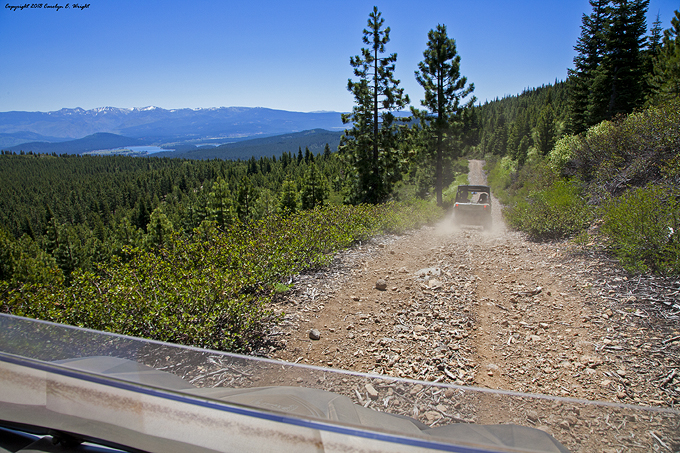
Prosser and Stampede reservoirs from the trail. Photo Copyright 2018 Carolyn E. Wright

So much dust kicks up it’s necessary to lag behind a bit as his taillights disappear around a corner. For someone with off road experience (none is required to rent a UTV) I was pretty pokey until my passenger essentially said there would be no photos at the pace I was going.

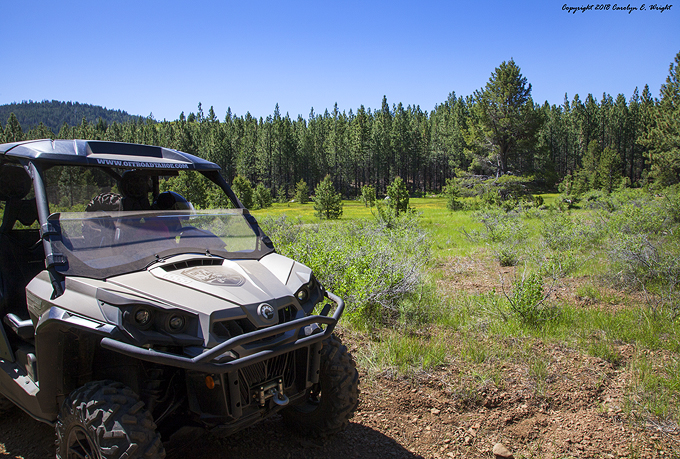
What makes these Can-Am Commander 1000cc machines different than an all-terrain vehicle (ATV) is that driver and passenger sit side-by-side and it’s a normal wheel instead of like a bike. The suspension is outstanding – better than a 2002 Wrangler on similar terrain.

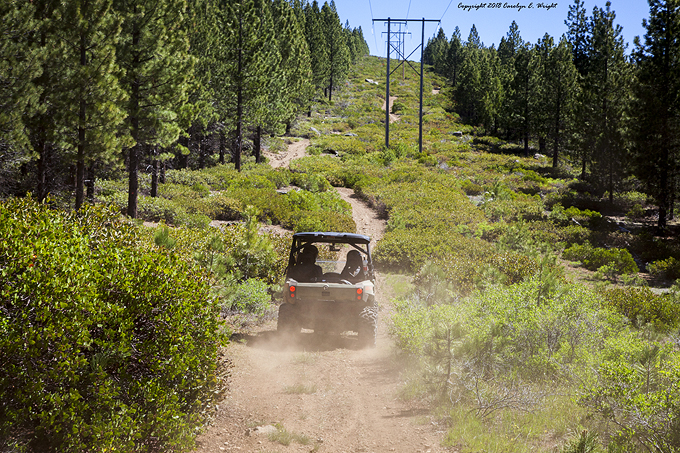
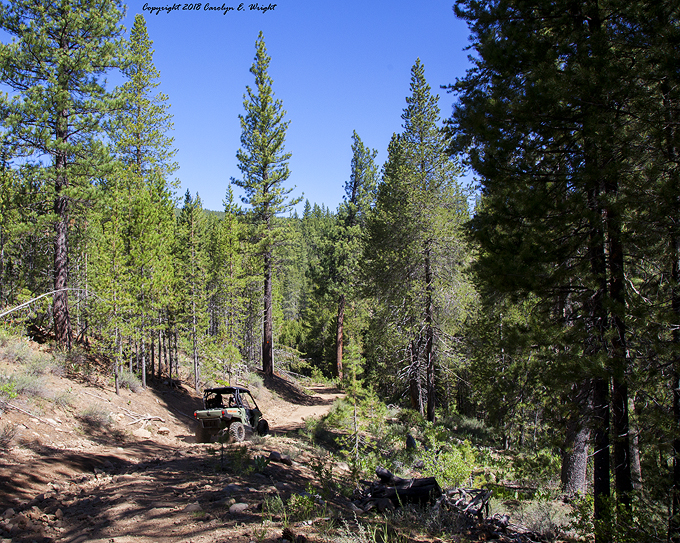
Most of the route is through the tall pines in the Tahoe National Forest. Photo Copyright 2018 Carolyn E. Wright

The company’s motto is: “We guide, you drive.” It’s perfect. It would be easy to get lost as one dirt road starts to look like the next. Using a tree as a marker isn’t likely to get you back to the trailhead when you’re in a forest.

Cass Walker is Field’s passenger; she adds to the experience by making sure guests are staying hydrated and have snacks at select stops. The wipes to clear the accumulated dust from exposed skin and sunglasses were welcome along the way and at the end of the expedition. Sunscreen, bug spray and Advil are in the glove compartment.

Sean Field is sharing his love of the outdoors with people who might not otherwise be able to see these locations. Photo Copyright 2018 Carolyn E. Wright

Field knows when to slow down, when to stop – where that Kodak moment is. And there are plenty. But that doesn’t mean there is a lot of stopping.

This adventure is about driving the bumpy U.S. Forest Service roads, going through some water, getting super dusty and grinning with glee.

At one outlook Stampede and Prosser reservoirs are visible, with Boca barely noticeable. Beyond that is the Carson Range and the backside of Mount Rose.

Wildflowers are just starting to pop in the Truckee area. Photo Copyright 2018 Carolyn E. Wright

“Skiing definitely taught me a lot about these mountains,” Field says as he imparts tidbits about the area. His exploration started in the winter and now continues with summer pursuits.

A pristine meadow which is the headwaters for Prosser Creek comes into view. This is the perfect spot to take in all the scenery, including the Pacific Crest, before turning around. Few signs of civilization are visible, making one feel so removed from everything; and feeling so small in this lush, vast terrain that almost looks like a painting.

Incredible vistas are the reward of having a guide lead the way. Photo Copyright 2018 Carolyn E. Wright

Field had done almost every sport the Sierra is known for before getting into rock crawling.

“I consider it a tool to access the backcountry,” he told Lake Tahoe News on a recent trek out of the Prosser OHV area near Truckee. “I almost got bored going by myself. It’s more fun with people.”

That is how Tahoe Off Road came into being. After securing a permit with the Tahoe National Forest he started offering tours in May.

The ride is about a 1,500 foot elevation gain. Photo Copyright 2018 Carolyn E. Wright

—–

Notes:

·      More details are on Off Road Tahoe’s website.

·      Season – May-October

·      20-mile round trip

·      Add-ons like lunch are available

·      2 2-person vehicles, 1 4-person vehicle

·      Open 7 days a week

·      2 tours a day


More wildlife now work the night shift

By Kaitlyn Gaynor, The Conversation

For their first 100 million years on planet Earth, our mammal ancestors relied on the cover of darkness to escape their dinosaur predators and competitors. Only after the meteor-induced mass extinction of dinosaurs 66 million years ago could these nocturnal mammals explore the many wondrous opportunities available in the light of day.

Fast forward to the present, and the honeymoon in the sun may be over for mammals. They’re increasingly returning to the protection of night to avoid the Earth’s current terrifying super-predator: Homo sapiens.

My colleagues and I have made the first effort to measure the global effects of human disturbance on the daily activity patterns of wildlife. In our new study in the journal Science, we documented a powerful and widespread process by which mammals alter their behavior alongside people: Human disturbance is creating a more nocturnal natural world.

Many catastrophic effects of humans on wildlife communities have been well-documented: We are responsible for habitat destruction and overexploitation that have imperiled animal populations around the world. However, just our presence alone can have important behavioral impacts on wildlife, even if these effects aren’t immediately apparent or easy to quantify. Many animals fear humans: We can be large, noisy, novel and dangerous. Animals often go out of their way to avoid encountering us. But it’s becoming more and more challenging for wildlife to seek out human-free spaces, as the human population grows and our footprint expands across the planet.

Global increase in nocturnality

My collaborators and I noticed a striking pattern in some of our own data from research in Tanzania, Nepal and Canada: animals from impala to tigers to grizzly bears seemed to be more active at night when they were around people. Once the idea was on our radar, we began to see it throughout the published scientific literature.

It appeared to be a common global phenomenon; we set out to see just how widespread this effect was. Might animals all over the world be adjusting their daily activity patterns to avoid humans in time, given that it is becoming harder to avoid us in space?

To explore this question, we conducted a meta-analysis, or a study of studies. We systematically scoured the published literature for peer-reviewed journal articles, reports and theses that documented the 24-hour activity patterns of large mammals. We focused on mammals because their need for plenty of space often brings them into contact with humans, and they possess traits that allow for some flexibility in their activity.

We needed to find examples that provided data for areas or seasons of low human disturbance – that is, more natural conditions – and high human disturbance. For example, studies compared deer activity in and out of the hunting season, grizzly bear activity in areas with and without hiking, and elephant activity inside protected areas and outside among rural settlement.

Based on reported data from remote camera traps, radio collars or observations, we determined each species’ nocturnality, which we defined as the percentage of the animal’s total activity that occurred between sunset and sunrise. We then quantified the difference in nocturnality between low and high disturbance to understand how animals changed their activity patterns in response to people. 

Overall, for the 62 species in our study, mammals were 1.36 times as nocturnal in response to human disturbance. An animal that naturally split its activity evenly between the day and night, for example, would increase its nighttime activity to 68 percent around people.

While we expected to find a trend toward increased wildlife nocturnality around people, we were surprised by the consistency of the results around the world. Eighty-three percent of the case studies we examined showed some increase in nocturnal activity in response to disturbance. Our finding was consistent across species, continents and habitat types. Antelope on the savanna of Zimbabwe, tapir in the Ecuadorian rainforests, bobcats in the American southwest deserts – all seemed to be doing what they could to shift their activity to the cover of darkness.

Perhaps most surprisingly, the pattern also held across different types of human disturbance, including activities such as hunting, hiking, mountain biking, and infrastructure such as roads, residential settlement and agriculture. Animals responded strongly to all activities, regardless of whether people actually posed a direct threat. It seems human presence alone is enough to disrupt their natural patterns of behavior. People may think our outdoor recreation leaves no trace, but our mere presence can have lasting consequences.

Future of human-wildlife coexistence

We don’t yet understand the consequences of this dramatic behavioral shift for individual animals or populations. Over millions of years, many of the animals included in our study have evolved adaptations to living in the daylight.

 Sun bears, for example, are typically diurnal and sun-loving creatures; in undisturbed areas less than 20 percent of their activity occurred at the night. But they increased their nocturnality to 90 percent in areas of the Sumatran forest where intensive forest research activity created a disturbance.

Such diurnally adapted animals may not be as successful at finding food, avoiding predators or communicating in the darkness, which could even reduce their survival or reproduction.

However, because our mammalian ancestors evolved under the cover of darkness in the time of the dinosaurs, most mammal species possess traits that allow for some flexibility in their activity patterns. As long as animals are able to meet their needs during the night, they may actually thrive in human-dominated landscapes by avoiding daytime direct encounters with people that could potentially be dangerous for both parties. In Nepal, for example, tigers and people share the exact same trails in the forest at different times of day, reducing direct conflict between humans and these large carnivores. Dividing up the day, through what researchers call temporal partitioning, may be a mechanism by which people and wildlife can coexist on an ever more crowded planet.

An increase in nocturnality among certain species may also have far-reaching consequences for ecosystems, reshaping species interactions and cascading through food webs. In California’s Santa Cruz Mountains, coyotes are becoming more nocturnal in areas with human recreation. By analyzing coyote scat, scientists have linked this behavioral change to dietary shifts from diurnal to nocturnal prey, with implications for small mammal communities and for competition with other predators.

Working on this study reminded me that people aren’t alone on the planet. Even if we don’t see large mammals while we’re out and about during the day, they may still be living alongside us, asleep while we are awake and vice versa. In areas where threatened species live, managers may consider restricting human activity to certain times of the day, leaving some daylight just for wildlife.

And it is likely that we need to preserve wilderness areas entirely free of human disturbance to conserve the most vulnerable and sensitive mammal species. Not all animals are willing or able to just switch to a nocturnal lifestyle around people. Those that try to avoid human disturbance entirely may be most vulnerable to the consequences of the expanding human footprint.

Kaitlyn Gaynor is a doctoral candidate in environmental science, policy and management, UC Berkeley.

Festival all about birds of Tahoe basin

As part of the Wild Tahoe Weekend, the Tahoe Institute for Natural Science in partnership with the U.S. Forest Service Lake Tahoe Basin Management Unit will host the 8th annual Lake Tahoe Bird Festival on June 24.

Located at Taylor Creek Visitor Center, just three miles north of South Lake Tahoe on Highway 89, residents and visitors are invited to attend this free family event from 10am until 3pm.

The event includes hourly guided bird walks along the Rainbow Trail in search of local birds. In addition, the bird festival will offer information and presentations on migratory birds, bird crafts and games, bird house building, demonstrations with live birds, a falconer, and much more.

Various local agencies will be participants of the Bird Festival including California State Parks, Nevada Department of Wildlife, Lake Tahoe Wildlife Care and much more. Food vendors will be present.