STHS girls tennis team wins local division

From left: Lyndsey Allen, Theresa Sandborn, coach Gina Tarwater, coach Suzy Allione, Allyson Cromwell, Gabbi Fisher, and Abby Burns. Photo/Rebecca Schwartz

South Tahoe High School girls tennis team is headed to the regional championships this week, with the hopes of competing in the state championships in Las Vegas on Oct. 19-21. The girls won their division this season.

The top two finishers from each team will go to state.

The boys and girls teams play Oct. 5 at home starting at noon and 3pm, respectively.

“Our star doubles team of Abby Burns and Gabbi Fisher were nearly undefeated in the regular season, having lost only the one line to Truckee’s No. 1 team,” coach Suzy Allione told Lake Tahoe News. “The entire team demonstrates sportsmanship and support like no other team in the league.”

— Lake Tahoe News staff report


Plenty of firewood available in Wrights Lake area

Eldorado National Forest is asking the local community to help continue to clean up the Wrights Lake Recreation Area.

It was severely damaged in the winter of 2013 when numerous large green trees were pushed over in extremely high winds. More than 200 trees fell during the wind storms causing a heavy accumulation of fuelwood in the areas adjacent to the campground, picnic areas, trails and recreation residences. During several special clean-up events in 2014 and two free fuelwood cutting events in 2015 and 2016, many loads of wood were removed.

However, the area still contains a large amount of dead and downed wood, and much of it is already cut and accessible off of adjacent roads.

To continue reducing dead and downed material in the area, free residential woodcutting will be permitted through Oct. 22 from 8am-5pm. The public with a valid permit for the Wrights Lake area will be allowed to cut and remove wood from a designated portion of the recreation area. Free permits for fuelwood cutting and gathering are available at the Pacific Ranger District office, Crystal Visitor Information Station.. The fuelwood is predominantly lodge pole pine.


Bear activity increasing; use common sense

California black bears are typically active and foraging between April and mid-fall, but in autumn, black bears experience changes in metabolism that drives the need to consume as many rich calories as possible. This metabolic spike is an important signal to the bear to bulk up and gain the fat that will sustain the animal through hibernation and periods of lean food sources.

Scientists estimate that black bears may forage as many as 20 hours a day at this time.

During this transition, residents in bear country like Lake Tahoe should be even more diligent to avoid attracting bears. This will avoid creating garbage bears, but it also means the bears getting the appropriate diet that will sustain them through the winter.

Residents leaving cabins for the season should remove all attractants from the cabins, and seal and lock all doors and windows. Crawl spaces under houses or porches should be sealed in order to prevent them from becoming denning sites.

Here are things to know:

  • Bears have a sense of smell seven times stronger than a bloodhound and eyesight as good as a human’s
  • Any scent, especially one of odorous foods like fish or other meats, may attract a bear to your home and yard
  • Remove bird feeders completely until later in the year
  • Remove fallen fruit off the ground promptly
  • Use bear-resistant garbage cans and wait to set trash out until the day of pick up
  • Store pet food inside
  • Do not leave food or other scented items in your car
  • Bears fed intentionally or unintentionally by people may become bold and aggressive—they may be killed if they become a threat to public safety or cause property damage
  • In the event a bear breaks into your home, move to a safe location and contact local authorities. Wildlife experts caution against directly confronting the bear or blocking the bear’s escape route.
  • Be alert on trails (avoid wearing headphones)
  • Keep a respectful and safe distance from bears at all times
  • Do not attempt to take “selfies” with bears or other wildlife
  • Never feed a bear – it is unlawful and dangerous to people and may result in the needless death of a bear.

— California Department of Fish and Wildlife


Private business on public lands a growing trend

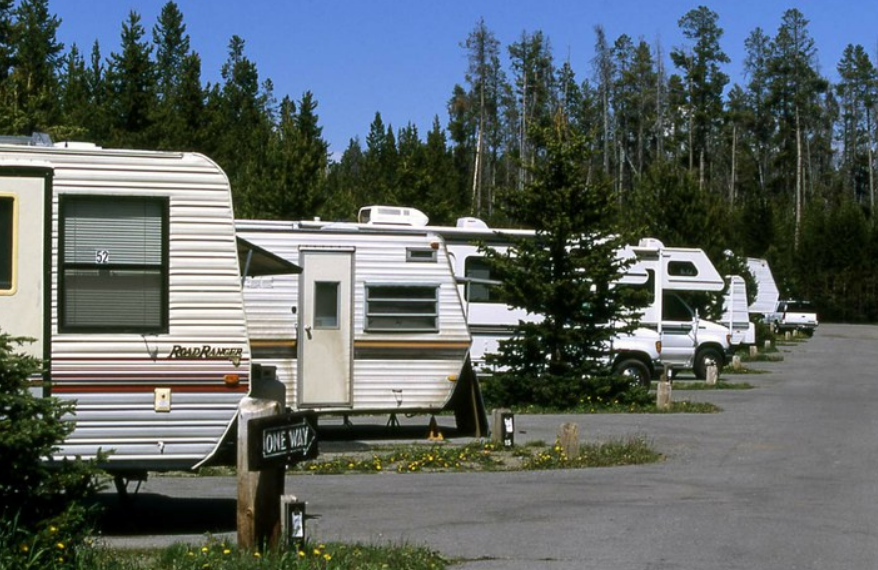
Recreational vehicles at an RV-only camping area in Yellowstone National Park run by Xanterra. Photo/Jim Peaco/National Park Service

By Joshua Zaffos, High Country News

A family heading to Yellowstone National Park this summer to sleep amid the geysers and grizzlies had lots of choice in accommodations. They could throw up a tent on a simple campsite without flush toilets for less than $20 a night. Campgrounds with full RV hookups, showers and bathrooms would cost $24 to $47. Cabins and rooms around Old Faithful, while much pricier, offer easy access to restaurants, stores, cell service and Wi-Fi.

Beyond the upgraded amenities, a difference the park-visiting family might not have noticed is who was running those campsites and cabins. The National Park Service manages the basic campgrounds, while Xanterra Parks & Resorts, a private concessionaire, operates the more developed campgrounds and lodges, food services, gift shops and guide outfits — all the services, in other words, that are well positioned to turn a profit.

Turning over campgrounds and other services to private companies is a common — and somewhat controversial — practice in popular national parks, and even many well trafficked national forests. And it may soon become even more ubiquitous, bringing changes that could alter the natural settings of campgrounds and public lands.

Read the whole story


Gear swap in Meyers for sellers-buyers

On Oct. 15 the Meyers Community Foundation will host the fourth annual Meyers Outdoor Gear Swap in the Westgate Center parking lot adjacent the Divided Sky from 11am-3pm.

Looking for some sweet gear? Shop for skis, snowboards, bikes, paddle gear, climbing gear, camping equipment, and other outdoor toys. Cash or credit cards will be accepted.

If you’ve got quality summer or winter gear to sell, come on down. Merchandise registration will take place in the parking lot between 8:30-10:30am; there is a $1 cash per item fee to register it for the swap. No equipment over 5 years old allowed. Unsold merchandise may be picked up between 3-5pm; unclaimed items will be donated. Twenty percent of the proceeds will go to the MCF.

To make a bigger contribution, gear donations to the MCF are accepted The MCF is a 501(c)(3) dedicated to improving life in Meyers.

For more information about the swap, contact Brian Levy at 530.545.9941 or René Brejc at 530. 545.0340.


Vonn to make bid to race against men in downhill

By Bryan Armen Graham, Guardian

The U.S. Ski and Snowboard Association will put forth a formal proposal to the International Ski Federation next week for Lindsey Vonn to participate in a men’s World Cup downhill race next year.

The bid would pitch Vonn, the most decorated skier in American history with 77 wins and 130 podiums, opposite men over the last weekend of November 2018 at Lake Louise, the lone Canadian stop on the circuit where she’s notched 14 of her record 39 World Cup downhill wins.

The USSA will make the proposal at the worldwide governing body’s pre-season meetings next week in Zurich.

Read the whole story


Pre-winter cleaning event at Sierra-at-Tahoe

Keep Sierra Clean Day is Oct. 22 from 10am-3pm.

Everyone is invited to grab a group of friends, ride the chairlift, clean the mountain and collect prizes.

Participants should come prepared to navigate steep and sometimes rocky terrain with sturdy footwear. Bring work gloves, a hat, sunscreen, sunglasses, a water bottle and a bucket. Trash bags will be provided in addition to gloves and buckets if needed.

Lunch will be provided.

Registration at the Solstice Plaza begins at 10am.


Athleticism not only component to being Olympian

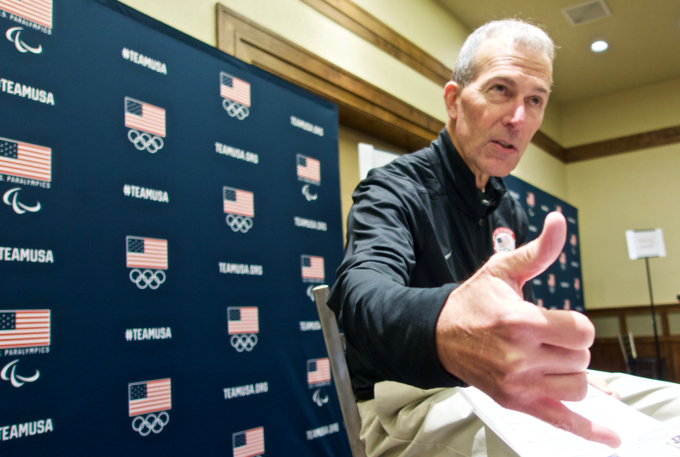
Randy Wilber with Team USA explains how to get Olympians to sleep as they travel around the world. Photo/Kathryn Reed

By Kathryn Reed

PARK CITY, Utah – Sleep and nutrition – they can’t be overlooked when it comes to athletics. And when the competitor is on the U.S. Olympic team, the importance is ratcheted to a level a weekend warrior might not be able to fully comprehend.

These elite athletes have access to sports psychologists, the latest technology, in addition to strength and conditioning experts. Some have their own entourage, some rely on the national experts, others use a combo.

Olympic officials have taken sports and made it a science.

The U.S. team mines data, analyzing an athlete’s performance against others. When a tenth of a second can make the difference between being on a podium or going home without hardware, every second on the snow or ice can make a difference.

Information is also used in hopes of preventing injury.

Travis Ganong, who lives in Tahoe City and calls Squaw Valley his home resort, is quick to admit that the mental aspect of the sport is what separates this level of athlete from others. While the downhiller doesn’t tap into the team’s psychologist, he knows to work on the mind game himself.

He takes a step back when needed, and says he internally processes what is going on without an external facilitator.

Still, his handlers also know when to manage him, so to speak. In January, at a men’s downhill race in Germany, Ganong was to race right after fellow American Steve Nyman. Nyman crashed, had to be airlifted out and sustained a season-ending injury. Ganong’s people told him Nyman was fine and was able to ski down after the fall.

Ganong admitted on Sept. 27 at the Team USA media summit in Park City that the false information helped him to focus. He went on to win that event.

For Randy Wilber, his expertise is in sports physiology.

“The No. 1 thing we’ve learned in the last five years is a lot about the biology and physiology of sleep – about the quality of sleep,” Wilber said.
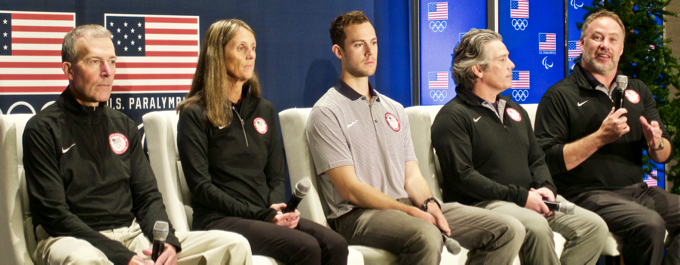
U.S. Olympic athletes have a variety of resources at their disposal. From left, Randy Wilber, sports physiology; Susie Parker-Simmons, nutrition; Brandon Sjakel, strength and conditioning; Alex Cohen, psychology; and Scott Riewald, sports technology. Photo/Kathryn Reed

Experts are using it to monitor training and recovery. Coaches-trainers can access the devices to know if the athlete had a good night’s sleep. Based on the data, the workout might be changed.

When traveling, athletes are given detailed info about when to sleep, when to get exposure to light, when to eat, when to exercise – all with the intent to get onto the new time zone as fast as possible. As little jetlag as possible is the goal.

These are disciplined individuals so being put on a regimen works – even for sleep.

“A couple challenges this year is that athletes will be competing late at night for TV. They aren’t used to that,” Wilber said of events scheduled at the 2018 Games in South Korea.

For Susie Parker-Simmons, she is tasked with making sure the athletes have enough nutrients to perform at their peak. The dietician took 10 years to develop a hot recovery drink. It’s not something that is available to the masses.

“Recovery foods have a specialized composition,” Parker-Simmons said. “Part of my job is to design foods that are not on the market.”

In PyeongChang, South Korea, she will have two venues set up just for the U.S. team competitors. She wants them in a food bubble, eating things they are used to.

She tries to get the athletes into the kitchen at the U.S. training center so they will develop healthy lifelong habits and be able to feed themselves, and make healthy decisions when she isn’t around.

An Olympian needs on average 30 percent more nutrients than the everyday athlete. Being in a cold venue requires an intake of 18 percent more calories than warm weather sports.

Cross country skiers are the hardest for Parker-Simmons to keep fueled because they need an extra 1,000 calories beyond the normal 3,000. This is because they are working their arms and legs for a sustained period of time. She said it’s that last 1,000 calories that can be difficult because people feel full. That’s why new foods need to be developed.

Parker-Simmons also has to battle the athletes being inundated by social media about the latest diet craze. Two years ago it was gluten free, today it is vegan or plant based diets.

Getting the correct allocation of nutrients is her concern and responsibility. This doesn’t usually jive with what the masses are doing.

Then there are the athletes like snowboarder Jamie Anderson of Meyers who do what they want, which isn’t always conventional at least by Western standards. She is more into holistic remedies and natural foods. She has what she calls a “green drink” with lots of nutrients.


Nevada OKs ban on reptile collection

By Ben Botkin, Las Vegas Review-Journal
 
CARSON CITY — The Nevada Board of Wildlife Commissioners has permanently banned the commercial collection of reptiles in the Silver State.

The state commission’s 6-1 decision, made during its Saturday meeting, effectively ends Nevada’s policy of allowing unlimited commercial reptile collecting. The decadeslong policy set the state apart from its neighbors in the West, alarming conservationists and state wildlife officials who are concerned about the effect on reptile populations.

The Center for Biological Diversity pushed for a complete ban, sending state wildlife officials a letter signed by four dozen scientists.

Read the whole story


Elite athletes bond as they rise above everyone else

By Kathryn Reed

PARK CITY, Utah – It’s more than training, dedication, drive, determination, athleticism and skill. It’s about believing you are better than everyone else. That is what often sets a gold medal Olympian apart from others.

It’s not that these select athletes don’t have their doubts – even on game day – but it’s the persistent confidence in themselves that keeps them going.

Mikaela Shiffrin admitted this week she gets nervous before most races. Her mom is a calming influence.

In nearly the same breath, though, she wasn’t about to back down from her earlier claim that she could compete in five disciplines in the 2018 PyeongChang Games – and medal in them. The World Cup season that starts next month will help determine what events she will compete in in February.

She earned a gold in slalom at Sochi, Russia, in 2014; the youngest athlete in history (age 18) to do so. On the World Cup circuit last season, including at Squaw Valley, she was dominating the slalom and giant slalom courses.

Shiffrin along with more than 100 athletes are in Park City this week as part of the annual Team USA media summit. 

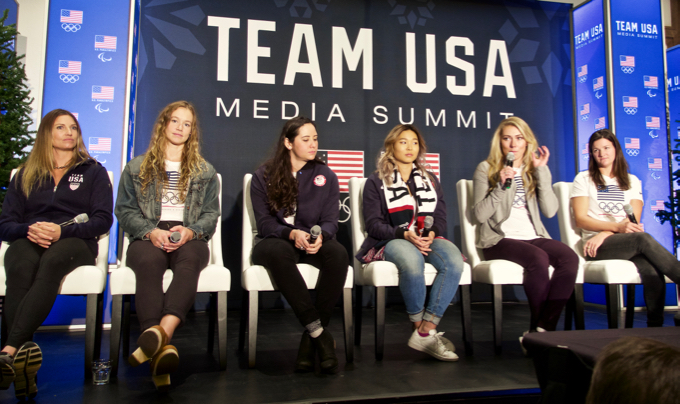
Multiple generations — in athletic terms — make up the U.S. ski and snowboard team. From left are, Squaw Valley’s Julia Mancuso, Laurenne Ross, Jackie Wiles, Chloe Kim of Mammoth Mountain, Mikaela Shiffrin, and Kelly Clark of Mammoth. Photo/Kathryn Reed

Another common thread is they are having fun. Yes, being a professional athlete (the Olympics are long past being about amateurs) is a job, but, it’s so much more. For the most part these men and women started out in their sports like anyone else. It might have been something mom and dad introduced them to, or friends were doing and they wanted to join.

Sometimes it was natural ability that pushed them along, or sibling rivalry, or wanting to keep up with or be better than a friend.

Joss Christensen and McRae Williams grew up together in Park City. Both hope to be on the freeskiing team that goes to South Korea in a few months. On Sept. 26, though, it was obvious their friendship and the camaraderie they have with other guys is what helps keep them motivated. It’s not often teammates can talk about how the other’s mom drove them places in middle school.

Believing in each other is another motivating factor. If they aren’t No. 1, they want their teammate and friends to be.

Maddie Bowman of Meyers, along with Maggie Voisin and Devin Logan all compete in the same event – halfpipe skiing. Bowman brought the gold back to Tahoe in 2014; in particular to Sierra-at-Tahoe, her home resort.

The three sat next to each other Tuesday. It was obvious theirs is a genuine friendship. They admitted to being exuberant when the others are in the pipe – they want to share in each other’s successes. It some ways it’s like being a team in an individual sport.

As with many sports, there comes a point when an idol becomes a colleague. Chloe Kim remembers when she was about 8 and for the first time saw Kelly Clark at Mammoth – where they both snowboard. Kim was giddy, Clark was encouraging. Today they are teammates. Kim couldn’t compete in Sochi because of age restrictions. South Korea would be Clark’s fifth Olympics.

“Hopefully, my ceiling becomes her floor,” Clark said of Kim and their respective achievements and places in history.