UNR team wins Tahoe MedWAR challenge

Twelve teams of four racers navigated through various physical activities and completed wilderness medical scenarios in Tahoe last month.

MedWAR, which stands for Medical Wilderness Adventure Race, is designed for participants with or without a medical background. For the Tahoe Challenge, participants varied from local adventurers, medical students from URN and Stanford University, and five teams from Arizona.

Volunteer victims acted out wilderness medical scenarios designed to teach and test each team on their wilderness survival and medical skills. A sampling of the scenarios included an ATV accident, a lightning strike, and an avalanche victim buried in the sand.

Team Med Students Gone Wild from UNR School of Medicine were the champions. All teams completed the race within 10½ hours.

Winners were:

  • First place: Med Students Gone Wild – UNR (Jenna Johnson, Austin Meng, Patrick Mullett, and Robert Shrake)
  • Second: Team H2UP (Jenn Drennan, Emma Dayberry, Chris Kozlowski, and Caitlin Robinson)
  • Third: Team EPI (William Gray Grandy, Jeff Koeck, Morgan Machen, and TJ Middlemis-Clark)
  • Fourth: Peumothorax x 4 (Brooke Myatt, Andrew Odland, Kevin Robinson, and Jeremy Vandehurt).

The MedWAR Tahoe Challenge is hosted by Barton Health, Tahoe Center for Orthopedics, and Tahoe Emergency Physicians.


Squaw-Alpine invest $4M for avalanche control

By Kathryn Reed

Combined, Squaw Valley and Alpine Meadows ski resorts are getting $4 million worth of safety improvements that will be used starting this season. All are centered on avalanche control.

A variety of tools have been added. For the first time a helicopter will be enlisted. The resort is leasing an ASTAR AS-350B3 from Minden’s Skydance Helicopters. Squaw-Alpine are the only resorts in California using a helicopter for this type of work, though Alta, Snowbird, Telluride and Whistler Blackcomb use one.

Using the helicopter would help get the mountains open sooner.

“The helicopter enables us to assess snow conditions around the mountain, using test explosives, in under 30 minutes. We can use it to drop explosives onto the terrain below and transport our teams up onto the mountain to complete their avalanche control routes on the ground,” Will Paden, Squaw Valley ski patrol director, said in a statement.

Skydance pilots will fly the bird, with specifically trained ski patrol employees launching the devices.

The helicopter will be stationed near the Far East building and chairlift in the high season, with the ability to have them fly in from Minden at other times.

“All of these investments were voluntary. Our first priority as a company has always been safety, and that priority is evident not only in this season’s expansion, but the millions that we have invested in snow safety over the years,” Liesl Hepburn, spokeswoman for the resorts, told Lake Tahoe News.

She said the upgrades are not a reaction to the January death of ski patroller Joseph Zuiches at Squaw Valley. CalOSHA found infractions at the ski resort and fined Squaw $11,250 for “failing to correct an identified unsafe working condition by implementing a procedure for protection against the workplace hazards associated with hang cord entanglement during hang cord blasting operations.” The second fine of $9,000 was for “failing to ensure that all crew members maintained visual contact or awareness of physical location of crew members at all times during avalanche control activities.” Squaw is appealing the decision, saying the state’s findings are not accurate and the fines not justified.

With the 728 inches of snow last season, it meant avalanche control was needed almost every third day. In all, 56 days of avalanche control were required.

Another tool that will be available this season is the avalauncher, which can send an explosive more than a mile. Alpine has been using them and will get two additional ones. Squaw used them in the past; and now will have two.

They allow ski patrollers to trigger avalanches from a distance and control the snowpack prior to the resort opening. They are compressed-nitrogen cannons that fire an explosive projectile.

Dragons are another resource for snow safety. It’s something Squaw has been using since 2015. A combination of propane gas and oxygen are used to create a concussive blast to trigger an avalanche. The discharge is done remotely. Thirteen have been added to the arsenal.

Several will be placed along Alpine Meadows Road. This is always a precarious location. Last year debris from an avalanche impacted several houses.

Ski patrol at both resorts is rather significant, with 34 pro patrollers at Alpine Meadows, 70 at Squaw Valley. Nearly two thirds of Squaw Valley and Alpine Meadows ski patrollers have more than 10 years of patrol experience. If national ski patrollers are trained and licensed to perform avalanche control, then they may help out.

“The goal is to have as many patrollers as possible trained on these tools, but with newer ones like the helicopter it will take more time to develop those groups,” Hepburn said.


Star Guide: Telescopes — a great gift idea

By Tony Berendsen

Every young mind, and some older ones, too, are filled with the wonders of learning and exploring. Some limit the exploration to their local neighborhood, some travel the world to exotic unspoiled locations. Well, maybe a lot of us would like to travel to those exotic locations, but adventure travel is expensive.

There is an exotic unspoiled place we can all go to that doesn’t require costly travel – that’s the cosmos. It’s as close as your backyard. You can explore the cosmos just by looking up in the sky at night with your naked eyes, but my favorite way is to wander the depths of it with a telescope.

If you are looking for a fun, educational gift to give this Christmas, why not give a ticket to adventure and discovery; give someone a telescope.

I’m a big fan of computerized telescopes, but they can be expensive and difficult to use for the novice. Celestron has a new line of telescopes called Inspire that are low cost, but high value, and perfect for an entry level astronomy experience.

The telescope comes with an azimuth mount for easy pointing of its erect image optics, and a nice sturdy steel tripod designed for quick assembly with a folding accessory tray that can be illuminated by a removable red led flashlight stored in the mount.

The optical tube can be pointed accurately using the StarPointer Pro non-magnified finder scope, and comes with two eyepieces, giving a nice range of magnification.

One of the really cool things about this scope is the lens cap. It is designed to be a cell phone mount for taking images through the telescope. Imagine how fun it would be to take pictures of craters on the moon to share with your friends.

Inspire can be used as at terrestrial telescope, too, offering close up views of wildlife with an innovative calibrated focus micrometer. Yes, you can take pictures during the day using the cellphone adapter.

Inspire is offered in three different apertures options from 70mm to 100mm, ranging in price from $179.95 to $289.95.

This is not the only telescope Celestron offers, but one that I recommend for the novice or intermediate level observer.

I began my life of exploration when I received a telescope for Christmas from my parents when I was 8 years old. I’ve been exploring the exotic destinations of the Cosmos ever since. Maybe you can “Inspire” someone with a telescope for Christmas.

Tony Berendsen runs Tahoe Star Tours. He may be reached at 775.232.0844 or tony@tahoestartours.com.


Bowman eager to defend gold medal in Korea

Publisher’s note: This is one of a series of stories about Lake Tahoe area athletes who hope to compete in the 2018 Olympics in South Korea. 

By Susan Wood

PARK CITY, Utah – The girl next door may become an even bigger household name.

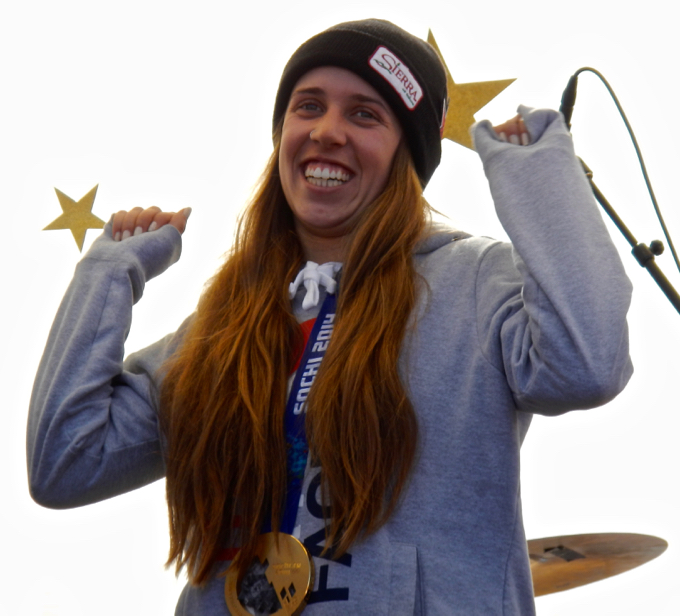
Olympic gold medalist Maddie Bowman of Meyers is gearing up in a big way for the Winter Games next February in PyeongChang, South Korea.

At age 23, the humble, modest freestyle skier plans to return to the podium in half pipe skiing coming off the Sochi Olympics in 2014.

What new tricks are up her sleeve?

“I find a lot of inspiration when trying something new,” she responded to Lake Tahoe News at last month’s Olympic media summit in Park City.

Maddie Bowman of Meyers is gearing up for her second Olympics in February. Photo/Kathryn Reed

Sometimes flying in the air and landing an acrobatic move can even be an accident – unintentional but inventive. She finds the fun of her sport being creative with her friends.

“I don’t just say I’m going to try something new for the Olympics,” she said, explaining the individual nature of the sport. “Everyone has a unique style.”

Bowman has no rituals. She cross trains on her mountain bike in the woods of Tahoe – Mr. Toads being her favorite route. (She even welcomes the sandpits.)

Bowman watched every Olympic Games she can remember as a child, and it’s left an indelible mark. Her father, Bill Bowman, was a racer for the U.S. National Alpine Ski Team, so ski competition runs in the family.  

Now, she’s turning a corner in maturity – wanting to give back. 

“I’m in a unique position that I never thought I’d be in. I hope I inspire the athletes of younger generations,” she said.

Throw in what she calls a little “rebel vibe,” and you’ve got quite a mix destined for greatness on and off the hill. Bowman is active in the Protect Our Winters organization. POW is an environmental advocacy group consisting of athletes who use educational means to warn of the dangers of climate change.

The celebrity athlete tours schools, spreading the dire message to students in the hopes a younger generation will save the planet and the snow continues to grace the Tahoe mountains.

With her busy schedule, Bowman took a break as a junior at Westminster College in Salt Lake City to prepare for the South Korea Olympics.

She feels exuberant about the upcoming Games, including the security of them despite the war of words exchanged between the United States and South Korea’s neighbors 50 miles to the north.

 “I do trust the State Department. They’re not going to put us in harm’s way,” she said.

She also likes her chances at the event, especially since going out for a test run of the mountain last year. She likes how wide the halfpipe is, raising the bar for big tricks.

This year, the Olympic trials slated for December and January allow for a short window. But she’ll be prepared to go and looks forward to the whole experience.

Maddie Bowman at the 2014 celebration at Sierra-at-Tahoe. PhotoLTN file

The Olympian who took the South Shore by storm more than three years ago has had a few bumps and bruises along the way. Her knees get battered, but a relaxed-looking Bowman insists she feels great.

Of course, there’s much pressure to repeat her spectacular performance in Russia and numerous podium stands at the X Games and World Cups but “I keep it in check,” she insists.

Not many athletes would make a better candidate for a Wheaties box.

Part of the self-assured quality comes from knowing an entire community is behind her.

When she and fellow Meyers gold medalist Jamie Anderson came home after their stunning performances, the community threw a huge “Golden Girls” party for them. The duo, with fellow Olympian Hannah Teter, rode from South Lake on a vintage fire truck on a route lined by hundreds of spectators. It ended 12 miles west on Highway 50 at the trio’s home resort, Sierra-at-Tahoe, where longtime General Manager John Rice greeted them with open arms.

Bowman grew up skiing at Sierra, even gaining a free ski pass when she got all A’s through an incentive program between the ski resort and Lake Tahoe Unified School District.

Skiing wasn’t the only sport she was good at. She was a member of the state championship-winning South Tahoe High School soccer team.  

Perhaps that’s why she shared such a fondness for the U.S. Olympic women’s ice hockey team. She still has an appreciation for team sports.

“They’re spunky and funny,” she said.

Her legacy will be permanently cemented on the South Shore when she is inducted into South Lake Tahoe’s Champions Plaza on Lakeview Avenue later this year. She will join the likes of Anderson, Teter, Jonna Mendes, Glen Plake, Shaun Palmer, Kyle Smaine, Elena Hight, Travis Cabral and Travis Ramos.

“I’m honored and flattered. It’s so cool how the community has come together,” Bowman said.


Moose are putting down roots in Nevada

Moose are taking up residence in northeastern Nevada. Photo/Nevada Department of Wildlife

By Benjamin Spillman, Reno Gazette-Journal

Add “moose attack” to your list of hazards in the Nevada backcountry.

The state’s northern reaches appear to be home to a small but growing number of the gangly ungulates, according to the Nevada Department of Wildlife.

The increased number of sightings suggests moose are no longer just visiting the Silver State and are putting down roots.

Read the whole story


All-day avalanche workshop at LTCC

The fourth annual California Avalanche Workshop is Oct. 14 from 9am-4pm at Lake Tahoe Community College theater.

This is a preseason gathering of snow travelers. It’s an opportunity to share knowledge, learn, and network. The workshop will feature speakers from different sectors of the winter sports industry.

This seminar is modeled after the International Snow Science Workshop and other regional one-day snow and avalanche workshops throughout the west.

Cost is $20 in advance, $25 that day. 

For more info, email reichel@ltcc.edu.


Stakeholders refuse to give up on Tahoe Olympics

By Susan Wood

PARK CITY, Utah – If the U.S. Olympic Committee would be inclined to open the gate for another Winter Games in the Lake Tahoe area, like it hinted at during its annual summit in Utah last month, the coalition tasked with preparing for it would jump.

Officials will meet this week to discuss the matter.

Albeit those close to the possibility of bringing the Winter Games back to Squaw Valley and beyond after more than a half century admit it’s a perceived long shot in the world of sports.

“The flame has never
gone out over the years
as we review possibilities.”
Reno-Tahoe Winter Games Coalition Chairman Brian Krolicki


If anything, representatives should already get a medal in patience and due diligence. After all, this is the Olympics – a global event that practically invented the word tenacity among athletes.

“It’s a great chance. There are tons of locations for incredible alpine skiing. And to have them back in Reno-Tahoe – just the history of that is pretty awesome,” Tahoe Olympian Julia Mancuso told Lake Tahoe News during a roundtable discussion in Utah set up for the 2018 Winter Games at PyeongChang, South Korea.

Mancuso, a never-say-die, four-time medalist in downhill skiing, skis at Squaw, the host mountain in 1960 – a time of another long shot. So the idea of a return sounds intriguing to say the least.

Squaw Valley just hosted the Audi FIS Women’s World Cup Tour, an event Mancuso helped plan with Chief Executive Officer Andy Wirth, but unfortunately had to sit out. At the time, Wirth – who sits on the local Olympic board –told LTN having the World Cup offered a chance to showcase the resort on a global level. He was looking down slope at the grand prize.

He’s not alone.

“The flame has never gone out over the years as we review possibilities,” Reno-Tahoe Winter Games Coalition Chairman Brian Krolicki told Lake Tahoe News.

Nevada’s former lieutenant governor admits the difficulty may have increased with Los Angeles receiving the nod for hosting the Summer Games in 2028 – 44 years from its last honor. By the time the U.S. would host another Winter Games, more than a quarter century will have passed since the Olympics graced Salt Lake City, which received a $200 million profit from the endeavor and developed venues visitors and residents still use today.

Getting the International Olympic Committee to buy off on back-to-back or recent returns to one nation is more in tune to a chess match.

Squaw Valley would be an integral part of any future Winter Olympics in the greater Lake Tahoe region. Photo/LTN

The Reno-Tahoe Winter Games Coalition started this effort in 2001 with Reno sports commissioner Jim Vanden Heuvel, who died in 2009. In the last five years, the coalition has bumped its interest from 2022 to 2026, with the latter considered too close to L.A.’s latest windfall.

“I know we were prepared while thinking about 2022,” Krolicki said. “We’d be ready to dust off the plan. We were ready to do this yesterday. We’d be ecstatic.”

If given the chance, UNR would play an important role alongside the ski resorts.

Nonetheless, reality brings a heavy weight to the table.

“People shouldn’t get their hopes up. In theory, the possibility could be problematic,” Krolicki admitted.

Even though the challenges would not remove the option from the table, finances and infrastructure run a steep price when considering the reality. Since 1960, the Games have been all about sustainability – a catch phrase missing in the vernacular back then. Also, the venues – where to put them, how to build them, how much of them to keep – could represent “the white elephant” in the room, according to Krolicki. There is no quick fix here.

He looks forward to more discussions with the USOC, which will meet Oct. 13 on the matter.

USOC Chairman Larry Probst joined Chief Executive Officer Scott Blackmun in mentioning the Reno-Tahoe region as “definitely interested in hosting the Games” along with other cities in front of large media crowd last month. One interested region is the staging ground of the summit – Park City-Salt Lake City. Denver was also mentioned.

These are the medals that will be given out at the South Korea Games in February; Reno-Tahoe would like to start designing theirs. Photo/LTN

Everyone has an opinion.

World Cup champion Mikaela Shiffrin would like the Olympics in Vail-Beaver Creek in her home state of Colorado. But she believes the practical choice would be Park City-Salt Lake City.

“It would be amazing to compete in the Olympics in front of my hometown (Colorado) crowd. It’s a dream I’m almost afraid to say but think about,” she said during a press conference, but later qualified a more reasonable option during the roundtable discussions.

“(Park City-Salt Lake City) would be incredible for American athletes. It’s fairly accessible (for spectators),” she said.

Halfpipe snowboarder Kelly Clark agrees accessibility matters in making a good host for the Winter Games. But despite its remote nature, she’d like the Olympics to return to California.

“I’ve lived and trained in Mammoth forever. My favorite mountain is Mammoth. (But) I’m not sure it’s conducive (to hosting),” Clark said.

Still, Tahoe athlete Travis Ganong is partial to his home resort of Squaw Valley. He was excited hearing of a bid proposal years ago because he felt he’d be in line to compete, but now 2030 appears too far off for him to go. Either way, Ganong prefers the snow conditions in the United States versus Europe.

If anything, his snowboard cross counterpart, Nate Holland, would at least like to see Squaw host a men’s World Cup – which hasn’t happened in decades.

Meyers freestyle skier Maddie Bowman said “it would be great” if the Winter Games were to return to the United States because “they do such a good job.”

Many choices of where to have the Olympics seem personal for a number of athletes.

Aja Evans, who runs a bobsled, joined Shiffrin in looking close to home – no matter how far-reaching the idea is.

“I’d love them in Chicago,” Evans said of her home city. “It certainly gets cold enough there.”

Fellow bobsled Olympian Jamie Greubel Poser opts for South Korea because “my sister was adopted from there.”

She’ll have her chance in a matter of months.


Story behind wilderness taco stop in the Sierra

By Benjamin Spillman, Reno Gazette-Journal
 
Alison Blair stopped in her tracks.

The 54-year-old backpacker needed a moment to process the scene.

A group of people with backpacking stoves, dishes and condiments carefully arranged on a tree stump asked Blair if she would like a made-to-order taco and cold beer.

The strange part was that it was happening at Purple Lake on the John Muir Trail, more than 10 miles over rugged terrain from the nearest trailhead.

It’s a temporary taco and beer oasis that’s materialized on the John Muir Trail six times since 2014 only

to disappear within a few hours of each appearance.

Read the whole story


Large-scale forest thinning project in Incline

Thinning of trees to remove excess vegetation that can feed wildfires and improve forest health has resumed on National Forest lands above Incline Village. 

Mechanical cut-to-length tree removal is taking place in Unit 36 off Highway 431. Thinning operations are expected to continue throughout fall until winter weather sets in for the season.

A harvester cuts the tree down, remove the limbs and cut the tree into sections in the cutting area. The Forest Service recommends that the public avoid this area due to the hazards posed by heavy equipment and falling trees. Hazards may be present even when operations have ceased for the day. 

This forest thinning is part of the Incline Hazardous Fuels Reduction and Healthy Forest Restoration Project, which aims to treat nearly 4,000 acres on North Shore to reduce the risk of severe wildfire, improve forest health, and provide defensible space to neighboring communities.


Prescribed fires planned for D.L. Bliss State Park

California State Parks will kick off the Tahoe Fire and Fuels Team fall prescribed fire program Oct. 10. 

If conditions are favorable, prescribed fire operations will take place in D.L. Bliss State Park. 

Smoke may be visible and is expected to last through the week. To receive prescribed fire notifications, send an email to pa_ltbmu@fs.fed.us. 

Each prescribed fire operation follows a specialized prescribed fire burn plan, which considers temperature, humidity, wind, moisture of the vegetation, and conditions for the dispersal of smoke.  This information is used to decide when and where to burn.