Sprint to Capitol expected in today’s leg of Tour de California

By John Schumacher, Sacramento Bee

After the climb up Donner Summit, the long descent toward Sacramento strongly suggests a familiar finish today in the second stage of the Amgen Tour of California.

amgenGet ready for another field sprint in front of the state Capitol.

That’s the consensus among riders and team directors asked about the 133.2-mile trek from Squaw Valley to downtown Sacramento on Day 2 of the sixth annual pro cycling race.

A 2.3-mile ascent on Donner Pass Road early in the stage includes 829 feet of elevation gain, giving ambitious riders plenty of opportunity to stage a breakaway.

But the course drops 7,000 feet from there, heading down Interstate 80 and Highway 20 before going through Nevada City, Grass Valley, Beale Air Force Base and Wheatland.

Read the whole story


2011 Tour de California route called toughest yet

By John Schumacher, Sacramento Bee

The consensus among riders ready to test the sixth annual Tour de California: This is the toughest course in the event’s history.

The addition of two mountaintop finishes – one on Sierra Road in San Jose in Stage 4 and the other a climb up Mount Baldy to end Stage 7 – has caught cyclists’ attention.

“This is the hardest condition for the Amgen Tour of California in the six years,” said Levi Leipheimer, a three-time winner who has ridden in all five Amgen races.

“When I rode (Mount Baldy), I thought, ‘Wow, this is worthy of the Tour de France.’ This edition is definitely a mini-Tour de France. I don’t think we could ask for anything more.”

The eight-day stage race covers nearly 800 miles. But it’s the climbs that have toughened up this year’s event.

Read the whole story


Historic train route begins excursions Memorial Day weekend

The Virginia and Truckee Railroad’s 2011 season begins May 28 with roundtrip and one-way excursions along the historic 14-mile Comstock route between Carson City and Virginia City.

Tickets are on sale with rides departing Fridays, Saturdays and Sundays through Oct. 30.

The routes include scenic vistas of the Sierra Nevada and Carson River.

For more information, go online.


Watching a road bike race is worth the few seconds

By Heidi Hill Drum

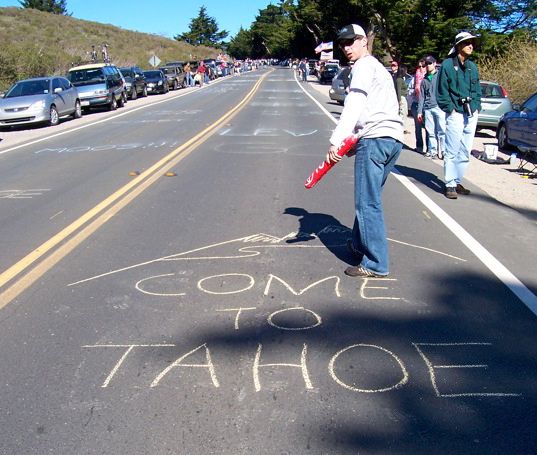
Finally it is here! The photo was taken several years back at the Amgen Tour stage leaving Sausalito and heading up to Santa Rosa. We waited in the back of our car on the side of a super steep, windy hill in Marin County. Drawing pictures on the closed road kept Dalton entertained (he was only 3 and now 9.)

We thought this would be the best place to see the riders going slow. Well, the peloton (the riders all together in the main pack) don’t really go slow. It is either fast or really fast. They sped up that hill with amazing speed.
It took several years, but John Drum's message finally got heard. Photos/Heidi Hill Drum

It took several years, but John Drum's message finally got heard. Photos/Heidi Hill Drum

It was too early in the day for a breakaway group, so within about two minutes the entire peloton passed us by. Yes, Dalton asked, “Is that it?”

Our souvenir that day was a cowbell handed out by the folks at Toyota, one of the early sponsors, so he left happy.

We have been to at least a couple of stages of every Amgen Tour de California and its predecessor, the San Francisco Gran Prix. When it was in February it usually coincided with Dalton’s break from school, so we managed to get in a few stages fairly easily. Now, since it is in May we have a few more logistics to work out, but it is all worth it. When Lance rode in it last year we saw him in Sacramento. The year before we watched in the rain in Santa Cruz as Levi rode strong in one of his winning years.

Last summer we were fortunate to be able to see the real deal in France. Le Tour de France is so special and an incredible economic benefit to the towns that host a stage. In our opinion, this Amgen Tour is on track to be very similar for our state. We can’t thank those enough who worked tirelessly behind the scenes for all they did to bring these first two stages to Tahoe (but thank you Carol and Andy).

We realized last week when we started volunteering that it isn’t just a one-day event for our town. Riders, staff, mechanics, and others have been arriving all week. They are staying in our hotels, eating at our restaurants, and likely will be buying lots of hats and gloves in our local shops for today’s cold race.

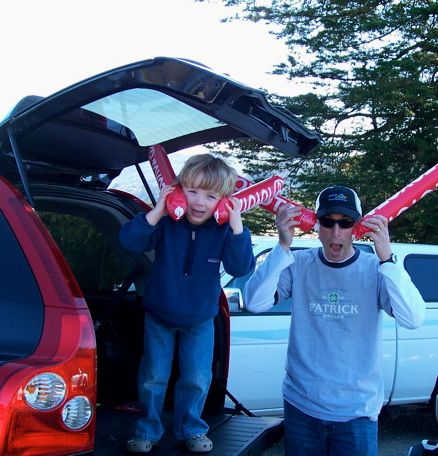
Dalton and John Drum at one of the early Amgen races. The South Shore guys will be routing on the riders today.

Dalton and John Drum at one of the early Amgen races. The South Shore guys will be watching the the riders today from their home town.

Highway 50 closing Wednesday before the race instead of the Monday after is unfortunate, as it is likely more visitors will choose to go to the North Shore to see the finish. However, our entire community is still benefiting.

We have been volunteering to drive riders and staff from the Reno airport to their hotels here and those of us who live here sometimes forget how spectacular a sight Lake Tahoe is the first time you come up the hill. Every one of the folks who are a part of this tour have been inspired as they see the lake for the first time. Let’s take advantage of this amazing opportunity to open our doors, make everyone feel especially welcome and thank them for their participation in this event. Let’s also hope we can show enough Tahoe spirit to encourage Amgen to consider Lake Tahoe as another host city in a future Tour de California.


Winter weather advisory issued for Lake Tahoe

The National Weather Service in Reno has issued a winter weather advisory for the Lake Tahoe Basin from 3-11am Sunday.

Snow is expected to begin late tonight and continue through Sunday morning, then taper to showers through the afternoon.

Forecasters are calling for 1 to 3 inches below 7,000 feet and 2 to 4 inches about 7,000 feet. There could be 6 inches near the Sierra crest.

Roads are expected to be slick with the oil having accumulated on them.

Amgen Tour de California officials are likely to make a decision Saturday night as to whether the race route will be altered. It is supposed to start at 10:30am Sunday near the state line, with cyclists doing 1.5 laps around Lake Tahoe before ending at Northstar-at-Tahoe. Stage two leaves from Squaw Valley on Monday.

— Lake Tahoe News staff report


Leipheimer in search of 4th Tour de California title

By Agence France-Presse

LOS ANGELES – One year after a 2010 edition rocked by the drugs accusations of Floyd Landis, the Tour de California starts on Sunday with RadioShack’s Levi Leipheimer heading the field in search of a fourth title.

The eight-stage race starts Sunday in Lake Tahoe in the Sierra Nevada mountains and ends on May 22 in Thousand Oaks west of Los Angeles.

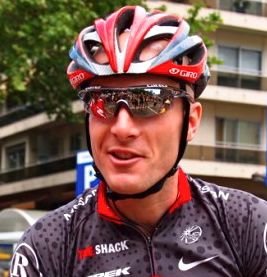
Levi Leipheimer

Levi Leipheimer

The 2011 edition promises to provide the most demanding challenge since the event’s inception in 2006, with two stage finishes at altitude.

Leipheimer, who won three straight titles in the United States’ most prestigious road race from 2007-2009, finished third in last year’s race won by Michael Rogers riding for HTC-Columbia.

Read the whole story


Feds reach settlement regarding endangered species

By Felicity Barringer, New York Times

The Interior Department, facing an avalanche of petitions and lawsuits over proposed endangered species designations, said Tuesday that it had negotiated a settlement under which it will make decisions on 251 species over the next six years.

Under the agreement, species that the department has already deemed to be at potential risk but whose status remains in limbo, including the New England cottontail and the greater sage grouse of the West, will take priority in the Fish and Wildlife Service workload.

If approved by a federal judge, the settlement would bring about the most sweeping change in the enforcement of the Endangered Species Act since the 1990s, when the department streamlined a procedure for protecting the habitats that endangered species need to recover.

The backlog of more than 250 cases resulted from lawsuits and petitions filed by environmental groups, a strategy for forcing the Fish and Wildlife Service to be more assertive about fulfilling its wildlife-protection mandate. Over the past four years, the service has fielded requests for listing more than 1,230 species as endangered or threatened.

Read the whole story


State looking at revamping dredging rules

By Carlos Alcalá, Sacramento Bee

There was controversy but few surprises Tuesday as the California Department of Fish and Game held its final hearing on the contentious issue of suction dredging for gold in the state’s rivers and streams.

The hearing attracted advocates and critics from El Dorado, Placer and Sierra counties – three of the top five counties for dredging according to a 2008 survey.

The department – under orders from the Legislature and a court ruling – has drafted an environmental impact report and regulations to control dredging, which sucks up river bottom gravel in an attempt to collect gold.

The report will be revised on the basis of months of public input. The department hopes to issue final regulations in November.

The most unexpected thing at Tuesday’s hearing on the report and proposed rules may have been the turnout.

Mark Stopher, the agency’s official in charge of developing the EIR and rules, told the the audience he had received well over 8,000 emails on the topic and had expected an overflow crowd at the 200-seat auditorium in downtown Sacramento.

Read the whole story


Minnesota joins growing number of states tackling invasive species

By Dennis Anderson, Star Tribune

Department of Natural Resources conservation officer Lisa Kruse has extracted an angry raccoon from a suburban hot tub and thwarted the picture-window rampages of a kamikaze-style ruffed grouse — two unusual types of “invasive species.”

Now she and the DNR’s 136 other conservation officers will focus their considerable enforcement powers on far more threatening critters — zebra mussels, Asian carp, round gobies and spiny water fleas, as well as Eurasian watermilfoil and other invasive aquatic plants.

Armed with tougher invasive-species laws expected to pass the Legislature this session, more costly penalties for violators and support from Gov. Mark Dayton and thousands of concerned anglers and lake-property owners, the DNR this summer will be on heightened alert for anyone toting destructive aquatic hitchhikers on their boats or trailers as they travel from lake to lake.

“Written citations will be the norm this summer for invasive-species violations, rather than the exception, as they were last year,” said DNR conservation officer Lt. Jason Jensen.

A bill passed by the Senate this session calls for a $500 fine for boaters who launch boats with zebra mussels attached to them into state waters. The penalty would double for a second violation.

High stakes warrant the high fines, officials say. At risk in the fight against invasive species are the state’s fabled 10,000 lakes and its nearly $3 billion sport fishing industry. Already, zebra mussels have infested Minnetonka and Mille Lacs, two of Minnesota’s most popular fishing lakes.

The intensified invasive-species enforcement effort this summer will kick off what might become the most prolonged natural-resources protection undertaking in Minnesota history, as the DNR tries to accomplish what no other state has: stopping the spread of zebra mussels and other evil aquatic critters and plants.

But it might be too little, too late. Already, zebra mussels infest at least 20 Minnesota lakes, along with the St. Croix, Mississippi and Zumbro rivers, among other state waters. Round gobies are in the Duluth harbor. Spiny water fleas inhabit various northern Minnesota waterways, and a bighead carp — one of four species of highly destructive Asian carp — was caught this spring in the St. Croix River by a commercial fisherman.

Read the whole story


Tour de California gains prestige in cycling circles

By John Schumacher, Sacramento Bee

The world’s best cycling races drip with tradition. The Tour de France started in 1903, the Giro d’Italia in 1909 and the Vuelta a España in 1935.

amgenAny discussion of the sport’s standout events begins with those three grand tours, each lasting three weeks and testing the skills and stamina of the world’s top riders.

But the Amgen Tour of California, set to begin its sixth year Sunday with an opening stage at Lake Tahoe, has quickly thrust its way into the conversation.

The eight-day stage race, which is scheduled to reach Sacramento with a Stage 2 finish Monday at the state Capitol, is widely considered the top cycling event in the United States.

It doesn’t have the grand tours’ history or the prestige of the World Championships or Olympic Games, but the Tour of California is highly regarded by many in the cycling world.

A 2010 Cyclingnews Reader Poll ranked the Tour of California the third-best stage race in the world, trailing only the Tour de France and the Giro d’Italia.

Riders also give the event high marks.

Read the whole story