2 Tahoe adaptive athletes train locally for South Pole expedition

On Jan. 17, 2012, for the first time in history two adaptive athletes will “push” the limits and themselves in sit skis 100 miles across the frozen Antarctic landscape to the most inhospitable place on the planet — the South Pole. This chosen date for “The Push” marks the 100-year anniversary when Capt. Robert Falcon Scott’s Terra Nova expedition set foot on this remote terrain.

As part of their rigorous training for this difficult journey – all of which will be professionally filmed – Lake Tahoe residents and spinal cord-injury athletes John Davis, a two-time Paralympics gold medalist, and Grant Korgan, a world-class kayaker and adventurer, will kayak approximately 50 miles in four days following the Lake Tahoe Water Trail. Seasoned guides Doug Stoup and Tal Fletcher of Lake Tahoe will accompany Davis and Korgan on stand up paddleboards.

“The Push” expedition team is encouraging the public to join the paddle, whether it be for an hour or day, creating a human-powered armada that will follow and cheer on the team via kayaks and stand up paddleboards.

The group will launch Aug. 9 at 6am from Sunnyside Restaurant & Lodge on the West Shore, then paddle clockwise 7 miles to Carnelian Bay. They will land just before noon at a lakefront estate (4850 North Lake Blvd.) for a private presentation by “The Push.”

From there, the team will paddle to Waterman’s Landing in Carnelian Bay for a quick stop before continuing onto Tahoe Vista, completing leg one (10 miles total) at Mourelatos Lakeshore Resort at 5pm.

This landing is open to the public and will include live music, along with free stand up paddleboard and kayak rentals and demonstrations. It’s also where the team will overnight.

Day two begins at 8am with 16 miles along the North Shore and camping lakeside that evening on Nevada’s East Shore.

The film crew will continue to follow the team Aug. 11 with another long stretch of paddle, 12 miles.

Day four (12 miles) is the final day of the trip. Davis, Korgan and company will depart the campsite early morning and arrive at Ehrman Mansion at Sugar Pine Point on the West Shore, 10 miles south of Tahoe City, at noon for a picnic lunch.

The team will close the loop on circumnavigating Lake Tahoe, ending their 50-mile paddling exercise, with an official landing taking place at Sunnyside Restaurant & Lodge at approximately 6pm.

Lake Tahoe’s high-water mark leveling off

By Jeff Delong, Reno Gazette-Journal

After experiencing its sixth most impressive rise in more than a century, a brimming Lake Tahoe is leveling off.

Soon, maybe today and for sure within a week, Tahoe will begin a slow but steady drop as evaporation rates exceed inflow from the Tahoe Basin’s streams.

“It’s almost there. It was a heck of a ride,” said Dave Wathen, a federal hydrologist and deputy water master.

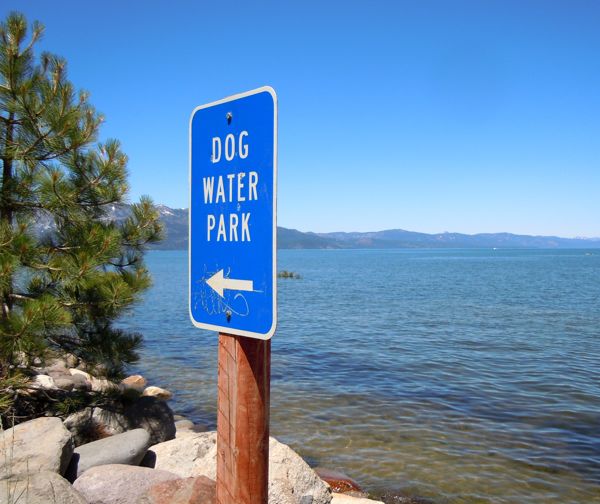
There is no sand for dogs to romp on at Regan Beach in South Lake Tahoe. Photo/LTN

There is no sand for dogs to romp on at Regan Beach in South Lake Tahoe. Photo/LTN

Rising waters have had beachgoers crowding onto smaller patches of sand all around the lake. Paul Mileo of Zephyr Cove Resort estimated there’s about 40 feet less beach than last summer.

Gradually, that situation will start to change as evaporation lowers the lake.

But not by much. Even on the hottest and windiest days, when evaporation levels are at their greatest, the lake will lower only by a quarter-inch or so per day, Wathen said.

How much the lake will lower before rain and snow start to raise levels again come winter is unknown and largely dependent on weather conditions. One projection by the Water Master’s Office suggests levels could drop about 1.5 feet between now and the end of the year.

That could expose a few more feet of beach, but maybe not before it’s too cold for beachgoers to notice.

On Tuesday, Tahoe’s water level was 6,229.41 feet above sea level — the same point it was at the previous two days, Wathen said. That’s only about 8 inches below Tahoe’s federally mandated legal limit and far above where lake levels sat prior to an epic winter.

Read the whole story


Squaw to spend $35 mil. in 2 years on upgrading resort

Squaw Valley expects to invest $15 million in the 2011-12 ski season. This is the first chunk of the $50 million that is planned to be spent in the next five years.

When KSL Capital Partners became only the second owners of the North Shore ski resort in November, the Colorado company promised an infusion of cash to upgrade the resort.

Terrain parks, while popular in the industry, have not been something Squaw has done much with. That is about to change this winter with a variety of small, medium and large features being installed.

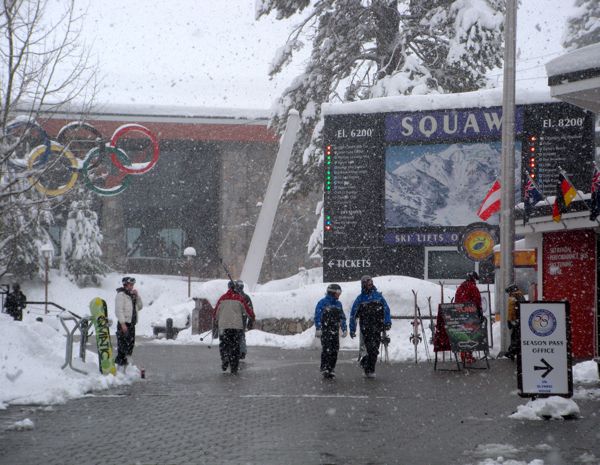
Squaw Valley's village and mountain is about to undergo changes. Photo/LTN file

Squaw Valley's village and mountain are about to undergo changes. Photo/LTN file

The funitel stop at the top of the mountain will be upgraded to look like something other than a dungeon.

The Gold Coast area will host North America’s first ski-up coffee shop.

Signs will be added to make it easier for people to know where the are and how to get to where they want to go, along with real-time lift status boards. With this information comes revamped maps identifying before unnamed runs.

In the village, the Blue Coyote restaurant will be overhauled.

The KT-Sundeck will be completely redesigned. The entire deck will feature an indoor-outdoor bar. Other restaurants in the village will also undergo upgrades.

For beginners, the ski school is changing to focus on them.

A slopeside rental shop will open.

The bottom level of Squaw Valley’s Olympic House base lodge will be transformed into a day lodge and family recreation center.

Next to it will be the new sales and services center enabling skiers and riders to purchase lift tickets, season passes, activity products and sign up for snowsports lessons in one place.

“The removal of the resort’s ticket portals will eliminate the barrier between the village and the base area, creating a mountain ‘beachfront’ in the village providing enhanced views of Squaw Valley’s peaks,” CEO Andy Wirth said in a statement.

The following year the resort expects to spend $20 million in upgrades.

The most significant is adding two high-speed detachable lifts — one lift replacing Granite Chief and the other replacing the High Camp chairlift. The existing High Camp chairlift will be refurbished and reinstalled in a new location with improved alignment.

“These new lifts, slated to open for the 2012-13 winter season, will have an uphill capacity of 7,200 skiers per hour, allowing skiers and riders to spend less time on the lifts and more time on the mountain,” Wirth said.

— Lake Tahoe News staff report


Nevada bear hunt also an economic issue

By Ed Pearce, KOLO-TV

INCLINE VILLAGE — Residents and visitors to Lake Tahoe share the basin with the area’s wildlife including what may be a majority of Nevada’s entire population of 400 to 500 black bears.

Beginning Aug. 20 it will be legal to hunt them here.

That’s welcome news to the small number of hunters who pressed wildlife officials for years for the opportunity, but it’s hard to find anyone cheering in Incline Village on the lake’s north shore.

“We have human-bear problems every year here in Incline Village,” says Bill Hoffman,. the Executive Director of the local visitors bureau. “But we have a lot of bear lovers in this community who don’t want to see these bears hurt or messed with in any way.”

While much of the opposition comes from such sentiment or safety concerns, there are also worries the hunt is simply bad for business.

“People come to see our bears if they can, if they get lucky,” says Hoffman. “It’s something that’s part of what we sell.”

And selling to the tourist is what Incline and most of the lake is all about.

Tourism drives the Tahoe economy and outdoor recreation drives much of the tourism industry, but hunting has never been part of that equation.

Read the whole story


Harassing bicyclists outlawed in Los Angeles

By Kate Linthicum, Los Angeles Times

The Los Angeles City Council on Wednesday passed a pioneering new law intended to protect bicyclists from harassment by motorists.

The ordinance, which backers described as the toughest of its kind in the nation, makes it a crime for drivers to threaten cyclists verbally or physically, and allows victims of harassment to sue in civil court without waiting for the city to press criminal charges.

Its passage comes one day after a 63-year-old bicyclist was struck and killed by a car on a downtown street — an incident that bicycle advocates say underscores the dangers cyclists face.

The new law is the latest bicycle-friendly measure to hit L.A., where an increasingly vocal community of activists has been calling for more protections.

Several of them showed up at City Hall on Wednesday to share stories of harassment; they described motorists who threw objects, shouted insults and tried to run them off the road.

As the number of cyclists on L.A. streets has swelled — local census data from 2008 show that about 13,000 commute to work on bikes, a 48 percent increase over the last eight years — so too have conflicts between motorists and bicyclists. Some motorists have accused cyclists of flouting traffic laws, while cyclists have complained that they are treated like second-class citizens.

Read the whole story


Rim to Reno trail work begins in August

The 2011 Rim to Reno trail season kickoff has been postponed until Aug. 6 due to heavy snow in the project area.

The Tahoe Rim Trail Association seeks volunteers construct trail at the first workday of the year at 9am Aug. 6 at the Mt. Rose Trailhead near the summit of the Mt. Rose Highway.

In October 2010, representatives from the Tahoe Rim Trail Association, U.S. Forest Service-Carson Ranger District, Great Basin Institute and Washoe County Regional Parks and Open Space joined volunteers in breaking ground on the trail that connects the existing Tahoe Rim Trail to Reno.

The Tahoe Rim Trail circles the mountain ridges above Lake Tahoe, through the Humboldt-Toiyabe National Forest’s Mount Rose Wilderness. The Rim to Reno project will build trail segments connecting the existing trails and creating a new system that includes loop trails along with the connector trail to Reno.

Workdays will run on Thursdays and Saturdays (9am to 4pm) for the rest of the summer. Volunteers of all skill levels and physical abilities are welcome and encouraged to participate — no prior experience necessary. To join a volunteer work crew, register online or contact Max at (775) 298.0239 or trails@tahoerimtrail.org.

Volunteers should bring lunch and water, wear long-sleeved shirts, long pants, boots, work gloves, and bring sunscreen, bug spray, and a backpack. The Tahoe Rim Trail Association will provide hard hats, trail building tools and expert crew leaders.


Hot August Nights revs up for 25th year of classic car fun

By Susan Voyles, Reno Gazette-Journal

Twenty-five years ago, Wolfman Jack took to the stage in the parking lot at the Reno-Sparks Convention Center, and Hot August Nights was born.

“When Wolfman Jack got on that stage, the crowd went crazy. Everybody went nuts,” said Willie Davison, event co-founder. “That first night was something. We had to get a hold of that tiger by the tail. It was unbelievable.”

While only about 3,000 people were expected, Davison said 10,000 people showed up that first night and emptied a Coors truck loaded with a hundred kegs of beer. That was Aug. 1, 1986.

Davison said people jumped at the chance to relive the good times, classic cars and rock n’ roll from their high school years in the late 1950s and early 1960s. Hot August Nights drew 28,000 people for three days that first year in 1986, nearly three times more than expected. Today, it’s the biggest event in Reno and Sparks.

Read the whole story


Lupine dotting South Shore landscape

By Kathryn Reed

It wouldn’t stop. The lupine just kept going on and on and on.

Instead of pedaling through our favorite patch of wildflowers two weeks ago, we walked our bikes because the water on the trail was midway up our calves.

Lupine are more prolific this summer. Photos/Kathryn Reed

Lupine are more prolific this summer. Photos/Kathryn Reed

The appropriate superlative has not been created to describe this lush, picturesque, tranquil, gorgeous and mesmerizing sea of purple.

What is spectacular about the field of lupine is how much of it there is this year. All this water is allowing flowers to pop up in places not before seen as well as in greater quantities.

We aren’t ever quite sure how to get to the lupine because of all the trails that exist in this area. That’s also one of the fun things about riding mountain bikes on the north side of Fallen Leaf Lake – all the routes make it an adventure each time.

One of the benefits of all the water was not too many mosquitoes were out. But as the water dissipates, the skeeters are bound to be a nuisance, especially for anyone lingering to take photos.

Not only was the section of trail where the lupine are under water, but other parts also required either finding a completely different route or walking our bikes around the obstacle.

Leading up to Fallen Leaf Lake is Taylor Creek – normally a rather subdued body of water that eventually flows into Lake Tahoe. Not earlier this month. It was raging like a river.

Getting there:

From South Lake Tahoe, go north on Highway 89. Turn left on Cathedral Road, which is just beyond Fallen Leaf Lake Road.

The trail starts as a road, but then up a bit a dirt trail veers off to the left.

I’ve never found the lupine patch the same way – so good luck.

ngg_shortcode_0_placeholder (Click on photos to enlarge.)


Boaters staying away from Lake Tahoe

By Jeff Delong, Reno Gazette-Journal

A tough economy is showing itself with decreased boating activity at Lake Tahoe, a report released by Lake Tahoe regulators shows.

Monitoring of boat traffic over the last two years shows the number of vessels using Tahoe dropped by more than 1,200 from 2009 to 2010, a decrease of nearly 8 percent.

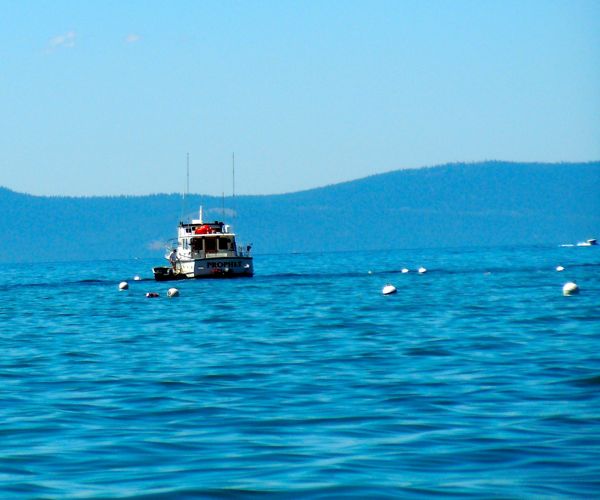
Unused buoys signal fewer boaters on Lake Tahoe. Photo/LTN

Unused buoys signal fewer boaters on Lake Tahoe. Photo/LTN

The recession and high gas prices likely prompted fewer boaters to spend the money to hit the lake, said officials with the Tahoe Regional Planning Agency.

“Definitely it’s the economy and less disposable income,” TRPA spokesman Jeff Cowen said. “There’s less people traveling and fewer people boating.”

While no precise numbers are yet available for this summer, the trend appears to be continuing, Cowen said.

“It’s flat or a little bit less,” than the 2010 boating season, Cowen said.

Read the whole story


Filmmaking contest to benefit U.S. state parks

Sony Corporation has joined forces with the America’s State Parks organization in a Filmmaker Challenge Contest designed to provide funding to California State Parks and other state parks across the nation.

In the competition, park visitors are invited to create videos of their favorite park experiences in a contest for Sony prizes.

The benefit for Sony is that it is encouraging visitors to capture, edit and create their own material using Sony’s new Vegas Movie Studio Platinum HD video editing software. The benefit for America’s State Parks is the campaign will help build awareness of America’s magnificent state park system at a time of reduced budgets. For every sale of the editing software, Sony will donate $20 to America’s State Parks. Additionally, America’s State Parks will offer a $30 discount to the public on Sony’s Vegas Movie Studio HD Platinum 11.

Submissions will be accepted through Sept. 1, America’s State Parks will host the user videos on its YouTube page.

More information can be found at the America’s State Parks webpage.