Snowboarding icon White delivers at Breckenridge

By John Meyer, Denver Post

BRECKENRIDGE — Looking down a 602-foot superpipe with walls 22 feet high apparently doesn’t faze Shaun White, but a movie put a good scare into him this month.

The action sports superstar from San Diego came down with a bad head cold two weeks ago on a flight from Beijing to Los Angeles. And the “heavy part” was that he was watching the movie “Contagion” on the plane.

“Oh, my gosh,” White said, “it was rad.”

He’s still bothered by the cold, and he’s been on snow only four days this season, but neither challenge prevented him from winning Saturday’s Dew Tour superpipe competition at Peak 8. White won with a score of 95 points on his first run and crashed hard doing a McTwist 1260 on his second. Louie Vito of Bellefontaine, Ohio, was second with 92.75 on his second run.

White said a case of “dead leg” from a lot of riding compressed into four days caused the crash.

“I didn’t get enough pop on that last hit,” White said. “It just gave out on me.”

Because White represents Vail Resorts​ and trains at Northstar, company co-president John Garnsey came out to watch. Garnsey is an alpine ski racing guy to the core, but he was blown away by White’s ability to be the best man in the pipe after only four days on snow.

Read the whole story


Meyers Landfill site to stay closed through 2012

Hazardous conditions are keeping Meyers Landfill site off Pioneer Trail near South Lake Tahoe off-limits to snowmobilers, snowshoers, cross country skiers, mountain bikers, off-highway vehicle users and other recreationists.

Construction at the site will continue next summer. The site has been winterized, but safety hazards remain, including steep, irregular slopes with a slippery plastic cover, rock-lined channels, partially buried fencing, metal standpipes, concrete bollards, and roped-together sandbags, according to the U.S. Forest Service.

The Meyers Landfill has been under a closure order since 1997. In June 2010, the Forest Service expanded the closure to include the area from Garbage Dump Road to Saxon Creek. The Forest Service has extended this closure through Dec. 31, 2012.


Pollution in China altering weather in Western U.S.

By John Blackstone, CBS News

A U.N. conference on climate change ended Sunday without a major deal to cut toxic emissions. No country emits more carbon dioxide than China — a byproduct of its booming economy. And, as CBS News correspondent John Blackstone reports, those Chinese emissions are having a big impact in the U.S.

Chinese officials insist the murky air over Beijing this month is just fog. But measurements taken at the U.S. embassy there show dangerously high levels of air pollution — so bad that traffic has been disrupted and flights have been delayed or cancelled.

“It’s no longer just their problem; it’s our problem,” said Kim Prather of the Scripps Institution of Oceanography.

Prather studies atmospheric chemistry. CBS News met her at a scientific conference in San Francisco, where she was presenting research that shows what’s in the air over China can affect the weather in America.

“The atmosphere has no walls,” she said. “So pollution on this side of the world can make it the other side of the world in about five days.”

The Chinese pollution is carried by the jet stream across the Pacific. In the atmosphere over this country, it can stop the clouds from producing rain and snow.

In general, Prather said, the equation is more pollution equals less precipitation.

The particles of air pollution from China collect moisture in the clouds. But the particles are so small and numerous they don’t get heavy enough to fall as rain or snow. So the water stays in the clouds.

Read the whole story


Douglas County increasing the number of miles of trails

Groups like the Carson Valley Trails Association are making trail access a reality in Douglas County. Volunteers contributed more than 4,000 hours building trails and installing signs and kiosks, mostly on the Genoa Trails Project, which now boasts 16 miles of new trail almost ready to open in the spring. When complete, the Discovery Trail will stretch about seven miles along the base of the Carson Range above Genoa.

The Sierra Canyon Trail will climb the range with 3,500 feet of elevation gain in less than 10 miles of tight switchbacks to connect Genoa with the Tahoe Rim Trail.

Besides locals enjoying the trails, coordinated systems can help boost the economy. A 2009 study for the University of Minnesota found that trail users in the northeast region of that state spent $628 million, and that spending supported thousands of jobs. Nearly three-quarters of that money was spent by visitors from outside the area.


Sugar Bowl Philanthropy Day helps with domestic violence issues

Sugar Bowl’s Philanthropy Day is Jan. 22 — benefiting Tahoe SAFE Alliance.

Sugar Bowl will donate the proceeds from 500 tickets priced at $35 to support programs that help to reduce the incidence and trauma of domestic violence, sexual assault and child abuse in North Lake Tahoe and Truckee.

The ticket is good Jan. 22-26.

Tickets may be picked up Jan. 22 at Mt. Judah Lodge at Sugar Bowl. They may be purchased online.


Doctors to give lesson in preventing ski-snowboard injuries

Tahoe Center for Orthopedics’ and U.S. Ski and Snowboard Team physicians Terrence Orr and Jonathan Finnoff will give a lecture focusing on ski and snowboard injury prevention and treatment options on Jan. 5 from 6-7pm at Lake Tahoe Community College (One College Avenue, South Lake Tahoe).

The event is free.

In addition to ski and snowboard injury awareness, surgical and non-surgical approaches to injury treatment will be addressed.

Orr and Finnoff bring years of winter injury experience, serving Lake Tahoe and beyond. From the beginner snowboarder to the advanced skier, this talk will address a multitude of accident scenarios and prevention techniques.

This lecture is part of Barton Health’s 2012 wellness lectures. Attendees will receive an attendance “punch card” and automatically be entered to win a 2012-13 season pass to a Lake Tahoe ski resort, in addition to other prizes.

For more information, call (530) 543.5656.


Registration open for Tahoe Science Conference

The Tahoe Science Consortium and Sierra Nevada College will host the 2012 Tahoe Science Conference May 22-24 on at Sierra Nevada College in Incline Village.

The theme of the conference will be “Environmental Restoration in a Changing Climate”. Lake Tahoe and many other high alpine lakes around the world are being increasingly stressed by climatic changes and urban development. Compounding these factors are economic stresses on government agencies, local communities, the environmental community, and the public.

The 2012 Tahoe Science Conference is designed to encourage creative dialogue among scientists, artists, environmental managers, public officials, and the general public about how to protect high alpine ecosystems under changing environmental and social climates.

The registration fee covers all program activities beginning Tuesday afternoon and extending through Thursday evening. Register online.

For more information, contact Tina Triplett at (775) 473.5473 or creativerno@charter.net.


Wacky weather patterns throughout California

By Matt Weiser, Sacramento Bee

La Niña is back in control of California’s weather, and like last winter, her temper seems to be flaring.

First it was strafing November winds. Then persistent December frost. Now half the state is dry – not a drop of rain in Sacramento this month, and Lake Tahoe ski resorts are yearning for snow. And at the other end, Los Angeles is breaking rainfall records.

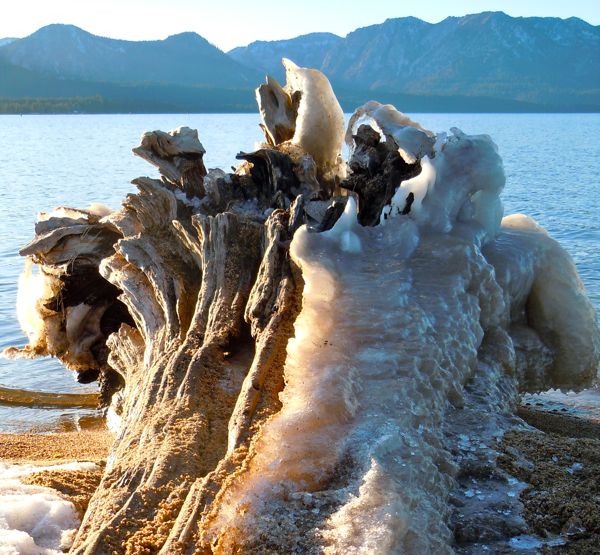
Lots of ice to be found on the shoreline of Lake Tahoe, but not any snow. Photo/LTN

“It’s been a strange La Niña,” said Ken Clark, a senior meteorologist at AccuWeather based in Southern California. “It’s playing havoc with our precipitation amounts so far. We’ve got a lot of signs that were right on track, but the weather pattern’s been kind if screwy.”

What’s screwy is a high-pressure system parked offshore of Northern California, diverting storms around the region and into Southern California instead. That’s not normal La Niña stuff.

La Niña is a periodic cooling of the equatorial Pacific Ocean that causes the jet stream to arc far to the north. It is a fickle phenomenon in California because the position of the jet stream determines whether the state is wet or dry in La Niña conditions.

In Central California latitudes, including Sacramento and Lake Tahoe, the outcome is often a tossup.

Read the whole story


Western U.S. becoming a bit of a dust bowl

By Kirk Johnson, New York Times

DENVER — Oh say, can you see across the Grand Canyon? Not as well as you used to on some days.

A dust storm that covered Phoenix in July dramatically attested to Western air quality concerns.

The question of how clean the air is in the American West has never been an easy one to answer, strange to say. And now scientists say it is getting harder, with implications that ripple out in surprising ways, from the kitchen faucets of Los Angeles to public health clinics in canyon-land Utah to the economics of tourism.

It is at least partly about dust, something that has been entwined with Western life for a long time, and now appears to be getting worse.

In the 1800s, the high deserts stretching west and south of the Rockies became a famed destination for respiratory sufferers like “Doc” Holliday, the gunfighter-dentist (and tuberculosis patient), who came to take what was called the desert cure.

But cattle and sheep by the tens of thousands were at the same time trampling across those fragile landscapes, loosening once stable soils to the four winds and creating a kind of parallel — but equally true — Western mythology around the tumbleweed and the dusty trail.

The region’s air quality, then as now, was partly pristine and partly poor depending on when and where you looked and which way the wind blew.

But now a new and even more complicated chapter appears to be unfolding, researchers in many different fields say. From off-road vehicle use, which has in some places replaced the clumping trod of the old cattle herds, to drought’s impact on plants with their soil-anchoring roots, more dust appears to be up and moving.

And scientists say they are also understanding for the first time the deep connections between the dust’s main source — a vast high-desert region called the Colorado Plateau, which stretches through four states and is home to national parks like the Grand Canyon and Arches — and the economic, environmental and demographic life in cities and suburbs far removed.

“Changing conditions on the Colorado Plateau affect high-elevation water sources, commerce and population centers with tens of millions of people,” said Richard L. Reynolds, a research geologist who has been studying dust at the United States Geological Survey. And with climate models suggesting a hotter, drier future in much of the West, potentially compounding dusty conditions, the dust is also opening a window on how the region is changing. “It’s giving a glimpse of what we can expect,” Reynolds said.

In the last few years, winter dust storms on the high peaks of the Rocky Mountains in Colorado have sharply increased in number, affecting the rate of melting snows into the Colorado River, a main source of water for agriculture and for the drinking supply for more than 20 million people. Of 65 so-called dust-on-snow events since 2003, when tracking began, 32 have struck in just the last three years, according to the Center for Snow and Avalanche Studies, a nonprofit research group based in Silverton, Colo. Dust can accelerate how fast snow melts because it absorbs heat.

Read the whole story


TVES students help set Guinness World Record

Tahoe Valley Elementary School students helped set a Guinness World Record then they were part of a jumping jack contest in October.

Put on by National Geographic Kids between 3pm Oct. 11 and 3pm Oct. 12, 300,265 jumpers all over the world took part in the event. The old record for the most number of people jumping for 24 hours was 20,425.

The South Lake Tahoe school will soon receive a certificate from National Geographic.