No snow doesn’t mean no skiing in Lake Tahoe

By Kathryn Reed

In 11 days, the first snow survey of the season will be conducted by the state Department of Water Resources. National Weather Service forecasters say the next two weeks will be dry and that the snowpack is 15 percent of normal.

In a normal month, South Lake Tahoe receives 1.84 inches of precipitation by Dec. 22 for the month of December. The city has received a trace this month.
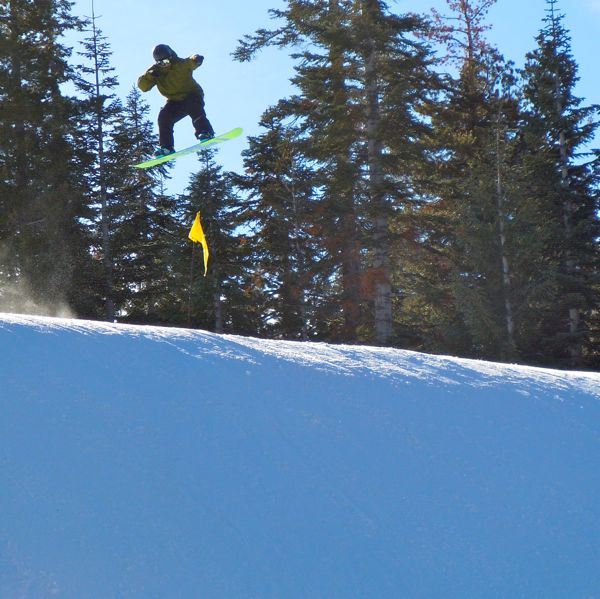
Northstar's terrain park has plenty of snow to play in. Photos/Kathryn Reed

For the entire month of December, Tahoe City averages 5.5 inches of precip. It has recorded zero this month.

Ski resorts for the 2010-11 season boasted of a record snowfall. Squaw Valley had more than 800 inches. This season resorts like Heavenly and Northstar are bragging about their snowmaking capabilities.

When will it snow?

“So many different global patterns and influences affect the weather. The main thing that needs to happen is the ridge of high pressure off the West Coast needs to shift and head south,” explained Scott McGuire, meteorologist with the National Weather Service in Reno.

The La Nina jet stream is keeping storms north of Lake Tahoe. While the basin basks in sunshine, it is also freezing with below normal temperatures. The morning low Dec. 22 was 10 degrees in South Lake Tahoe. The normal low is 16 degrees.

“There is no indication this overall pattern is going to change for the better,” McGuire told Lake Tahoe News. “(Models) just show a couple storms trying to drop, so the southern edge of the storms may clip us. It’s hard to believe it will sit like this the entire winter, but it could.”

Drought conditions?

Last winter’s deluge has reservoirs in California and Nevada faring well so far – even better than a year ago this time. Lake Tahoe on Dec. 22 was at 6,226.85 feet, while on that date in 2010 it was at 6,224.37 feet.

It’s losing about one-hundredth of a foot a day because of evaporation – even more when it’s windy.

The Climate Prediction Center issues a “drought monitor” for the whole country. Tahoe was recently listed at the bottom rung, or “abnormally dry”. This is the first of five stages.

“If we don’t see improvement in January, they will probably worsen the outlook,” Gary Barbato, hydrologist and federal water master in Reno, said. “We typically have two good months left. We’ll see how we do.”

While there have been “March Miracles”, they are a rare occurrence. January and February need to be wet for any optimism to continue.

Barbato said with Tahoe and Lahontan Reservoir being above average, he is not alarmed yet by the lack of snow – even though the wet season usually starts in November and it’s been dry all this time.

Lake Tahoe, while is supplies water to some water purveyors in the basin, is the main water source for Reno via the Truckee River.

The Sierra snowpack is the source of water for much of California. Reservoirs in California are faring well despite a dry December.

“We are not unduly worried yet. The reservoirs are still in very good shape with carryover storage from last winter’s storms,” Ted Thomas with the California Department of Water Resources told Lake Tahoe News. “This is a very dry December, obviously, one of the driest so far.”

Helping Mother Nature

There was a time when skiing at Christmas in Lake Tahoe was iffy. That was before snowmaking became the norm.

Those who skied on the manmade white stuff in the early days could not find anything positive to say about it. What comes out of the guns today is so far superior at times it’s hard to distinguish between what is real and what is fake.

Another advantage customers have today is getting the truth about conditions from other skiers and riders. Resort and personal Facebook pages tell it like it is. No longer can resorts embellish the snow report.

Skiers at Northstar on Dec. 20 may have had doubts about the conditions based on riding a chairlift over rocks, grass and logs, but at the end of the ride were perfectly groomed conditions.

That’s the other thing that has changed through the years – the groomers. Between the machine and the operators they lay out corduroy each day that makes people forget it didn’t snow the night before.

So, there isn’t tree skiing and Tahoe is waiting for its first powder day – those who like groomers or have a need to schuss are likely to be satisfied. Just don’t look at what’s at lake level to know what the slopes are all about. Plus, most of the resorts have made a concerted effort to have terrain parks open.

At Northstar this week skiers and boarders were spinning, jumping, back scratching, and twisting their way over features. The 22-foot superpipe where Shaun White will train is expected to be finished any day.

Heavenly had its terrain park operating on opening day – last month.

While most resorts in the greater Lake Tahoe area are open at some level, Heavenly has the largest snowmaking capabilities.

Heavenly can cover 73 percent of its mountain with manmade snow. Today about 25 percent of the resort’s 97 trails are open. More are opening every day, with Boulder expected to open Christmas Day and Groove potentially, as well.

Northstar is bragging of snow depths of 18 to 24 inches on 25 trails. In a 24-hour period they use 5 million gallons of water to cover 100 acres.

Squaw uses 2,000 gallons of water per minute. It has a 12-inch base on eight runs.

“We could go all season making snow, but we hope Mother Nature will kick in and help us out at some point,” Russ Pecoraro, Heavenly spokesman, told Lake Tahoe News.

ngg_shortcode_0_placeholder (Click on photos to enlarge.)


Zephyr Lodge — bring an appetite, wallet, camera

By Kathryn Reed

TRUCKEE – No snow at a ski resort can be a good thing – at least when your business is construction.

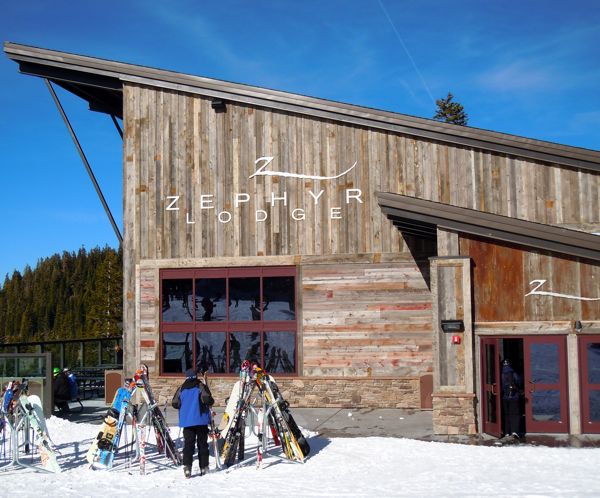
With winter delayed in the Sierra, it meant the team of builders from SMC Contractors could complete the Zephyr Lodge at Northstar in five months. No days off also allowed the 17,000-square-foot facility to open this week.

Zephyr Lodge increases seating at Northstar by 50 percent. Photos/Kathryn Reed

Joe Stewart of SMC was at the resort Tuesday to see firsthand what it looks like with people using the multimillion-dollar lodge.

While building at nearly 7,000 feet presents an array of challenges, Stewart and his team had a head start on this project with having completed the Tamarack Lodge at Heavenly Mountain Resort a year ago. Zephyr’s design is based on her sister resort’s lodge.

“This has a lot of character,” Stewart told Lake Tahoe News as he looked at the reclaimed wood on the exterior.

While the interior of the two lodges feels similar, the exterior does not even though the design is much the same. Much of the difference is the initial look of the lodge from Zephyr chairlift and then skiing to it.

The gray of the wood seems to blend in to the backdrop of the Sierra Crest.

With the entrance on what could be called the side wall, the building does not appear as large as it is.

This addition to Northstar could mean the era of long food lines and little room to sit is over. The 500 indoor chairs and more than 200 outdoor seats increased the overall mountain seating by 50 percent.

On a sunny day like Dec. 20, sitting outside with views of the snowcapped mountains was inviting. But the ambiance and energy of the warm indoors kept most people inside. Plus, the massive windows provide stunning views.

While the lack of snow was good for SMC, with the snowmaking guns going full tilt, the white stuff eventually presented a few challenges.

“They’ve been delivering furniture by snowcat the past couple weeks,” Northstar COO Bill Rock said.

Noting California’s dismal economy, state Sen. Ted Gaines, R-Roseville, spoke of how the $30 million infusion of cash into Northstar for this season by owner Vail Resorts is good for the local and state economies. He also presented Rock with a proclamation from the state Senate.

Food and drink

Building on the success of their Colorado resorts, the more upscale food court is what Zephyr and Tamarack lodges offer. Often eating at a ski resort is a less than desirable experience for a vegetarian. Not at Zephyr.

The veggie burger ($10.25) is made on site. It’s tasty and a bit messy. But what a nice change from the usual cardboard restaurants often pass off as a veggie burger.

The tomato bisque ($7.75) comes in a decent size bowl. Definitely worth having. Christine, who manages the lodge, says sharing recipes is something that’s being talked about. This would be a soup worth making at home.

The veggie pizza is good, but at $8.50 a slice, not worth it.

For some reason, the fries at Northstar, Heavenly, Vail and Beaver Creek are all lacking and can be skipped.

The Asian bowls are said to be one of the “must haves” — and based on flavor we agree. You get to choose a variety of items. Brown rice, tofu, veggies, water chestnuts and Kung Pao sauce filled my bowl. Sue’s had snow peas, squash, sticky rice, shrimp and a green curry coconut sauce. Each bowl is $14.75.

Of the seven drinks we tried (samplers, not full glasses), we placed the same in the top four, just a different order. My favorite was the African Winter – dark rum, hot African tea, peach liqueur, lemon, orange bitters. Hot and refreshing – though not often two words that go together – they do with this drink.

Sue’s favorite was the Zinger – Hangar One Kaffir lime vodka, ginger beer, lime juice, orange liqueur. It was a perfect complement for her Asian bowl.

Rounding out our top four were the Pimm’s Royale (sparkling wine, Pimm’s No. 1, cucumber spear) and S’more Snow (Firelit coffee liqueur, Absolute vanilla, hot cocoa, whipped cream).

The Z Bar inside Zephyr Lodge has 13 specialty drinks not served anywhere else on the mountain. All are $12.

All the juices in the drinks are fresh squeezed at the lodge.

The easiest way to get to Zephyr Lodge is via the Zephyr lift from mid-mountain. It’s to the right at the top. But the lodge will be a convenient gathering spot for people skiing the Back Side, including The Promised Land lift that opened this week, too. And even if you aren’t eating or drinking, the setting is gorgeous and worth stopping to have a look.

ngg_shortcode_1_placeholder (Click on photos to enlarge.)


Skiing, eating raises money for Winter Discovery Program

Full moon yurt dinners benefit the Tahoe Cross Country Ski Education Association. The adventure starts with a moonlit ski from the Tahoe Cross Country Ski Area across gentle terrain.

Limited tickets are available at $65 per person. This price includes meal, a beverage, ski or snowshoe equipment and trail pass.

All money raised benefits the Winter Discovery Program at Tahoe Cross Country.

The Jan. 6 and Jan. 7 dinners will be prepared by Chef Doug Baehr of Uncommon Kitchen. The Feb. 4 and Feb. 5 meals will be cooked by Chef Douglas Dale of Wolfdale’s. The skiing-dining adventures are from 6-9pm.

Reservations can be made by calling (530) 583.5475.


3 top youth shredder movies shot by S. Lake Tahoe firm

By Kathryn Reed

Snowboarding over a car may not be an original trick, but how many 5-year-olds can say they’ve done it?

Bailey Duran for one.

First Tracks Productions in South Lake Tahoe immortalized the event on film. This video and two others by the local company caught the attention of Ski Channel. The three are part of a top 10 list of best mini shredder (aka kid) videos of the year. The one of Bailey jumping the car is No. 1.

Lexis Roland at Regan Beach in South Lake Tahoe. Photo/Carrie Reiter

“The folks at Ski Channel came across them organically. We didn’t send them to them,” said Anthony Cupaiuolo, who with his wife, Karen Johnson, started the ski film company in fall 2001.

Bailey is from Connecticut and mostly skis Vermont. Dylan Heinstein is from the Bay Area and is part of the Burton program at Northstar. His whole video was shot at Northstar. Lexi Roland is from Minnesota, though a significant amount of the winning video was shot in Lake Tahoe.

It’s not that First Tracks doesn’t work with Tahoe area youth; it’s all about parents finding them. And with the Internet making the world smaller, people have more choices readily available for whatever they want.

While there are “Little League parents” in the ski world, Cupaiuolo says most of the parents he runs into are easy to work with. Parents aren’t likely to ask someone to shoot their kid knowing a tantrum might be thrown. The kids Cupaiuolo has worked with all want to be on the slopes.

“It’s easy because all the kids I work with are doing this because they love it,” Cupaiuolo told Lake Tahoe News.

When he started in the ski film industry it was all about the backcountry and making a DVD to sell each year. But with everyone thinking they can shoot quality video, YouTube’s popularity and the public’s desire for immediacy, the last DVD First Tracks Productions put out was in 2009.

That’s not to say the company is only shooting kids. They like to mix it up. Cupaiuolo likes being in the backcountry on a splitboard.

“Working with adults you can talk about what it is we are looking for,” Cupaiuolo said. “Kids want to play and have fun.”

But at the same time those youngsters have seen plenty of film to know what tricks are hot, who’s doing what and that camera angles, sunlight and shadows all play a part in how a video of them will ultimately look.

And these aren’t your average youngsters.

“The kids we have been filming are already on a level where they are doing stuff I don’t do. You have to check your ego aside,” Cupaiuolo said.

His footage of Lexi was part of the Warren Miller movie two years ago. The legendary film company has been talking to Cupaiuolo about the talent he will be shooting this winter in case there is an opportunity to incorporate it into the 2012 Warren Miller film.

With a bit more time on their hands now that First Tracks isn’t doing an annual video, the company is expanding a bit.

This summer they were at Northstar to shoot the All Women Sports Camp.

Mountain biking and BMX were sports shot this past year by First Tracks. Next summer kayaking and surfing are on the list of things to film.

They regularly shoot promotional footage for Prior Splitboards in British Columbia, as well as work for other companies. With video being a growing segment for how companies promote themselves, short travel vignettes are becoming popular.

What Cupaiuolo is working on is securing a six-episode television project featuring young athletes. He wouldn’t give more away about it at this point.

While Cupaiuolo and Johnson have a 9-month-old daughter, she isn’t on YouTube yet. Cupaiuolo said family and friends don’t understand why only four videos of the little one exist. He says that may change when Olivia starts riding. Then he’ll definitely have a Tahoe kid in his stable.


Public boat ramps in Tahoe closed Dec. 25, Jan. 1

Cave Rock, Sand Harbor and Lake Forest launch boat ramps will be closed Christmas and New Year’s Day.

No inspections or decontaminations will be available either day.

Private facilities, such as the Tahoe Keys Marina, Obexer’s, or Ski Beach may be open and should be contacted directly for hours of operation. Private launch ramps/marinas will only launch wire-sealed boats.


Tahoe Vista land restoration, bike trail project proceeds

Acquiring an easement from the California Tahoe Conservancy is allowing Placer County to accept a $1 million grant from the state Natural Resources Agency to restore wetland and riparian habitat.

Had the CTC not taken action this month, the grant would have been void in January.

The county wants to clean up the former concrete batch plant in Tahoe Vista. The plant provided material to pave Highway 267. Lisa O’Daly, CTC environmental planner, told the board Dec. 16 that fill on the south end of the property is between 4 inches and 4 feet thick.

The Conservancy’s interest in granting the easement is the project restores a stream environmental zone and increases public recreation via bike trails.

Board Chairman Larry Sevison abstained from the vote because he owns property in the area. Members John Hooper and Angela Swanson were not at the meeting. The remaining board members voted to approve the easement.

— Lake Tahoe News staff report


Lakeview Commons about to open to the public

By Kathryn Reed

Fencing at Lakeview Commons in South Lake Tahoe is expected to come down before Christmas.

While interior work continues on the boathouse this winter, that section of the waterfront project on Highway 50 will be cordoned off. The whole project has taken longer than expected.

Lakeview Commons should be open to the public this week. Photo/Kathryn Reed

The last touches on the multimillion-dollar project will come in late spring.

South Lake Tahoe City Councilman Tom Davis last week said he would like the city to arrange for a summer concert to kick off events at the renovated site that sits across from Campground by the Lake.

Norma Santiago, who as El Dorado County’s supervisor sits on the California Tahoe Conservancy board, asked at the Dec. 16 CTC meeting about getting the parties together to talk about completing the second half of phase one.

CTC Deputy Director Ray Lacey said even though the Conservancy was the funding agency, it is a city and county project and they need to coordinate reconvening the steering committee.

Santiago said she wants to discuss the name of the project. When the Board of Supervisors met in Tahoe in November 2009, the name Lakeview Commons did not sit well with them.

The land the project is on is leased by the city from the county.

It will take another $4 million to $5 million to complete the first phase. The rest of what was once called the 56-acre project is on the other side of Highway 50. Ideas have been bounced around for what to do there, but no concrete plans are in place.


Truckee organization helping adaptive skier reach South Pole

By Tim Mowry, Fairbanks Daily News-Miner

FAIRBANKS, Alaska — Grant Korgan wants to be the first adaptive athlete — he’s paralyzed from the waist down — to reach the South Pole and he came to Fairbanks to help make that dream come true.

Korgan, along with teammates Tal Fletcher and Tom Day, spent three days in Fairbanks last week pushing his sit-ski around on the ski trails at Birch Hill Recreation Area and the University of Alaska Fairbanks as part of his preparation for what he hopes will be a historic event.

Early next month, Korgan, Fletcher and renowned polar explorer Doug Stoup, along with a four-man film crew, will attempt to ski 100 miles to the South Pole. For Korgan, that means pushing a sit-ski — basically a chair on skis — 10 miles a day for 10 days while enduring temperatures that could drop as cold as 70 degrees below zero.

That’s where Fairbanks came in.

“One of the main reasons we came to Alaska was for cold weather training,” said Korgan, as he, Fletcher and Day prepared for a training session at Smith Lake on the UAF ski trails Friday afternoon.

Needless to say, they were a little disappointed when they arrived early last week to temperatures in the teens.

“When we booked our tickets it was 40 below,” Korgan said, referring to a record-setting cold snap that hit Fairbanks the week before Thanksgiving.

Despite the relatively balmy temperatures, Korgan, Fletcher, who will serve as one of two guides on the trip, and Day, a cinematographer who is part of the film crew, deemed their short stay in Fairbanks a success. They were able to test their equipment and bodies in the cold, namely a thermocouple device that measures the temperature of Korgan’s feet. Because Korgan doesn’t have feeling in his feet, he can’t tell when they get cold.

“We’re up here to test our gear, to test ourselves and to test the cold on my minimal circulation limbs,” Korgan said.

Sitting in his sit-ski before their training session at Smith Lake on Friday afternoon, Korgan checked the temperature of his feet by plugging thermocouples that were taped to a toe on each of his feet into a digital thermometer. One foot was 77 degrees and the other was 75.

“Last night my foot got down to 27 degrees,” Korgan said. “That’s 5 degrees too cold.”

When that happened, they called it a night and retreated to their car and hotel rooms to warm up. On Friday, Korgan returned wearing two pairs of socks and he had chemical heat packets in the bottom of his boots to help keep his feet warm. He planned to spend the next eight hours pushing his sled in circles around the lake. He hoped to cover 10 miles, the average distance they will have to go each day during their expedition.

In addition to the cold feet Thursday, the team encountered some mechanical difficulties after Korgan crashed at Birch Hill Wednesday and broke a push rod on his sit-ski, a small rod that allows the skis to bend and flex. They couldn’t find a similar part anywhere in Fairbanks and ended up going to Sentry Hardware and buying a $3.78 turnbuckle they rigged between the two skis.

“That’s the name of the game,” Fletcher said. “When you’re taking a spinal cord injury into that environment, you’re going to have to do some problem solving. We need to do a lot of problem solving up here. They don’t have hardware stores and super friendly people like they have in Fairbanks at the South Pole.”

Dubbed simply “The Push,” the expedition is the first of its kind. While lots of people have skied to the South Pole, nobody has ever pushed a sit-ski to the Pole. The sit-ski Korgan will use is custom designed by two-time paralympic gold-medalist Kevin Bramble of New Jersey.

Called the KBG Artik Crosscountry Sit Ski, the contraption has two independently articulating skis rather than the traditional monoski used by disabled skiers.

That feature allows athletes to push through turns rather than dragging a hand to turn. It also enables them to traverse undulating terrain and side hills. Made from carbon fiber and aluminum, the sit-ski weighs only 8 pounds.

Originally, the plan was for both Korgan and John Davis, a two-time paralympic gold medalist in downhill skiing, to push sit-skis to the Pole. But Davis suffered a training injury in Argentina recently that knocked him out of the expedition.

Korgan, 34, was paralyzed in a snow machine wreck deep in the Sierra Nevada Mountains in March 2010. He was in the hospital when he met Roy Tuscany, who founded the High Fives Foundation, a Truckee-based nonprofit organization dedicated to raising money and awareness for athletes who have suffered life-altering injuries. Tuscany, who dreamed of becoming a world-class professional skier, was paralyzed in April 2006 while skiing in Mammoth Mountain, Calif., though he since has recovered to the point he can walk again.

Read the whole story


Outdoor enthusiasts sharpening their blades

By Martha Bellisle, Reno Gazette-Journal

Making lemonade out of the lemon weather pattern that has brought weeks of cold, clear skies and no snow to the Reno-Tahoe area, about 50 ice skaters converged on Prosser Reservoir in Truckee on Saturday for some pick-up hockey games and gliding fun.

“This time of year, most of these people would be skiing today, but at least we can skate,” said Greg Keziah of Truckee as he tied on his hockey skates and headed out on the ice. “It’s amazing how fast it froze. A couple of weeks of single-digit temperatures, and it’s a good 5, 6 inches thick.”

Experts say ice should be at least 4 to 6 inches thick for safe skating. It’s also important never to skate alone.

Prosser is one of several Truckee-Tahoe area bodies of water that have frozen in the past month; others include the pond in Martis Valley near Truckee-Tahoe Airport; the ponds near Coldstream and Serene Lakes in Soda Springs; and Spooner Lake at Spooner Summit, west of Carson City.

Read the whole story


From surf to turf — Squaw freeriders embrace challenging sport

By Kirsten Fairchilds, Santa Cruz Sentinel

Cody Townsend freely admits to getting scared. But unlike other mere mortals who might try to avoid feeling fear at all costs, Townsend purposely faces it down on a regular basis.

He has used fear to carve out a career. While the Santa Cruz native may accurately describe himself as a professional skier, 28-year-old Townsend is more specifically a freerider. Also called freeskiing, freeriding is still a relatively new sport.

“Freeriding and freeskiing are interchangeable terms,” Townsend said by telephone from his Olympic Valley home. “It’s a pretty recent job description — about two decades old. In competitions, you go to the top of a mountain where there are cliffs and a lot of natural features and you ski down in the coolest way possible. A panel of judges scores you. It involves jumping, doing flips and spins and skiing the mountain in a challenging and aesthetic way.”

A former ski racer, Townsend started freeriding in 2004. He met former Alpine ski racer Elyse Saugstad at a ski industry event in Las Vegas in 2005. She had just moved to Olympic Valley, Townsend’s winter base and the home of Squaw Valley Ski Resort.

With Townsend’s encouragement, Saugstad took up the sport to great success. In 2008, she was the women’s overall winner of the Freeride World Tour. Sports magazines referred to the couple as “ski royalty.” Townsend proposed to Saugstad late last year and they planned their royal wedding on Maui in October.

Both skiers embrace fear as part of the thrill of freeriding. And despite a number of occupational injuries, they agree that freeriding is a better fit for their personalities than ski racing ever was. Freeriding offers them challenges that allow them to look fear squarely in the eye on a consistent basis.

Read the whole story